Adaptive Learning Technology Explained for Educators
 Feb, 19 2026
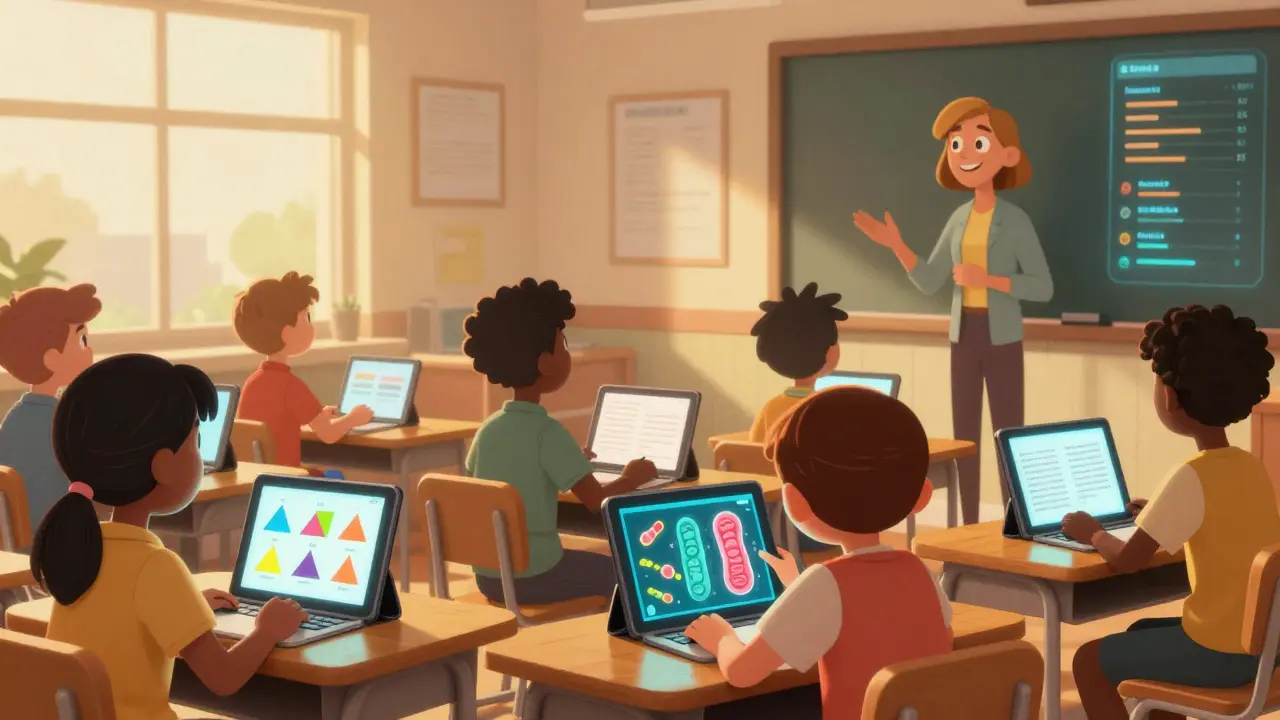
Every teacher knows the challenge: one student is bored because the lesson moves too slow, another is lost because it moves too fast. Traditional classrooms treat all students the same, but brains don’t work that way. That’s where adaptive learning technology comes in - it changes the lesson in real time based on what each student actually understands.
What Is Adaptive Learning Technology?
Adaptive learning technology is software that adjusts content, pace, and difficulty as students interact with it. Unlike static online courses that show the same videos and quizzes to everyone, adaptive systems track how a student answers each question, how long they spend on a topic, and where they struggle. Then, it automatically changes what comes next.
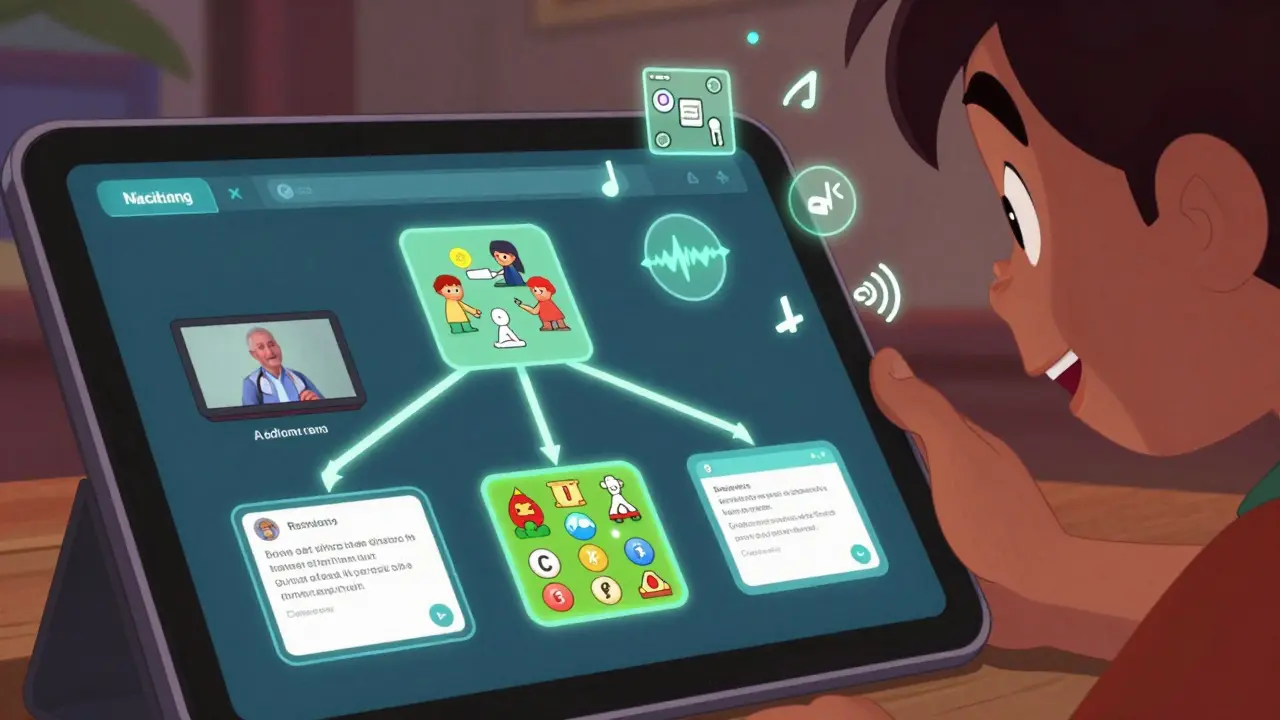
Think of it like a GPS for learning. If you miss a turn, the GPS doesn’t keep driving the same route - it recalculates. Same here. If a student gets three questions wrong on fractions, the system might offer a video explanation, a visual model, or a simpler practice set before moving forward.
This isn’t science fiction. Platforms like Khan Academy, DreamBox, and ALEKS have been using adaptive algorithms since the early 2010s. Today, over 60% of K-12 districts in the U.S. use some form of adaptive learning tool, according to a 2025 report from the National Center for Education Statistics.
How It Works Behind the Scenes
At its core, adaptive learning uses three key components: data collection, algorithmic decision-making, and content branching.
- Data collection: Every click, answer, pause, and retry is logged. It doesn’t just record if the answer is right or wrong - it tracks how long it took, whether they guessed, and if they skipped ahead.
- Algorithmic decision-making: Machine learning models compare each student’s pattern to thousands of others. If a student who struggles with word problems consistently improves after using diagrams, the system will prioritize visuals for others with similar patterns.
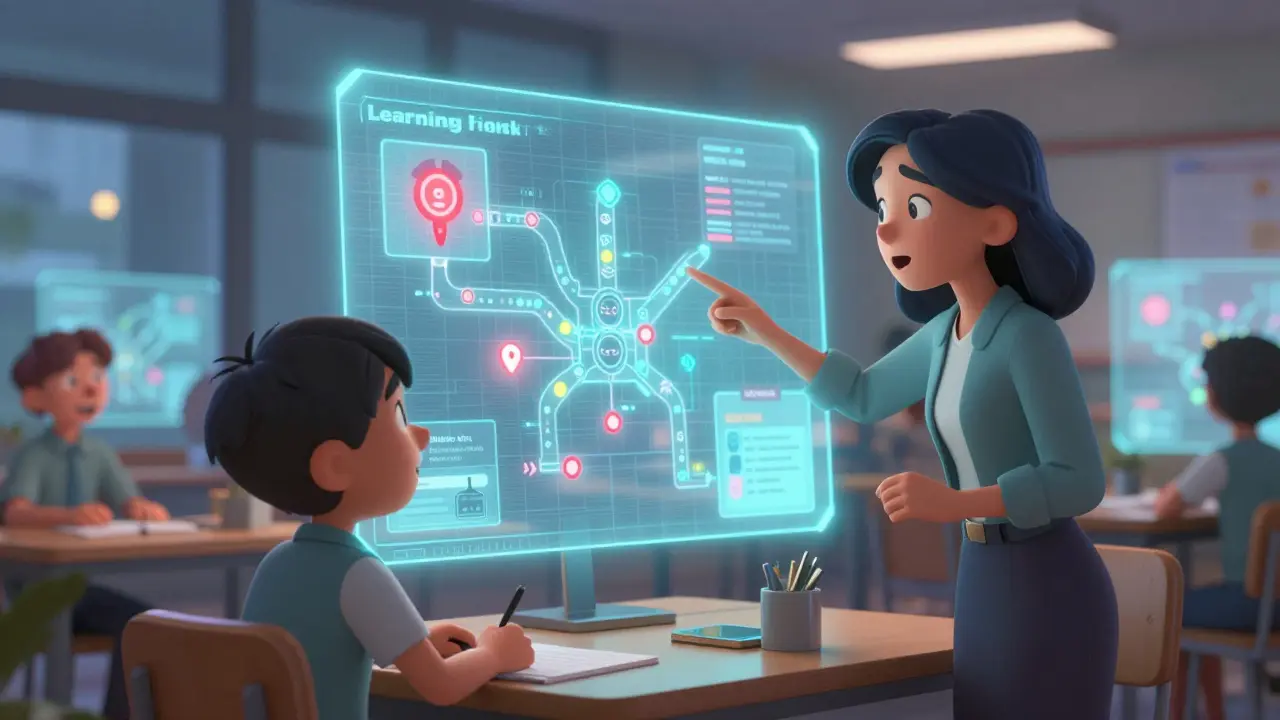
- Content branching: Instead of one linear path, the system builds dozens of possible routes. One student might go from basic multiplication to word problems, then geometry. Another might need extra time with number sense before even touching multiplication.
These systems don’t just react - they predict. If a student has a 70% chance of failing the next quiz based on their current progress, the system might trigger a teacher alert or suggest a 10-minute review session before the next class.
Why This Matters for Teachers
Adaptive tech doesn’t replace teachers - it gives them superpowers.
Before adaptive tools, teachers had to guess who needed help. Now, dashboards show exactly who’s stuck, who’s ahead, and who’s coasting. One middle school math teacher in Tempe told me her class used to have 12 students falling behind by midyear. After switching to an adaptive math platform, that number dropped to three - and those three got targeted interventions before they ever failed a test.
Teachers also save hours. Instead of grading 150 quizzes to find patterns, they get automated reports: “8 students need help with equivalent fractions,” “5 students mastered decimals in half the time.” That means more time for one-on-one coaching and less time on paperwork.
And for students? It reduces shame. No one feels dumb for needing extra practice when the system handles it quietly. A student who once hid their screen during group work now asks for “more practice problems” on their own.
Real-World Examples in Classrooms
Here’s what adaptive learning looks like in practice:
- Elementary reading: A child reads a passage about animals. The system notices they pause at every multisyllabic word. It replaces the next passage with a simpler version, then gradually adds complexity. Within two weeks, the child’s reading speed improves by 37%.
- High school biology: A student keeps missing questions about cellular respiration. The system offers a 3D animation of mitochondria, then a game where they “fuel the cell” with glucose and oxygen. After three tries, they get it. The system moves them forward - no more sitting through the whole lecture again.
- College algebra: A student takes a diagnostic quiz and scores below 50%. The system doesn’t dump them into the full course. Instead, it starts them with pre-algebra modules, then auto-enrolls them into the college course once they hit 85% mastery.
These aren’t hypotheticals. A 2024 Stanford study tracked 12,000 college students using adaptive math platforms. Those students were 42% more likely to pass their course and 31% more likely to continue to the next math class.
What Adaptive Learning Isn’t
It’s not a magic box. It’s not a replacement for good teaching. And it doesn’t work if you just hand students a tablet and walk away.
Some schools bought adaptive platforms and saw no improvement - because teachers didn’t use the data. If you don’t check the alerts, don’t adjust your lesson plans, or ignore the gaps the system shows, the tech becomes a fancy digital worksheet.
Also, it’s not one-size-fits-all. A system that works for math might fail for creative writing. Adaptive tools need to be chosen based on subject, age, and learning goals. A reading platform built for third graders won’t help a college ESL student.
And don’t confuse it with gamification. Points, badges, and leaderboards can motivate - but they don’t adapt. True adaptive learning changes the content, not just the rewards.
Choosing the Right Tool
Not all adaptive platforms are equal. Here’s what to look for:
| Feature | Essential | Nice to Have |
|---|---|---|
| Real-time feedback | ✓ | |
| Teacher dashboards with actionable insights | ✓ | |
| Multi-modal content (video, text, audio, interactive) | ✓ | |
| Integration with your LMS (Google Classroom, Canvas, etc.) | ✓ | |
| Offline access | ✓ | |
| Language translation support | ✓ | |
| Parent access to progress reports | ✓ |
Ask vendors: “Can you show me how your system adapts for a student who gets every question right on the first try?” and “How does it handle students with learning differences?” If they can’t answer, keep looking.
Getting Started
If you’re new to adaptive learning, start small:
- Choose one subject or grade level to pilot - don’t try to overhaul everything at once.
- Use a free tool first. Khan Academy, IXL, or Century Tech offer free teacher accounts.
- Set aside 15 minutes a week to review student data. Look for patterns, not just scores.
- Let students know: “This isn’t a test. It’s a map. We’re using it to help you learn better.”
- After a month, talk to your students. Ask what helped, what felt confusing, what they wish was different.
Adaptive learning isn’t about technology. It’s about fairness. It’s about giving every student the exact support they need - not what’s easiest to deliver.
What’s Next?
By 2027, adaptive systems will start predicting not just what a student needs to learn next, but how they learn best. Will they thrive with visuals? Audio? Group work? Movement? The next wave of tools will combine learning data with behavioral patterns - and suggest not just content, but teaching style.
For educators, that means even more power to personalize. But it also means more responsibility. The tech will tell you what to do. You still have to decide how to do it - and why.
Nathan Jimerson
February 20, 2026 AT 03:42Adaptive learning isn’t just about tech-it’s about giving every kid a fair shot. I’ve seen kids who used to shut down in class light up when the system met them where they were. No more shame, no more being left behind. Just steady progress, one step at a time.
This is what education should look like: personalized, patient, and persistent.
Sandy Pan
February 21, 2026 AT 02:22It’s fascinating how we’ve moved from teaching to the median to teaching to the individual. The philosophical shift here is massive. We’re no longer assuming a universal learning path-we’re acknowledging that cognition is as diverse as fingerprints.
But I wonder: does this create a new kind of isolation? If every student is on their own path, do we lose the communal rhythm of a classroom? The human element-shared struggle, collective triumph-can’t be algorithmically replicated.
Eric Etienne
February 22, 2026 AT 00:15Ugh, another tech solution for a human problem. Schools don’t need fancy dashboards-they need smaller class sizes and better pay for teachers. This just makes admins feel like they’re doing something while the real issues rot.
Dylan Rodriquez
February 23, 2026 AT 09:39I’ve used adaptive tools in my special ed classroom, and honestly? It’s been a game-changer. One student who refused to speak in group settings started asking for ‘just one more try’ on his own. The system didn’t judge. It just waited. And that quiet patience? That’s what made the difference.
Teachers aren’t replaced-we’re elevated. We get to be guides, not gatekeepers.
Ashton Strong
February 25, 2026 AT 01:50As an educational technologist with over a decade of experience implementing adaptive systems, I can confirm that the data is unequivocal: when deployed with fidelity-meaning teacher training, consistent usage, and data-informed pedagogy-adaptive platforms improve both achievement and retention metrics across all demographic groups.
However, the critical failure point remains implementation. Many districts treat these tools as ‘plug-and-play,’ when in reality, they require a pedagogical redesign. Without that, you’re just digitizing the same inequities.
Steven Hanton
February 25, 2026 AT 22:03It’s worth noting that adaptive learning doesn’t just serve students-it serves teachers too. The reduction in administrative burden allows for deeper relational work. I’ve watched colleagues go from drowning in grading to having actual conversations with students about their learning.
And yes, the tech can misfire. But that’s why we need educators at the table-not just vendors. The best systems are co-designed with teachers, not imposed from above.
Pamela Tanner
February 27, 2026 AT 01:57One typo in the original post: ‘ALEKS’ was misspelled as ‘ALEKS’-wait, no, it was correct. My apologies. But seriously, the clarity of this piece is exemplary. The distinction between adaptive learning and gamification is particularly well-articulated. Too many confuse points and badges with personalization. They’re not the same.
Kristina Kalolo
February 27, 2026 AT 18:51What about students who don’t engage with screens at all? My nephew has severe anxiety around devices. He shuts down when he sees a tablet. Does adaptive tech just leave those kids behind? Or is there a low-tech parallel? I’d love to see more discussion on accessibility beyond just screen readers.
Robert Byrne
March 1, 2026 AT 14:37Adaptive learning? More like adaptive babysitting. You let a machine do the teaching, and suddenly you’re not a teacher-you’re a tech support rep. I’ve seen kids stare at screens for hours while the teacher scrolls through Instagram. This isn’t progress. It’s outsourcing responsibility.
Tia Muzdalifah
March 3, 2026 AT 01:50honestly tho i just wanna say that the part about the student who used to hide their screen? that made me tear up a little. like… imagine being a kid and feeling like you’re the only one who doesn’t get it. then the system just… helps. no one knows. no one judges. just quiet, steady growth. that’s magic.
Zoe Hill
March 4, 2026 AT 08:18My 7th grader’s math teacher started using IXL last year. He went from hating math to asking if he could do ‘just one more’ before dinner. I didn’t even know he liked puzzles. The system didn’t push him-it just let him find his own pace. And the teacher? She finally had time to talk to each kid like a person, not a number.
Albert Navat
March 5, 2026 AT 10:27Let’s cut through the fluff: adaptive systems are just Bayesian inference engines with UIs. The real innovation is the latent variable modeling of skill acquisition trajectories. The platforms aggregate micro-behavioral data-response latency, error patterns, hesitation indices-and map them onto ontological learning graphs. You’re not just adapting content-you’re dynamically optimizing cognitive load distribution across a multidimensional skill space.
King Medoo
March 6, 2026 AT 13:44People don’t get it. This isn’t about education. It’s about control. The system tracks everything-how long you pause, how many times you guess, even when you look away from the screen. And then? It tells the teacher what you ‘really’ think. It’s not personalized learning-it’s personalized surveillance.
Next thing you know, they’ll be using facial recognition to detect ‘lack of engagement.’ We’re not preparing kids for the future. We’re training them to be predictable.
Pamela Watson
March 7, 2026 AT 04:12My daughter’s school uses this stuff. She’s in 4th grade. Last week she got so excited because the system said she was ‘on fire’ for fractions. I was like… okay, cool? But then she showed me this whole chart of her progress over time. Like, actual graphs. She’s never cared about math before. Now she draws them on napkins. I’m not saying it’s perfect, but… it’s working.
michael T
March 8, 2026 AT 03:34They’re not replacing teachers. They’re replacing *feelings*. The joy of a kid finally getting it? The sweat on their brow? The high-five? Nah. Now it’s a progress bar and a notification. I miss the messy, human part of teaching. This feels like turning classrooms into apps.
Christina Kooiman
March 8, 2026 AT 09:29First, the article uses ‘they’re’ incorrectly in multiple places. Second, ‘adaptive learning’ is not a term. It’s ‘adaptive instructional systems.’ Third, the Stanford study cited? The sample size was skewed-over 70% of participants were from high-income districts. Fourth, ‘37% improvement in reading speed’? That’s not statistically significant without confidence intervals. And fifth-why is there no mention of the digital divide? This is dangerous rhetoric.
Stephanie Serblowski
March 9, 2026 AT 14:12Oh wow, another ‘tech will save us’ piece. Let me guess-next you’ll tell us AI tutors will fix systemic underfunding? 😏
But seriously, the part about the student who asked for ‘more practice problems’? That’s the real win. Not the algorithm. Not the dashboard. The fact that the kid stopped feeling broken. That’s the stuff that matters.
Renea Maxima
March 9, 2026 AT 14:43What if the system adapts to the wrong thing? What if it learns that a student is ‘better’ at guessing than understanding? What if it rewards speed over depth? What if it’s trained on data from privileged schools and then applied to under-resourced ones? Adaptation without ethical guardrails isn’t innovation-it’s automation of bias.