Attendance and Participation Requirements for Online Courses
 Feb, 27 2026
When you sign up for an online course, you might think it’s all about watching videos and clicking through quizzes. But if you’ve ever been dropped from a course for missing too many live sessions or not posting in discussion boards, you know attendance and participation aren’t just suggestions-they’re requirements. And they’re enforced for a reason.
Why Attendance Matters in Online Learning
Online courses don’t have physical classrooms, but they still have structure. Instructors design courses around scheduled live sessions, group discussions, and timed assignments. Missing those isn’t like skipping a lecture on campus-it breaks the learning flow for everyone. A 2024 study from the National Center for Education Statistics found that students who missed more than two live sessions in a 12-week online course were 63% more likely to fail or drop out entirely. That’s not because they were lazy. It’s because engagement is cumulative. Each session builds on the last. Skip one, and you’re already behind.
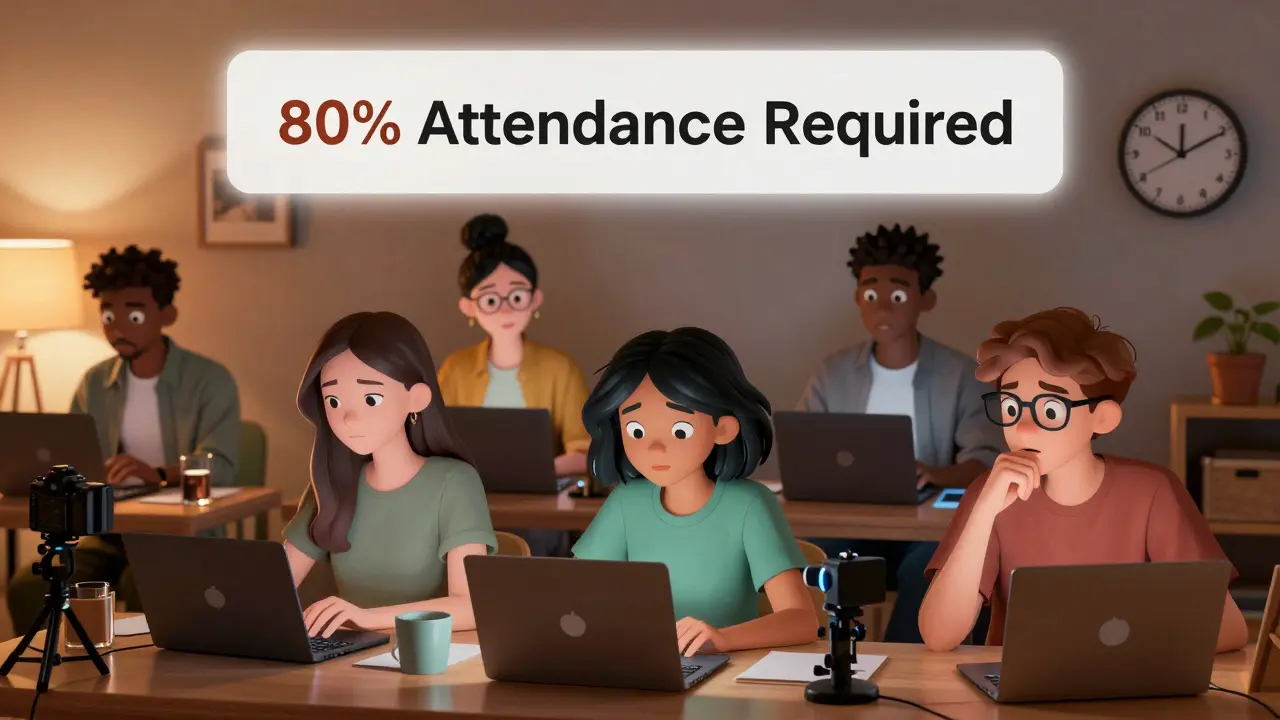
Some programs require you to attend at least 80% of live sessions. Others tie participation to your final grade-sometimes as much as 30%. If your course says, “Participation counts for 25% of your grade,” that means your name needs to show up-not just log in, but actively contribute. A passive learner doesn’t cut it.
What Counts as Participation?
It’s not enough to log in and click "I’m here." Participation means interaction. That includes:
- Posting thoughtful replies in discussion forums (not just "I agree" or "Great post!")
- Joining live video sessions with camera on (if required)
- Submitting peer feedback on assignments
- Collaborating in breakout rooms or group projects
- Responding to instructor prompts within deadlines
Some platforms track your activity automatically: how long you spend on readings, how often you comment, whether you watch videos to the end. Others rely on instructors to manually grade participation. Either way, if you’re silent for two weeks straight, you’re at risk.
Take a graduate-level business course at Arizona State University’s online program. Students must post at least twice a week in the discussion board-once in response to the prompt, once to a peer. If you don’t, you lose 5% of your grade per week. No warnings. No grace period. That’s not punishment-it’s accountability.
Attendance Policies Vary by Institution
There’s no federal law mandating online attendance. That means policies differ wildly. A public university might require 90% attendance with documented exceptions. A private bootcamp might say, "You need to attend every live session or you lose your spot." Some courses allow recorded sessions for review, but still require you to attend at least one live session per module to qualify for credit.
Here’s what you’re likely to see:
| Program Type | Attendance Requirement | Participation Requirement | Consequence of Non-Compliance |
|---|---|---|---|
| Public University | 80-90% of live sessions | Weekly forum posts + peer feedback | Grade reduction, possible withdrawal |
| Private Bootcamp | 100% required | Daily check-ins, project collaboration | Immediate removal from course |
| Corporate Training | 95% attendance for certification | Completion of all simulations | No certificate issued |
| MOOC (e.g., Coursera, edX) | None enforced | Optional quizzes and forums | No grade impact, but lower completion rates |
Always check your course syllabus. If it’s not clear, email your instructor. Don’t assume. Policies change between semesters, and some instructors update them mid-term.

What If You Can’t Attend?
Life happens. A sick child. A power outage. A last-minute work emergency. You’re not alone. Most institutions have a process for excused absences-but you have to ask.
Here’s how to handle it:
- Notify your instructor before the session if you know you’ll miss it.
- Provide documentation if required (medical note, employer letter).
- Ask for an alternative assignment-like a recorded session summary or a one-on-one chat.
- Don’t wait until after the deadline. Late requests are rarely approved.
One student in Tempe missed three live sessions due to a family medical crisis. She emailed her instructor with a doctor’s note and offered to complete a 1,000-word reflection on the missed material. The instructor accepted it. She passed. But she’s the exception. Most students wait too long and lose the chance to make it right.
Why Institutions Enforce These Rules
It’s not about control. It’s about outcomes.
Online courses are expensive to run. Schools invest in platforms, instructors, support staff, and tech. If students enroll, don’t show up, and don’t participate, the program fails. That’s why accreditation bodies like SACSCOC and HLC now require institutions to track engagement metrics. If too many students drop out or fail due to non-participation, the school risks losing its accreditation.
Also, employers care. If you’re taking a certificate course for career advancement, your employer may require proof of completion. That proof often includes attendance logs and participation records. A certificate with no participation history looks empty on a resume.

How to Stay On Track
Here’s what actually works:
- Block time in your calendar for live sessions-treat them like meetings with your boss.
- Set phone reminders 30 minutes before each session.
- Join the first 5 minutes of every class. Even if you’re late, showing up early shows effort.
- Post something in the discussion board every week-even if it’s just one sentence.
- Reach out if you’re falling behind. Instructors prefer to help you early than penalize you late.
One student in her 40s, working full-time and raising two kids, started failing her online psychology course because she never posted. She didn’t think anyone noticed. Then her instructor sent a private message: "I see you’re watching the videos. But I need to see your thoughts too." She started posting one short reflection a week. Her grade went from a D to a B+. She said it changed how she saw online learning.
What You Should Never Do
Don’t assume:
- That recording the session replaces attendance.
- That clicking "I attended" counts as participation.
- That your instructor won’t notice if you’re silent.
- That policies won’t change mid-term.
- That you can make it up later without consequences.
And don’t blame the system. Online learning isn’t easier than in-person. It’s different. It demands more self-discipline. The rules exist because they work. People who follow them finish. People who ignore them don’t.
Can I be dropped from an online course for not attending?
Yes. Many institutions have automatic drop policies if attendance falls below a set threshold-often 70-80%. This is usually outlined in the syllabus. Some schools drop you after just two unexcused absences. Always read the fine print before enrolling.
Do I have to turn on my camera during live sessions?
It depends on the course. Some programs require cameras on to verify attendance and build community. Others allow audio-only. Check your syllabus or ask your instructor. If cameras are required, they’ll usually say so upfront. Refusing to turn it on when required can count as non-participation.
What if I have a disability or chronic illness?
You’re entitled to accommodations. Contact your school’s disability services office as soon as possible. They can work with your instructor to adjust attendance requirements-like allowing recorded attendance, extended deadlines, or alternative participation methods. Documentation is required, but you’re not alone.
Can I make up missed participation points?
Sometimes, but not always. Some instructors offer bonus opportunities-like writing an extra reflection or leading a discussion. Others don’t. It’s up to them. Never assume make-up work is available. Always ask before the deadline, and be ready to do extra work.
Do MOOCs like Coursera or edX have attendance rules?
No. MOOCs don’t track attendance or enforce participation. You can watch all videos and skip every quiz-no one will notice. But if you want a certificate, you must complete all graded assignments. Participation is optional, so you’re on your own to stay motivated.
Yashwanth Gouravajjula
February 28, 2026 AT 04:44From India, I’ve taken 3 online courses. No camera, no problem. But I post daily-short, real thoughts. No fluff. Just shows I’m there. Instructors notice. Grade improves. Simple.
Kevin Hagerty
March 1, 2026 AT 08:05Wow another lecture on how we must suffer to learn. Can we just admit these rules exist because schools need to justify their $10k tuition? I watched every video. Did every quiz. But I didn’t ‘participate’ because I’m not here to make friends with strangers on a forum. Go touch grass.
Janiss McCamish
March 1, 2026 AT 15:59Real talk: if you’re working full-time and have kids, ‘weekly posts’ can feel impossible. But one sentence? Yes. I do one. ‘Found the lecture on cognitive load helpful.’ That’s it. My prof replied: ‘Thanks for showing up.’ That’s all they want. Stop overthinking it.
Richard H
March 2, 2026 AT 09:22Let’s be real. America’s education system is falling apart because people think online means easy. You want a degree? Then show up. No excuses. If you can’t commit to 2 hours a week, go get a job at Walmart. This isn’t a Netflix binge. It’s your future.
Kendall Storey
March 3, 2026 AT 16:00As someone who’s TA’d 3 online courses, I can say this: the students who *just* show up-log in, post one thing, show up to one live session-are the ones who pass. Not the ones who ace every quiz but ghost the forums. Engagement isn’t performative. It’s relational. You’re not just learning content. You’re building a learning community. Don’t be a ghost.
Ashton Strong
March 5, 2026 AT 09:34Dear learners: your dedication is not invisible. Even the smallest contribution-a single thoughtful reply-signals commitment. Institutions enforce these standards not to punish, but to preserve the integrity of learning outcomes. Your effort matters. Please continue.
Steven Hanton
March 6, 2026 AT 15:21I’ve been in online grad programs for 7 years. The pattern is clear: students who engage consistently-regardless of how quiet they are-finish. Those who wait until the last minute to ‘catch up’ rarely do. It’s not about quantity. It’s about continuity. Show up, even a little. Every time.
Pamela Tanner
March 8, 2026 AT 09:59Correction: the article says ‘80-90% attendance’ for public universities. That’s accurate. But many students misunderstand ‘attendance’ as logging in. It’s not. It’s being present-mentally and actively. One student emailed me last semester saying, ‘I watched the recordings.’ I replied: ‘I saw you. But I didn’t hear you.’ That’s the difference.
Kristina Kalolo
March 9, 2026 AT 00:50MOOCs don’t enforce attendance because they’re not accredited. But if you’re taking it for a job, you’re fooling yourself. Employers check completion rates. They know who did the work. Don’t fake it. The system’s not rigged-it’s just selective.
ravi kumar
March 10, 2026 AT 22:23From India, working night shifts. I post at 3am. One line. Always. ‘This changed how I see X.’ My instructor saved my grade once because he said, ‘You showed up when no one else did.’ It’s not about length. It’s about presence.
Megan Blakeman
March 12, 2026 AT 11:15Ugh, I hate when people say ‘just one sentence!’ Like, really? That’s the bar? I’ve been in courses where I wrote 500-word replies and got ignored… but someone who said ‘I agree’ got a reply. Why? Because they showed up. I’m done trying to be ‘thoughtful.’ I just post ‘I’m here.’ And it works. 😔
Akhil Bellam
March 14, 2026 AT 00:55Let’s be brutally honest: if you’re struggling to meet participation requirements, you probably shouldn’t be in an online course. You’re not ‘busy’-you’re unprepared. Real professionals show up. Real learners engage. The rest? They’re just collecting certificates for LinkedIn. Pathetic.
Amber Swartz
March 14, 2026 AT 18:33MY INSTRUCTOR ONCE SAID ‘I CAN TELL WHEN YOU’RE NOT LISTENING’ AND I CRIED. I WASN’T EVEN IN THE SESSION. HOW IS THAT FAIR? I’M A SINGLE MOM. I DIDN’T EVEN HAVE TIME TO SHOWER. NOW I’M SCARED TO LOG IN. WHY DO THEY DO THIS TO US?
Robert Byrne
March 15, 2026 AT 12:54That ‘one sentence’ thing? Yeah, I’ve done it. But here’s the truth: if you’re silent for two weeks, then drop in with ‘I’m back!’-your instructor knows you were gone. And they don’t forget. Don’t gaslight yourself. Presence isn’t a checkbox. It’s a pattern. Build it.
Tia Muzdalifah
March 15, 2026 AT 15:32Just wanted to say-this post saved me. I thought I was failing because I never spoke in live sessions. But then I started posting one thing a week. Just one. My grade went up. My anxiety went down. Turns out, they just wanted to know I was human. Not perfect. Just there.