B2B vs B2C Online Learning: Which Market Should You Target in 2026?
 Jun, 13 2026
Imagine you have spent months building a high-quality video course on project management. The content is solid, the slides are clean, and your expertise is undeniable. Now comes the hardest part: who pays for it? Do you sell directly to individuals looking to upskill on their own time, or do you pitch this exact same curriculum to HR directors at mid-sized companies? This decision defines your revenue model, your marketing strategy, and your daily workflow.
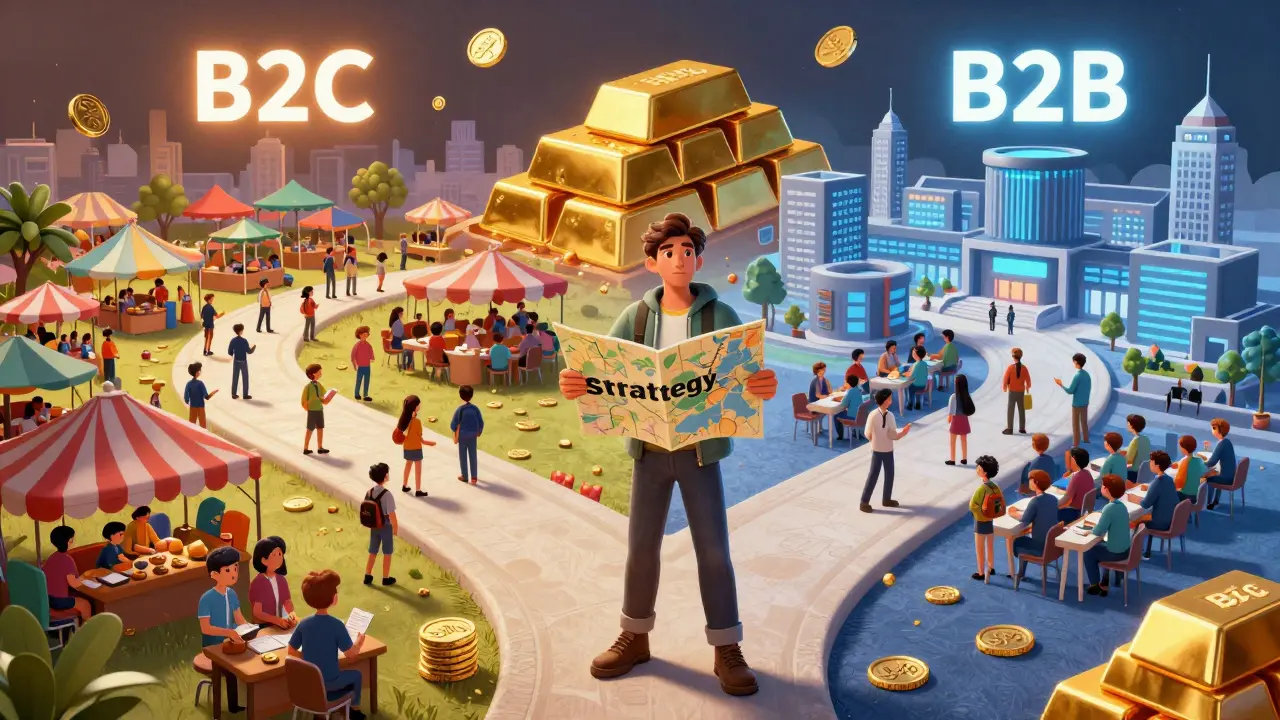
In 2026, the online learning landscape has split sharply into two distinct ecosystems. On one side, you have B2C (Business-to-Consumer) online learning, where individuals buy courses for personal growth. On the other, there is B2B (Business-to-Business) online learning, where organizations purchase training solutions for their employees. Both markets are growing, but they operate under completely different rules. Choosing the wrong path can lead to wasted ad spend, frustrated customers, and stalled revenue. Let’s break down exactly how these models work so you can decide which fits your goals.
The B2C Model: High Volume, Low Ticket
Selling to consumers is often the first choice for creators because it feels intuitive. You create something valuable, you put it on a platform like Udemy, Teachable, or your own website, and you market it to people. The barrier to entry is low. You don’t need a sales team; you just need good copy and effective social media ads.
The core dynamic here is volume. Because individual buyers typically spend between $50 and $300 per course, you need thousands of students to generate significant income. This means your primary focus shifts from pure instruction to marketing and community building. In 2026, attention is the scarcest resource. If your course doesn’t stand out in a saturated feed, it won’t sell.
- Speed to Revenue: You can launch and start selling within days. There is no procurement process.
- Creative Control: You decide the price, the format, and the updates. No client feedback loops required.
- Customer Acquisition Cost (CAC): Can be high if you rely on paid ads, but organic reach through SEO and social media can lower this over time.
However, churn is real. A student might take your course once and never return unless you have a strong subscription model or a robust content ecosystem. Building a brand that retains users requires constant engagement, newsletters, and new content drops. It is a grind, but the upside is scalability without complex negotiations.
The B2B Model: Low Volume, High Ticket
Now look at the corporate side. When you sell B2B, you aren’t selling to a person; you are selling to an organization. Your customer might be an L&D (Learning and Development) manager, a CHRO, or a department head. They aren’t buying your course because they love the topic; they are buying it because it solves a business problem, such as compliance gaps, skill shortages, or onboarding inefficiencies.
This model relies on relationships and proof of value. A single contract could be worth $10,000 to $100,000+ annually, depending on the size of the company and the number of seats purchased. But getting that contract takes time. Sales cycles can stretch from three to nine months. You will face procurement hurdles, legal reviews, and requests for custom reporting.
- Stability: Annual contracts provide predictable recurring revenue.
- Higher Lifetime Value (LTV): One happy client can expand usage across departments or renew for years.
- Integration Needs: Buyers expect your platform to integrate with existing systems like Slack, Microsoft Teams, or their LMS (Learning Management System).
You also need to speak a different language. Instead of "learn Python," your value proposition becomes "reduce deployment errors by 40% through certified engineering training." You must demonstrate ROI. If you cannot show how your training impacts the bottom line, you will lose to competitors who can.

Key Differences in Marketing and Sales
The way you acquire customers differs drastically between these two models. In B2C, you are playing a game of mass appeal. Your marketing funnels are broad. You use emotional triggers, aspirational outcomes, and social proof. Think Instagram reels showing transformation stories or YouTube tutorials that lead to a landing page. The goal is impulse buys or considered purchases based on trust in your personal brand.
In B2B, marketing is about authority and data. You publish whitepapers, host webinars for industry leaders, and speak at conferences. Your sales process involves demos, pilot programs, and case studies. You aren’t trying to convince someone to feel inspired; you are convincing a stakeholder that your solution mitigates risk. Trust is built through credentials, certifications, and peer references, not just testimonials.
| Feature | B2C (Consumer) | B2B (Corporate) |
|---|---|---|
| Average Order Value | $50 - $300 | $5,000 - $50,000+ |
| Sales Cycle | Days to Weeks | Months (3-9) |
| Decision Maker | Individual Learner | L&D Manager / HR Director |
| Primary Goal | Personal Growth / Career Change | ROI / Compliance / Skill Gap Closure |
| Content Customization | Low (One-size-fits-all) | High (White-labeling, specific modules) |
| Retention Strategy | Community & New Content | Contract Renewals & Account Management |
Technical Infrastructure and Platform Choices
Your choice of technology stack depends heavily on your target market. For B2C, simplicity and user experience are king. Platforms like Kajabi, Podia, or even Shopify with a digital product plugin work well. These tools handle payments, email automation, and basic analytics out of the box. You want frictionless checkout. If a user has to jump through five hoops to buy a $97 course, you’ve lost them.
B2B buyers, however, demand enterprise-grade features. They need Single Sign-On (SSO) via SAML or OAuth. They require SCORM or xAPI compliance to track progress within their own Learning Management Systems. They want detailed reports on completion rates, assessment scores, and time-on-task. If your platform cannot export this data or integrate with APIs, you are not viable for most medium-to-large enterprises. You might need a more robust LMS like LearnDash, TalentLMS, or a dedicated B2B platform like Docebo or Cornerstone, though the latter are expensive and complex to manage.
Monetization Strategies: Beyond the Course Sale
Once you pick a lane, how do you maximize revenue? In B2C, the trend in 2026 is moving away from one-off course sales toward subscriptions. Platforms like Skillshare proved the model, but independent creators are now using Patreon or Memberstack to offer ongoing access to a library of courses, live Q&As, and templates. This creates Monthly Recurring Revenue (MRR), which stabilizes income against the volatility of ad campaigns.
In B2B, monetization is often tiered. You might offer a base license fee per seat, plus add-ons for certification exams, coaching hours, or custom content development. Another powerful model is the "freemium" approach for B2B, where you offer free basic training to attract users, then upsell the employer for advanced analytics and admin controls. This bottom-up adoption strategy is common in software and increasingly popular in learning tech.
Which Path Fits Your Profile?
If you are a solo creator with limited capital and a strong personal brand, B2C is likely the better starting point. It allows you to validate your ideas quickly and build cash flow without needing a sales team. You can always pivot to B2B later once you have case studies and a proven curriculum.
If you have a background in corporate training, consulting, or sales, and you prefer deeper, longer-term relationships over chasing viral hits, B2B may suit you better. It requires patience and resilience during long sales cycles, but the financial rewards and job security are significantly higher. Many successful edtech founders start in B2C to build their audience and then license their content to corporations, effectively capturing both markets.
Ultimately, the best choice depends on your resources, your tolerance for sales complexity, and your long-term vision. Are you building a lifestyle business or a scalable enterprise? Answer that question first, and the market will become clear.
Can I sell the same course to both B2B and B2C markets?
Yes, many creators do this. However, you may need to package it differently. For B2C, emphasize personal transformation and ease of use. For B2B, highlight compliance, team collaboration features, and ROI metrics. You might also need different pricing structures and possibly separate landing pages to address the unique concerns of each buyer persona.
What is the average conversion rate for B2B online learning sales?
Conversion rates in B2B are generally lower than B2C because the stakes are higher. While B2C e-commerce averages 2-3%, B2B lead-to-customer conversion can range from 1% to 5% depending on the quality of leads and the length of the sales cycle. However, the lifetime value of a B2B customer makes up for the lower conversion rate.
Do I need an LMS to sell B2B courses?
Not necessarily, but it helps. Small businesses might accept simple video links and PDFs. However, larger enterprises usually require an LMS that supports tracking, reporting, and integration with their existing HR tech stack. If you lack this infrastructure, partnering with an established LMS provider might be a smarter move than building your own.
How much does it cost to acquire a B2B customer compared to B2C?
The Customer Acquisition Cost (CAC) for B2B is typically much higher due to the need for sales teams, personalized demos, and longer nurturing campaigns. It can range from hundreds to thousands of dollars per customer. In contrast, B2C CAC is often driven by ad spend and can be lower, but margins are also thinner, requiring higher volume to break even.
Is B2B online learning growing faster than B2C in 2026?
Both sectors are growing, but B2B is seeing accelerated investment due to the rapid pace of technological change in the workplace. Companies are under pressure to reskill employees for AI, cybersecurity, and data analytics. This urgency drives budget allocation toward corporate training, making B2B a particularly lucrative area for specialized skills.