Bootcamp ROI: A Realistic Cost-Benefit Analysis for Career Switchers in 2026
 Aug, 6 2026
That email from the recruiter feels like a miracle. You spent three months grinding through Coding Bootcamps are intensive, short-term training programs designed to teach practical skills in fields like software development, data science, and UX design. You maxed out your credit cards or signed an Income Share Agreement (ISA) that scares you to death. Now, someone wants to hire you as a Junior Developer. But before you celebrate, pause. Is this actually a good financial move? Or are you about to trade one form of debt for another?
The promise of six-figure salaries is real, but so is the tuition bill. In 2026, the landscape has shifted. The "gold rush" era of hiring anyone who can center a div is over. Employers are pickier. Tuition hasn't dropped. If you want to make money switching careers, you need to treat your education like a business investment. You need to calculate the Return on Investment (ROI). This isn't just about getting hired; it's about paying back what you owe and coming out ahead.
The True Cost of Entry: It’s Not Just Tuition
Most people look at the sticker price of a bootcamp and stop there. That’s a mistake. To get an accurate ROI calculation, you have to look at the Total Cost of Attendance (TCA). This number is usually higher than the brochure suggests.
Tuition fees are the direct cost paid to the educational institution for instruction and resources. For a top-tier full-time immersive program in a major city like San Francisco or New York, expect to pay between $15,000 and $20,000. Online options might range from $8,000 to $14,000. But here is where the hidden costs creep in.
- Opportunity Cost: If you take a full-time bootcamp, you aren’t working. If you were making $40,000 a year in your previous role, losing that income for 12 weeks adds roughly $9,000 to your total cost. Part-time bootcamps reduce this risk because you keep your day job, but they extend the timeline, which means longer delays in reaching your new salary.
- Hardware and Software: You’ll need a decent laptop. Most curricula require macOS or a high-end Windows machine. Budget at least $1,200 for a MacBook Air or equivalent if you don’t already own one.
- Living Expenses: Are you relocating? Moving to Austin or Seattle for a job hunt costs money. Even staying put requires covering rent while you study.
When you add these up, a $15,000 bootcamp often becomes a $25,000 investment. Keep this number handy. It’s the baseline for your break-even analysis.
Understanding Payment Models: Loans vs. ISAs
How you pay matters just as much as how much you pay. The financial structure of your education dictates your monthly cash flow for years after graduation.
Income Share Agreements (ISAs) are a payment model where students pay nothing upfront and instead repay a percentage of their future income for a set period once employed. They sound appealing because there’s no upfront cost. However, they can be expensive in the long run. A typical ISA might require 10% of your salary for 48 months. If you land a job paying $80,000, that’s $8,000 a year going straight to the school. Over four years, you’ve paid $32,000. Compare that to a loan with interest, and the ISA might actually cost more unless the cap is low.
Federal Student Loans are government-backed loans available for eligible career training programs, offering fixed interest rates and repayment flexibility. Since the passage of legislation allowing federal aid for certain career schools, many accredited bootcamps now accept them. Federal loans offer lower interest rates and income-driven repayment plans. This is often safer than private loans or predatory ISAs.
Private Education Loans are loans from banks or credit unions that typically require a cosigner and have variable interest rates based on creditworthiness. These are risky. Interest rates in 2026 hover around 7-9%. If you graduate into a recession and struggle to find work, those payments pile up fast.
| Payment Method | Upfront Cost | Total Potential Cost | Risk Level | Best For |
|---|---|---|---|---|
| Self-Pay / Savings | High ($15k+) | Lowest (No Interest) | Low | Those with emergency funds |
| Federal Loans | None | Moderate (Fixed Interest) | Medium | Long-term stability seekers |
| Income Share Agreement (ISA) | None | Variable (Can exceed $30k) | High | High earners only |
| Private Loan | None | High (Variable Interest) | Very High | Last resort option |
The Revenue Side: Realistic Salary Expectations
Now let’s talk about the money coming in. Bootcamp marketing materials often highlight outlier stories-the student who landed a $120,000 job at a FAANG company. Those exist, but they are not the average.
In 2026, the entry-level tech market has corrected. Junior Software Developer Salaries are compensation ranges for entry-level programming roles, varying significantly by location and specialization. According to recent labor data, the median starting salary for a junior developer in the US is approximately $65,000 to $75,000. In high-cost areas like San Francisco, it might hit $90,000, but your living expenses will eat that up. In rural areas or smaller cities, it might be closer to $55,000.
You also need to account for the time-to-hire. It used to take two weeks to get an offer. Now, it takes three to six months. During this gap, you are paying down debt without earning the new salary. This delay impacts your ROI significantly.
Consider the specialization. Full Stack Development is a broad skillset involving both front-end and back-end web technologies, offering the most job opportunities for beginners. This remains the safest bet for volume of jobs. Data Science Bootcamps are programs focused on statistics, Python, and machine learning, often requiring stronger mathematical backgrounds. These can lead to higher salaries ($80k+) but have fewer entry-level openings. UX Design offers a middle ground with slightly lower starting salaries but less intense competition than coding.
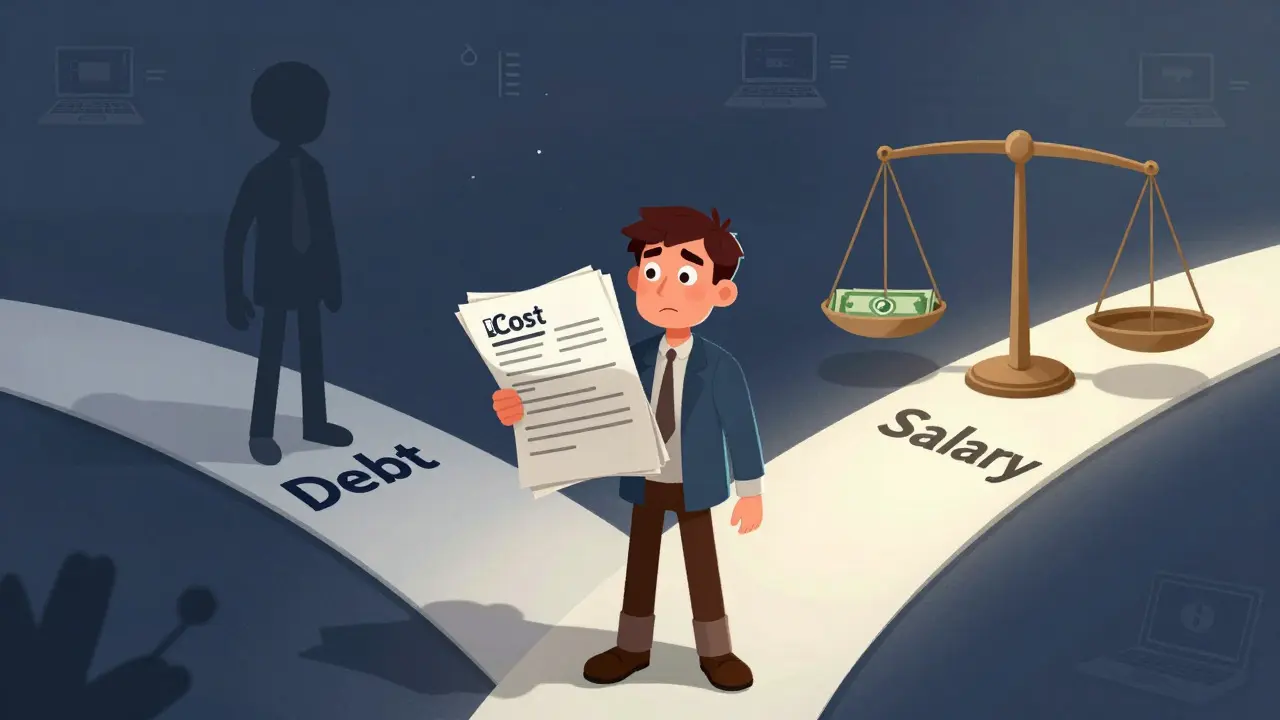
Calculating Your Personal Break-Even Point
To know if a bootcamp is worth it, you need to do the math yourself. Here is a simple formula to determine your break-even point.
- Determine Total Debt: Add tuition + estimated interest + opportunity cost. Let’s say $25,000.
- Estimate Monthly Net Gain: Calculate the difference between your new expected salary and your old salary (or unemployment benefits), divided by 12. If you earned $40k before and now earn $70k, your annual gain is $30k. Monthly net gain is $2,500.
- Subtract Monthly Debt Payments: If you have a loan payment of $400/month, your true monthly gain is $2,100.
- Divide Debt by Monthly Gain: $25,000 / $2,100 = ~12 months.
In this scenario, it takes you one year to pay off the investment. After month 13, every dollar you earn is pure profit compared to your previous life. If the break-even period exceeds three years, the risk increases dramatically. Why? Because technology changes fast. Skills learned today might be obsolete in five years. If you spend half your career paying for the other half, the ROI shrinks.
Hidden Variables: Job Placement Rates and Support
Not all bootcamps are created equal. Some are rigorous engineering factories; others are diploma mills. When evaluating ROI, scrutinize the job placement metrics.
CIP-EAL Reporting Standards are federal guidelines requiring career schools to report job placement outcomes honestly, including definitions of 'placed' and 'employed'. Look for schools that adhere to these standards. Be wary of claims like "95% placement rate." Ask what they define as placed. Does it include freelance gigs? Part-time roles unrelated to coding? Jobs held for only two weeks?
A realistic placement rate for reputable schools in 2026 is between 60% and 75% within six months of graduation. If a school claims 90%+, dig deeper. Also, check the alumni network. Strong communities provide referrals, which are the primary way people get hired in tech today. Cold applying works rarely. Networking does.

Alternatives to Consider Before Paying Up
Before you sign that contract, ask yourself if you really need the bootcamp. The barrier to entry for self-study has never been lower.
Self-Paced Online Courses are affordable educational resources like freeCodeCamp, The Odin Project, or Coursera that allow learners to study at their own speed. These cost between $0 and $500. They lack the structure and accountability of a bootcamp, but if you are disciplined, the technical knowledge is identical. Many successful developers started this way.
University Degree Programs are traditional four-year computer science degrees that provide theoretical foundations but take longer and cost more upfront. While slower, degrees still hold weight in corporate HR filters. If you have time, a degree might offer better long-term ROI due to broader eligibility for senior roles later.
The bootcamp sits in the middle: faster than a degree, more structured than self-study, but expensive. It is best suited for career switchers who need rapid immersion and external accountability to succeed.
Final Verdict: Who Should Do It?
So, is the ROI positive? For the right person, yes. If you have savings to cover tuition, live in a region with a healthy tech job market, and are willing to network aggressively, a bootcamp can double your income within two years. That is a massive return.
However, if you are taking on high-interest debt, moving to a saturated market, or expecting a job to fall into your lap after graduation, the ROI could be negative. You might end up with a certificate and $30,000 in debt, working in a non-tech role.
Treat this decision like a startup launch. Validate the market (job demand), minimize burn rate (tuition/living costs), and ensure you have a clear path to revenue (job search strategy). Do the math before you commit. Your future self will thank you.
What is the average ROI of a coding bootcamp?
The average ROI varies widely, but studies suggest that graduates who secure employment within six months see a positive return within 12-18 months. On average, bootcamp alumni earn $20,000-$30,000 more annually than their pre-bootcamp salaries. However, this assumes successful placement and manageable debt levels.
Are Income Share Agreements (ISAs) worth it in 2026?
ISAs can be worthwhile if you have no savings and qualify for a low percentage rate (under 10%) with a reasonable cap. However, if you land a high-paying job quickly, federal loans or self-pay often result in lower total costs. Always read the fine print regarding payment caps and deferment periods.
How long does it take to recoup bootcamp costs?
For most students, the break-even point occurs between 12 and 24 months after graduation. This depends on your starting salary, the total amount borrowed, and how quickly you find employment. Faster hiring leads to quicker ROI.
Is a bootcamp better than self-study for career switchers?
Bootcamps offer structure, networking, and career services that self-study lacks. If you struggle with motivation or need help navigating the job market, a bootcamp provides value beyond just code. Self-study is cheaper but requires immense discipline and proactive networking.
What is the current job market for junior developers?
In 2026, the market is competitive but stable. Entry-level roles are harder to find than in previous years, with employers seeking candidates who have portfolios and internship experience. Specializations in AI integration and cloud computing are seeing higher demand.