Coursera vs Udemy: Which Online Learning Platform Should You Choose?
 Jun, 17 2026
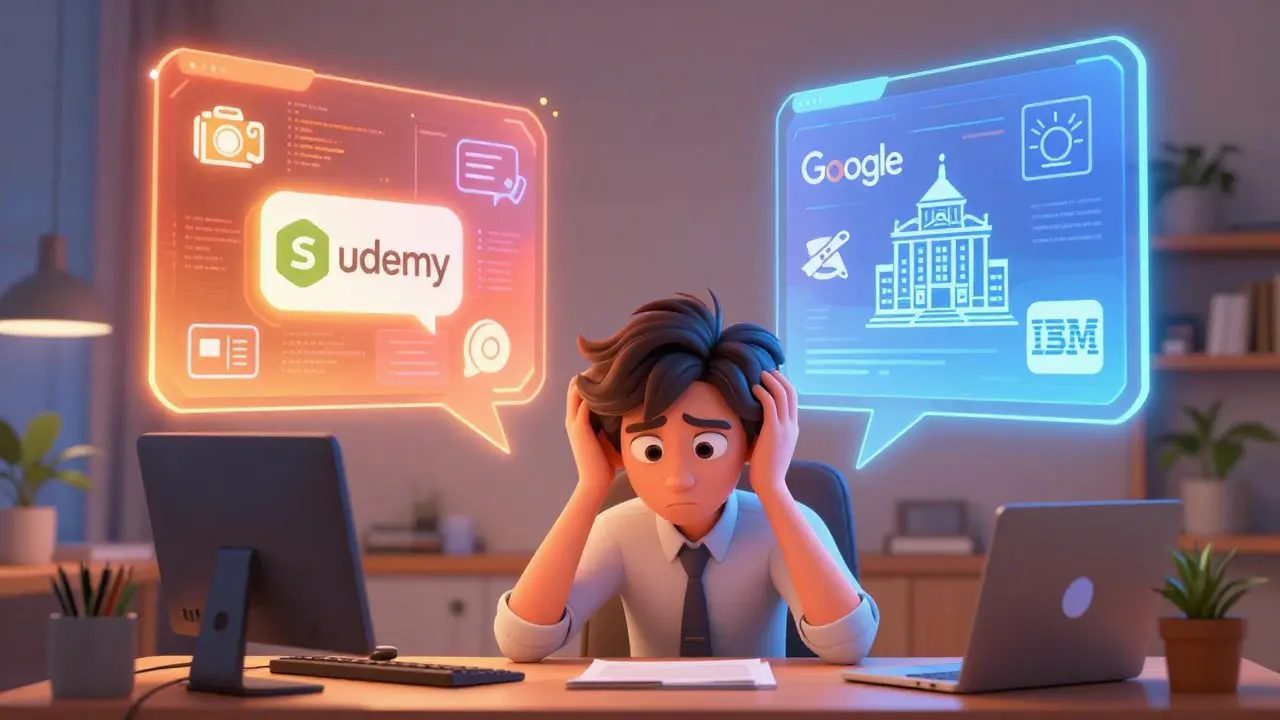
You want to learn a new skill. Maybe you need Python for work, or perhaps you just want to understand digital marketing better. You open your browser and type in "online courses." Two names pop up immediately: Coursera is an online learning platform that offers courses from top universities and companies worldwide. And then there's Udemy, a massive marketplace where anyone can create and sell courses on virtually any topic. Both are huge. Both have millions of users. But they are completely different animals.
Picking the wrong one can cost you time, money, and frustration. If you buy a cheap Udemy course expecting a university-grade credential, you'll be disappointed. If you pay hundreds for a Coursera certificate when you just wanted to learn Excel shortcuts, you're wasting cash. This guide cuts through the noise. We’ll look at pricing, content quality, certificates, and who actually benefits from each platform so you can make the right call today.
The Core Difference: Marketplace vs. Partner Network
To understand which platform fits you, you first need to understand how they operate. They have fundamentally different business models, and this shapes everything else about the experience.
Udemy operates as an open marketplace. Think of it like Amazon for video courses. Any instructor-whether they are a senior engineer at Google or a freelance graphic designer with a webcam-can upload a course. Udemy takes a cut of the sales, but they don't strictly vet every single lesson before it goes live. This means you get incredible variety. You can find courses on "How to Train Your Dog" next to "Advanced Machine Learning with TensorFlow." The barrier to entry is low, which leads to high volume but variable quality.
Coursera, on the other hand, works more like a digital extension of a university campus. They partner with established institutions. When you see a course on Coursera, it’s usually created by professors from Stanford University, Yale, or industry giants like Google and IBM. The content is curated, structured, and often tied to academic standards. You aren’t buying from an individual; you’re enrolling in a program backed by an institution.
This distinction matters because it dictates the rigor of the material. Udemy is great for quick, practical skills. Coursera is built for deep, theoretical understanding and formal credentials.
Content Quality and Instructor Expertise
Let’s talk about what you actually watch and read. On Udemy, the quality depends entirely on the specific instructor. Some instructors are world-class. Others? Not so much. Because anyone can publish, you have to do your homework. You must check the reviews, look at the last update date, and preview the free lectures. A highly-rated course from 2018 might be obsolete if it covers software that has changed significantly since then.
On Coursera, the baseline quality is higher because of the institutional backing. A data science course from Johns Hopkins will follow a syllabus similar to what their on-campus students receive. The videos are professionally produced, and the reading materials are often peer-reviewed papers or textbooks. However, this doesn't mean it's always "better" for you. Academic courses can sometimes feel dry or overly theoretical compared to the hands-on, project-based approach many Udemy instructors take.
If you are learning coding, for example, a Udemy instructor might show you exactly how to build a specific app step-by-step. A Coursera professor might explain the underlying algorithms and computer science principles behind that app. Both are valuable, but they serve different learning styles.
| Feature | Udemy | Coursera |
|---|---|---|
| Instructor Type | Independent experts, freelancers, professionals | University professors, corporate trainers |
| Quality Control | User reviews and ratings drive visibility | Institutional accreditation and editorial review |
| Update Frequency | Varies wildly; some never updated | Regularly updated to match academic semesters or industry changes |
| Learning Style | Practical, tactical, quick wins | Theoretical, comprehensive, structured |
Pricing and Payment Structures
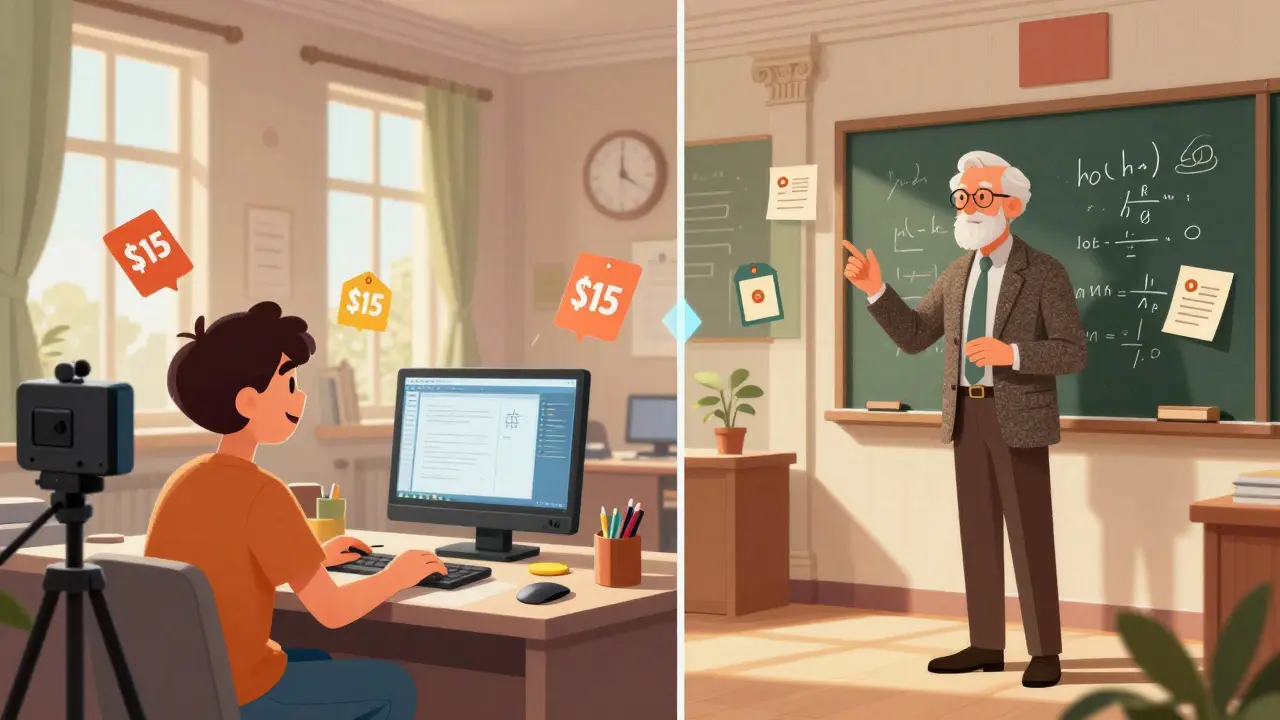
Money is usually the deciding factor. Here is where the two platforms diverge sharply. Udemy runs on a perpetual license model with frequent sales. Coursera uses a subscription or per-course payment model.
On Udemy, you rarely pay full price. Courses often list for $100-$200, but they go on sale almost every week for $10-$20. Once you buy a course, you own it forever. Even if the instructor updates it later, you get those updates for free. This makes Udemy incredibly cost-effective if you know exactly what you want to learn. You can grab three different courses on photography for less than the price of one dinner out.
Coursera has two main paths. First, you can audit many courses for free. This gives you access to the video lectures and readings, but you won’t get graded assignments or a certificate. Second, if you want the certificate or the graded work, you pay per course (usually $49-$99) or subscribe to Coursera Plus. Coursera Plus costs around $59 per month or $399 per year and gives you unlimited access to most courses. It’s a no-brainer if you plan to take multiple courses in a short period. However, if you only need one specific skill, paying per course might be cheaper than a subscription.
Be careful with Coursera’s financial aid. They offer it for many courses, but the application process can take weeks. Udemy doesn’t offer financial aid, but the low sale prices usually negate the need for it.
Certificates and Career Impact
Why are you learning? If it’s just for fun, neither certificate matters much. But if you need to put something on your LinkedIn profile or resume, the weight of the credential differs.
A Udemy certificate proves you watched the videos and completed the quizzes. It shows initiative, but employers generally don’t recognize Udemy as an accredited body. It’s a nice-to-have, not a deal-maker. It tells a hiring manager, "I took the time to learn this tool," but it doesn’t carry the prestige of an educational institution.
Coursera certificates are different. Because they come from recognized universities and companies, they hold more weight. A Professional Certificate from Google or IBM on Coursera is explicitly designed to signal job readiness. Many employers recognize these programs as valid proof of competency. Some Coursera offerings even lead to full degrees (Bachelor’s or Master’s) from accredited universities, which obviously carry significant career value.
If you are switching careers-for instance, moving into data analytics-a Coursera specialization from a reputable university can help get your foot in the door. For a hobbyist wanting to learn watercolor painting, a Udemy certificate is plenty sufficient.

User Experience and Community
How does it feel to learn on each platform? Udemy’s interface is straightforward. You click play, and you watch. There are discussion forums under each lecture, but engagement varies. Sometimes you get helpful answers; other times, the thread is dead. Since instructors are independent, support is limited to what they choose to provide.
Coursera feels more like a classroom. You have weekly deadlines (if you opt into them), peer-graded assignments, and discussion forums moderated by teaching assistants. The peer-grading aspect can be hit-or-miss-you might get detailed feedback or just a generic "good job"-but it forces you to engage with the material actively rather than passively watching videos. The community is larger and more diverse because people from all over the world enroll in these university-level courses.
Which One Should You Choose?
Let’s simplify this into decision scenarios. Ask yourself these questions:
- Do you need a specific technical skill quickly? Choose Udemy. If you need to learn Photoshop, SQL, or ReactJS by next week, Udemy has thousands of targeted, affordable courses that get straight to the point.
- Are you looking for a career change or academic credit? Choose Coursera. If you need a credential that HR departments recognize, or if you want to explore subjects like psychology, history, or advanced mathematics with academic rigor, Coursera is the way to go.
- Is budget your primary constraint? Choose Udemy. With courses often costing under $20, it’s hard to beat the value for self-paced, non-credentialed learning.
- Do you prefer structure and accountability? Choose Coursera. The weekly schedules and peer interactions keep you on track, whereas Udemy requires total self-discipline.
You don’t have to pick just one forever. Many learners use both. Use Udemy to pick up quick tools and techniques, and use Coursera to build foundational knowledge and earn credentials. In 2026, the best strategy is often a hybrid approach: leverage the breadth of Udemy for immediate tasks and the depth of Coursera for long-term career growth.
Can I get a refund if I don't like the course?
Yes, but the policies differ. Udemy offers a 30-day money-back guarantee on almost all courses, regardless of how much content you’ve consumed. Coursera allows refunds within 14 days of purchase, provided you haven’t used the service extensively. Always check the specific terms before buying.
Are Coursera certificates worth the money?
It depends on your goal. If you need a credential for your resume or LinkedIn, yes. Employers recognize partners like Google, IBM, and major universities. If you are just learning for personal enrichment, auditing the course for free is often enough, making the certificate unnecessary.
Which platform is better for programming?
Both are strong, but for different reasons. Udemy is excellent for practical, framework-specific tutorials (e.g., "Build a Django App"). Coursera is better for computer science fundamentals and algorithmic thinking (e.g., "Algorithms Specialization" from Stanford). Beginners often start with Udemy for quick wins and move to Coursera for deeper understanding.
Do employers care about Udemy certificates?
Generally, no. Most employers do not view Udemy certificates as formal qualifications. However, listing the skills you gained can still be beneficial during interviews if you can demonstrate practical ability. Coursera certificates, especially Professional Certificates, carry more weight due to their institutional backing.
Can I switch between platforms easily?
Absolutely. There is no exclusivity. Many professionals use Udemy for niche software training and Coursera for broader professional development. Your progress on one platform does not transfer to the other, so manage your accounts separately.