Credential Renewal and Ongoing Maintenance Requirements for Course Certifications
 Jan, 31 2026
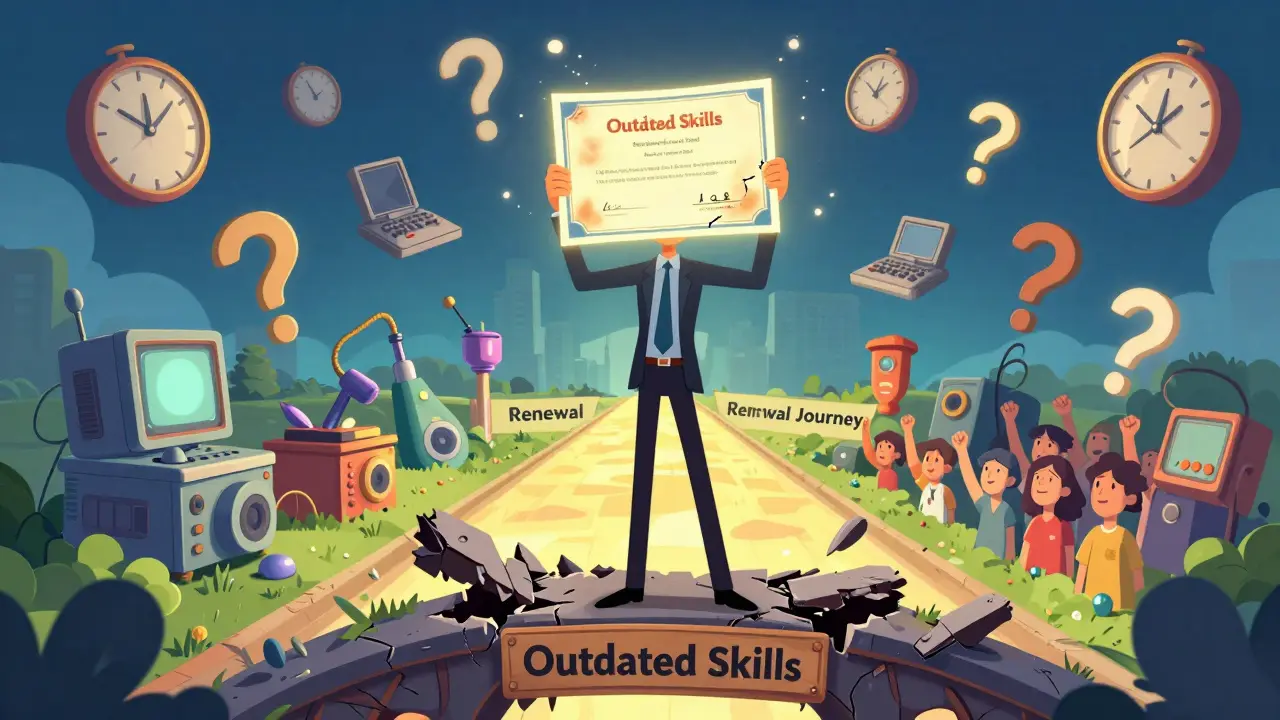
Ever finished a course, got your certificate, and then realized you have to do something else to keep it valid? You’re not alone. Many professionals assume that once they earn a credential, it’s good forever. But in today’s fast-changing job market, most certifications come with strings attached. You have to renew them. You have to prove you’re still up to date. Skip this step, and your hard-earned credential becomes just a digital badge collecting dust.
Why Credentials Don’t Last Forever
Certifications aren’t trophies. They’re proof you can do something right now. If you don’t keep learning, that proof becomes outdated. A cybersecurity certificate from 2020 doesn’t mean much when ransomware attacks have evolved five different ways since then. A project management credential based on Waterfall methods won’t help you lead agile teams today. Employers and clients don’t care about what you knew three years ago-they care about what you know today.Organizations that issue credentials know this. That’s why they built renewal systems. It’s not about making money. It’s about keeping standards high. If everyone could keep an old certificate forever, the value of the whole system drops. Renewal requirements protect the credibility of the credential-and your reputation when you list it on your resume.
What Renewal Usually Looks Like
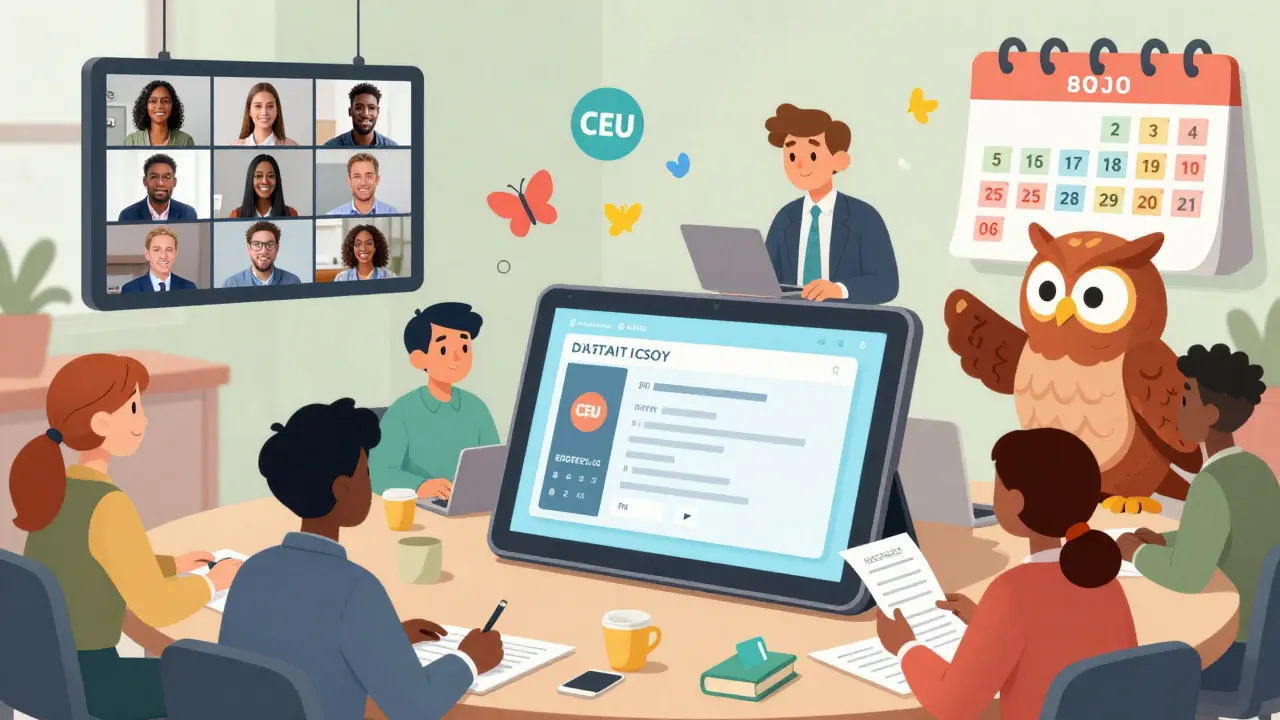
Most credential renewal processes follow one of three paths: continuing education, retesting, or active practice.Continuing education is the most common. You’ll need to earn a certain number of continuing education units (CEUs) or professional development hours (PDHs) every one to three years. For example, the Project Management Institute (PMI) requires 60 PDUs every three years to keep your PMP active. These hours can come from attending webinars, taking short courses, speaking at events, or even writing articles about your field.
Retesting is used when the material changes fast. Certifications in cloud computing, IT security, or data privacy often require you to retake the exam. Microsoft’s Azure certifications, for instance, expire after one year. You can’t just renew by logging hours-you have to prove you still know the current version of the platform.
Active practice is less common but growing. Some healthcare and engineering licenses require you to show you’ve been working in the field. You might need to submit pay stubs, client logs, or supervisor verification. This ensures you’re not just studying-you’re applying the knowledge.
Where to Find Your Renewal Rules
The first mistake people make? They assume the rules are the same everywhere. They’re not. Every certifying body sets its own deadlines, requirements, and acceptable activities.Start with the official website of the organization that issued your credential. Look for a section called “Maintain Your Certification,” “Continuing Education,” or “Recertification.” If you can’t find it, search for “[Your Certification Name] renewal requirements.”
Some organizations send reminders via email. Others don’t. Don’t wait for a notice. Set a calendar alert for six months before your expiration date. That gives you time to plan-whether you need to take a course, schedule an exam, or gather documentation.
Pro tip: Save every certificate, attendance record, or receipt. You’ll need them when you submit your renewal. Some organizations audit a random 5-10% of applicants. If you can’t prove you earned the hours, your credential could be revoked.
Common Pitfalls and How to Avoid Them
Here are the top three mistakes people make-and how to dodge them.- Waiting until the last minute. Courses fill up. Exams get backed up. If you wait until your credential expires, you might lose it entirely. Some organizations let you renew up to 90 days late-but you’ll pay a fee and lose access during that time.
- Choosing easy, low-value activities. You can’t just watch YouTube videos and call it CEU credit. Most certifying bodies only accept accredited providers. Check their approved list before signing up for anything.
- Ignoring expiration dates across multiple certs. If you hold five certifications, you’re managing five renewal cycles. Use a spreadsheet or app like Notion or Google Calendar to track them all. Color-code them by due date so you don’t get blindsided.
How to Make Renewal Easier
Renewal doesn’t have to feel like a chore. Turn it into part of your professional rhythm.Block out two hours a month for learning. That’s 24 hours a year-enough to cover most renewal requirements without pressure. Subscribe to newsletters from your certifying body. They often list free or discounted training opportunities.
Join a peer group. Many professionals form study circles or accountability groups to share resources and track progress. You’ll stay motivated, and you might even learn something new from someone else’s experience.
Some employers pay for renewal fees or offer paid time off for training. Ask your HR department. Even if they don’t have a formal policy, many will support it if you show how it benefits your role.
What Happens If You Let It Expire?
Letting a credential expire doesn’t mean you lose everything-but it’s not harmless.Most organizations give you a grace period-usually 60 to 90 days-to renew with a late fee. After that, you may have to retake the full exam. Some, like CompTIA, let you reinstate your credential by completing a recertification path, but you’ll pay more than if you’d renewed on time.
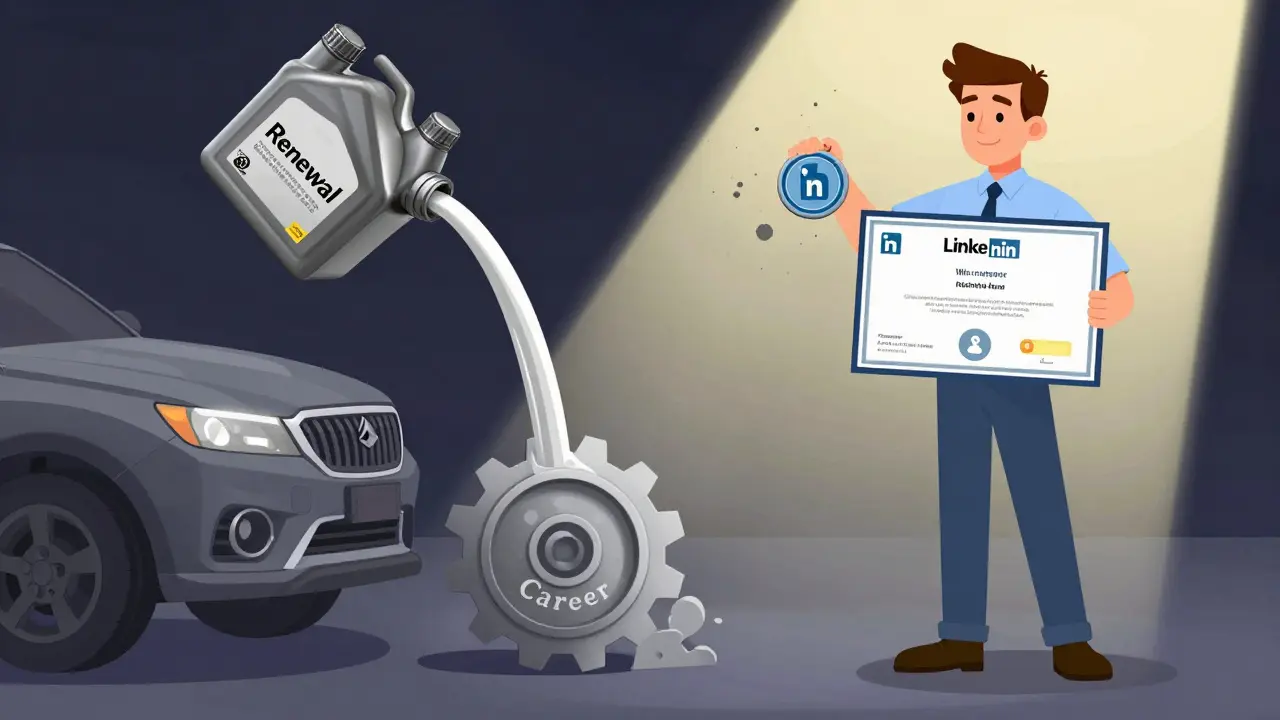
Worse, you might have to remove the credential from your LinkedIn profile, resume, or email signature. That’s embarrassing. Clients and hiring managers notice when a “certified” professional suddenly isn’t. You lose credibility, even if you’re still skilled.
And if you’re in a regulated field-like nursing, accounting, or engineering-letting your credential lapse could mean losing your license to practice. That’s not just a resume issue. It’s a career stopper.
Renewal Isn’t Optional. It’s Part of the Job.
Think of credential renewal like car maintenance. You don’t wait until the engine dies to change the oil. You do it on schedule because you know what happens if you don’t.Your certification is your professional engine. Renewal keeps it running. It’s not a penalty. It’s a commitment-to your skills, your reputation, and your future.
Start today. Check your expiration date. Find your renewal requirements. Schedule your next learning step. Don’t wait for a reminder. Don’t hope it’ll be easy. Take control. Your next promotion, client, or job offer might depend on it.
Do all professional certifications require renewal?
No, not all. Some entry-level or vendor-neutral certifications are valid for life. But most industry-recognized credentials-especially those tied to job roles like project management, cybersecurity, or HR-require renewal. If the certifying body is reputable and widely respected, they almost certainly have renewal rules. Always check their official site.
Can I renew my certification early?
Yes, and you should. Most organizations allow you to start accumulating renewal credits up to a year before your credential expires. You can even complete all requirements months ahead of time. Early renewal doesn’t shorten your next cycle-it resets the clock from the date you complete the process. This gives you breathing room and avoids last-minute stress.
What if I can’t afford the renewal fee?
Many certifying bodies offer fee waivers or discounts for students, unemployed professionals, or those in nonprofit roles. Contact their support team directly. Some also partner with local workforce boards or community colleges that cover renewal costs. Don’t assume you can’t afford it-ask. You’d be surprised how often help is available.
Can I use the same course for multiple certifications?
Sometimes. Many organizations accept the same continuing education activity for multiple credentials, as long as the content is relevant. For example, a course on data privacy might count for both your CIPP and CISSP renewals. But you’ll need to report it separately for each cert. Always check each organization’s policy-some cap how many credits you can double-dip.
How do I prove I completed a course for renewal?
Most providers send a completion certificate or email confirmation. Keep that. Some platforms, like Coursera or edX, let you download a PDF transcript of your completed courses. For live events, save your registration receipt and attendance log. If you’re self-studying, some organizations accept a signed log with dates, topics, and hours-along with a summary of what you learned. Always follow their exact documentation rules.
What happens if I fail the renewal exam?
You usually get one or two retakes, often with a waiting period. If you fail all attempts, you’ll need to reapply as a new candidate-meaning you’ll pay the full exam fee and possibly retake the original certification test. That’s why preparation matters. Use practice exams, review guides, and study groups. Don’t treat the renewal exam like a formality. It’s a real test of your current knowledge.
Ashley Kuehnel
February 1, 2026 AT 01:39OMG YES this is so real!! I let my PMP expire last year and had to retake the whole thing-total nightmare. I thought I was too busy to bother with CEUs but now I block out 2 hours every month like the post said and it’s so much easier. Also, save EVERY receipt. I lost one once and spent 3 weeks begging PMI for mercy. Don’t be me.
adam smith
February 2, 2026 AT 08:27It is imperative that one adheres to the stipulated renewal protocols as delineated by the certifying authority. Failure to do so constitutes a breach of professional decorum.
Mongezi Mkhwanazi
February 3, 2026 AT 12:56Let me be perfectly clear: the entire certification-industrial complex is a money-grubbing scam masquerading as professional development. You think they care about your skills? No. They care about your recurring subscription fee. The ‘renewal’ system exists solely to extract more money from overworked professionals who’ve already paid $500 to get certified in the first place. And don’t even get me started on ‘approved providers’-they’re all just corporate shills with inflated course prices. You’re being played.
Mark Nitka
February 4, 2026 AT 20:42Look, I get the fear-but this isn’t about control. It’s about keeping standards from collapsing. If you’re not updating your skills, you’re not just falling behind-you’re misleading people who hire you. I’ve seen too many ‘certified’ folks who haven’t touched a tool since 2018. That’s dangerous. Renewal isn’t punishment. It’s accountability.
Kelley Nelson
February 5, 2026 AT 22:50How quaint. One assumes that the professional community would naturally uphold its own standards without the need for such bureaucratic formalities. Yet, here we are-forced to engage in performative learning to maintain the illusion of competence. It is, frankly, degrading.
Aryan Gupta
February 6, 2026 AT 15:31Did you know that 73% of certification bodies are secretly owned by the same 3 tech conglomerates? They’re not trying to keep standards high-they’re creating artificial scarcity so they can sell you the same course every year under a new name. And the ‘audit’? That’s just a pretext to collect your personal data and sell it to recruiters. I checked the TOS-there’s a clause that lets them track your browser history during the renewal quiz. You’re being surveilled.
Fredda Freyer
February 6, 2026 AT 22:47It’s interesting how we treat credentials like they’re permanent achievements, when really they’re just snapshots of a moment in time. We’re not static people-we’re evolving. Renewal isn’t about compliance; it’s about honoring the fact that your knowledge should grow with you. If you’re not learning, you’re not living in your field-you’re just replaying an old recording. The real question isn’t ‘Do I have to renew?’ It’s ‘Am I still curious?’
Denise Young
February 8, 2026 AT 12:41Ugh. I spent 8 months grinding PDUs for my CISSP only to realize half the courses I took were ‘approved’ but completely useless. Like, I watched a 45-minute video on ‘Risk Assessment in the Cloud’ that was just someone reading slides from 2019. I swear, if I have to sit through one more webinar where they say ‘as we discussed in Module 3’ and I’ve never taken Module 3, I’m going to scream. And don’t even get me started on the $200 ‘late fee’-that’s just a tax on being human.
Sam Rittenhouse
February 10, 2026 AT 05:56I used to hate renewal. Felt like a chore. Then I started treating it like a monthly coffee date with my future self. One hour. One new thing. No pressure. Now I look forward to it. I’ve learned more in the last two years through renewal than I did in my entire degree. It’s not a burden. It’s a gift you give yourself.
Peter Reynolds
February 11, 2026 AT 13:23Most people don’t realize you can often stack credits across certs. I used one AWS course for my PMP, CISSP, and ITIL renewals. Just make sure you document each one separately. Also, set calendar reminders. I lost one cert once because I forgot. Never again.
Fred Edwords
February 12, 2026 AT 16:06Correction: The Project Management Institute requires 60 Professional Development Units (PDUs) every three years-not ‘PDHs.’ PDHs are for engineers. Also, ‘CEUs’ are typically used by non-profit organizations, not PMI. Please ensure accuracy before disseminating information.
Sarah McWhirter
February 13, 2026 AT 03:25Okay but… what if the renewal system is just a trap to make you feel guilty so you keep buying their stuff? Like, what if they design the exams to be impossible so you HAVE to buy their $300 prep course? And what if your ‘expiration’ date is secretly manipulated? I swear my CISSP was due in March but I got an email in April saying it expired in February. Coincidence? I think not.
Ananya Sharma
February 14, 2026 AT 00:39You’re all missing the point. These certifications were never meant to validate skill-they were designed to gatekeep access to high-paying jobs. The renewal system isn’t about keeping standards-it’s about keeping the poor out. If you’re not rich enough to afford $500 every two years for ‘renewal,’ you’re not a professional-you’re a serf. And the people who wrote this article? They’re the ones profiting. They’re not your mentors-they’re the gatekeepers.
kelvin kind
February 15, 2026 AT 12:09Check your dates. Set a reminder. Done.
Ian Cassidy
February 17, 2026 AT 08:15Cloud certs are the worst. One year? That’s insane. I’m just trying to do my job, not be a full-time student. But yeah, I get it. Tech moves fast. Still feels like a grind.
Ashley Kuehnel
February 18, 2026 AT 03:34Wait-so you can renew early? I didn’t know that. I’ve been stressing for months thinking I had to wait till the last minute. This changes everything. Thanks for this!