Customer Service Training for Organizations: How to Design an Effective Course
 Jan, 14 2026
Most companies think customer service training is just another box to check. They hand out a PDF, show a 20-minute video, and call it done. But when customers complain about long wait times, rude agents, or unresolved issues, they don’t care about your training checklist. They care about whether the person on the other end actually knows how to help them.
Why Most Customer Service Training Fails
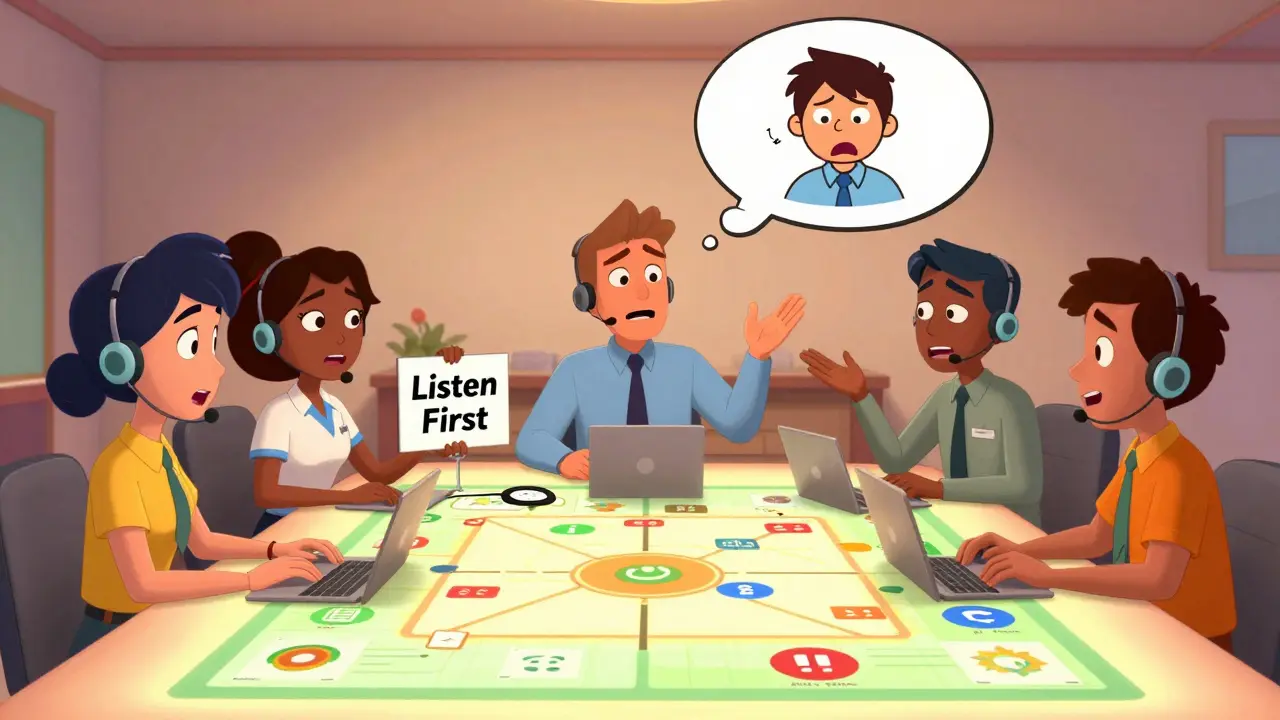
Training that feels like a lecture doesn’t stick. A 2024 study by the Customer Service Institute found that 73% of employees forget key service techniques within three weeks of generic training. Why? Because they weren’t practicing real situations. They weren’t role-playing angry customers, handling refund requests under pressure, or learning how to de-escalate a call while their manager watched.
Companies that treat training like compliance-something to get through before an audit-end up with agents who recite scripts but can’t think on their feet. Real customer service isn’t about memorizing responses. It’s about reading tone, adjusting language, and making people feel heard. That’s not something you teach with slides.
Start With the Real Problems Your Team Faces
Before you design a single slide, look at your support data. What are the top three complaints from customers? What do your top performers do differently? Talk to frontline staff. Ask them: "What’s the one thing you wish you had more help with?"
At a mid-sized SaaS company in Arizona, agents kept getting stuck on billing disputes. They didn’t know which system to pull data from, and they were afraid of making mistakes. The training team didn’t create a new module on payment policies. Instead, they built a 15-minute simulation: agents logged into a copy of the billing system, pulled real (but anonymized) tickets, and had to resolve a dispute in under five minutes. After two weeks, resolution time dropped by 41%.
Your training should solve actual pain points-not hypothetical ones. Don’t assume you know what agents need. Let the data and the people tell you.
Structure Your Course Around Scenarios, Not Topics
Don’t organize your course by "Communication Skills," "Product Knowledge," and "Policy Overview." That’s how you get bored, disengaged learners. Instead, build modules around real customer interactions.
Here’s how one retail chain redesigned their training:
- Scenario 1: The Angry Return - Customer demands a refund for a used item, no receipt. Agent must stay calm, check policy, offer alternatives.
- Scenario 2: The Confused New User - Customer can’t figure out how to set up their device. Agent must diagnose without tech jargon.
- Scenario 3: The Escalating Ticket - Customer has emailed five times. Agent must acknowledge frustration, close the loop, and follow up.
Each scenario includes a video of a real interaction (with permission), a breakdown of what went right or wrong, and a chance for learners to try their own version. They record themselves, get feedback from peers, and revise. This isn’t passive learning. It’s practice with consequences-just like the real job.
Use Real Tools, Not Simulated Ones
Training should happen inside the same systems agents use every day. If your team uses Zendesk, Salesforce, or Intercom, train them in those tools-not a fake demo version.
Why? Because switching between training systems and live systems creates mental friction. Agents forget steps. They click the wrong button. They panic when the real interface doesn’t match what they practiced.
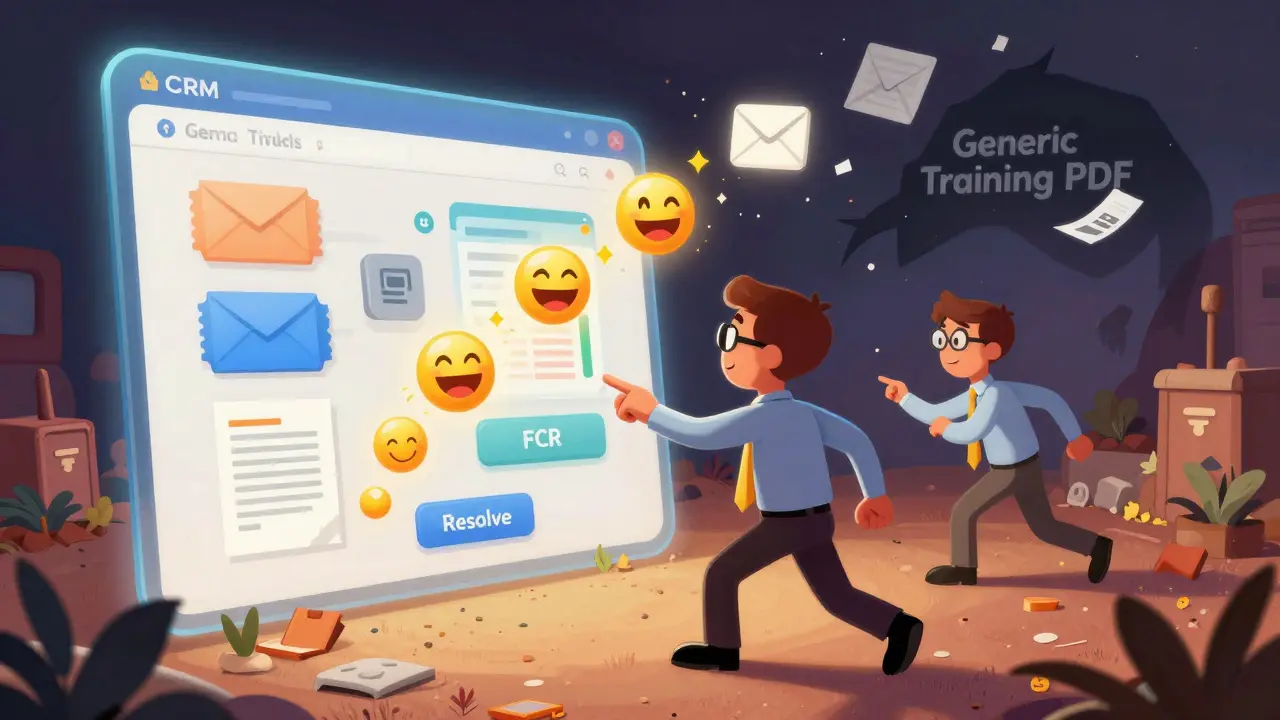
At a telecom provider in Texas, they built a sandbox environment inside their actual CRM. Trainees could open tickets, send emails, update statuses-all without affecting real customers. They could make mistakes, retry, and see the impact. After three months, first-call resolution rates jumped from 68% to 82%.
Include Peer Learning and Feedback
People learn more from each other than from managers. Set up weekly peer review sessions where agents watch each other’s training recordings and give one piece of praise and one suggestion.
Don’t make it a performance review. Make it a learning circle. Use a simple template:
- What did you notice that worked well?
- What’s one thing you’d try differently?
- What’s a phrase or technique you’d borrow?
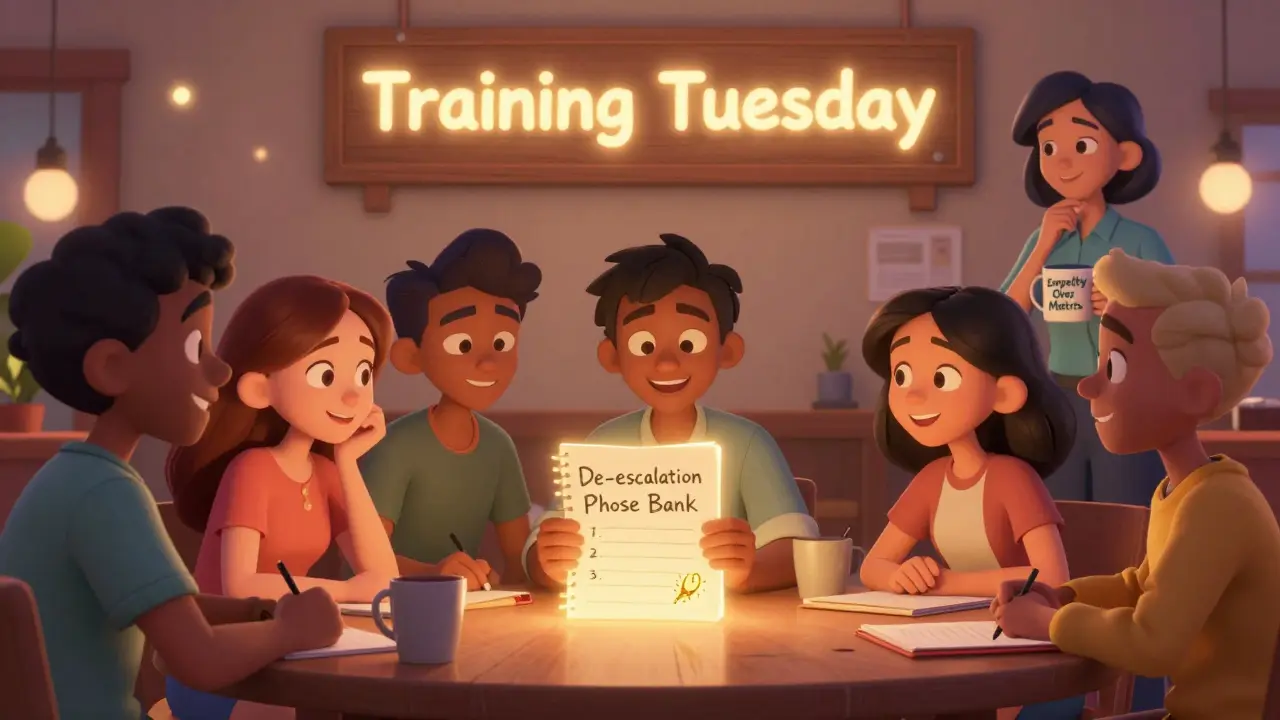
At a healthcare call center, these sessions became the most popular part of training. Agents started sharing their own scripts, recording quick tips, and even creating mini-playbooks. One agent started a "De-escalation Phrase Bank" that got adopted company-wide.
Measure What Matters
Don’t track completion rates. Don’t count how many hours people spent watching videos. Track outcomes.
Here are the three metrics that actually change customer behavior:
- First Contact Resolution (FCR) - Did the customer’s issue get solved in one interaction?
- Customer Effort Score (CES) - On a scale of 1 to 5, how easy was it for the customer to get help?
- Agent Confidence Score - After training, ask agents: "On a scale of 1 to 10, how confident are you handling tough situations?" Track the change.
These aren’t vanity metrics. They’re signals of real improvement. If FCR goes up and CES goes down, your training is working. If agent confidence stays flat, you’re still teaching theory, not skills.
Make It Continuous, Not a One-Time Event
Customer service changes fast. New products launch. Policies update. Customers get more demanding. Training can’t be a one-time event in Q1.
Build a rhythm:
- Monthly 30-minute micro-sessions on one tough scenario
- Quarterly peer feedback reviews
- Biannual refreshers based on new complaint trends
At a financial services firm, they started a "Training Tuesday"-a 20-minute live session where agents vote on the next scenario to practice. It’s not mandatory. But attendance is high because it’s short, relevant, and feels like peer support, not another lecture.
Design for Different Learning Styles
Not everyone learns the same way. Some people absorb information by doing. Others need to read. Some learn best by hearing.
Your course should offer multiple paths:
- Visual learners: Short video clips of real interactions, flowcharts of decision trees
- Hands-on learners: Simulations, role-playing, sandbox systems
- Auditory learners: Audio snippets of good and bad calls, guided reflection prompts
- Reading learners: One-page cheat sheets, quick-reference guides, scenario summaries
Don’t make people choose one format. Give them options. Let them learn how they learn best.
Leadership Has to Be Involved
Training fails when managers don’t reinforce it. If your team hears "Be empathetic" in training, but their manager yells at them for taking too long on a call, the training is meaningless.
Managers need to:
- Model the behavior they expect
- Recognize agents who handle tough cases well
- Use training scenarios in one-on-ones
- Ask: "What did you learn this week that helped you?" instead of "How many calls did you close?"
At a travel agency, managers started sharing one "Great Service Moment" from their team each Monday. It wasn’t about sales. It was about how someone turned a frustrated customer into a loyal one. That small ritual changed the culture.
What Happens When It Works
When training is designed well, you don’t just get better service. You get better employees. People stay longer. They feel valued. They speak up about problems. They become mentors.
One logistics company saw turnover drop by 30% after overhauling their training. Why? Because agents finally felt equipped. They weren’t just following rules-they were solving problems. And that made all the difference.
Customer service training isn’t about making agents sound polite. It’s about giving them the tools, confidence, and support to do their best work. That’s what turns good service into great service-and employees into advocates.
How long should a customer service training course be?
There’s no magic number. A full course should be broken into 15- to 30-minute chunks spread over several weeks. Most people can’t absorb more than 20 minutes of active learning at a time. Focus on depth over duration. One well-designed scenario that’s practiced three times is worth three hours of lecture.
Should we train new hires and experienced staff the same way?
No. New hires need foundational skills-how to use the system, basic de-escalation, company policies. Experienced staff need advanced scenarios: handling VIP complaints, navigating policy exceptions, mentoring others. Tailor your content by experience level. One-size-fits-all training wastes time and frustrates skilled agents.
Can we use AI to help design customer service training?
Yes-but not to replace human insight. AI can analyze thousands of customer calls to find the most common complaints, identify patterns in agent responses, and even suggest scenarios based on real data. But only humans can decide which situations matter most, how to frame feedback, and how to build empathy into the training. Use AI as a research tool, not a curriculum designer.
How do we get buy-in from leadership for better training?
Show them the cost of bad service. How many customers left last quarter because of poor support? What’s the average ticket resolution time? What’s the employee turnover rate in the service team? Tie training improvements to those numbers. For example: "If we improve FCR by 10%, we could save $120,000 in repeat calls and lost customers over the next year." Data speaks louder than opinions.
What’s the biggest mistake companies make when designing training?
They design it for the trainer, not the learner. They create long presentations because it’s easy to make. They use corporate jargon because it sounds professional. They skip practice because it’s "too time-consuming." The real mistake is thinking training is about delivering information. It’s about building ability. If your agents can’t do it after training, you didn’t design it right.
Designing customer service training isn’t about creating the fanciest slides or the longest videos. It’s about asking the right questions: What are our agents struggling with? What do customers really want? How can we give people the chance to practice, fail, and improve-without risking real customers? When you answer those, you stop training people. You start empowering them.
Vishal Gaur
January 14, 2026 AT 16:05man i used to do customer service training at my old job and it was always just a pdf with bullet points and a quiz at the end. nobody cared. i mean, who even reads those? i remember one guy fell asleep during the video and started snoring. the trainer just paused it and said "we’ll resume after break" like it was normal. we had a 90% forget rate within two weeks. honestly, this post is the first thing that made me think maybe there’s a better way. i’m gonna suggest this to my manager next week, if i can get past the HR portal.
Nikhil Gavhane
January 15, 2026 AT 07:29This is exactly what we’ve been missing. I’ve seen too many teams trained on scripts but frozen when a customer says something unexpected. The scenario-based approach you described? That’s not training. That’s preparation. And the sandbox CRM idea? Brilliant. We’re using Zendesk too. I’m printing this out and putting it on the manager’s desk tomorrow.
Rajat Patil
January 15, 2026 AT 23:51I appreciate the thoughtful structure of this article. It is clear that the focus is on practical application rather than theoretical knowledge. Many organizations overlook the importance of real-world simulation in skill development. It is recommended that training be aligned with actual job demands, and that feedback be provided in a supportive environment. Such practices contribute to long-term retention and improved employee morale.
deepak srinivasa
January 16, 2026 AT 16:01Interesting. But how do you measure "agent confidence score"? Is it a survey? Do agents just guess? What if they’re overconfident and mess up? Or underconfident and don’t try? And how do you avoid bias when they’re self-reporting? Also, what about time zones? We have agents in three countries. Do they all do training at the same time? How do you handle that?
pk Pk
January 17, 2026 AT 14:39This is the kind of stuff that changes lives. Not just customer service-agent lives. I’ve seen agents quit because they felt useless. Not because they were bad. Because they were never given the tools to be good. The peer feedback idea? That’s gold. Let people learn from each other. Let them feel like they’re part of something. I’ve started doing this in my team. We call it "Win & Grow". One praise, one tweak. No judgment. Just growth. And guess what? People show up now.
NIKHIL TRIPATHI
January 18, 2026 AT 02:28Agreed on the scenario thing. We tried doing it once with roleplay and it was awkward as hell because no one knew how to act. Then we started using real call recordings (anonymized, of course) and it clicked. People actually laughed at the bad ones and said "oh wow, I did that once". That’s when learning happened. Also, the "Training Tuesday" idea? We’re stealing that. We’re calling it "Trouble Tuesday" now. People love it.
Vishal Bharadwaj
January 18, 2026 AT 11:37Yeah right. Another fluffy article from someone who’s never actually handled 80 calls a day. You talk about "real simulations" but what about the 60% of cases that are just people yelling because their package is late? No script helps there. And your "confidence score"? Most agents are just faking it to get through the survey. And who’s paying for all this sandbox CRM setup? Your company’s got unlimited budget? I’ve seen this before. It’s all theory until you’re drowning in tickets and your boss says "just fix it". This post is just corporate noise.
anoushka singh
January 19, 2026 AT 20:43Wait, so you’re saying we should let agents record themselves? What if they’re ugly on camera? Or have bad breath? Or wear pajamas? I mean, come on. This sounds like a nightmare. What if someone uploads a video and it goes viral? "Look at this agent screaming at a customer in pajamas"? We’d get sued. Also, why are we spending so much time on this when we could just hire more people?
Jitendra Singh
January 21, 2026 AT 05:25I like the idea of peer feedback. Quietly, I’ve been doing something similar with my team-just sharing one tip each morning in our Slack channel. Not formal. Just "Hey, I used this phrase yesterday and it worked: 'I hear you, and I’m going to make this right.'" No one said anything. But now people are starting to use it. Small things matter. This post just reminded me to keep doing it.
Madhuri Pujari
January 22, 2026 AT 22:04Oh. My. GOD. You actually think a "De-escalation Phrase Bank" is going to fix systemic underfunding, understaffing, and leadership that doesn’t care? You’re not training people-you’re putting lipstick on a pig. And who approved the "confidence score"? Did you ask the agents if they want to be emotionally evaluated? Did you get consent? This isn’t training. It’s emotional labor disguised as innovation. And you wonder why turnover is high?
Sandeepan Gupta
January 24, 2026 AT 10:09Just a quick grammar note: in the "Structure Your Course Around Scenarios" section, you wrote "they record themselves, get feedback from peers, and revise"-should be "they record themselves, receive feedback from peers, and revise". "Get" is too casual here. Also, "one piece of praise and one suggestion" is great-but maybe add "specific"? Like, "one specific thing that worked"? Helps avoid vague feedback. Otherwise, this is spot-on. I’ve used the sandbox CRM idea for 3 years. It’s the only thing that works.
Tarun nahata
January 25, 2026 AT 16:07THIS. THIS IS THE FIRE. I’ve been screaming this from the rooftops for years. Training isn’t a PowerPoint. It’s a dojo. You don’t learn karate by watching a video-you punch bags, you mess up, you get corrected, you try again. And when your agent finally nails that angry customer call after three tries? That’s not training. That’s transformation. We’ve got a wall in our office now with sticky notes from agents: "I used this phrase and they thanked me." That’s the trophy. Not a completion certificate. Keep going. You’re not just writing a guide-you’re starting a revolution.