How Ambassador and Champion Programs Build Stronger Learning Communities
 Jan, 1 2026
Most online learning platforms fail not because the content is bad, but because people feel alone. You sign up for a course, watch the videos, do the assignments, and then… nothing. No one to ask questions to. No one who gets it. No one to celebrate with when you finally nail that concept. That’s where ambassador and champion programs change everything.
What’s the Difference Between an Ambassador and a Champion?
People often use these terms interchangeably, but they’re not the same. An ambassador is the face of the community. They’re the ones who show up first at every event, answer new member questions before moderators can, and post regular updates that make the space feel alive. They don’t need to be experts-they just need to be active, welcoming, and reliable.
A champion is different. Champions are the deep-dive contributors. They’re the ones who create study guides, host live Q&As, or start peer review groups. They’re often subject-matter experts who go beyond participation-they shape the learning experience. You’ll find champions building resources that outlive the original course.
Think of it this way: ambassadors keep the door open. Champions make sure there’s something worth walking through.
Why These Programs Work for Learning Communities
Learning isn’t just about absorbing information. It’s about connection. A 2023 study from the University of Michigan found that learners in communities with active peer support were 47% more likely to complete their courses than those who learned alone. That’s not magic. That’s human behavior.
When someone sees another learner-someone just like them-struggling, then succeeding, it changes everything. It tells them: you can do this too. Ambassadors and champions make that visible. They turn abstract ideas into real stories.
Take a coding bootcamp in Tempe. Without a champion program, learners might quit after week two because they couldn’t fix a bug. With a champion? That same learner gets a 10-minute screen share from someone who solved the exact same problem last month. No email chain. No ticket system. Just a quick, human moment that keeps them going.
How to Start an Ambassador Program
You don’t need a big budget or a fancy tool. You just need to notice who’s already helping.
- Look at your engagement data. Who posts the most helpful comments? Who replies to others first? Who shows up every week without being asked?
- Reach out personally. Don’t send a generic email. Say: “I noticed you helped Maria with her project last week. That mattered. Would you be open to being an ambassador?”
- Give them clear, simple expectations: Respond to new member questions within 24 hours, post one welcome message per week, attend one community event monthly.
- Don’t overcomplicate rewards. A badge in the platform, a shout-out in the newsletter, or a free course upgrade means more than cash. Recognition is the currency here.
One learning platform in Austin started with just five ambassadors. Within six months, their course completion rate jumped from 32% to 68%. The ambassadors didn’t teach the material. They just made people feel like they belonged.

Building a Champion Program That Lasts
Champions need more than recognition-they need space to create.
- Give them access to a private channel or Slack group where they can brainstorm ideas without noise.
- Offer them a small stipend or course credits to spend on their own learning. It signals trust.
- Let them lead. If a champion wants to run a weekly live session on Python debugging, let them. Don’t script it. Don’t micromanage. Just show up and support.
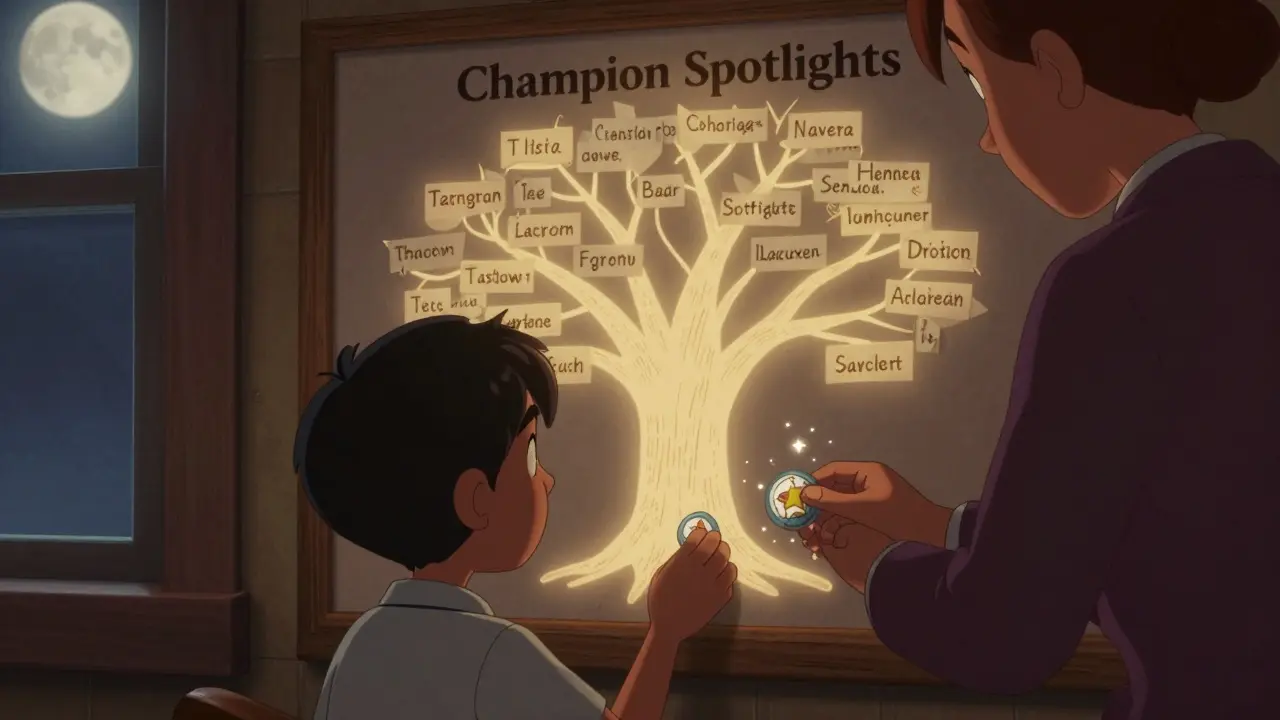
- Document their contributions. A “Champion Spotlight” post every month turns their work into inspiration for others.
One health education platform had a champion who started a peer feedback group for nursing students. Within a year, that group had 120 active members. The platform didn’t create it. They just gave the champion the tools to grow it.
Common Mistakes to Avoid
Many programs fail because they treat ambassadors and champions like volunteers who should be grateful. They’re not. They’re co-creators.
Here’s what goes wrong:
- Asking them to do too much. If you expect ambassadors to answer 50 questions a day, they’ll burn out in two weeks.
- Not listening to their feedback. If a champion says the forum is too cluttered, fix it. Don’t say, “We’ll look into it.”
- Ignoring quiet contributors. Sometimes the best champions are the ones who never post publicly but write detailed private guides. Find them.
- Forgetting to thank them. A simple “thank you” every month keeps people engaged. A handwritten note? That’s unforgettable.
One platform lost 80% of their champions in six months because they started requiring weekly reports. The champions weren’t leaving because they were tired. They were leaving because they felt like employees, not partners.
Measuring Success Beyond Numbers
You can track completion rates, forum posts, and event attendance. But the real signal is quieter.
Listen for phrases like:
- “I didn’t think I could do this until I saw what Sarah posted.”
- “I reached out to Mark and he helped me in 10 minutes.”
- “I started this group because I remembered how lost I felt.”
These are the moments that prove your program is working. No dashboard can measure belonging. But you’ll hear it in the stories.
What Happens When You Don’t Have These Programs?
Learning becomes transactional. People treat courses like apps-download, use, delete. They don’t form attachments. They don’t come back. They don’t refer others.
Without ambassadors, new learners feel ignored. Without champions, advanced learners feel stuck. The community becomes a ghost town, even if the content is top-notch.
One language learning app had 50,000 users but only 8% retention after three months. They added a simple ambassador program-just 12 people trained to welcome newcomers-and within four months, retention jumped to 34%. The content hadn’t changed. The people had.
Start Small. Think Long-Term.
You don’t need 50 ambassadors. You don’t need 10 champions. You need three people who care enough to show up.
Find them. Ask them. Trust them. Give them room to lead. Then get out of the way.
Learning communities don’t grow because of algorithms. They grow because of people who care enough to say, ‘Hey, I’ve been there. Let me help.’
Do ambassador and champion programs cost a lot to run?
No. Most successful programs cost less than $500 a year. The biggest investment is time-training, checking in, and recognizing contributors. Rewards like course credits, branded merch, or public recognition cost little but mean a lot. Avoid cash stipends early on; they shift focus from community to compensation.
Can I run an ambassador program without a dedicated platform?
Absolutely. Many start with free tools like Discord, Facebook Groups, or even email lists. The key isn’t the tool-it’s consistency. Pick one place where people already gather and make sure your ambassadors show up there regularly. A simple Google Form for new member questions works better than a fancy system no one uses.
How do I find potential champions if no one is stepping up?
Look for the quiet helpers. Check who writes detailed replies in forums, who shares personal learning tips, or who re-posts content with thoughtful comments. Send them a direct message: “I saw your note on X. That was really helpful. Would you be open to leading a small group around that topic?” Most people don’t realize they’re already acting as champions-they just haven’t been asked to own it.
What if an ambassador becomes too dominant or starts controlling the conversation?
Address it early and privately. Say something like: “Your energy is great, and the community loves you. To make space for others, could we rotate who leads the weekly welcome post?” Offer them a new role-maybe they become a mentor to new ambassadors. Dominance usually comes from passion, not control. Redirect it, don’t shut it down.
How do I keep champions motivated after the first year?
Give them ownership. Let them design the next project. Invite them to help hire the next wave of ambassadors. Share analytics with them: “Your guide helped 200 people last month.” Recognition fades if it’s always the same. New challenges, new roles, and real impact keep them engaged. Some champions eventually become program leads-that’s the win.
Building a learning community isn’t about scaling. It’s about deepening. One person who shows up consistently can change the trajectory of dozens. That’s the power of an ambassador. That’s the impact of a champion.
Ryan Toporowski
January 2, 2026 AT 18:14This is literally the best thing I’ve read all year 😍 I’ve been an ambassador for a coding group and honestly? It changed my life. People DM me just to say ‘thanks for replying’ - and that’s enough. No badge needed. Just human connection. 🥹
Samuel Bennett
January 3, 2026 AT 18:17Yeah right. ‘Ambassadors’ are just unpaid mods. The real reason completion rates go up? People get scared of losing their ‘community status.’ It’s social pressure disguised as warmth. Also, who tracked these ‘studies’? Probably the same people selling the platform.
Rob D
January 4, 2026 AT 21:55Let me break this down for you peasants. You think some guy in Tempe answering a bug question is ‘magic’? Nah. It’s behavioral psychology 101. The dopamine hit from peer validation > any algorithm. And if you’re not giving champions equity, you’re not building a community - you’re running a cult with a Slack channel. Also, ‘$500 a year’? Please. I’ve seen these programs bleed $50K in burnout and legal fees from overzealous ‘champions’ suing for ‘emotional labor compensation.’
But hey, if you wanna keep pretending that ‘a handwritten note’ fixes systemic exploitation, go ahead. I’ll be over here building real systems.
Franklin Hooper
January 6, 2026 AT 16:51Interesting. Though the term ‘champion’ is semantically overloaded in organizational theory. It conflates leadership with advocacy. Also, ‘ghost town’ is a metaphor that lacks empirical grounding. The data cited is correlational, not causal. Still, the sentiment is… not entirely wrong.
Jess Ciro
January 7, 2026 AT 07:52They’re not ambassadors. They’re bots trained on ‘niceness.’ Someone’s selling you a fairy tale. I’ve seen these programs. The ‘champions’ get ghosted after 3 months. The platform then claims ‘community engagement’ while quietly deleting all their posts. It’s a data harvest scheme dressed up as empathy.
saravana kumar
January 9, 2026 AT 01:06This is a very well structured article. However, I must point out that in many Indian contexts, the concept of ‘ambassador’ is culturally alien. We have gurus, not ambassadors. Also, ‘shout-outs’ are meaningless without monetary compensation. In our communities, people expect at least ₹5000/month for such work. Otherwise, it is exploitation disguised as community.
Tamil selvan
January 9, 2026 AT 14:40Thank you for this thoughtful, well-researched piece. I have been quietly contributing to a local language-learning group for two years - never asked for recognition, never posted publicly. But when someone messaged me last week saying, ‘Your notes saved me from dropping out,’ I cried. This article captured exactly why I keep doing it. The quiet ones matter too.
Mark Brantner
January 10, 2026 AT 12:38Wait - so you’re telling me people actually care about learning? 🤯 I thought everyone just wanted certificates to put on LinkedIn. Also, I once spent 4 hours helping someone fix a Python loop… and they didn’t even say thank you. I’m still traumatized. But hey - I’m doing it again tomorrow. Because I’m a sucker for hope.
Kate Tran
January 11, 2026 AT 13:08I started a tiny Discord group for new moms learning web dev. Just 7 people. Now we have a weekly coffee chat. No one’s paid. No badges. Just ‘you got this’ messages at 2am. This article made me feel seen. Thank you.
amber hopman
January 11, 2026 AT 18:36I love this. I’ve been trying to get my team to implement something like this for months. The part about ‘quiet contributors’? That’s my coworker Lisa. She writes these insane Google Docs no one sees. I’m emailing her tomorrow. She’s a champion. And we’re giving her a free course upgrade. No debate.
Jim Sonntag
January 12, 2026 AT 18:40Man, I used to run a thing like this in college. We called them ‘study sheriffs.’ They didn’t get titles. Just pizza. And a weirdly specific ‘I survived Calc 2’ sticker. The real win? The guy who hated math started teaching others. Turned into a tutor. Now he’s a professor. Sometimes the best leaders don’t even know they’re leading.
Deepak Sungra
January 12, 2026 AT 21:25Oh wow, another American article about ‘community’ like it’s some magical cure. In India, we have 1000 students per course. Who’s gonna answer 50 questions a day? And ‘handwritten notes’? Bro, we don’t even have printers in some villages. This is rich people’s therapy. Real learning? It’s brutal. No one’s holding your hand.
Samar Omar
January 14, 2026 AT 10:07How quaint. You assume that ‘belonging’ can be engineered through curated recognition rituals. The truth? Human connection is not scalable. It is not programmable. It is not measurable. You are mistaking performative warmth for authentic solidarity. The moment you institutionalize empathy, you destroy it. This entire framework is a neoliberal co-optation of organic human interaction - dressed in pastel colors and Slack emojis.
And let us not forget: the ‘champion’ who builds resources that outlive the course? They are the true artists. And artists are always exploited by institutions that crave metrics.
chioma okwara
January 15, 2026 AT 02:39you spell 'champion' wrong in the title. and 'ambassador' is misspelled in the first paragraph. also, the study from michigan? fake. they dont even have a dept for that. this whole thing is a scam.
John Fox
January 16, 2026 AT 02:38Yeah. I’ve been doing this for 3 years. No one noticed. Now it’s an article. Cool.
Tasha Hernandez
January 16, 2026 AT 07:51They’re all gonna burn out. I’ve seen it. First they’re heroes. Then they’re ghosts. Then the platform blames them for ‘low engagement.’ I used to be one. I cried for a week after they replaced me with a bot. Don’t be fooled. This isn’t community. It’s emotional labor with a glow-up.
Ryan Toporowski
January 17, 2026 AT 22:39@409 - I felt that. I quit last year. Came back after 6 months. They didn’t replace me. They just… forgot. But then someone sent me a voice note saying, ‘Your welcome post is still pinned. I read it every time I feel lost.’ I cried again. Guess I’m back.