How to Build Global Learning Communities Across Time Zones
 Feb, 20 2026
Building a global learning community isn’t just about putting people on a Zoom call at 3 a.m. It’s about designing a system where someone in Nairobi can learn alongside someone in Tokyo, and neither has to sacrifice sleep, work, or sanity. The real challenge isn’t technology-it’s time. When your learners span 12 time zones, synchronous meetings become a logistical nightmare. But that doesn’t mean learning has to suffer. In fact, when done right, global communities can be more dynamic, diverse, and resilient than any single-location classroom.
Start with Asynchronous First
Most teams jump into live sessions because they think real learning happens in real time. That’s a myth. The most effective global learning communities are built on asynchronous foundations. That means content, discussions, and feedback happen on a schedule that works for everyone, not just the ones in the same time zone as the instructor.Here’s how to make it work: Record all lectures as short videos-no longer than 12 minutes. Use tools like Loom or Vimeo to host them. Add transcripts and captions. Don’t just upload a 45-minute lecture and call it a day. Break it into chunks. Each video should answer one clear question: How do I set up my API key? Why does this theory work in emerging markets?
Then, create discussion prompts tied to each video. Instead of asking, “What did you think?” ask, “How would you apply this in your workplace?” That invites real stories. A learner in Jakarta might share how they adapted a strategy for rural health workers. Someone in Mexico City might explain how budget limits changed their approach. These aren’t just answers-they’re case studies that become part of the curriculum.
Design a Rolling Calendar
Forget Monday at 2 p.m. Eastern. That’s meaningless to someone in Mumbai or Santiago. Instead, build a rolling calendar. Assign weekly tasks with a 72-hour window to complete them. For example:- Monday 12 a.m. UTC: New video released
- Wednesday 11:59 p.m. UTC: Discussion post due
- Friday 11:59 p.m. UTC: Peer feedback due
This gives everyone at least two full days to engage, no matter where they are. Someone in Sydney can watch the video Monday night, post their thoughts Tuesday morning, and reply to peers Wednesday afternoon. Someone in Toronto can do the same, just 12 hours later. The rhythm becomes predictable, not chaotic.
Use a shared calendar (Google or Notion) that shows deadlines in each major time zone. Label them clearly: “Due in EST, CET, JST.” This removes confusion. People stop asking, “When is this due again?” because they can see it in their own time.
Use Time-Zone-Aware Tools
Not all platforms handle global collaboration well. Slack? Great for real-time chat, terrible for delayed responses. Discord? Same issue. You need tools built for delayed interaction.Try these:
- Padlet for visual group boards-people add ideas, images, links whenever they can.
- Flip for video replies. Instead of typing, learners record 60-second responses. It feels personal, and it’s easy to consume on mobile.
- Notion for structured learning paths. Each module has a template: Video → Notes → Discussion → Reflection.
- Circle.so or Mighty Networks if you want a branded community space with built-in scheduling and reminders.
These tools don’t require everyone to be online at once. They let people contribute when they’re ready. And they create a permanent record of learning-something live Zoom calls never do.
Rotate Live Sessions, Don’t Require Them
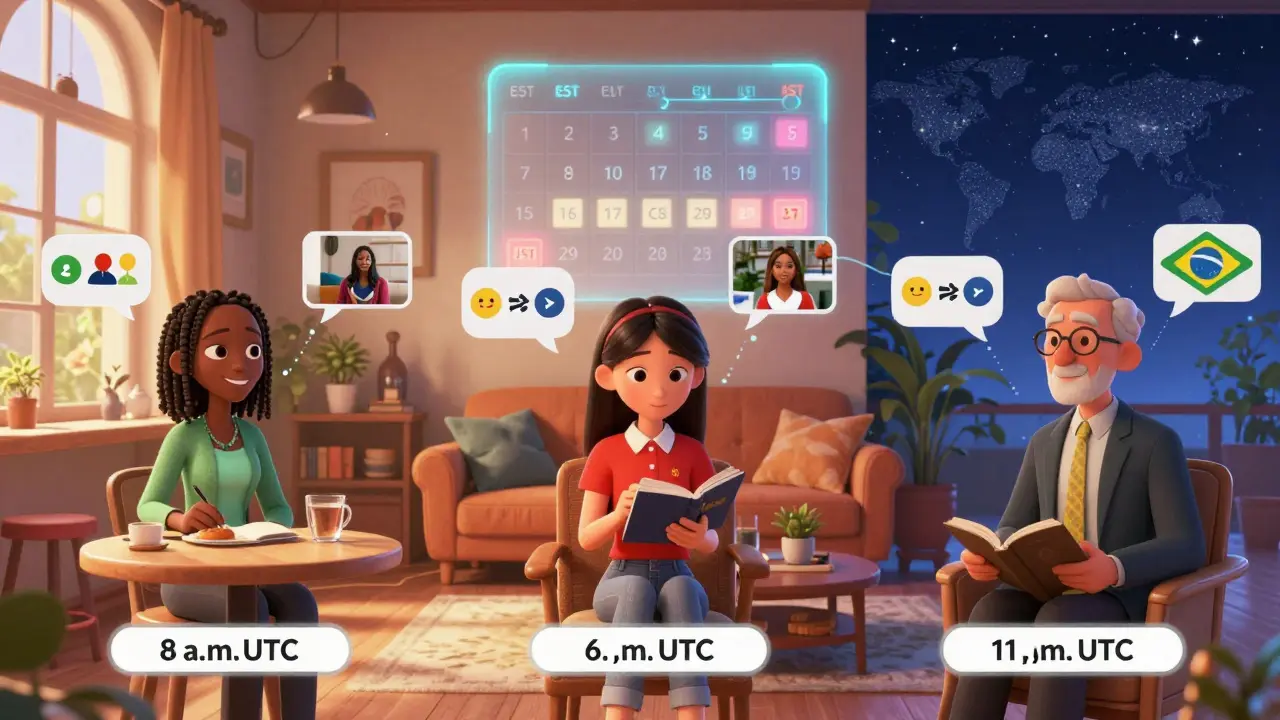
Live sessions still have value-but only if they’re optional and rotated. Don’t lock people into one time slot. Instead, host three live Q&A sessions per month:- One at 8 a.m. UTC (good for Europe and West Africa)
- One at 6 p.m. UTC (good for North and South America)
- One at 11 p.m. UTC (good for Asia and Australia)
Record every session. Add timestamps for key questions. Share the recording with everyone. Then, let people submit questions ahead of time via a form. This way, even if someone can’t make the live call, their question gets answered.
And here’s the trick: Assign a different facilitator for each session. Someone from Kenya. Someone from Vietnam. Someone from Brazil. It signals that leadership isn’t centered in one region. It also gives learners a chance to hear different communication styles, accents, and perspectives-something no textbook can teach.
Create Peer-Led Learning Pods
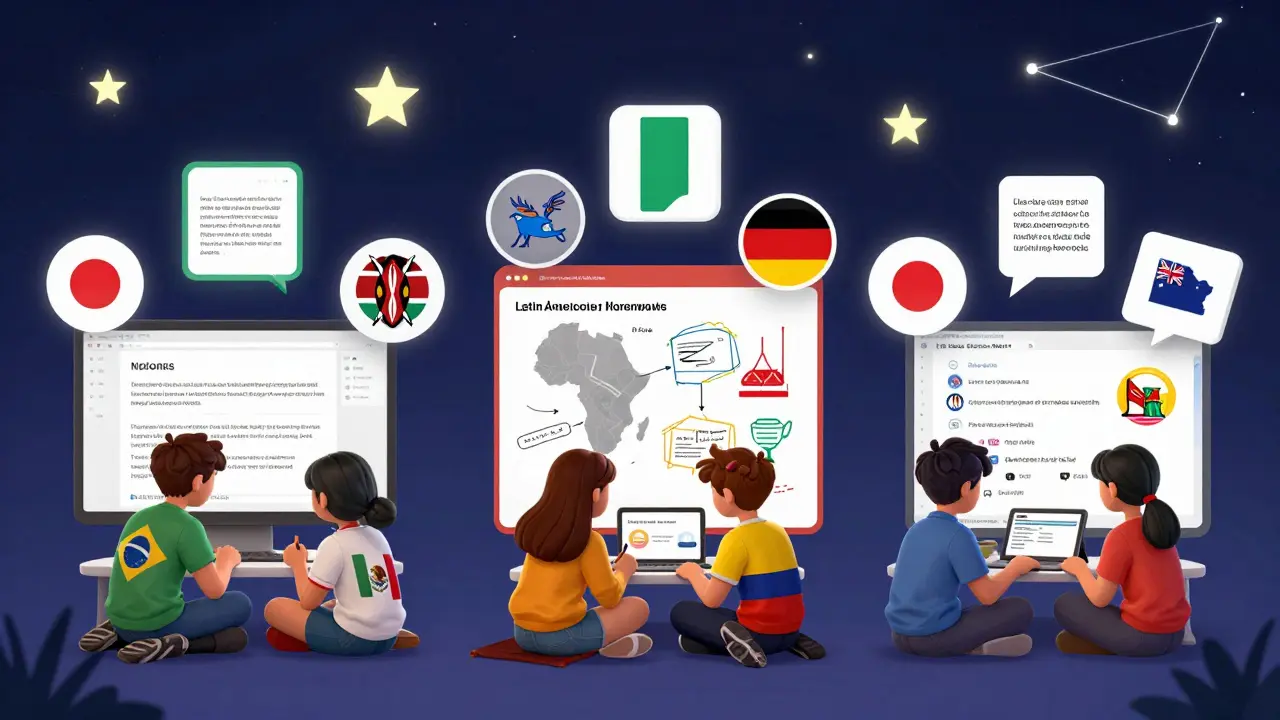
The most powerful learning happens between peers. So, organize small groups of 4-6 people based on overlapping time zones. Not random. Not by language. By availability.For example:
- Pod 1: Brazil, Mexico, Colombia (all UTC-3 to UTC-5)
- Pod 2: Germany, Kenya, South Africa (UTC+1 to UTC+2)
- Pod 3: Japan, Philippines, Australia (UTC+9 to UTC+10)
Each pod gets a shared Notion page. Their job: meet once a week for 45 minutes. No instructor. Just them. They review each other’s work, troubleshoot problems, and share local insights. One pod might discover that their local tax laws make a certain business model impossible. Another might learn how a rural school in Nepal uses the same tool for free.
These pods become micro-communities within the larger one. They build trust. They solve problems faster. And they reduce the pressure on the central team to be everywhere at once.
Measure What Matters
Don’t track attendance. Don’t count logins. Don’t care if someone watched the video at 2 a.m. What you care about is this:- How many people posted a meaningful response?
- How many replies did their posts get?
- Did someone use a concept from another country in their own project?
- Did a peer’s feedback change their approach?
Use simple metrics: response rate, comment depth, cross-regional references. A learner from India referencing a case study from Nigeria? That’s success. A learner from Canada who redesigned their workflow after reading a post from Indonesia? That’s impact.
Survey learners every 6 weeks. Ask: “Did you learn something from someone in a different time zone?” 87% of global learners say yes-when the system is designed right.
Why This Works
Traditional online courses treat time zones as a bug. They try to fix them with recordings and time-zone converters. But that’s like trying to fix a leaky roof by putting a bucket under it. The real solution is to change the roof’s design.Global learning communities thrive when they’re built for asynchronicity, not just accessibility. When people can learn on their own rhythm, when they’re not forced to choose between sleep and education, when their culture and context are seen as assets-not obstacles-that’s when real learning happens.
It’s not about being global. It’s about being human.
What if my learners can’t afford premium tools?
You don’t need expensive software. Free tools like Google Docs, Padlet, Flip, and Notion’s free plan work perfectly. The key is structure, not cost. Use a shared Google Calendar for deadlines, a Google Form for questions, and a simple folder system for videos. Many successful global communities run on nothing but free tools and clear rules.
How do I handle language barriers?
Encourage English as the common language, but don’t punish non-native speakers. Use simple vocabulary. Avoid idioms. Offer auto-translations in tools like Flip and Notion. Celebrate when someone shares a concept in their native language-then invite others to translate it. Language diversity becomes a teaching tool, not a barrier.
Should I hire moderators from different regions?
Yes. Not to manage people, but to represent them. A moderator from Lagos can help you understand why a deadline on a Friday doesn’t work for many Muslim learners. A moderator from Manila can tell you why video uploads fail on slow networks. These aren’t HR roles-they’re cultural bridges. Even one part-time moderator per major region makes a huge difference.
What if learners drop out because they’re too busy?
Dropouts happen. But they’re often caused by rigid schedules, not lack of interest. If you design for flexibility-no live-only requirements, no penalties for late submissions, no pressure to be “active every day”-you’ll keep 60-70% more learners. Let them come back. A learner who takes a month off might return with a breakthrough idea.
Can this work for corporate training?
Absolutely. Companies like Unilever and Siemens use this model for global onboarding. They replace 4-hour mandatory Zoom trainings with 10-minute video modules and peer review. Managers report higher retention, better application of skills, and fewer complaints about time zones. The key? Make it optional, not mandatory. Trust people to learn when they can.
Nikhil Gavhane
February 20, 2026 AT 14:18Finally, someone gets it. Learning shouldn't be about forcing people to choose between their sleep and their growth. When I was working with a team across India, Kenya, and Canada, we tried live sessions every week. Half the team was asleep. The other half was burnt out. Then we switched to asynchronous videos and peer pods. Everything changed. People started sharing stories from their villages, their markets, their kitchens. That’s where real learning happens-not in a Zoom room at 3 a.m.
Veera Mavalwala
February 20, 2026 AT 16:37Oh honey, you’re preaching to the choir-but let me tell you what no one else will: the real magic isn’t in the tools, it’s in the silence. The quiet spaces between posts. The 14 hours someone in Lagos spends stewing over a single video, then writes a reply so layered it could be a thesis. That’s not engagement-that’s alchemy. And yes, I’ve seen it. I’ve watched a woman in rural Bihar redesign an entire supply chain model after reading a post from a guy in Oaxaca who had never heard of her country. That’s not education. That’s evolution. And it only happens when you stop screaming at people to ‘participate’ and start trusting them to show up when they’re ready.
Shivam Mogha
February 21, 2026 AT 13:56Simple. Works.
Bhagyashri Zokarkar
February 22, 2026 AT 00:09i just want to say that i cried when i read this. not because im emotional, but because after 3 years of trying to run global training for my org, i finally feel seen. we were using teams and zoom and everyone hated it. now we use flip and notting and the vibe is… different. like people actually want to show up. not because they have to. but because they want to. and last week, a guy from jakarta sent a voice note in bahasa and someone from brazil translated it and now we have a new phrase in our lexicon: ‘jalan kaki panjang’-long walk, slow progress. its beautiful. thank you
sampa Karjee
February 23, 2026 AT 18:21As someone who actually runs a global cohort, I find it amusing how Westerners think they’ve discovered ‘asynchronous learning.’ We’ve been doing this since the 90s in India-email threads, shared Google Docs, handwritten notes scanned and uploaded. You didn’t invent anything. You just rebranded it with Notion and Loom. Also, ‘peer-led pods’? We call them ‘study groups.’ And no, we don’t need a branded platform to do it. We use WhatsApp. And it works better than your ‘Circle.so’ nonsense.
Ray Htoo
February 24, 2026 AT 14:00Love this. I’ve been trying to get my team to stop treating global learning like a scheduling puzzle. It’s not about fitting people into slots-it’s about creating space where their voices naturally rise. I tried a ‘live Q&A’ last month at 9 p.m. UTC. Only three people showed up. One was from Nigeria. One from Japan. One was me. But the next day, 47 people left video replies. One guy in Lima recorded himself explaining how he used our framework to convince his entire village to start a composting collective. That’s the kind of impact you can’t schedule. You just have to trust the rhythm.
Vishal Gaur
February 25, 2026 AT 04:09ok so i read this whole thing and honestly i think its kinda bs? like sure you can do all this async stuff but what about people who just dont care? like my cousin in delhi he’s got 3 jobs and a baby and he opens the app once a month and then says ‘i’ll do it later.’ and later never comes. you can’t force people to be ‘engaged’ if they’re just trying to survive. maybe we need to stop romanticizing global learning and just accept that some people will drop out. and that’s fine. not everyone needs to be a ‘community.’ some just need a damn certificate.
Natasha Madison
February 25, 2026 AT 23:56Let me get this straight-you’re advocating for a system where people from ‘emerging markets’ get to ‘share their stories’ while Western instructors sit back and ‘facilitate’? This isn’t learning. This is performative diversity. Who’s funding this? Who’s moderating? Who’s verifying these ‘case studies’ from Jakarta and Nairobi? And why are we pretending that a 60-second Flip video from someone with a phone and a WiFi hotspot is equivalent to structured academic rigor? This feels like digital colonialism with a nice UI.
Sheila Alston
February 27, 2026 AT 22:11It’s so frustrating how people treat global learning like it’s some kind of feel-good project. We’re not here to ‘celebrate diversity.’ We’re here to build competence. And if someone in Mumbai can’t keep up with the pace because they’re ‘sleeping through time zones,’ then maybe they shouldn’t be in the program. I’ve seen too many learners use ‘time zone flexibility’ as an excuse to slack off. There’s a difference between accessibility and lowering standards. This post blurs that line dangerously.
Patrick Sieber
February 28, 2026 AT 22:21Just want to say the rolling calendar idea is genius. I implemented it for a team of 80 across 11 time zones. We used a shared Notion calendar with color-coded zones. Within two weeks, questions like ‘when is this due?’ dropped by 90%. People started planning their weeks around it. One guy in Manila told me he now schedules his laundry around the Friday feedback deadline. That’s not just learning-that’s culture change.
Kieran Danagher
March 1, 2026 AT 12:33Oh wow. Another blog post telling us how to ‘design for humans’ while ignoring that humans have rent, kids, and bad WiFi. You mention Padlet and Flip like they’re magic wands. Have you tried uploading a 100MB video to a 3G network in rural Odisha? Or asking someone to record a 60-second reply when their phone dies at 12%? This reads like a Silicon Valley fantasy. Real global learning doesn’t need a branded platform. It needs stable power, cheap data, and zero guilt trips.
OONAGH Ffrench
March 2, 2026 AT 21:44Time zones are not obstacles they are rhythms. The idea that learning must be synchronized is a relic of industrial timekeeping. What we are witnessing is a return to organic patterns of knowledge exchange. People learn when they are ready. Not when a calendar says so. The structure you describe allows for this. It is not a workaround. It is a correction. And it is beautiful.
poonam upadhyay
March 4, 2026 AT 08:07Okay so let me break this down because I’ve been watching this for 3 years and I’m tired of the performative ‘global community’ nonsense. You say ‘no live sessions’ but then you have THREE live Q&As? That’s not optional-that’s coercion. And ‘peer pods’? Who picks them? Who monitors them? What if someone in Pod 2 is a toxic manager from Germany and the Kenyan guy just wants to learn? You think this is empowering? It’s just another layer of surveillance with better branding. Also-why is every example from ‘emerging markets’ some magical ‘rural health worker’ story? Real people don’t live in case studies. They live in 10x10 rooms with no AC and 4 kids yelling. Stop romanticizing poverty.
Rakesh Dorwal
March 4, 2026 AT 16:07Look I’m from India and I’ve seen this before. First they say ‘no Zoom calls’ then they say ‘but you need to use Flip’ then they say ‘oh but Flip doesn’t work on low-end phones’ then they say ‘just use WhatsApp.’ So why not just use WhatsApp from the start? Why do we need 5 tools and 3 podcasts and a Notion template? We don’t. We need one thing: a group chat. That’s it. No apps. No platforms. No ‘community.’ Just a WhatsApp group. And if someone doesn’t reply? They’re not ready. Let them come back. No guilt. No metrics. Just a chat.
Rajat Patil
March 6, 2026 AT 14:58It is important to recognize that the human element transcends technological solutions. When individuals are granted the dignity of time and space, learning emerges naturally. The structures described here do not impose; they enable. This is not merely pedagogical innovation. It is an ethical imperative.
pk Pk
March 8, 2026 AT 06:35Just wanted to add-I started a pod with 5 people from Nepal, Bangladesh, and Sri Lanka. We don’t use any app. We use a shared Google Doc. One person writes a reflection. The next adds a note. Then someone else adds a photo of their local market. Last week, a girl from Kathmandu wrote how she used our ‘API key’ lesson to help her uncle set up a mobile payment system for his tea stall. We didn’t even discuss it. She just did it. That’s the power of this model. No lectures. No deadlines. Just space.
NIKHIL TRIPATHI
March 8, 2026 AT 15:35Agreed with the rolling calendar. We tried it at work. Took 3 weeks for people to get used to it. But then? The quality of responses went through the roof. People weren’t rushing. They were thinking. One guy in Jakarta sent a 2000-word reply with links to three local studies. I’ve never seen that before. We used to get one-liners like ‘nice video.’ Now we get essays. And they’re not perfect. But they’re real. That’s what matters.
deepak srinivasa
March 10, 2026 AT 00:36What about learners who are illiterate? Or those who can’t read English? You mention auto-translations but what if they can’t read even that? How do you reach them? This feels like a solution for people who already have access. What about the ones who don’t?
Shivani Vaidya
March 10, 2026 AT 17:57The most profound insight here is not technological but philosophical: that learning is not an event but a process shaped by context. By honoring the temporal and cultural rhythms of learners, we do not compromise quality-we deepen it. The asynchronous model does not replace the classroom. It restores the humanity of education.