Instructor On-Camera Confidence: Delivery Techniques for Course Creators
 Jan, 3 2026
Ever watched an online course and felt like the instructor was reading from a script while staring at a blank wall? You’re not alone. Most course creators know their content inside out-but when the camera rolls, their confidence vanishes. The truth? Your expertise doesn’t matter if your delivery makes viewers click away. On-camera confidence isn’t about being a natural performer. It’s a skill you build, one video at a time.
Stop Thinking Like a Student, Start Acting Like a Guide
Most people freeze in front of the camera because they’re still thinking like students. They worry about getting every word right, afraid they’ll sound dumb. But learners don’t want a lecture. They want a guide who’s been where they are and can show them the way. Think of your video like a coffee chat with someone who’s stuck. You’re not performing. You’re helping. That shift changes everything. When you stop trying to impress and start trying to connect, your body relaxes. Your voice steadies. You start speaking like you do when you’re explaining something to a friend. Try this: Before recording, write down one real problem your student might have. Then, imagine you’re answering it for them over coffee. Record that. No script. Just you and the problem. You’ll sound more human. And humans trust humans, not polished robots.Use Your Space Like a Pro
Your physical space is part of your delivery. Too many course creators sit too close to the camera, making their face look like a floating head. Others stand too far back, losing the personal connection. Here’s what works: Sit or stand about 3-4 feet from the lens. That’s the distance you’d naturally be from someone you’re talking to in a quiet room. Your upper chest and shoulders should fill the frame. Leave a little headroom-no more than an inch above your head. Too much empty space above makes you look small. Too little makes you look claustrophobic. Lighting matters just as much. Natural light from a window to your side works better than a harsh overhead lamp. If you’re using artificial light, point it at your face, not behind you. A simple ring light or a softbox from a dollar store makes a huge difference. You don’t need studio gear. You need clarity.Speak Like You Mean It-Even If You’re Nervous
Nervousness isn’t your enemy. It’s energy. The problem isn’t that you’re shaking. It’s that you’re trying to hide it. The more you fight it, the more it shows. Instead, own it. Say out loud before you hit record: “I’m a little nervous, but I’m excited to share this with you.” You’d be surprised how many learners relate to that. It’s not weakness-it’s honesty. Practice pacing. Most people rush when they’re nervous. Slow down. Pause after key points. Let the idea land. A 2-second silence feels long to you, but it feels natural to the viewer. Record yourself saying this: “This next step is the most important one-and most people skip it.” Say it slowly. Pause. Then continue. Listen back. That’s the rhythm you want.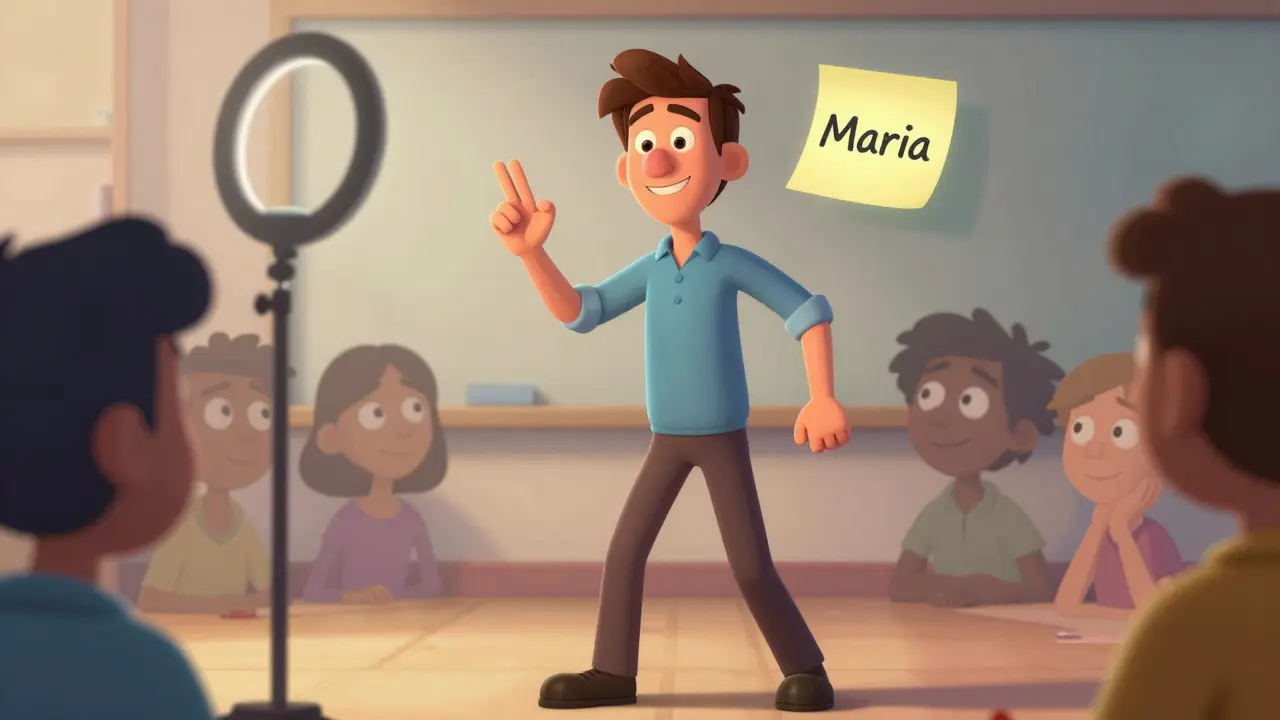
Eye Contact Isn’t About the Lens-It’s About the Person
The myth: Look directly into the camera to make eye contact. The truth: That’s awkward unless you’re giving a TED Talk. Here’s the real trick: Place a small sticky note with a photo of a real student-someone you’ve helped before-right above your camera. When you speak, look at their face. Your eyes will naturally go to the camera, but your brain will feel like you’re talking to a person. You’ll sound warmer. Your tone will soften. You won’t feel like you’re talking to a black hole. If you don’t have a photo, use a sticky note with the word “Maria” or “James”-a name of someone you’ve helped. It grounds you. It reminds you that behind every click is a real person trying to learn.Move with Purpose, Not Panic
Standing still feels safe. But stillness can feel stiff. Too much movement feels chaotic. The sweet spot is purposeful motion. When you make a key point, take one small step forward. When you explain a process, use one hand to count steps on your fingers. When you ask a rhetorical question, pause and tilt your head slightly. These aren’t gestures for show. They’re cues for the brain. Avoid pacing. Avoid fidgeting with your pen. Avoid touching your face. These habits scream anxiety. If you’re standing, plant your feet shoulder-width apart. If you’re sitting, keep your shoulders relaxed. Let your body be steady, but not frozen.Record in Short Chunks-Not Marathon Sessions
Most course creators try to record an entire 30-minute lesson in one go. That’s a recipe for burnout and frustration. Your energy drops after 8 minutes. Your voice gets tired. Your focus slips. Break your lesson into 5-8 minute chunks. Record each one separately. Do a quick reset between takes: stand up, stretch, take a sip of water, breathe. This isn’t editing laziness-it’s performance strategy. You’ll get better takes. You’ll feel less pressure. And when you edit, you can mix and match the best parts. You don’t need one perfect take. You need three good ones stitched together.
Patrick Sieber
January 4, 2026 AT 15:16Love this. The coffee chat analogy is spot on. I used to stress over every word until I started recording like I was explaining something to my cousin who just got laid off. No script, just truth. My completion rates jumped 40% in two weeks.
Kieran Danagher
January 5, 2026 AT 03:36Stop trying to be a TED speaker and start being a human. The camera doesn’t care about your diction. It cares about your clarity. And your humanity. That’s it.
OONAGH Ffrench
January 6, 2026 AT 22:20Eye contact above the lens is genius. I tried it with a photo of my first student who cried after passing her exam. I didn’t realize how much that changed my tone until I watched the playback. No more robotic delivery. Just warmth.
poonam upadhyay
January 8, 2026 AT 08:20Ugh, this is so basic. Everyone knows you should ‘speak like a friend’-but most people are too lazy to even fix their lighting or mic placement. And don’t even get me started on those who record in their bedroom with a neon sign behind them. It’s like watching someone try to sell you a used car from their closet.
Also, ‘delete the playback’? No. You should analyze every blink, every ‘um’, every micro-expression. If you’re not editing for perfection, you’re not serious. This advice is dangerously low-effort.
Shivam Mogha
January 8, 2026 AT 09:40Record short chunks. Yes.
mani kandan
January 8, 2026 AT 11:41I used to think confidence came from gear. Bought a $500 mic, a ring light, a green screen. Still sounded like a bored librarian. Then I started recording one 90-second clip a day. No pressure. Just me and the problem. After 30 days, I didn’t recognize my own voice. It was calmer. Clearer. Human. The gear didn’t change. I did.
Rahul Borole
January 10, 2026 AT 04:53It is imperative to underscore the significance of consistent delivery as the foundational pillar of pedagogical efficacy in digital learning environments. The psychological dissonance experienced by learners when confronted with performative inauthenticity directly correlates with attrition rates. One must therefore cultivate a disciplined, iterative approach to on-camera presence, grounded in empathy and structural clarity.
Sheetal Srivastava
January 11, 2026 AT 21:44Look, I’ve been in this space for 12 years and I’ve seen every ‘tip’ under the sun. This is just corporate fluff dressed up as wisdom. The real issue? Platforms don’t reward authenticity. They reward clickbait. So if you’re not doing dramatic zooms, flashy graphics, and screaming ‘YOU’RE DOING IT WRONG!’ you’re invisible. This advice is for people who still believe in ‘learning’ instead of ‘viral engagement’.
Also, your ‘sticky note’ trick? Cute. But if your content isn’t optimized for TikTok attention spans, no amount of eye contact will save you.
Bhavishya Kumar
January 13, 2026 AT 14:55There is a grammatical error in the third paragraph. ‘You’re not performing. You’re helping. That shift changes everything.’ Should be: ‘That shift changes everything.’ - no period needed after ‘helping’ if it’s a compound sentence. Also, ‘you’ll hate watching yourself’ - ‘you’ll’ is informal. Use ‘one will’ in formal instructional contexts. This article is well-intentioned but lacks linguistic rigor.
ujjwal fouzdar
January 14, 2026 AT 19:01What if the camera isn’t the problem? What if the problem is that we’ve been taught to perform instead of be? We’re not instructors. We’re mirrors. And every time we try to fix our delivery, we’re just polishing the glass instead of cleaning the dust off our own souls. The real question isn’t how to speak on camera-it’s why we’re afraid to be seen. And that… that’s the real course.
I recorded my first video after my dad passed. I didn’t know what to say. I just said, ‘I miss him.’ And I cried. And I kept recording. That video got more DMs than all my others combined. Turns out, people don’t want experts. They want witnesses.
Anand Pandit
January 15, 2026 AT 21:29This is gold. I was stuck for months thinking I needed to sound like a professor. Then I started recording while walking my dog. Just talking about the lesson like I was telling a story. No script. No lights. Just me and the dog. My students said I sounded ‘like I actually cared’. That’s all that matters.
Reshma Jose
January 17, 2026 AT 08:02So true about the 5-8 minute chunks. I used to try to do 20-minute videos and end up deleting 80% of it. Now I do 3 short ones, stitch them together, and my energy stays high. Also, the sticky note trick? I used my niece’s photo. She’s 7. She doesn’t care about my tone. She just wants me to explain it so she gets it. That’s my audience.
rahul shrimali
January 18, 2026 AT 18:01Do it even when you’re tired. That’s the secret. Not perfect. Just done.
Eka Prabha
January 19, 2026 AT 23:20Let me guess… this is from someone who’s never had a course get flagged by YouTube’s algorithm. You talk about ‘helping’ and ‘authenticity’ like it’s a moral virtue. But in reality, the platform rewards outrage, not clarity. Your ‘coffee chat’ is buried under influencers screaming ‘THIS CHANGED MY LIFE’ in 10 languages. This advice is nice. But it’s not survival.
Bharat Patel
January 20, 2026 AT 18:25There’s a quiet truth here: the camera doesn’t see your fear. It sees your intention. If you’re trying to impress it, it turns away. If you’re trying to help it, it leans in. That’s all. No gear. No technique. Just presence.
Bhagyashri Zokarkar
January 21, 2026 AT 16:32I used to record at 2am after my kids went to sleep and I was exhausted and my voice was scratchy and I kept forgetting where I was in the script and I thought no one would listen but then someone wrote me saying ‘your voice made me feel like I wasn’t alone’ and I cried for an hour and now I record like that every time because I realized people don’t want perfect they want real and I don’t even care about views anymore I just want to be the person who makes someone feel seen even if it’s just one person even if it’s just one time
Rakesh Dorwal
January 21, 2026 AT 17:38Western advice. In India, we respect authority. If you sound too casual, students think you’re not qualified. You need to sound like a teacher. Not a friend. Not a coffee buddy. A teacher. This advice might work for your audience, but it’s not universal. Stop assuming your way is the right way.
Vishal Gaur
January 22, 2026 AT 12:05I tried the sticky note thing but I accidentally used a photo of my ex and now every time I record I get emotional and start rambling about how she never believed in me and I think my students noticed because one left a comment saying ‘are you okay?’ and now I’m not sure if I should change the photo or just keep going with the drama because honestly it’s getting more engagement than my other videos
sumraa hussain
January 22, 2026 AT 18:01There’s something beautiful about this whole thing. The way you talk about stillness as safety. About how we mistake motion for mastery. About how the camera doesn’t care about your credentials-it cares about your heartbeat. I’ve watched 100+ course creators. The ones who last? They’re not the loudest. Not the flashiest. They’re the ones who forgot the camera was there. They just showed up. And somehow… that’s enough.
Maybe the real skill isn’t delivery. Maybe it’s letting go.
sampa Karjee
January 23, 2026 AT 17:14How quaint. You think your ‘coffee chat’ approach is revolutionary? In my country, we don’t waste time with ‘authenticity’. We deliver value with authority. If you sound uncertain, you lose credibility. No one wants to learn from someone who sounds like they’re apologizing for existing. This is performative vulnerability dressed as pedagogy. It’s not teaching. It’s therapy.