Product Management Course: Master Discovery, Roadmaps, and Metrics
 Jan, 2 2026
Most product management courses teach you how to write user stories and run sprint planning. But if you’ve ever been stuck trying to figure out what to build next-or worse, built something no one wanted-you know those skills don’t cut it. The real difference between good and great product managers lies in three areas: discovery, roadmaps, and metrics. Skip the fluff. This is what actually works in real companies, not just in textbooks.
Product Discovery: Stop Guessing, Start Learning
Discovery isn’t a phase you finish before development starts. It’s a continuous loop. The best product teams treat every idea as a hypothesis, not a requirement. They don’t ask users what they want. They watch what they do.
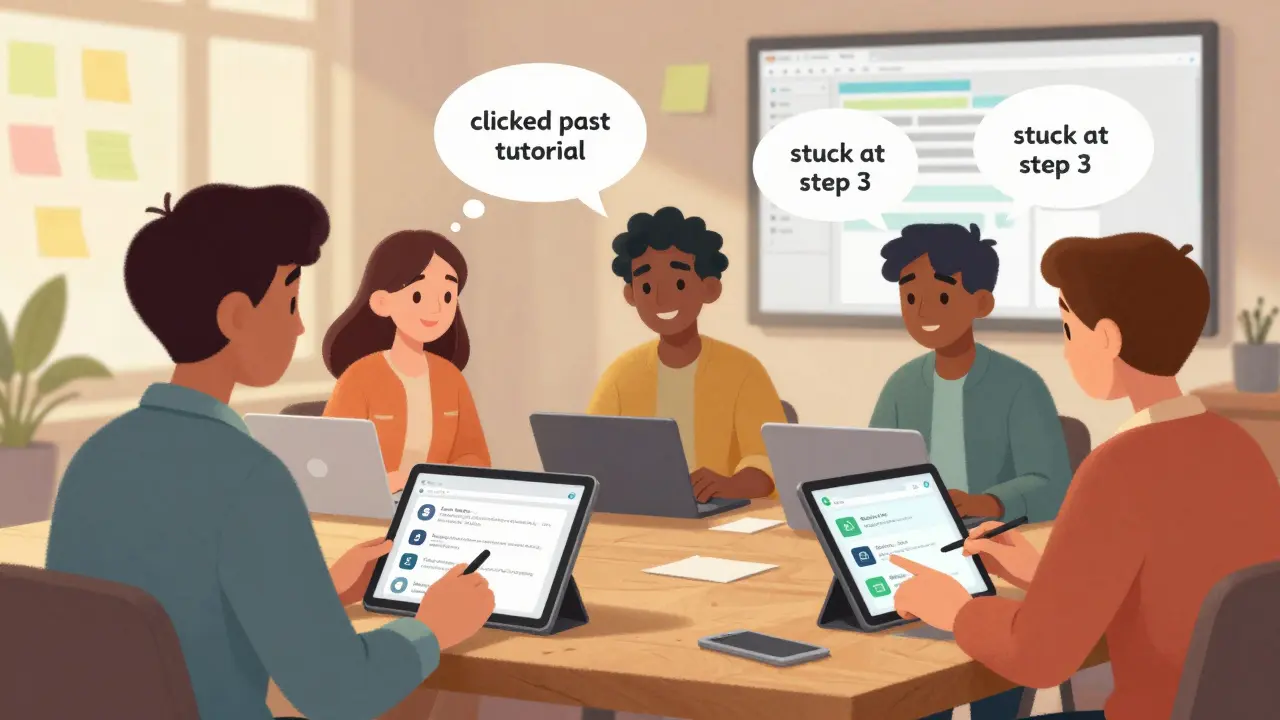
Take a SaaS company trying to improve onboarding. Instead of running a survey asking, “How can we make onboarding better?” they recorded 50 screen-sharing sessions of new users signing up. What they found? 72% of users clicked past the tutorial without reading it. The fix? They replaced the tutorial with a single interactive walkthrough that triggered only when users got stuck. Sign-up completion jumped from 41% to 68% in two weeks.
Here’s how to do discovery right:
- Use behavioral interviews, not opinion-based ones. Ask, “Show me how you’ve done this before,” not “What do you think?”
- Test ideas with prototypes before writing a single line of code. Use Figma, Notion, or even paper sketches.
- Limit your sample size. Five to eight users will reveal 85% of the biggest problems. You don’t need a hundred.
- Track the “Jobs to Be Done.” What task is the user hiring your product to complete? A person doesn’t buy a drill. They buy a hole.
Companies like Airbnb and Dropbox built their early growth on deep discovery. They didn’t guess features. They observed behavior. That’s the gap between average and standout product teams.
Product Roadmaps: Beyond Feature Lists
Most roadmaps look like Gantt charts with a list of features. They’re useless. A roadmap shouldn’t tell engineers what to build. It should tell everyone why they’re building it.
At a mid-sized fintech startup, the CEO kept pushing for a new “money-saving tool.” The product team pushed back. Instead of building it, they ran a 3-week experiment. They created a simple landing page and drove targeted ads to it. Only 3% of visitors clicked “Notify Me.” That told them the problem wasn’t important enough to solve-no matter how sexy the feature sounded.
Good roadmaps have three things:
- Goals, not features. Example: “Increase retention for users aged 25-34 by 20% in Q2,” not “Add dark mode.”
- Timeframes that reflect uncertainty. Use “Q2-Q3” instead of “June 15.” If you’re certain about the date, you’re probably lying.
- Clear criteria for success. What data will prove you’re moving the needle?
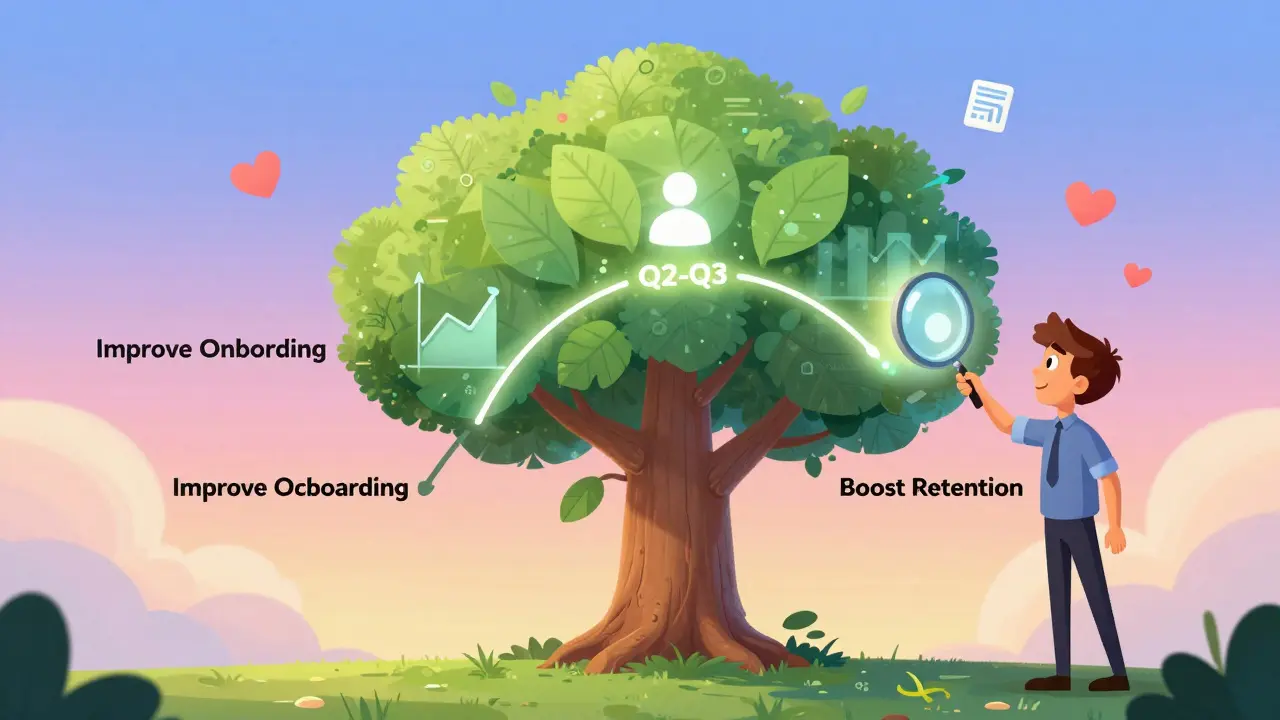
Use a theme-based roadmap. Group work into themes like “Improve Onboarding” or “Reduce Churn.” This keeps teams focused on outcomes, not output. Tools like Productboard and Aha! help, but you can do this in Notion or even a spreadsheet. The format doesn’t matter. The thinking does.
And here’s the hard truth: If your roadmap doesn’t change every month, you’re not learning fast enough. The best product managers treat their roadmap like a living document-updated weekly based on new data, not executive opinions.
Metrics That Matter: Stop Counting Vanity Numbers
DAU? MAU? Click-through rate? These are vanity metrics. They look good in slides but don’t tell you if your product is working.
At a health app company, leadership was obsessed with “total sessions per user.” The team noticed that users were opening the app 10 times a day-but only for 12 seconds each time. They were checking their weight, then leaving. The real metric? “Users who log a workout once a week.” That’s the behavior tied to long-term retention. They shifted focus, redesigned the home screen, and saw weekly active users climb 47% in 10 weeks.
Here’s how to pick the right metrics:
- Find the North Star Metric. It’s the one number that best reflects your product’s core value. For Slack, it’s “messages sent per workspace.” For Netflix, it’s “hours watched per account.”
- Track leading and lagging indicators. Lagging: revenue, churn. Leading: feature usage, support tickets, onboarding completion.
- Segment everything. Don’t look at overall retention. Look at retention by user cohort, device, region, or acquisition channel.
- Set a minimum viable metric threshold. If you’re trying to increase sign-ups, what’s the smallest change that would make the effort worth it? 5%? 10%? Know it before you start.
Use the HEART framework from Google: Happiness, Engagement, Adoption, Retention, Task Success. It’s not a checklist. It’s a lens. Pick one or two that align with your current goal.
And never, ever measure “time spent.” That’s a trap. A user spending 20 minutes on your app might be frustrated and lost. Or they might be deeply engaged. Context matters more than the number.
Putting It All Together: The Feedback Loop
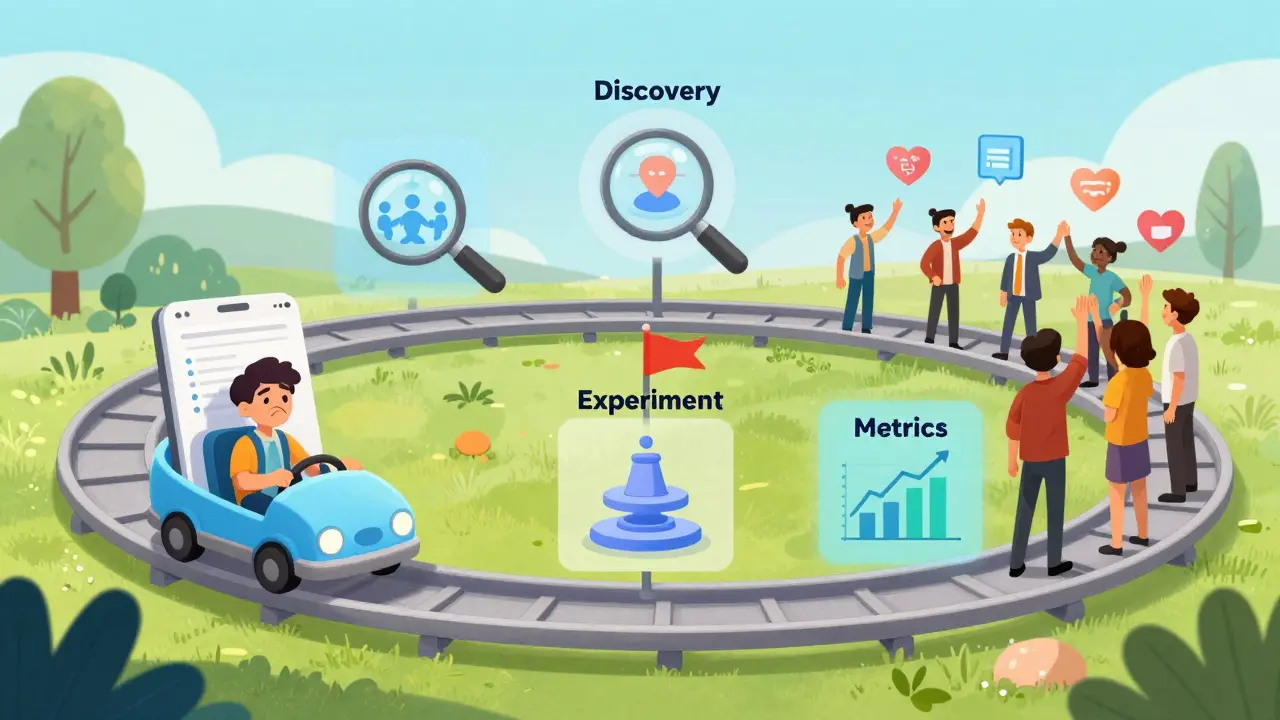
Discovery, roadmaps, and metrics aren’t separate steps. They’re a loop.
Start with discovery: Talk to users, observe behavior, find a problem worth solving.
Turn that insight into a goal on your roadmap: “Reduce onboarding drop-off by 30% in Q1.”
Build a small experiment: A new tutorial flow, a simplified form, a tooltip.
Measure the outcome: Track the drop-off rate before and after.
Learn. Adapt. Repeat.
Teams that do this consistently outperform those that rely on gut feel or top-down directives. At a recent survey of 120 product teams, those using this loop had 2.3x higher customer satisfaction scores and 40% faster time-to-market for new features.
It’s not about having the fanciest tool or the biggest team. It’s about building a habit of learning. Every week. Every sprint. Every release.
Common Mistakes (And How to Avoid Them)
Here’s what goes wrong in most product management courses-and what you’ll see in real companies:
- Mistake: Building features because a stakeholder asked for them. Solution: Ask, “What problem are you trying to solve?” If they can’t answer, don’t build it.
- Mistake: Waiting for perfect data before acting. Solution: Use the 80/20 rule. 80% of the insight comes from 20% of the data. Start with what you have.
- Mistake: Treating metrics as targets, not signals. Solution: If your North Star metric drops, don’t panic. Dig into why. Maybe users are happier, just using the product differently.
- Mistake: Ignoring negative feedback. Solution: The loudest complaints are often your best clues. A user saying “I hate this button” might be telling you the whole flow is broken.
One team at a logistics startup kept getting complaints about their delivery tracking page. Instead of redesigning it, they looked at the heatmaps. Turns out, users weren’t clicking the tracking button-they were scrolling down to the bottom of the page, looking for a phone number. They added a prominent “Call Us” button. Support calls dropped by 60%.
Where to Start Today
You don’t need a course. You need a habit.
Here’s your 7-day challenge:
- Choose one product you use daily. It could be your company’s app, or even your phone’s calendar.
- Observe how three different people use it. Watch. Don’t ask questions.
- Write down one behavior that surprised you.
- Find one metric that could measure if that behavior improved.
- Sketch a simple change you’d make to test it.
- Share your findings with someone on your team.
- Do it again next week.
That’s it. No certifications. No PowerPoint decks. Just curiosity and observation. That’s what separates product managers who move the needle from those who just manage tasks.
What’s the difference between a product roadmap and a project plan?
A project plan says when and how something will be built. A product roadmap says why it’s being built and what success looks like. One is tactical. The other is strategic. A project plan might say, “Launch login redesign on March 15.” A roadmap says, “Increase sign-up conversion by 25% in Q2 by simplifying the onboarding flow.” The roadmap guides the project plan-not the other way around.
Do I need to know how to code to be a good product manager?
No. But you need to understand how software gets built. You don’t have to write Python or JavaScript, but you should know what a backend API is, how long a feature might take, and what trade-offs developers face. The best product managers speak the language of engineering without needing to be engineers themselves.
How do I get buy-in from leadership when they want to build features I think are wrong?
Don’t say no. Say, “Let’s test it.” Propose a low-cost experiment: a landing page, a survey, a prototype. If leadership wants a new feature, ask them to define the goal. Then measure whether that goal moves after the test. Data beats opinions every time. If the data says no, the conversation changes.
What’s the best tool for product roadmaps?
There’s no single best tool. Jira is great for execution but terrible for strategy. Productboard and Aha! are built for roadmaps but can be overkill for small teams. Many successful teams use Notion, Trello, or even Google Sheets. The tool doesn’t matter. What matters is whether your roadmap is visible, updated regularly, and tied to outcomes-not features.
How often should I update my product metrics?
Check your North Star Metric daily. Look at trends weekly. Do deep dives monthly. If you’re launching a new feature, track it hourly at first. Metrics are like a car’s dashboard-you don’t stare at it, but you check it often enough to avoid crashes. Set up alerts for big drops or spikes. Don’t wait for a meeting to notice something’s wrong.
Next Steps: Build Your Own Learning System
Don’t wait for the next course. Start today.
Keep a “Product Journal.” Every Friday, write down:
- One thing you learned about your users
- One metric that moved
- One assumption you tested-and whether it was right
After 12 weeks, you’ll have more real insight than most product managers get in a year. And you won’t need a certificate to prove it. You’ll have results.
E Jones
January 2, 2026 AT 08:22So let me get this straight - you’re telling me that if I just watch people use my app like some creepy stalker with a notebook, I’ll magically unlock the secrets of the universe? No wonder Silicon Valley is full of broke geniuses who think empathy is a startup metric. I’ve seen this before. The same people who told us ‘discovery’ would fix everything are now selling NFTs of their ‘user journey maps.’ You didn’t discover anything. You just got lucky. And now you’re monetizing your lucky stumble like it’s divine revelation. Wake up. The real product isn’t your app. It’s the cult of ‘lean methodology’ they’re selling you. And guess what? You’re the product.
Meanwhile, real companies? They just hire ex-consultants with PowerPoint addictions and call it ‘strategic alignment.’ You think Airbnb observed users? No. They found a loophole in the rental market and ran like hell. Observation? That’s just the story they tell investors after they’ve already won.
And don’t even get me started on ‘North Star Metrics.’ That’s just corporate jargon for ‘what number do we lie about to the board?’ I’ve seen teams kill themselves chasing a 0.5% increase in ‘task success’ while the entire product is held together by duct tape and hope. You’re not building products. You’re building KPIs. And the users? They’re just the noise between the graphs.
But hey, if you want to feel like a prophet, keep recording screen shares. Just don’t be surprised when the next ‘breakthrough’ is a button that says ‘Subscribe for More Insights.’
Barbara & Greg
January 2, 2026 AT 12:56It is deeply troubling that so many in the product management field have come to equate observation with insight, and experimentation with wisdom. The notion that one can derive universal truths from the behavior of five to eight users is not only statistically unsound - it is philosophically bankrupt. Human behavior is not a dataset to be mined, but a complex tapestry woven from culture, emotion, and context. To reduce the human experience to a heatmap or a clickstream is to commit a form of epistemological violence.
Furthermore, the glorification of ‘agile’ iteration as a substitute for deep reflection betrays a profound misunderstanding of both ethics and engineering. A product is not a hypothesis to be tested, but a covenant with the user - one that demands intentionality, not improvisation.
And while the HEART framework may sound elegant, it is merely a rebranding of behaviorist psychology dressed in startup chic. Where is the moral accountability? Where is the consideration of dignity, autonomy, and long-term societal impact? These are not metrics. They are imperatives.
One cannot build a just product by chasing engagement. One builds it by asking: For whom? And at what cost?
selma souza
January 3, 2026 AT 00:14You wrote ‘you don’t need a hundred’ - that’s incorrect. It should be ‘you don’t need a hundred users.’ Also, ‘sign-up completion jumped from 41% to 68%’ - missing the word ‘rate.’ And ‘they replaced the tutorial with a single interactive walkthrough’ - no comma before ‘that triggered.’
And you say ‘a person doesn’t buy a drill. They buy a hole.’ That’s a misquote. It’s ‘people don’t buy quarter-inch drills. They buy quarter-inch holes.’ You’re not just wrong - you’re sloppy. If you can’t get the basics right, why should anyone trust your ‘discovery’ methods?
Also, ‘HEART framework from Google’ - Google didn’t invent it. It was developed by a team at Google, led by K. H. and M. S., published in 2010. Cite properly. Or at least don’t pretend it’s common knowledge when it’s not.
And please stop using ‘you’ in imperative form. It’s condescending. Write in passive voice. Or third person. Anything but this casual, authoritarian tone. You’re not a guru. You’re a blogger with a slide deck.
Frank Piccolo
January 3, 2026 AT 10:30Let’s be real - this whole ‘discovery’ nonsense is just American corporate yoga. You think other countries do this? In Germany, they build what the engineers say works. In Japan, they improve what already exists. In China, they copy what’s popular. Here? We turn ‘watching people click buttons’ into a TED Talk and charge $2,000 for a certificate.
And ‘North Star Metric’? That’s just a fancy way of saying ‘what number do we lie about to our VCs?’ I’ve worked at three startups. None of them cared about ‘outcomes.’ They cared about hitting ARR targets before the next funding round. The ‘roadmap’ was whatever the CEO wanted to brag about at Web Summit.
Also, ‘don’t measure time spent’? Oh, so if users are stuck for 20 minutes, that’s fine? You’re literally telling me to ignore the most obvious sign of a broken product. What a joke. The only thing more useless than a vanity metric is a product manager who thinks they’re above metrics.
And the ‘7-day challenge’? That’s not a habit. That’s a parlor trick. Real product managers don’t need to ‘observe’ users. They just ship stuff and see what sticks. The rest is noise.
James Boggs
January 4, 2026 AT 21:53This is one of the clearest, most practical summaries of real product work I’ve read in years. Thank you.
The emphasis on outcomes over output, and learning over guessing, is exactly what’s missing in so many teams. I’ve seen too many roadmaps that are just feature wishlists dressed up as strategy. This approach - observe, hypothesize, test, measure - is simple, but not easy. And that’s why it works.
Also, the ‘7-day challenge’ is brilliant. It’s low barrier, high impact. I’m starting it tomorrow. No excuses.
Addison Smart
January 6, 2026 AT 01:48I’ve spent the last decade working across six countries, from Lagos to Seoul, and what struck me most is how universal these principles are - even when the context isn’t. In Nairobi, we didn’t have screen recordings. We sat with users in markets, watched how they paid for water using mobile money, and realized they weren’t ‘ignoring’ the tutorial - they were terrified of losing their balance. So we added voice guidance in Swahili and reduced steps from 7 to 3. Sign-up jumped 82%.
Discovery isn’t about tools. It’s about humility. It’s about showing up, listening without agenda, and letting the user teach you what they need - not what you think they should want.
And metrics? In rural India, ‘weekly active users’ meant nothing. What mattered was ‘how many times a week did they tell someone else about this?’ That became our North Star. Because adoption wasn’t about usage - it was about trust.
This isn’t a guide for Silicon Valley. It’s a guide for anyone who wants to build something that actually matters. Thank you for writing this. I’m sharing it with my team in Jakarta tomorrow.
David Smith
January 7, 2026 AT 05:57Oh wow. Another ‘product guru’ telling us how to ‘learn’ while charging $3,000 for a course. You didn’t invent anything. You just took every cliché from Y Combinator and slapped a ‘real companies’ label on it.
And you think Airbnb ‘observed’ users? They got lucky because people were desperate to rent out their couches during a recession. They didn’t discover anything - they capitalized on a crisis. That’s not insight. That’s opportunism.
Also, ‘5-8 users reveal 85% of problems’? That’s not science. That’s wishful thinking. I’ve seen teams miss catastrophic UX flaws because they only interviewed ‘nice people’ from their LinkedIn network. What about the 15%? The ones who quit because the button was too small? The ones who don’t speak English? The ones who don’t have smartphones?
You’re not building products. You’re building echo chambers. And I’m tired of it.
Lissa Veldhuis
January 9, 2026 AT 04:05OMG I’m so done with this ‘discovery’ nonsense. I’ve been in product for 12 years and I’ve seen every single one of these ‘frameworks’ come and go. First it was ‘lean.’ Then ‘design thinking.’ Now it’s ‘jobs to be done’ and ‘HEART’ and ‘North Star’ and ‘living roadmaps’ - like it’s some kind of cult initiation. You’re not a product manager. You’re a spiritual advisor with a Notion template.
And the ‘7-day challenge’? Please. I have a 3-year-old. I don’t have time to ‘observe three people using the calendar app.’ I have to pay bills. My team has deadlines. We don’t have the luxury of ‘curiosity’ - we have the curse of quarterly targets.
Also - ‘don’t measure time spent’? LOL. If my app’s users are spending 20 minutes, that means they’re hooked. That’s a win. Who cares if they’re lost? As long as they’re not leaving, they’re monetizable.
And the ‘real companies’ thing? You’re talking about Airbnb and Dropbox like they’re gods. Newsflash: they’re corporations. They do what makes money. They don’t care about your ‘feedback loop.’ They care about their stock price.
Stop pretending this is wisdom. It’s just marketing with a thesaurus.
Michael Jones
January 9, 2026 AT 09:51This is it. This is the real deal. No fluff. No jargon. Just truth.
Stop building features. Start building understanding.
Watch. Listen. Test. Repeat.
That’s all. Everything else is noise.
I’m printing this out and putting it on my wall.
Thank you.
allison berroteran
January 10, 2026 AT 19:09I’ve been reading this slowly, letting it sink in. What stood out to me wasn’t the frameworks - it was the quiet humility in the tone. There’s no ‘I solved this’ or ‘here’s my genius method.’ Just: here’s what we saw. Here’s what happened. Here’s what we learned.
That’s rare. In a world where everyone’s selling a system, this feels like a gift.
I work in healthcare tech, and I’ve seen so many ‘innovations’ fail because they were built on assumptions about what patients ‘should’ want - not what they actually needed. The part about ‘the user isn’t buying a drill, they’re buying a hole’ - that hit me hard. We were building an app to help seniors track meds. We thought they wanted notifications. Turns out, they wanted someone to call them. So we added a one-tap call button to their caregiver. Usage tripled.
Thank you for reminding me that the best product decisions aren’t made in meetings. They’re made in silence - watching, listening, waiting.
Gabby Love
January 11, 2026 AT 23:36Minor correction: In the SaaS example, you say ‘sign-up completion jumped from 41% to 68%’ - but you don’t specify what ‘completion’ means. Is it signing up? Completing onboarding? Creating a profile? It matters.
Also, ‘paper sketches’ - yes, but make sure they’re not just doodles. Use a consistent style. I use a template with boxes for buttons, arrows for flow, and sticky notes for copy. Keeps it clean.
Otherwise - excellent. Practical. Real. I’m sharing this with my juniors.
Jen Kay
January 12, 2026 AT 00:41Wow. This reads like a pep talk from someone who’s been through the fire. And honestly? It’s refreshing. I’ve spent the last year fighting with executives who think ‘dark mode’ is a KPI. This? This is the antidote.
But let’s be real - most companies aren’t ready for this. They want quick wins. They want to ship. They don’t want to sit in silence with users who don’t speak English well or who are too embarrassed to say they’re confused.
So yes - this is brilliant. But it’s also a radical act. Not everyone will thank you for it. Some will call you ‘too slow.’
Keep going. The world needs more of this.
Michael Thomas
January 13, 2026 AT 21:36Discovered? No. Copied. This is just a regurgitation of Steve Jobs’ ‘customers don’t know what they want’ line. And the ‘7-day challenge’? That’s not innovation. That’s a middle school science fair project.
Real product managers don’t ‘observe.’ They lead. They decide. They ship. The rest is therapy.
Also - ‘North Star Metric’? That’s just a fancy way of saying ‘revenue.’ Stop pretending you’re deep. You’re not.
Abert Canada
January 15, 2026 AT 15:35Man I love this. We did something similar in Montreal last year - we stopped asking users what they wanted and just followed them around the grocery store with tablets. Turns out, people weren’t using our budgeting app because they didn’t trust it with their numbers. So we added a ‘no data stored’ badge and a one-tap delete button. Usage went up 200%.
Also - the ‘7-day challenge’? I did it with my 70-year-old uncle. He said he hated the ‘notifications’ but loved the ‘weekly summary email.’ So we built that. Now he’s our most engaged user.
Canada doesn’t do hype. We just do what works. This? This is what works.
E Jones
January 17, 2026 AT 00:03Oh, so now you’re the ‘real product manager’? You watched your uncle use an app and suddenly you’re a guru? That’s the same logic they used to sell me ‘quantum healing crystals.’
And you think your ‘one-tap delete’ button fixed trust? Nah. You just made it easier to quit. That’s not engagement - that’s resignation.
Meanwhile, the real winners? They’re the ones who made users feel like they’re part of the product. Not observers. Not testers. Co-conspirators.
That’s what you’re missing. Not the tools. Not the metrics. The story.
And no - I’m not selling a course. I’m just watching.