Professional Association Certification Standards: What to Align With
 Jan, 4 2026
Getting certified through a professional association isn’t just about adding a title to your email signature. It’s about proving you meet real, measurable standards that employers, clients, and regulators actually care about. But here’s the problem: not all certifications are created equal. Some are respected. Others are just expensive pieces of paper. If you’re trying to decide which certification to pursue, you need to know exactly what standards to align with - not just what looks good on paper.
What Makes a Certification Worth Your Time?
There are over 12,000 professional certifications listed in the U.S. alone. But only about 1,200 of them are recognized by major employers as credible. The difference? Rigorous standards. A strong certification isn’t just a test you can study for in a weekend. It’s built on industry-wide consensus about what competent professionals must know and do.
Look at the Project Management Professional (PMP) from PMI. To qualify, you need 35 hours of formal education, 36-60 months of project leadership experience depending on your degree, and you have to pass a 180-question exam based on a published body of knowledge. That’s not random. That’s designed by hundreds of practicing project managers across industries. That’s why 93% of Fortune 500 companies say they value PMP holders.
Compare that to a certification you found on a random website offering instant credentials for $99. No experience required. No exam. Just a video and a certificate. It doesn’t carry weight because it wasn’t built with input from professionals in the field. It was built to make money.
Check the Governance: Who Runs the Certification?
Not every association is trustworthy. Some are run by for-profit companies that use the word ‘association’ to sound official. Real professional associations are nonprofit, member-driven, and governed by elected boards of practitioners - not sales teams.
Ask yourself: Who sets the exam content? Is it a committee of active professionals in the field? Or is it a single vendor who also sells training materials? If the same organization that certifies you also sells the prep course, that’s a red flag. True standards are developed independently. The Certified Information Systems Security Professional (CISSP), for example, is governed by (ISC)², a nonprofit with over 150,000 members. The exam content is reviewed every three years by global subject matter experts - not marketing staff.
Look for associations that publish their certification framework publicly. If you can’t find their competency model, job task analysis, or recertification requirements on their website, walk away.
Align With Standards That Are Required, Not Just Recommended
Some certifications are optional. Others are mandatory. If you work in healthcare, finance, or government contracting, your certification might not be a choice - it’s a legal or contractual requirement.
For example, if you’re a healthcare administrator in the U.S., you need a Certified Professional in Healthcare Information and Management Systems (CPHIMS) if you’re handling Medicare data. If you’re a financial auditor, the Certified Public Accountant (CPA) isn’t just preferred - it’s legally required to sign off on audits in most states.
Don’t pick a certification because it sounds impressive. Pick one because it’s listed in job postings you want, required by your employer, or mandated by your industry regulator. The Association for Healthcare Documentation Integrity (AHDI) reports that 87% of medical transcription employers require or prefer certified professionals. That’s not a trend - it’s a baseline.

Verify Recertification Requirements
A certification that never expires might sound nice, but it’s usually a sign of low standards. The best certifications require ongoing learning. Why? Because the field changes. Cybersecurity threats evolve. Regulations get updated. Best practices shift.
The Global Information Assurance Certification (GIAC) requires recertification every four years through continuing education or retesting. The Society for Human Resource Management (SHRM-CP) requires 60 hours of professional development every three years. These aren’t hoops to jump through - they’re proof you’re staying current.
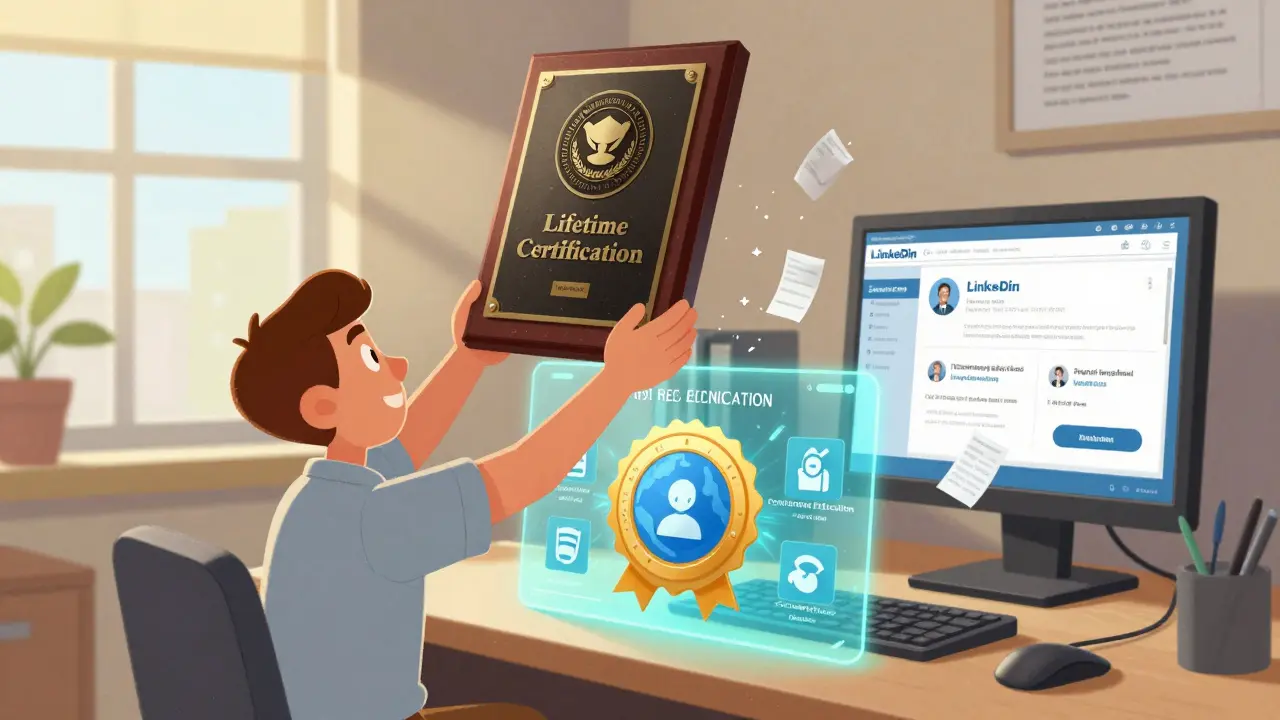
If a certification says it’s “lifetime,” dig deeper. Does it require any continuing education? Any peer review? Any updated exams? If not, it’s likely outdated. Employers know this. They’ll see a lifetime certification and wonder: Did this person stop learning in 2015?
Look at Industry Adoption, Not Just Marketing
Don’t trust the glossy brochures. Look at where the certification is actually used.
Search LinkedIn. Type in your job title and filter by certification. How many people in your target roles hold it? Are they working at companies you admire? Are they getting promoted? Are they being hired for higher salaries?
Check job boards. Look at 50 postings for roles you want. How many list a specific certification as required or preferred? If only one or two mention it, it’s probably not worth the investment. If 30 or more do - that’s your signal.
For example, the Certified Supply Chain Professional (CSCP) from APICS is listed in over 68% of U.S. logistics job postings that mention certifications. The Certified ScrumMaster (CSM) is in 72% of junior product manager roles. These numbers aren’t guesses - they’re tracked by hiring platforms like Indeed and Glassdoor.
Ask About Accessibility and Equity
A certification that only the wealthy can afford isn’t a professional standard - it’s a barrier. The best associations offer financial aid, payment plans, or free study materials. They also design exams to be accessible to people with disabilities and offer testing in multiple languages.
The International Association of Business Communicators (IABC) offers scholarships for underrepresented groups. The National Association of Social Workers (NASW) provides discounted exam fees for students and those in public service. These aren’t perks - they’re part of ethical credentialing.
If an association doesn’t mention financial support, accessibility, or equity on their website, that’s a warning. Real professional standards should open doors, not lock them.
What to Do Next: Your Alignment Checklist
Before you pay a dime, run through this simple checklist:
- Is it governed by a nonprofit association? Not a for-profit company.
- Is the competency model publicly available? You should be able to download it for free.
- Are there experience or education prerequisites? No legitimate cert lets you skip the basics.
- Is it required or preferred in your target job market? Check 50 job postings.
- Does it require recertification? If not, it’s probably not respected.
- Are there scholarships or payment options? If not, question its fairness.
- Is there a community of certified professionals? Look for local chapters, forums, or events.
If you answer yes to all seven, you’ve found a credential worth pursuing. If you answer no to even one, keep looking.
What Happens When You Get It Wrong?
I’ve seen people spend $2,000 on a certification that got them zero interviews. They thought it was ‘the industry standard’ because the website said so. But no employer had ever heard of it. They wasted months and money.
One marketing manager in Atlanta spent $1,800 on a ‘Certified Digital Marketing Strategist’ from a private training company. She listed it on her resume. She got zero callbacks. A year later, she got certified through the American Marketing Association (AMA) - the same cost, but recognized by 9 out of 10 companies she applied to. She got hired within six weeks.
The difference? One was built by marketers. The other was built by marketers who work in the field - and their peers agreed on what competence looks like.
Bottom Line: Align With Standards, Not Just Symbols
Your certification should be a signal - not a decoration. Employers don’t care about the logo on your certificate. They care about what it proves you can do. And the only way to prove that is to earn a credential built on real, measurable, industry-backed standards.
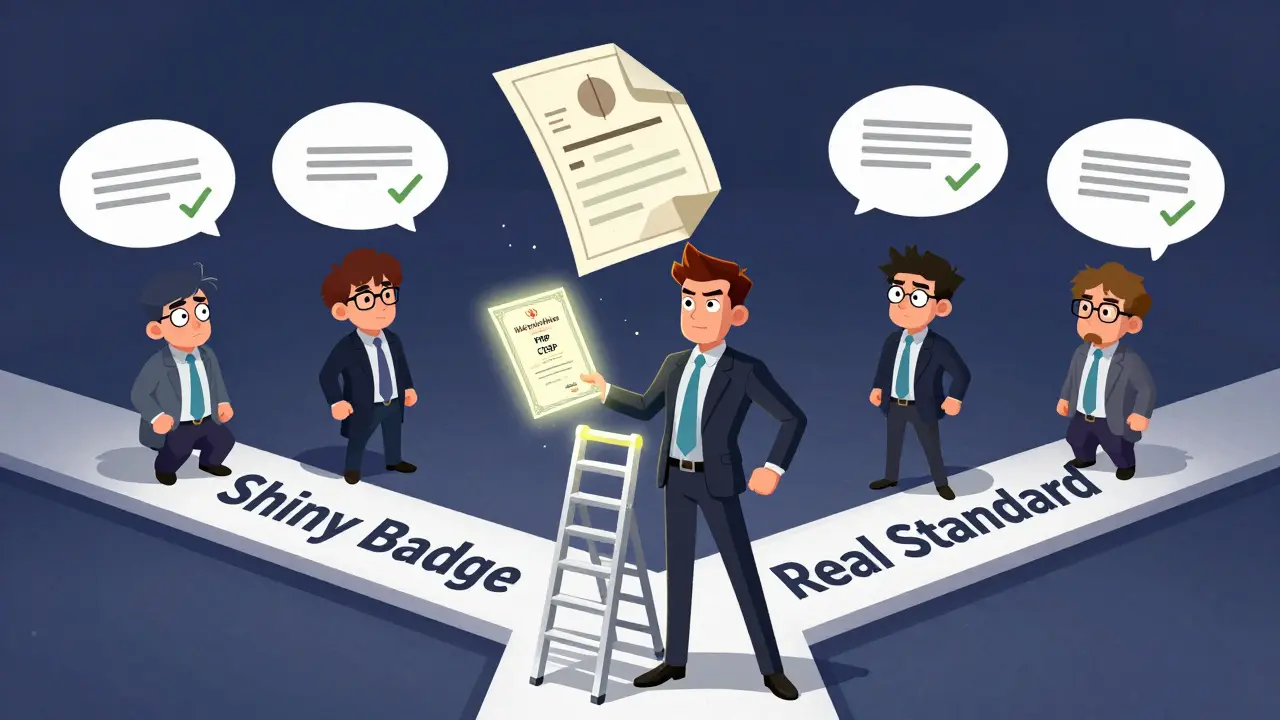
Don’t chase the shiny badge. Chase the standard behind it.
What’s the difference between a certification and a license?
A license is legally required by a government agency to practice a profession - like a nursing license or a real estate broker’s license. A certification is voluntary and issued by a professional association to show you meet industry standards. You can have a certification without a license, but you can’t legally practice in regulated fields without a license.
Can I get certified without a degree?
Yes, many certifications don’t require a degree. For example, the CompTIA A+ certification only requires passing two exams - no degree needed. The Certified Professional in Supply Chain (CPSM) requires three years of experience, not a diploma. But some, like the CPA or PMP, do require a degree or equivalent education. Always check the specific requirements before applying.
Are online certifications as good as in-person ones?
The delivery method doesn’t matter - the standard does. Whether you take the exam online or in a testing center, what counts is whether the certification is backed by a reputable association with validated competencies. Many top certifications, like the Google Project Management Certificate or the SHRM-CP, are now fully online. What matters is who issued it, not where you sat to take it.
How do I know if an association is legitimate?
Check if it’s a nonprofit (look for 501(c)(6) status in the U.S.), if it has a public governance board with named professionals, and if it’s listed on the International Organization for Standardization’s (ISO) directory of certification bodies. Also, search for reviews from current members on LinkedIn or Reddit. Legitimate associations don’t hide their leadership or funding.
Should I get multiple certifications?
Only if they’re relevant to your career path. Holding five unrelated certs looks scattered, not impressive. Focus on one or two that are required or highly valued in your target role. For example, a project manager should prioritize PMP or PRINCE2, not a photography certification. Quality over quantity always wins.
Gina Grub
January 5, 2026 AT 19:54Let’s be real - most certs are just corporate glitter. I’ve seen people spend $3k on some ‘Certified Digital Transformation Guru’ badge that no one in tech has ever heard of. The real ones? PMP, CISSP, CPA. Everything else is noise. Stop buying shiny paper and start aligning with what actually moves the needle.
And if your cert doesn’t require recertification? It’s a tombstone, not a credential.
Nathan Jimerson
January 5, 2026 AT 20:27This is one of the clearest breakdowns I’ve read on certifications. Too many people chase titles without understanding the standards behind them. The checklist at the end? Gold. Bookmarking this for my team.
Sandy Pan
January 7, 2026 AT 19:08There’s a deeper philosophical layer here: certifications are social contracts. They’re not about individual achievement - they’re about collective trust. When an industry agrees on what competence looks like, and enforces it through governance, that’s not bureaucracy - that’s civilization.
What we’re really talking about is epistemic authority. Who gets to define ‘expert’? And why should we believe them?
The answer isn’t marketing. It’s transparency. It’s peer review. It’s accountability. That’s what separates a credential from a scam.
Eric Etienne
January 8, 2026 AT 04:56Ugh. Another ‘professional association’ cult post. You know what’s really respected? Results. Not some 180-question multiple choice test that people memorize and forget the next day.
I’ve hired 50 people with PMPs. Three of them could actually manage a project. The rest just knew how to answer ‘Which process group comes first?’
Stop worshipping certificates. Hire people who ship stuff.
Dylan Rodriquez
January 8, 2026 AT 15:00I love how this post doesn’t just tell you what to do - it gives you the why. And honestly? It’s not about the cert. It’s about the community behind it.
When you earn a CISSP, you’re not just passing a test. You’re joining a global network of people who care about security standards. You’re agreeing to uphold ethics. You’re committing to stay current.
That’s the real value. Not the logo. Not the PDF. The responsibility.
And yes - if a cert doesn’t offer scholarships? That’s not just unfair. It’s a failure of the profession.
Amanda Ablan
January 9, 2026 AT 09:43My brother spent $2k on a ‘Certified Agile Coach’ from some random site. Got zero traction. Then he got his CSM through Scrum.org - same price, same course, but actual credibility. He got hired within a month.
Don’t get me wrong - I get why people fall for the scam certs. They’re marketed like life-changing magic. But the real ones? They’re quiet. They’re rigorous. And they don’t need to scream to be respected.
Meredith Howard
January 9, 2026 AT 18:21Very thorough analysis. I would add one more criterion: Is the certification recognized by international bodies? Many U.S.-based certs have limited global validity. If you’re working remotely or in multinational teams, that matters. ISO 17024 accreditation is a strong signal of legitimacy.
Also, check if the cert is listed in O*NET or similar labor databases. That’s a government-backed indicator of industry demand.
Yashwanth Gouravajjula
January 10, 2026 AT 18:51In India, many companies don’t even know PMP exists. They want local certs like NASSCOM or CII. But global ones still open doors abroad. So I recommend getting one global + one local. Balance is key.
Kevin Hagerty
January 12, 2026 AT 05:16Wow. Another sanctimonious guide on how to waste your money the right way. PMP? CISSP? Please. I’ve worked with people who passed those exams and still couldn’t write a coherent email.
And the ‘nonprofit’ argument? LOL. Most of these ‘associations’ are just fancy LLCs with a 501(c)(6) sticker. They make millions selling prep courses.
Real skill? Comes from doing. Not from memorizing a 500-page handbook you’ll never use again.
Janiss McCamish
January 12, 2026 AT 19:27My boss used to think certifications were useless. Then we hired a guy with SHRM-CP. He fixed our entire compliance mess in 3 weeks. Now we require it for all HR roles.
Don’t judge the cert. Judge the outcome. If it changes how people work - it’s worth it.
Richard H
January 12, 2026 AT 23:52Forget all this global nonsense. If you’re in the U.S., stick to American certifications. The PMP, CPA, CFA - these are built by Americans, for Americans. Why waste time on some international credential that no U.S. employer even recognizes?
Support your own country’s standards. That’s what real professionalism looks like.
Kendall Storey
January 13, 2026 AT 07:17Love this. The ‘check the governance’ part? Spot on. I once dug into a cert that claimed to be ‘industry-leading’ - turns out the board was three people from the same company that sold the training.
Red flag #1: Their ‘expert panel’ had zero practicing professionals.
Red flag #2: Their website had more ads than content.
Walk away. Always.
Ashton Strong
January 14, 2026 AT 08:55This is an excellent and thoughtful resource. I’ve shared it with every junior professional I mentor. The emphasis on recertification and equity is especially important - credentials should elevate the field, not gatekeep it.
For those feeling overwhelmed: start with one. Research it deeply. Talk to certified professionals on LinkedIn. Ask: ‘What did this actually do for your career?’
Then act. Not with fear. With intention.
Steven Hanton
January 15, 2026 AT 05:35One thing this post doesn’t address: the psychological impact of certification. For many, especially from underrepresented backgrounds, earning a recognized credential isn’t just about employment - it’s about validation. It’s about saying: ‘I belong here.’
That’s why accessibility matters. That’s why scholarships aren’t charity - they’re justice.
And that’s why the best certifications don’t just measure competence - they build belonging.
Eric Etienne
January 15, 2026 AT 23:41Actually, I’ll take your point about results over paper - but here’s the thing: the people who pass the PMP and CISSP? They’re usually the ones who’ve already been doing the work. The cert doesn’t make them good. It just proves they’ve been doing it long enough to get tested on it.
So maybe it’s not the cert that’s useless - it’s the people who think the cert is the goal, not the journey.