Protecting Course IP: Assignments for Co-Instructors and SMEs
 Jul, 24 2026
You spent three years building a signature curriculum. You hired an industry expert to record the video modules. Then, six months later, that expert launches their own version of your course on Udemy using the exact same slide deck. Sound familiar? It happens more often than you’d like to admit in the online education space. The root cause is almost always the same: a missing or vague Intellectual Property Assignment.
When you bring on co-instructors and Subject Matter Experts (SMEs) who contribute specific knowledge or teaching materials to an educational product, you are entering a high-risk zone if you don’t have clear contracts. Without a written agreement stating who owns what, you might find yourself sharing revenue-or worse, losing control-over content you paid someone else to create.
Why "Work Made for Hire" Isn't Enough
Many founders assume that because they paid the instructor, they own the work. In many jurisdictions, including the United States, this assumption can be legally dangerous. Copyright law generally presumes that the creator of a work retains ownership unless there is a written instrument explicitly transferring those rights to the hiring party.
The concept of work made for hire applies strictly to employees working within the scope of their employment. If your co-instructor or SME is classified as an independent contractor-which most are-their contributions do not automatically become your property. They remain the copyright holder. This means they could theoretically license that same script to your competitor next week. An explicit IP Assignment Agreement bridges this gap by forcing a transfer of title from the creator to the company.
Distinguishing Between Co-Instructors and SMEs
Not all contributors are created equal, and your contract should reflect the nature of their involvement. Understanding the difference helps you draft clauses that protect your business without scaring off top talent.
| Role | Primary Contribution | Default IP Risk | Key Contract Clause Needed |
|---|---|---|---|
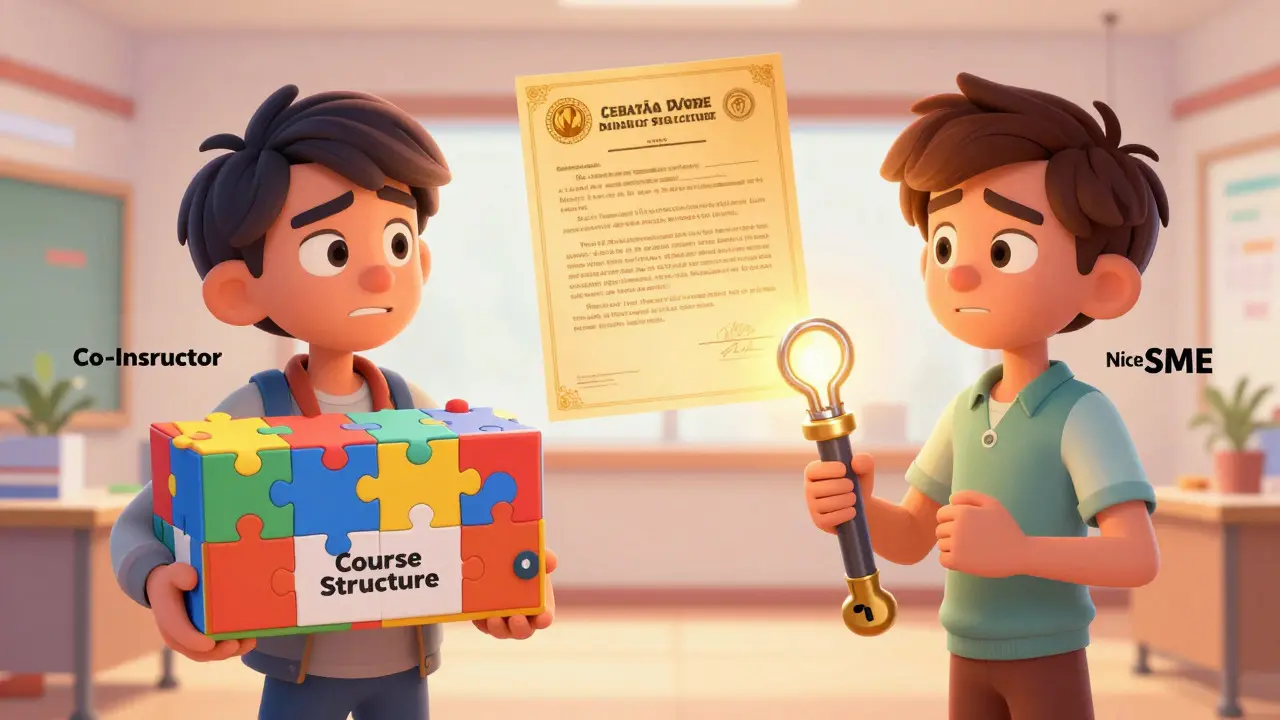
| Co-Instructor | Teaching delivery, module structure, quizzes | High: They may claim ownership of the course structure or scripts they wrote. | Full assignment of all created materials; non-compete for similar courses. |
| SME (Subject Matter Expert) | Technical accuracy, niche data, case studies | Medium: They may retain rights to pre-existing proprietary methodologies. | Licence grant for pre-existing IP; assignment of new derivatives. |
A Co-Instructor is often deeply involved in the pedagogical design. They help decide how the lesson flows, write the exam questions, and sometimes even record the audio. Because their input shapes the final product significantly, you need a broad assignment clause. This ensures that every email, document, and recording produced during the engagement belongs to your platform.
An SME, on the other hand, might just review a technical chapter or provide a unique dataset. They often bring "background IP"-knowledge or tools they developed before meeting you. You cannot assign what they already owned. Instead, you need a robust license granting you the right to use their background IP within your specific course forever.
Core Clauses Every Assignment Must Include
To build a bulletproof agreement, you need to move beyond generic templates. Here are the specific sections that prevent disputes down the line.
- Definition of Deliverables: Be painfully specific. Do not say "course materials." Say "all video recordings, PowerPoint slides, quiz banks, and student handouts created between [Start Date] and [End Date]." Ambiguity is where lawsuits start.
- Moral Rights Waiver: In some countries, creators have "moral rights" to be credited or to object to modifications. If you want to update your course annually without asking permission, you need a waiver of these rights.
- Background IP License: As mentioned, SMEs often use their own frameworks. Ensure the contract states: "Contributor grants Company a perpetual, irrevocable, worldwide, royalty-free license to use any pre-existing intellectual property incorporated into the Deliverables."
- Indemnification: What if the SME accidentally copies a chart from a copyrighted textbook? You need them to indemnify (protect) your company against third-party claims of infringement.
- Residual Knowledge Clause: This protects the contributor. It allows them to use general skills, experience, and know-how gained from the project for future work, as long as they don’t copy your specific files. This makes the contract feel fairer and increases acceptance rates.
Navigating Joint Ownership Traps
Avoid joint ownership at all costs. When two parties jointly own a copyright without a clear agreement, either party can often license the work to others without accounting to the first party. Imagine your co-instructor selling your course content to a corporate training firm while you’re asleep. Under default joint ownership rules, they might actually be allowed to do that.
Your goal is sole ownership. The contract must state that the company is the sole owner of all deliverables. If you must share ownership due to negotiation leverage, define exactly how royalties are split and require mutual consent for any sublicensing. But honestly, sole ownership is cleaner for scaling your business.
Common Pitfalls with Remote Teams
If you are hiring globally, jurisdiction matters. A contract signed in California might look different from one enforced in Germany or India. Local labor laws can override standard IP clauses. For instance, some European countries have strong protections for employee-created works that limit how much you can assign upfront.
Always specify the governing law and venue for dispute resolution. If you are based in New York, you want your contract to say disputes will be handled in New York courts. This discourages international freelancers from dragging you into expensive local litigation.
Practical Steps Before Signing
Before you send that contract, audit your current assets. Do you have proof of when each asset was created? Timestamped emails, version history in Google Docs, or metadata in video files can serve as evidence of creation dates if a dispute arises. Keep these records organized. They act as a backup layer of protection alongside your legal documents.
Also, consider using a digital signature platform that provides an audit trail. Services like DocuSign or HelloSign create a verifiable chain of custody showing exactly when and where the document was signed. This small step adds significant credibility if you ever need to prove the contract’s validity in court.
FAQ: Intellectual Property for Educators
Do I need an IP assignment if the co-instructor is an employee?
Yes. While "work made for hire" laws cover employees, it is still best practice to have a written assignment agreement. It clarifies expectations, covers inventions made outside of normal hours, and ensures moral rights are waived, preventing future ambiguity about who controls the content.
Can an SME keep the rights to their personal framework used in my course?
Yes, but you need a specific license. You cannot assign pre-existing IP. Instead, the contract should grant you a perpetual, exclusive, or non-exclusive license to use that framework within your specific course materials. Define the scope clearly so you aren't blocked from updating the course later.
What happens if we don't sign anything and just agree verbally?
You likely lose ownership. In most common law jurisdictions, copyright transfers require a written document. A verbal agreement is hard to enforce and leaves you vulnerable to the creator claiming full ownership and demanding royalties or blocking your distribution channels.
Should I include a non-compete clause in the IP assignment?
Non-competes are tricky and often unenforceable depending on your location (e.g., restricted in California). Instead, focus on a "non-solicitation" and "confidentiality" clause. Prevent them from stealing your students or leaking your unreleased curriculum, rather than banning them from working entirely.
How do I handle AI-generated content in our courses?
Current US copyright law does not protect purely AI-generated works. If your SME uses AI to write scripts, ensure the contract states that the human editor assumes responsibility for originality and that any human-edited portions are assigned to you. Clarify that the SME warrants the content does not infringe on third-party training data copyrights.