Recording Student Data and Consent Requirements in Courses
 Feb, 1 2026
When you record student data in a course-whether it’s video lectures, quiz responses, discussion posts, or attendance logs-you’re handling personal information that’s protected by law. It’s not just a best practice. It’s a legal obligation. Many educators assume that because they’re in a classroom or online course, they can record and store student data however they like. That’s a dangerous assumption. In 2026, schools and course providers face stricter rules than ever before. Failing to get proper consent or mismanaging student data can lead to fines, lawsuits, or even loss of accreditation.
What counts as student data?
Student data isn’t just names and grades. It includes anything that can identify a student and is tied to their educational activity. That means:
- Video or audio recordings of students participating in class
- Written responses in discussion boards or assignments
- Quiz scores, progress tracking, and time spent on tasks
- IP addresses, device IDs, or browser fingerprints used to track engagement
- Biometric data like facial recognition used for attendance
Even if you don’t store a student’s name, if their voice, face, or writing style can be linked back to them, it’s still personal data under laws like FERPA in the U.S., GDPR in Europe, and similar regulations worldwide. If you’re teaching students under 18, the rules get even tighter. Parental consent isn’t optional-it’s required.
Why consent matters more than ever
Consent isn’t a checkbox you click to get through compliance training. It’s a clear, informed agreement from the student-or their guardian-that they understand what data is being collected, why, and how it will be used. Many institutions still use vague language like “by enrolling, you agree to data collection.” That’s not consent. That’s a legal loophole waiting to be closed.
True consent means:
- Students know exactly which data is being recorded
- They understand how long it will be stored
- They’re told who has access to it
- They can opt out without penalty
- They can request deletion at any time
A 2025 study by the National Association of College and University Attorneys found that 68% of institutions had consent forms that failed basic legal standards. Common problems? No mention of third-party tools, no clear opt-out process, and no explanation of how data might be used for research or analytics. If your consent form looks like a terms-of-service agreement from a social media app, it’s not valid.
Legal frameworks you can’t ignore
There’s no single global law, but here are the big ones that affect most course providers:
- FERPA (Family Educational Rights and Privacy Act): Applies to U.S. schools that receive federal funding. Protects student education records. Requires written consent before disclosing personally identifiable information, with limited exceptions.
- GDPR (General Data Protection Regulation): Applies if you teach students in the EU or collect data from them. Requires explicit consent, right to access, right to be forgotten, and data protection impact assessments.
- COPPA (Children’s Online Privacy Protection Act): Applies if your course includes students under 13. Requires verifiable parental consent before collecting any data.
- CCPA/CPRA (California Consumer Privacy Act): Gives California residents rights to know, delete, and opt out of the sale of their personal data. Applies to any course provider doing business with Californians.
Many institutions think they’re safe because they’re not in California or the EU. But if a single student from those regions enrolls, those laws apply to them. Location doesn’t matter-student citizenship or residency does.
What your consent form must include
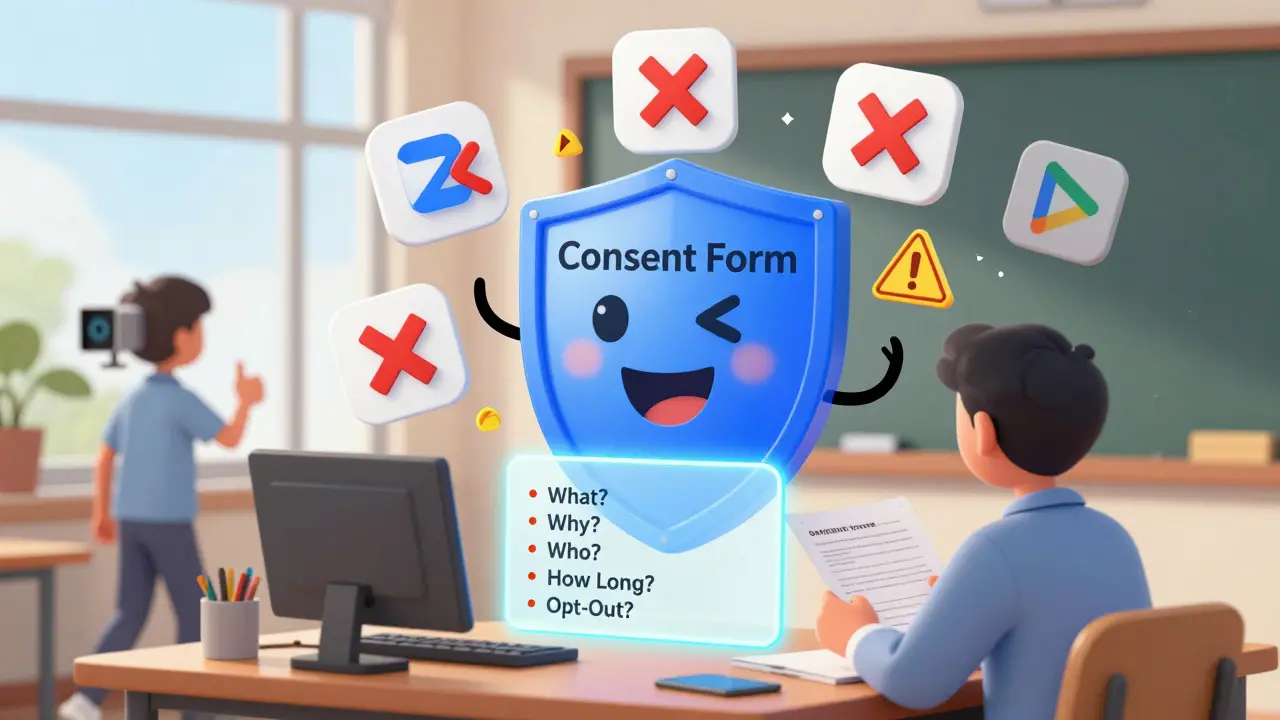
A legally sound consent form isn’t a wall of text. It’s clear, concise, and student-friendly. Here’s what every form needs:
- What data is collected: List each type-audio, video, text, metadata. Don’t say “all activity.” Say “video recordings of live sessions, quiz responses, and timestamps of logins.”
- Why it’s collected: “To assess participation” or “to improve course design” is acceptable. “For marketing purposes” is not unless you get separate consent.
- Who has access: Name the departments, vendors, or third parties (like LMS providers) that can view or store the data.
- Storage duration: “We keep recordings for 12 months after course end” is better than “as long as needed.”
- How to withdraw consent: Provide a direct link or email address. Don’t bury it in fine print.
- Consequences of refusal: “You can opt out of video recording without affecting your grade” is critical.
Include a signature line-digital or physical. And always give students a copy. No one should sign something they never see again.
Tools and platforms you’re already using
You’re probably using Zoom, Canvas, Moodle, or Google Classroom. But just because a platform is popular doesn’t mean it’s compliant. Many LMS tools collect student data for analytics, advertising, or product improvement-and that data might be shared with third parties.
Before you use any tool:
- Check the vendor’s Data Processing Agreement (DPA)
- Verify they’re certified under GDPR or SOC 2
- Ask if they store data in the EU or U.S.-and why that matters
- Confirm students can’t be tracked across other platforms
For example, Zoom’s default settings record meeting metadata and may store data on U.S. servers. If you’re teaching a student from Germany, that’s a GDPR violation unless you’ve enabled EU data centers and obtained explicit consent. Many institutions learned this the hard way after fines in 2024.
What happens if you don’t follow the rules
Penalties aren’t theoretical. In 2024, a U.S. community college was fined $210,000 for recording student discussions without consent and sharing them with a third-party analytics firm. A European university lost €1.2 million for using facial recognition in online exams without proper impact assessments.
But beyond fines, there’s reputational damage. Students and parents are more aware than ever. A single complaint can trigger an investigation. A negative review on Trustpilot or Reddit can cost you enrollment. And once trust is broken, it’s hard to rebuild.
Practical steps to get compliant today
You don’t need a legal team to start. Here’s what to do in the next 30 days:
- Inventory your data flows: List every tool, platform, and method you use to collect student data. Include backups, cloud storage, and shared drives.
- Review your consent forms: Are they clear? Are they signed? Do they mention all data types? If not, rewrite them.
- Train your staff: Instructors, TAs, and admins need to know what they can and can’t record. A quick 15-minute briefing isn’t enough-do a live demo with real examples.
- Offer alternatives: If a student opts out of recording, give them another way to participate-like submitting written summaries or attending live office hours.
- Set automatic deletion: Use tools that auto-delete recordings after 12 months. Don’t rely on someone remembering to delete them manually.
Start small. Pick one course. Fix its consent process. Then expand. Compliance isn’t a project-it’s a habit.
What to do if a student asks for their data to be deleted
Under GDPR and CCPA, students have the right to request deletion of their personal data. This includes recordings, messages, and grades tied to their identity. You can’t say no unless there’s a legal reason to keep it-like an ongoing investigation or accreditation audit.
When a request comes in:
- Verify the student’s identity (ask for ID or login details)
- Locate all copies-cloud, email, backups, USB drives
- Remove data from all systems within 30 days
- Confirm deletion in writing
Keep a log of all deletion requests. It’s your proof of compliance.
How to stay ahead of future rules
Privacy laws are changing fast. In 2025, at least 12 U.S. states passed new student data privacy bills. Canada, Australia, and Brazil are tightening their rules too. What’s legal today might be illegal next year.
Stay updated by:
- Subscribing to your institution’s legal compliance newsletter
- Joining EDUCAUSE or IAPP for education-specific privacy resources
- Reviewing your policies every six months, not annually
- Asking students for feedback: “Do you feel safe sharing your voice in this course?”
Compliance isn’t about avoiding punishment. It’s about respecting people. Every student has the right to control their own data. When you honor that, you build trust-not just legal safety.
Do I need consent to record a lecture if no students are visible or audible?
If the recording contains only the instructor’s voice and slides with no student interaction, consent isn’t legally required under FERPA or GDPR. But if the lecture is part of a course where students are enrolled, and the recording is stored in a system tied to their accounts (like an LMS), it’s still considered an education record. Best practice: disclose that recordings are made and give students the option to opt out of receiving them.
Can I use AI tools to transcribe student discussions?
Only if you’ve disclosed it in your consent form and obtained explicit permission. AI transcription services often send audio to third-party servers, which may store or analyze the data. This counts as sharing personal information. Many institutions have been fined for using tools like Otter.ai or Descript without informing students or getting consent.
What if a student refuses to give consent but still wants to take the course?
They still have the right to enroll. You cannot deny access to a course because a student refuses to consent to data recording. Instead, offer alternative participation methods-like written reflections, live participation without recording, or anonymous submissions. Your goal is inclusion, not compliance at the cost of access.
Are grades considered student data?
Yes. Grades, feedback, and evaluation records are protected under FERPA and GDPR. Even if you only share grades with the student, storing them in a system that links them to their identity counts as personal data. You must secure these records and only share them with authorized personnel.
Can I record public Zoom sessions if students are in a university classroom?
No. Even if the session is “public,” if students are enrolled in a course and their participation is recorded, it’s still educational data. The location doesn’t override their privacy rights. Always get consent before recording, regardless of whether the room is open to the public.
Kieran Danagher
February 2, 2026 AT 05:39Let’s be real - most institutions treat consent like a box-ticking exercise. You get a 10-page PDF no one reads, click ‘I agree,’ and move on. The law doesn’t care how you feel about it. It cares if you documented it, if you gave opt-out, and if you actually deleted data when asked. If your LMS vendor can’t show you a DPA that’s GDPR-compliant, you’re already in violation. Stop outsourcing your liability to tech companies that don’t give a damn about your students.
poonam upadhyay
February 2, 2026 AT 20:28OMG I JUST REALIZED MY PROF USED OTTER.AI TO TRANSCRIBE OUR DISCUSSIONS AND NEVER TOLD US??? THAT’S A CRIME!! THEY’RE SELLING OUR VOICES TO AD TARGETERS!! I SWEAR I HEARD A BOT LAUGHING AFTER I SAID ‘I THINK WE SHOULD JUST QUIT’ - IT WASN’T A JOKE, IT WAS A DATA POINT!!
Shivam Mogha
February 3, 2026 AT 15:32Consent isn’t optional. It’s basic human decency.
Anand Pandit
February 4, 2026 AT 13:35This is such an important post. I’ve been pushing my department to update our consent forms for months and got zero support until now. We’re switching to plain language versions next semester - no legalese, just clear bullet points. Students actually read them now. Small wins matter.
Nikhil Gavhane
February 5, 2026 AT 11:07I appreciate how you broke this down. I used to think compliance was just paperwork, but now I see it’s about respecting people’s right to control their own presence. That’s something every educator should carry with them, not just check off a list.
Sheetal Srivastava
February 7, 2026 AT 02:48Let me be clear - the entire edtech ecosystem is a surveillance capitalist Ponzi scheme disguised as ‘learning analytics.’ You think Zoom is innocent? It’s harvesting biometric micro-expressions from your students’ faces during quizzes. And you’re letting it happen because you’re too lazy to read the Terms of Service. FERPA doesn’t even touch this. This isn’t education - it’s behavioral mining.
Eka Prabha
February 8, 2026 AT 07:29Why are we even having this conversation? The government should just ban all recordings in education. If you can’t teach without recording, you’re not teaching - you’re manufacturing content for algorithms. Students aren’t data points. They’re human beings. And we’ve turned classrooms into data farms because convenience trumps ethics. Pathetic.
OONAGH Ffrench
February 8, 2026 AT 11:18Consent is not a form it is a conversation
Too many assume signing means understanding
It does not
True consent requires dialogue not delegation
Ask what they fear about being recorded
Listen to the silence between their words
That is where the real compliance begins
Samar Omar
February 9, 2026 AT 18:39Oh darling, let me tell you - I’ve been auditing institutional consent frameworks since 2021, and I’ve never seen anything less rigorous than what passes for ‘compliance’ in most universities. The average form reads like a Terms of Service from a shady cryptocurrency exchange - vague, buried, and deliberately uninterpretable. And don’t even get me started on the ‘opt-out’ clause that’s hidden under a footnote in 6pt font. If your institution hasn’t hired a dedicated data ethics officer by 2026, they’re not just negligent - they’re morally bankrupt. You cannot outsource human dignity to a third-party LMS vendor whose sole KPI is ‘engagement metrics.’ This isn’t pedagogy. It’s digital colonialism wrapped in a syllabus.
Rajat Patil
February 10, 2026 AT 04:22I think the most important part is not the law but the attitude
If we see students as people not data we will do the right thing
Even without a law
Bharat Patel
February 10, 2026 AT 21:14It’s funny how we’re so quick to protect data when it’s about money or passwords but forget that a student’s voice, their hesitation, their unique way of phrasing an idea - that’s also private. That’s their mind. Recording it without consent is like stealing a diary. We don’t need more laws. We need more humility.
rahul shrimali
February 11, 2026 AT 22:43Just fix your consent forms already
It’s not hard
Students will thank you
Natasha Madison
February 13, 2026 AT 21:46Did you know the UN is secretly pushing this to track global student movements? Consent forms are just the front. Once they have your kid’s voiceprint and writing style, they can predict political leanings. That’s why they’re pushing ‘GDPR for students’ - it’s not about privacy, it’s about control. The same people who banned school prayer are now digitizing every syllable you say. Wake up.
Bhavishya Kumar
February 14, 2026 AT 06:58The original post contains several grammatical inconsistencies including inconsistent capitalization in headings and improper use of serial commas in lists. Furthermore, the phrase 'data flows' is technically inaccurate - it should be 'data processing activities' under GDPR terminology. While the intent is commendable, the lack of precision undermines its authority. A properly drafted consent form must adhere to ISO/IEC 29100:2011 standards for privacy by design. Please revise.
Vishal Gaur
February 14, 2026 AT 08:14I read this whole thing and honestly I’m just tired. I teach five classes, grade 200 papers a week, and now I have to become a data lawyer too? My school gives me zero training, zero support, and then expects me to be compliant? The system is broken. They want us to fix it but won’t give us the tools. So yeah, I’m just gonna keep recording and hope no one complains. It’s not ideal, but it’s realistic.
Bhagyashri Zokarkar
February 15, 2026 AT 08:51i just realized my professor recorded our whole group project meeting last week and posted it on canvas… and we never signed anything… i cried for 2 hours… i said something dumb and now its out there forever… what if someone i know sees it… what if my future employer sees it… i just want to disappear
ujjwal fouzdar
February 17, 2026 AT 03:02Every time we record a student, we’re not just capturing sound - we’re freezing a moment of their soul. And then we store it in a server somewhere, labeled with a number, waiting for some algorithm to analyze their tone and predict their future. What if that algorithm decides they’re ‘low engagement’ and denies them a scholarship? What if it flags their voice as ‘suspicious’ because they paused too long? We’re not protecting data - we’re building a digital cage. And we call it education.
Reshma Jose
February 19, 2026 AT 01:51My school just rolled out a new consent form - short, visual, with checkboxes and emojis. Students actually read it. We had 98% opt-in for recordings. Turns out people will agree if you treat them like humans. Who knew?
Rakesh Dorwal
February 19, 2026 AT 09:45They say GDPR is for Europeans but what about us? We’re students too. Why should only Europeans get privacy? If my data can be stored on a US server, then I should have the same rights. This isn’t about borders - it’s about dignity. And if you’re not fighting for that, you’re part of the problem.