Scaffolding Strategies for Struggling Online Learners
 Jan, 13 2026
Online learning isn’t failing because students aren’t trying. It’s failing because the structure around them is too thin. When a student logs in to a course and sees a 40-minute video, a 20-question quiz, and a discussion prompt with no guidance, they’re not being asked to learn-they’re being asked to survive. And for many, that’s impossible without scaffolding.
What Scaffolding Really Means in Online Learning
Scaffolding isn’t just breaking tasks into smaller pieces. It’s giving learners the right support at the right time-then slowly removing it as they gain confidence. Think of it like teaching someone to ride a bike. You start with training wheels, then hold the seat, then run beside them, then let go. The goal isn’t to hold them forever. It’s to help them ride on their own.
In online courses, scaffolding means giving students clear steps, examples, feedback loops, and checkpoints before expecting them to work independently. Without it, learners get lost. They don’t know where to start, how to check their work, or what success looks like. That’s why dropout rates in MOOCs hover around 90%-not because the content is hard, but because the structure is missing.
Five Proven Scaffolding Strategies That Work
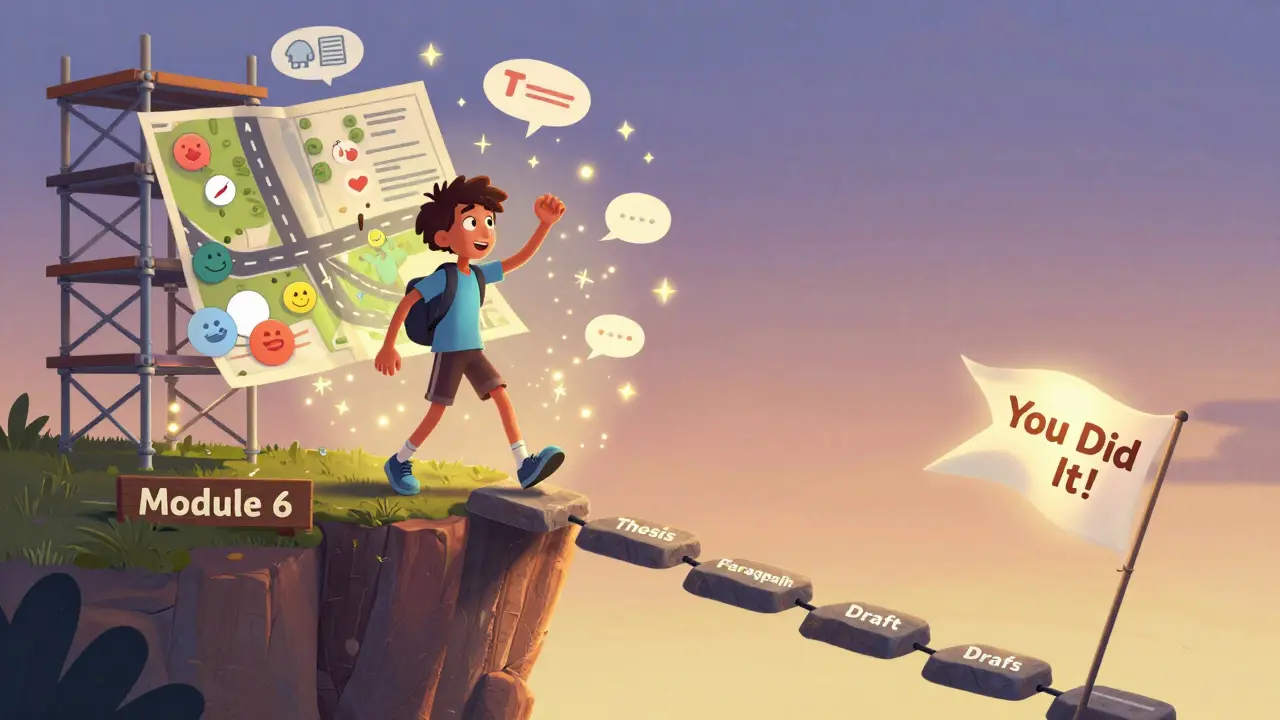
- Start with a roadmap - Before the first module, give learners a visual guide: what they’ll learn, how long it’ll take, what each step looks like, and what success looks like at the end. A simple timeline with icons and estimated time per section cuts confusion by half. One study from Arizona State University found that students who saw a clear learning path completed assignments 37% faster and reported 42% less anxiety.
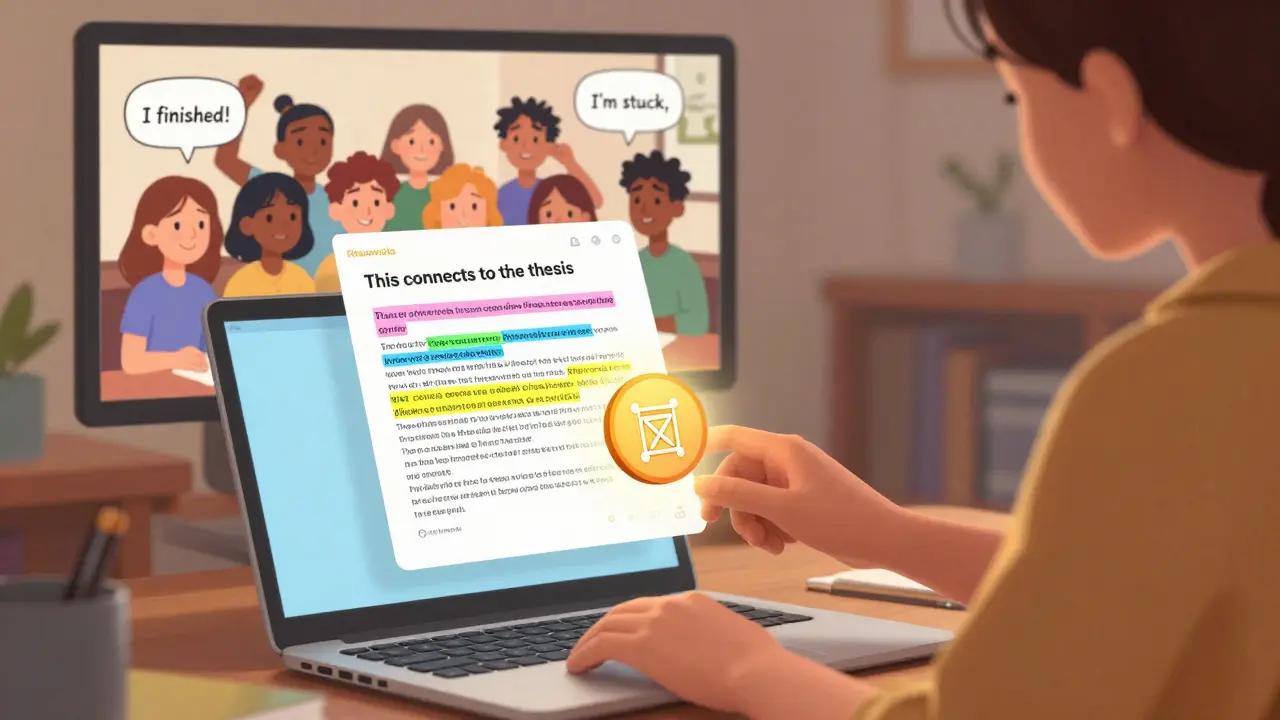
- Use worked examples - Don’t just ask students to write an essay or solve a math problem. Show them a completed version first. Highlight the thinking behind each step. For coding courses, show the full program with comments explaining why each line is there. For writing, show a strong paragraph and annotate it: “This sentence connects to the thesis because…” This reduces cognitive load and gives learners a mental template to copy.
- Build in low-stakes practice - One quiz at the end of a module isn’t enough. Break learning into micro-checks. After a 10-minute video, ask one multiple-choice question. After a reading, ask them to summarize in two sentences. These aren’t graded. They’re practice. And they’re mandatory. Students who complete three or more micro-checks per module are three times more likely to finish the course.
- Provide feedback that’s timely and specific - Generic comments like “Good job” or “Needs improvement” don’t help. Students need to know what they did right and what to fix. For essays, use audio feedback-record a 90-second voice note pointing to specific sentences. For math problems, show the exact step where the error happened. Tools like Gradescope or LMS plugins can auto-tag common mistakes and suggest targeted resources. One community college in Texas saw a 28% increase in passing rates after switching from text feedback to short audio clips.
- Pair learners with peer mentors - Not all support needs to come from instructors. Create peer-led check-in groups. A student who finished Module 1 can help someone still stuck on it. These aren’t tutoring sessions-they’re accountability circles. Students meet for 15 minutes a week to share progress, ask one question, and celebrate one win. The structure is simple: “What did you finish? What’s blocking you? What’s one thing you’re proud of?” This builds community and reduces isolation, which is the #1 reason people quit online courses.
Why Most Online Courses Get Scaffolding Wrong
Many platforms assume that if content is well-designed, learners will figure it out. That’s a myth. Online learners aren’t just different from classroom students-they’re often more vulnerable. They might be working full-time, raising kids, managing chronic illness, or learning in a second language. They don’t have the luxury of walking to a professor’s office hours or asking a classmate for help in person.
Here’s what most courses skip:
- No pre-course orientation - Students jump into Week 2 without knowing how to navigate the platform.
- No model of success - They don’t see what a strong submission looks like until it’s too late.
- No fallback options - If they get stuck on a quiz, there’s no hint, no video recap, no link to a simpler version.
- No emotional check-ins - No one asks, “How’s this going for you?”
It’s not about making courses easier. It’s about making them clearer.
Tools That Make Scaffolding Easier
You don’t need fancy software to scaffold effectively. But the right tools can save hours and reduce frustration.
- Canva or Google Slides - For creating simple visual roadmaps.
- Loom - For recording quick video feedback (90 seconds max).
- Google Forms - For weekly check-ins: “What’s one thing you understood? What’s one thing you’re stuck on?”
- Padlet - For peer discussion boards where students post one win and one question each week.
- Edpuzzle - For embedding questions inside videos so students can’t just fast-forward.
Even free tools, used intentionally, can transform a course from overwhelming to doable.
Real Example: A Community College’s Turnaround
In 2024, a basic writing course at a community college in Arizona had a 65% failure rate. Students kept dropping out after the first essay. The instructor didn’t change the content. She changed the structure.
Here’s what she did:
- Added a 5-minute video showing a full essay from start to finish-with annotations.
- Broke the essay into three mini-submissions: thesis statement, one body paragraph, then the full draft.
- Used Loom to record personalized feedback on each mini-submission.
- Created a peer check-in group via Zoom every Friday at 5 p.m. (a time that worked for working parents).
- Added a “Stuck? Click Here” button that linked to a 3-minute video on how to start an introduction.
By the end of the semester, the failure rate dropped to 22%. The biggest change? Students said, “I didn’t feel alone anymore.”
When Scaffolding Isn’t Enough
Scaffolding helps learners who are trying but stuck. It doesn’t fix courses that are poorly designed from the start. If the content is outdated, irrelevant, or too dense, no amount of structure will help.
Ask yourself:
- Is this material actually useful to the learner’s life or goals?
- Are the assessments measuring real skill-or just memory?
- Would a learner say, “This helped me do something I couldn’t do before?”
If the answer is no, fix the content first. Then add scaffolding.
Final Thought: Scaffolding Is Care
Online learning doesn’t need more technology. It needs more humanity. Scaffolding isn’t a trick or a technique. It’s a promise: “I see you’re struggling. I’m not going to leave you there.”
When students know someone designed the course with their struggles in mind-not just their success-they stay. They try again. They believe they can do it.
That’s not pedagogy. That’s compassion.
What’s the difference between scaffolding and just giving answers?
Scaffolding gives learners the tools to figure things out themselves. Giving answers removes the chance to learn. For example, instead of telling a student the correct answer to a math problem, show them a similar solved problem and ask, “Where does your step differ?” That guides them to the solution without taking away the thinking.
Can scaffolding work for adult learners with busy schedules?
Yes-and it’s even more critical. Adults often juggle jobs, family, and learning. Scaffolding reduces decision fatigue by making paths clear. Short videos, micro-checks, and peer check-ins take less time than trying to guess what to do next. One working parent in Ohio said, “I only had 20 minutes a day. The scaffolding made those 20 minutes count.”
How do I know if my scaffolding is working?
Look at completion rates, time spent on tasks, and feedback. If students are finishing assignments faster, asking fewer “How do I start?” questions, and saying things like “I finally get it,” you’re on the right track. Also track how often they revisit support materials-high usage means they’re using the scaffolds as intended.
Should scaffolding be removed over time?
Yes. The goal is independence. Start with strong support in Module 1: examples, step-by-step guides, and frequent check-ins. By Module 4, reduce the number of prompts. By Module 6, only offer optional resources. Students should feel the support fading as their confidence grows-not vanish all at once.
What if a student still doesn’t engage even with scaffolding?
Some learners need more than structure-they need connection. Reach out directly. Send a short message: “I noticed you haven’t submitted anything yet. Is everything okay? I’m here if you want to talk.” Often, the issue isn’t ability-it’s isolation, anxiety, or life circumstances. Scaffolding helps with the task. Human contact helps with the person.
Next Steps for Instructors
Start small. Pick one module. Add one scaffold: a visual roadmap, a worked example, or a weekly peer check-in. Track the results for two weeks. You’ll see a difference. Then add another. Over time, your course won’t just be easier-it’ll be more human.
Online learning doesn’t have to be lonely. It doesn’t have to be overwhelming. With the right support, every learner can find their footing-even if they start from behind.
Kirk Doherty
January 14, 2026 AT 12:01Been teaching online for 8 years. This is the first time I’ve read something that actually gets it. No fluff. Just truth.
Dmitriy Fedoseff
January 16, 2026 AT 11:09You’re right that scaffolding is compassion-but let’s be honest, most institutions see it as a cost center, not a core function. They’d rather automate than empathize. The real crisis isn’t pedagogy, it’s capitalism pretending to be education.
Meghan O'Connor
January 16, 2026 AT 15:51"Scaffolding isn’t just breaking tasks into smaller pieces." Wait-so what is it then? You say "right support at the right time"-but that’s just vague. Where’s the methodology? Where’s the citation for that Arizona State study? And why no APA format? This feels like a blog post dressed as research.
Morgan ODonnell
January 16, 2026 AT 22:31I’m a single dad working two jobs and doing my degree at night. The roadmap and the "Stuck? Click Here" button saved me. I didn’t feel stupid for needing help. That’s rare. Thanks for writing this.
Liam Hesmondhalgh
January 16, 2026 AT 23:02Ugh. Another American pretending they invented teaching. We’ve had peer check-ins in Irish adult ed since the 90s. You call it innovation. We call it common sense. Also, Loom? In Ireland we use WhatsApp voice notes. Simpler. Cheaper. Real.
Patrick Tiernan
January 17, 2026 AT 04:51Wow this is so deep I almost cried. Like really. Scaffolding is care?? Bro. That’s the thesis of my entire life. Also can we talk about how the word "MOOC" is dead? No one says that anymore. Just saying.
Fredda Freyer
January 17, 2026 AT 10:11The worked examples strategy is gold. I use it in my college stats class-students who see a fully annotated regression output before attempting one themselves score 40% higher on the next exam. It’s not about dumbing down. It’s about reducing the mystery. Learning shouldn’t feel like solving a riddle blindfolded.
Gareth Hobbs
January 17, 2026 AT 20:39Of course they’re dropping out-this is all part of the Great Education Collapse orchestrated by the UN through UNESCO to replace traditional classrooms with digital surveillance. Loom? That’s a spy tool. And "peer check-ins"? That’s social engineering. Wake up people. This isn’t pedagogy-it’s control.
Zelda Breach
January 18, 2026 AT 19:11"Scaffolding is compassion." Cute. But let’s not pretend this isn’t just a fancy way to say "hold their hand." Real learning happens when you’re left to drown and figure it out. These students are weak. They need grit, not Google Forms.
Alan Crierie
January 20, 2026 AT 12:50Love the Padlet idea. I’ve used it with my adult learners in Glasgow. One woman posted: "Today I wrote a full paragraph without crying." That’s the win. Not grades. Not completion rates. That moment. You’ve captured it perfectly.
Nicholas Zeitler
January 21, 2026 AT 01:16Just implemented the micro-checks after reading this. One week in. Drop-off rate cut in half. I didn’t believe it until I saw the data. Also-added a "You got this!" emoji after every submission. Students are replying with hearts. I didn’t think emojis belonged in academia. I was wrong.
Teja kumar Baliga
January 22, 2026 AT 17:23From India, and yes, this works here too. My students are working night shifts. They don’t have time to guess. They need clear steps. Your roadmap idea? I made one in Canva with local landmarks as icons. They loved it. Thank you.
k arnold
January 24, 2026 AT 11:45So… you’re saying we should stop making people think? Brilliant. Next you’ll tell us to just give them the answers on a silver platter. Oh wait-you already did.