Workplace Automation and Its Implications for Training: The 2026 Shift
 May, 28 2026
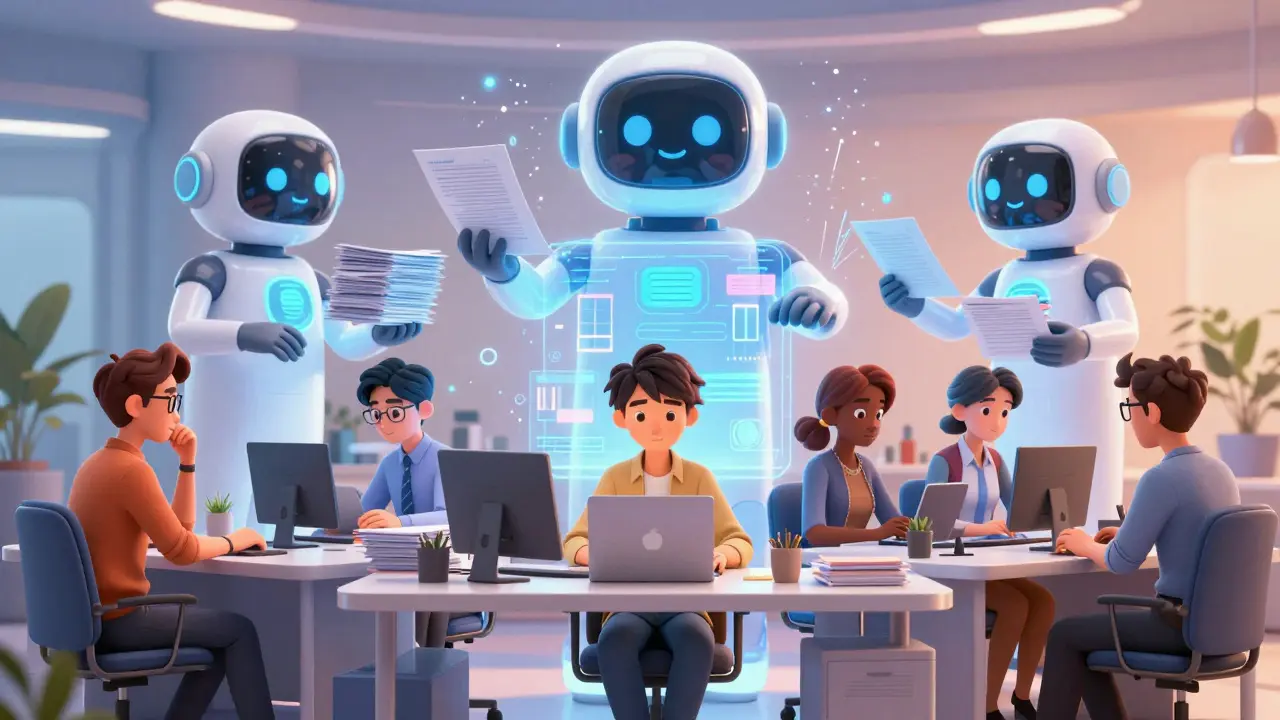
Walk into any office in 2026, and you’ll notice something missing. It’s not the people; it’s the repetitive tasks they used to spend half their day on. Data entry, basic customer service queries, and even preliminary code debugging are now handled by automation tools, which include everything from robotic process automation (RPA) bots to generative AI assistants. This shift has fundamentally changed what we expect employees to do. But here is the catch: most companies haven’t updated their training programs to match this new reality. They are still teaching workers how to push buttons that no longer exist or ignoring the soft skills that machines simply cannot replicate.
The gap between what technology can do and what employees are trained to do is widening. If your organization isn’t actively rethinking its learning strategy, you aren’t just falling behind on efficiency; you’re risking a workforce that feels obsolete before they’ve even started their new roles. The question isn’t whether automation will change your workplace-it already has. The real question is whether your training program is preparing your team to lead alongside these tools rather than compete against them.
What Actually Changes When Work Gets Automated?
To fix the training problem, we first need to understand what automation actually does to a job description. In 2024 and 2025, there was a lot of fear that robots would take all jobs. By 2026, the reality is much more nuanced. Automation doesn’t usually replace entire roles; it replaces specific tasks within those roles. A financial analyst no longer spends forty hours a week reconciling spreadsheets because an algorithm does it in seconds. Instead, that analyst spends their time interpreting complex market trends and advising clients on risk management.
This creates a "task shuffle." Routine, predictable, and data-heavy tasks move to software. Creative, strategic, and interpersonal tasks stay with humans-and often become more valuable because they are harder to automate. For training purposes, this means the curriculum must shift from procedural knowledge (how to fill out Form X) to conceptual knowledge (why Form X matters and how to improve the process).
Consider the role of a marketing coordinator. Five years ago, training focused heavily on mastering specific design software or writing SEO meta-tags manually. Today, AI tools generate drafts and optimize tags instantly. The new training focus is on brand voice consistency, ethical use of AI-generated content, and high-level campaign strategy. If you keep training people on the old manual skills, you’re wasting resources. You need to train them on the judgment calls that require human intuition.
The New Core Competencies for an Automated Workplace
If routine tasks are gone, what should you be teaching? The answer lies in three core competency areas that define the modern worker: digital literacy, critical thinking, and emotional intelligence. These aren’t buzzwords; they are survival skills for 2026 and beyond.
- Digital Literacy: This goes beyond knowing how to use Excel. It means understanding how to interact with AI prompts, recognizing when an automated output might be biased or incorrect, and knowing which tools integrate with your company’s ecosystem. Workers need to be comfortable being "tech-fluent" without necessarily being coders.
- Critical Thinking: When a machine provides an answer, the human’s job is to verify it. Training must emphasize skepticism and analysis. Employees need to learn how to ask the right questions to validate automated results. Can they spot a hallucination in an AI report? Can they identify a logical flaw in an automated workflow?
- Emotional Intelligence (EQ): As technical barriers drop, the premium on human connection rises. Sales, negotiation, leadership, and conflict resolution are deeply human activities. Training programs are seeing a surge in modules dedicated to empathy, active listening, and cross-cultural communication because these are the things that build trust-something algorithms struggle to replicate authentically.
These competencies form the backbone of the new workforce. Without them, employees become bottlenecks. With them, they become multipliers of the technology’s power.
Reskilling vs. Upskilling: Knowing the Difference
In the rush to adapt, many leaders use the terms reskilling and upskilling interchangeably. They are not. Getting this distinction wrong leads to wasted budget and frustrated employees.
Upskilling is about enhancing existing skills. If your graphic designers know Photoshop, upskilling teaches them how to use Midjourney or Adobe Firefly to speed up their workflow. They remain designers, but they are faster and more versatile. This is crucial for keeping current teams relevant as tools evolve.
Reskilling is about learning entirely new skills for a different role. If your administrative support staff are displaced by scheduling bots, reskilling might involve training them in data analytics or customer success management. This is a deeper, more expensive intervention, but it is necessary for roles where the core function has been fully automated.
A balanced training strategy requires both. You upskill the majority to handle the new tech stack, and you reskill a smaller percentage whose roles have fundamentally shifted. Ignoring reskilling leaves vulnerable employees behind, creating internal friction and high turnover costs.

Designing Training for the Age of AI
Traditional classroom lectures and static PDF manuals are dead in the context of rapid automation. Technology changes too fast for annual training cycles. The solution is continuous, micro-learning integrated directly into the workflow.
Imagine a sales rep using a CRM tool. Instead of sending them to a two-day seminar on how to use the new feature, the platform offers a sixty-second interactive tutorial right when they click the button. This is called "just-in-time" learning. It reduces cognitive load and ensures the information is immediately applicable. Studies from leading L&D firms show that retention rates for micro-learning are significantly higher than for traditional block training because the context is preserved.
Furthermore, training itself is becoming automated. AI-driven learning platforms analyze an employee’s performance data and recommend personalized modules. If a coder struggles with a specific Python library, the system suggests a targeted exercise rather than forcing them through a generic bootcamp. This personalization makes training feel less like a chore and more like a helpful resource.
| Feature | Traditional Training | Automation-Era Training |
|---|---|---|
| Frequency | Annual or quarterly | Continuous / Just-in-time |
| Format | Lectures, long videos | Micro-modules, interactive simulations |
| Focus | Procedural steps | Critical thinking & adaptation |
| Personalization | One-size-fits-all | AI-recommended paths |
| Measurement | Completion certificates | Performance impact metrics |
Overcoming Resistance and Building Trust
The biggest hurdle in implementing new training isn’t the technology; it’s the psychology. Employees often view automation as a threat. "If I learn to use this bot, will it replace me?" This fear kills engagement. If your team doesn’t trust the training program, they won’t participate, and the automation investment fails.
Leadership must communicate clearly that automation is a tool for augmentation, not replacement. Training sessions should start with transparency. Show employees exactly what the bot does and, more importantly, what it *doesn’t* do. Highlight the human-centric tasks that become more important. When people see that their unique human skills are valued, resistance turns into curiosity.
Create safe spaces for experimentation. Allow employees to make mistakes with new tools without penalty. Gamify the learning process. Reward teams that find innovative ways to use automation to solve problems. When training is framed as empowerment rather than surveillance, adoption rates skyrocket.

Measuring the ROI of Automation Training
You can’t manage what you don’t measure. In the past, training success was measured by attendance. That metric is useless now. You need to track behavioral change and business outcomes.
Look at key performance indicators (KPIs) such as:
- Time-to-Proficiency: How quickly can a new hire or reskilled employee reach full productivity using the new automated tools?
- Error Rates: Does the training reduce mistakes in processes that were previously prone to human error?
- Employee Satisfaction: Do workers feel more confident and less stressed after the training? Surveys and pulse checks can reveal this.
- Process Efficiency: Are workflows moving faster? Is the bottleneck shifting from execution to decision-making?
If your training program isn’t showing improvements in these areas within six months, it’s time to pivot. Maybe the content is too theoretical. Maybe the delivery method is clunky. Use data to iterate. The goal is a virtuous cycle where better training leads to better automation usage, which leads to better business results, which funds even better training.
The Future Outlook: Lifelong Learning as a Standard
By 2027 and beyond, the concept of a "career" will look very different. The idea that you learn a skill once and use it for twenty years is over. The half-life of a learned professional skill is now estimated to be around five years. This means lifelong learning isn’t a nice-to-have; it’s a requirement for employability.
Companies that thrive will be those that embed learning into their culture. They will offer stipends for external courses, provide internal mentorship programs, and create communities of practice where employees share tips on using new tools. The employer’s value proposition shifts from "we give you a job" to "we help you grow." In a world of rapid automation, the ability to learn is the only permanent job security.
How long does it take to reskill an employee for an automated role?
It varies widely depending on the complexity of the new role. Simple task transitions might take 2-4 weeks of intensive micro-learning. More significant role changes, like moving from administration to data analysis, can take 3-6 months. The key is continuous, supported learning rather than a one-off bootcamp.
Is automation training only for technical staff?
No. Every role interacts with automation in some way. HR uses AI for screening, marketing uses it for content, and finance uses it for forecasting. Non-technical staff often benefit the most from training on how to interpret AI outputs and apply human judgment.
What are the biggest risks of poor automation training?
The biggest risks are low adoption rates, increased errors due to misuse of tools, and high employee turnover. If staff feel threatened or incompetent, they will resist the technology, negating the efficiency gains you hoped to achieve.
How can small businesses afford comprehensive training?
Small businesses can leverage free or low-cost online platforms, peer-to-peer learning circles, and vendor-provided training materials. Many automation software providers offer extensive documentation and webinars specifically designed to help users get up to speed quickly without hiring expensive consultants.
Will AI eventually replace human trainers?
AI will augment trainers, not replace them. AI can deliver content and assess knowledge, but human trainers are essential for motivation, contextualizing learning, and providing emotional support during career transitions. The best model is a hybrid approach.