Adaptive Testing in eLearning: How Personalized Assessments Improve Learning Outcomes
 Mar, 5 2026
Imagine taking a test that changes as you go - getting harder questions when you’re on a roll, easier ones when you’re stuck. That’s adaptive testing in eLearning, and it’s not science fiction. It’s happening right now in online courses, corporate training, and certification programs around the world.
What Is Adaptive Testing?
Adaptive testing is an assessment method that adjusts the difficulty of questions based on how a learner answers previous ones. If you answer correctly, the next question gets tougher. If you get it wrong, the system serves something simpler. This isn’t just random guessing - it’s powered by algorithms that track your skill level in real time.
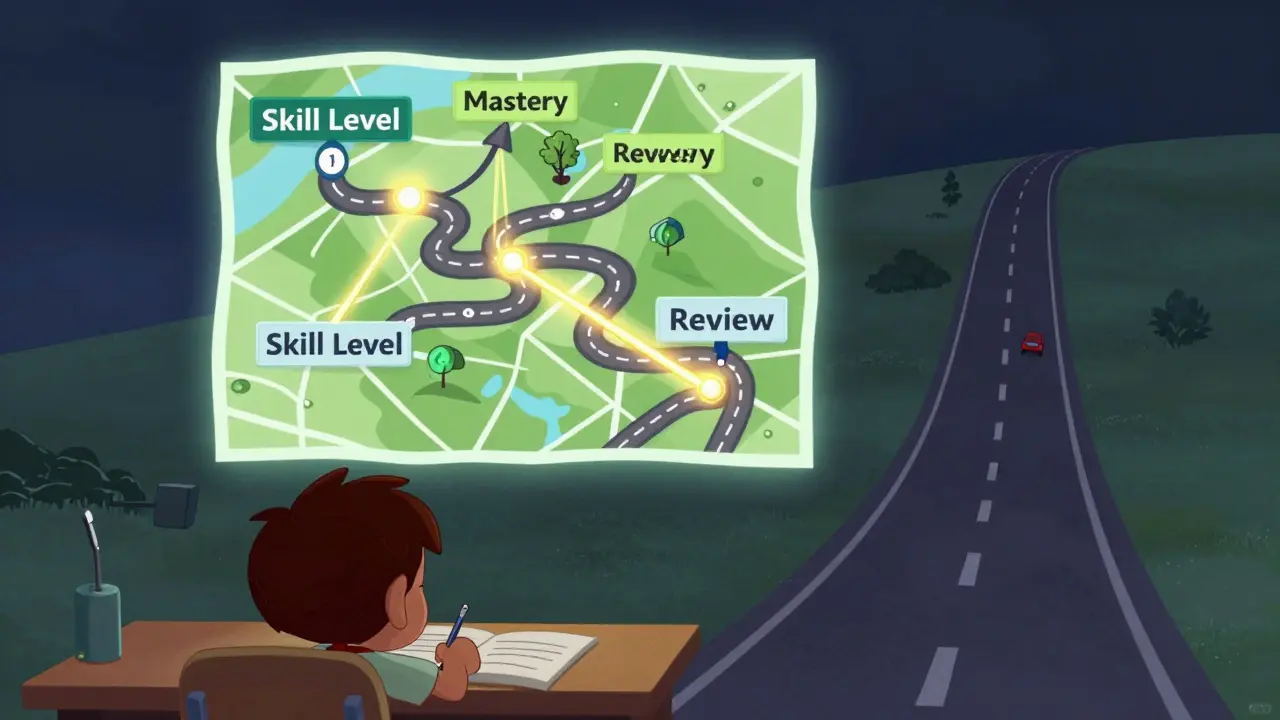
Unlike traditional tests where everyone sees the same 50 questions, adaptive tests can be as short as 10 or as long as 40, depending on how quickly the system pinpoints your ability. It’s like a GPS for learning: instead of showing you every road, it finds the fastest route to your true skill level.
Systems like those used by Pearson, Certiport, and even some modules in Coursera and LinkedIn Learning rely on item response theory (IRT), a statistical model that matches question difficulty with learner performance. These models have been refined over decades - originally used in military and medical certification - and now they’re reshaping online education.
How Adaptive Testing Works
Here’s the step-by-step process behind the scenes:
- A learner starts with a medium-difficulty question - not too easy, not too hard.
- Based on whether the answer is right or wrong, the system selects the next question from a pre-tested pool.
- Each question has been calibrated with data: its difficulty level, how well it distinguishes between skill levels, and how much information it gives about the learner.
- The algorithm keeps updating its estimate of the learner’s ability after each response.
- Once the system is confident (usually after 8-25 questions), it stops and gives a score.
This approach cuts down test time dramatically. A study from the Journal of Educational Psychology in 2024 found that adaptive tests reduced average testing time by 42% compared to fixed-length exams - without losing accuracy. In fact, they were more accurate at placing learners in the correct skill band.
Key Benefits of Adaptive Testing in eLearning
Why are schools, universities, and companies switching to this method? Here are the top reasons:
- Reduced test fatigue - Learners aren’t stuck with 100 questions when they only need 15 to prove mastery. This leads to higher completion rates and better focus.
- Personalized feedback - Instead of just a score, learners get insights like: "You excel in data analysis but need practice with statistical modeling." This turns assessment into a learning tool.
- Faster results - Since the system stops as soon as it’s sure, scores are available instantly. No waiting days for manual grading.
- Higher engagement - When questions feel relevant and challenging - not too easy or too confusing - learners stay motivated.
- More accurate placement - Employers and educators can trust the results. A 2025 survey of 1,200 corporate trainers showed that adaptive assessments reduced misplacement of learners by 68% compared to traditional methods.
One university in Ohio replaced its fixed math placement test with an adaptive version. Within one semester, course dropout rates dropped by 31%. Why? Because students were placed in classes that actually matched their skill level - not based on outdated high school grades or guesswork.

Real-World Examples
Adaptive testing isn’t theoretical. It’s already in use:
- Google Career Certificates - Their IT support and data analytics programs use adaptive quizzes to assess learners before moving to the next module. If you’re already strong in Excel, you skip ahead.
- NCLEX-RN (Nursing Licensure) - The U.S. nursing board has used adaptive testing since 2018. Nurses don’t take 200 questions - they take 75 to 145, depending on how clearly their competence shows up.
- Khan Academy - Their practice dashboards adapt question difficulty based on student performance over time, not just one test.
Even language learning apps like Duolingo use adaptive logic - not just for lessons, but for placement tests. If you get three Spanish verb conjugations right in a row, the system assumes you’re beyond beginner level and pushes you into intermediate content.
Challenges and Limitations
Adaptive testing isn’t perfect. Here are the common concerns:
- Requires a large question bank - Each question must be tested and calibrated with real learner data. Smaller platforms struggle with this.
- Can feel unfair at first - Learners who get a string of hard questions may think they’re failing - even if the system is just trying to find their ceiling.
- Not ideal for all subjects - Creative writing, open-ended projects, or performance-based skills (like public speaking) don’t translate well to multiple-choice adaptive models.
- Technical dependency - If the platform crashes or the algorithm glitches, the whole assessment breaks.
Good designers solve these by giving learners context: "You’re seeing harder questions because you’re doing well," or by including one or two non-adaptive questions for balance.
What’s Next for Adaptive Testing?
By 2026, we’re seeing three big trends:
- Integration with AI tutors - After an adaptive test, learners are automatically routed to personalized review modules. If you struggled with fractions, you get a mini-lesson on fractions.
- Real-time dashboards for instructors - Teachers can now see not just scores, but patterns: "70% of students hit a wall on quadratic equations - let’s reteach that unit."
- Mobile-first adaptive assessments - Short, snack-sized tests optimized for phones, used for just-in-time skill verification in fieldwork or remote jobs.
Some platforms are even testing "adaptive retakes" - where learners can retest immediately after failing, but the system only retests the areas they missed. No need to redo the whole thing.
Why This Matters for Learners and Educators
Adaptive testing flips the script on assessment. Instead of measuring how much you’ve memorized, it measures how well you can apply knowledge. It’s less about ranking and more about growth.
For learners, it means less stress, less wasted time, and more targeted help. For educators, it means better data, fewer guesswork decisions, and the ability to intervene before someone falls behind.
In a world where online learning is growing fast - over 100 million learners now use platforms like edX and Udemy - adaptive testing isn’t a luxury. It’s becoming the baseline for fair, efficient, and meaningful evaluation.
Is adaptive testing the same as personalized learning?
No, but they work together. Personalized learning changes the content you study - like recommending videos or exercises based on your weak spots. Adaptive testing changes the questions you’re asked during an assessment. One is for instruction; the other is for evaluation. Many platforms now combine both.
Can adaptive tests be cheated or gamed?
It’s harder than with fixed tests. Since questions are randomly selected from a large pool and difficulty adjusts instantly, memorizing answers won’t help. Some systems also include distractor analysis - if you consistently pick the same wrong option, it flags you. Proctoring tools can also detect unusual patterns, like rapid-fire answering or switching tabs.
Do adaptive tests work for all age groups?
Yes, but design matters. For kids under 12, tests need simpler language and visual cues. For adults, especially in corporate settings, the focus is on clarity and speed. The core algorithm works across ages - it’s the interface and question style that must adapt.
Are adaptive tests more expensive to create?
Initially, yes. Building a calibrated item bank with thousands of questions takes time and data. But once it’s done, the long-term cost per assessment drops sharply. You save on grading time, reduce retakes, and cut down on learner dropout - which offsets the upfront investment.
Can I use adaptive testing in my own course?
Yes - if you’re using platforms like Canvas, Moodle, or Thinkific with LTI integrations, many now offer built-in adaptive quiz tools. For custom setups, open-source libraries like CAT-ItemBank or R packages (e.g., catR) let you build your own. Start small: adapt just one quiz module and track how learners respond.
Adaptive testing isn’t about replacing teachers - it’s about giving them better tools. It’s not about making tests harder - it’s about making them smarter. And for learners? It’s the difference between being tested on what you’ve memorized - and being recognized for what you truly know.
Glenn Celaya
March 5, 2026 AT 23:25Wilda Mcgee
March 7, 2026 AT 16:55Chris Atkins
March 7, 2026 AT 23:56Jen Becker
March 9, 2026 AT 08:23Ryan Toporowski
March 9, 2026 AT 13:22Samuel Bennett
March 10, 2026 AT 05:27Rob D
March 11, 2026 AT 11:27Franklin Hooper
March 13, 2026 AT 07:31Jess Ciro
March 13, 2026 AT 16:38saravana kumar
March 14, 2026 AT 22:19Tamil selvan
March 16, 2026 AT 11:53Mark Brantner
March 16, 2026 AT 16:22Kate Tran
March 17, 2026 AT 00:44amber hopman
March 17, 2026 AT 10:04Jim Sonntag
March 19, 2026 AT 06:10Deepak Sungra
March 19, 2026 AT 14:25Samar Omar
March 21, 2026 AT 08:57chioma okwara
March 21, 2026 AT 09:05John Fox
March 21, 2026 AT 13:25