Assignment Rubrics for Online Courses: How to Design Clear Criteria and Fair Scoring
 Dec, 1 2025
Creating an online course is only half the battle. The real challenge? Making sure students actually learn-and know exactly how they’re being measured. That’s where assignment rubrics come in. A well-designed rubric isn’t just a grading tool. It’s a roadmap. It tells students what success looks like before they even start. Without it, confusion, frustration, and unfair grading creep in. And when that happens, engagement drops, completion rates fall, and trust erodes.
Why Rubrics Matter More in Online Courses
In a classroom, instructors can glance at a student’s face, hear their questions, or walk over to their desk. Online? None of that. Students work alone, often across time zones, with little feedback until the grade lands in their inbox. If the instructions are vague-"write a thoughtful analysis" or "show understanding"-they’re left guessing. That’s not learning. That’s stress.
Rubrics fix that. They turn abstract expectations into concrete benchmarks. A study from the University of Michigan found that students using detailed rubrics scored 18% higher on assignments and reported 32% less anxiety about grading. Why? Because they knew exactly what was expected. No surprises. No guesswork.
How to Build a Rubric That Actually Works
Start with the end in mind. What should students be able to do after completing this assignment? Not what you want them to write. Not how many sources they need. What skill are you testing? Critical thinking? Communication? Problem-solving? Once you know that, break it down.
Here’s a simple framework:
- Define the task clearly. "Write a 1,200-word case study analyzing a failed marketing campaign." Not "write an essay."
- Identify 3-5 key criteria. These are the core skills or components. For a case study: analysis depth, use of evidence, clarity of structure, writing quality, and real-world relevance.
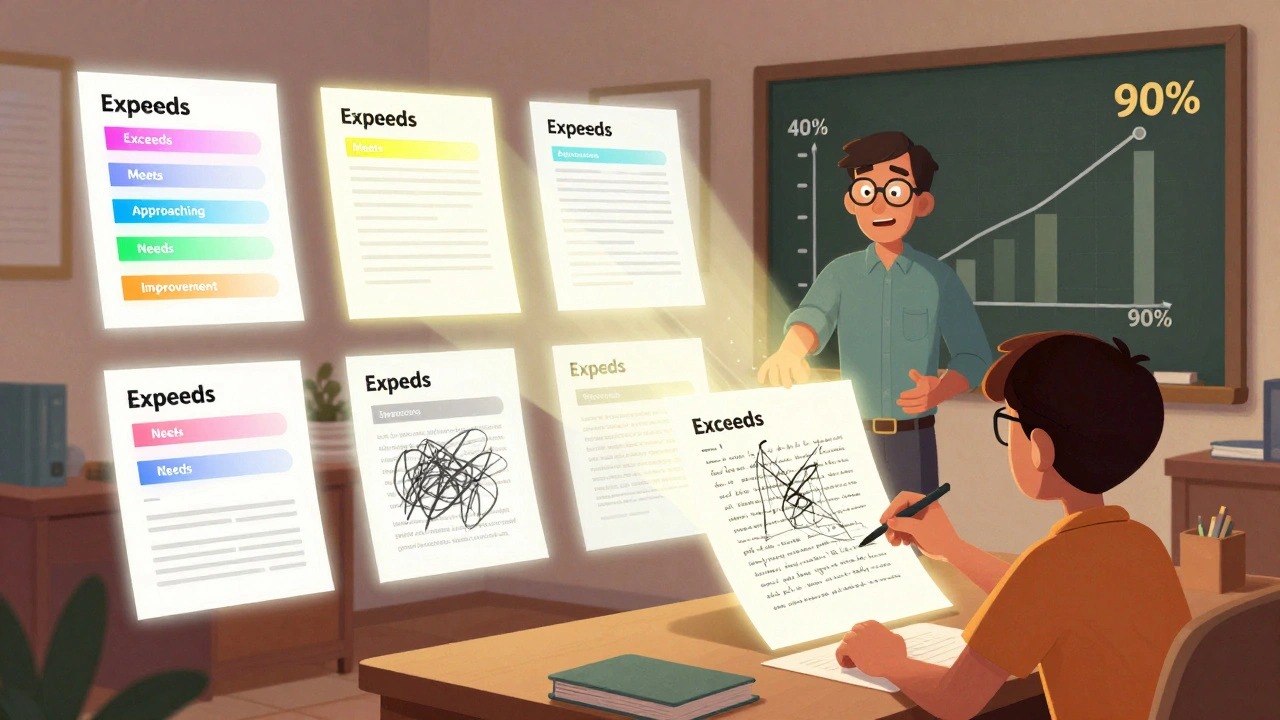
- Set 3-4 performance levels. Don’t use "Excellent, Good, Fair, Poor." Those mean different things to different people. Use descriptive labels like: "Exceeds Expectations," "Meets Expectations," "Approaching Expectations," "Needs Significant Improvement."
- Describe what each level looks like for every criterion. Don’t say "good writing." Say: "Sentences are varied and clear. Grammar and punctuation never distract from the message."
Here’s a real example from a business course:
| Criteria | Exceeds Expectations | Meets Expectations | Approaching Expectations | Needs Significant Improvement |
|---|---|---|---|---|
| Analysis Depth | Identifies root causes beyond surface symptoms; connects to broader industry trends | Identifies clear causes; links to course concepts | Lists observable facts; minimal connection to theory | Describes events without analysis; no connection to course material |
| Use of Evidence | Uses 5+ credible sources with clear integration and citation | Uses 3-4 relevant sources with proper citations | Uses 1-2 sources; citations incomplete or unclear | No sources used or sources are unreliable |
| Clarity of Structure | Logical flow; transitions guide reader; conclusion ties back to key insights | Clear organization; paragraphs have focus; conclusion present | Some organization; paragraphs are disjointed; weak or missing conclusion | No clear structure; ideas jump randomly |
Scoring: How to Make It Fair and Efficient
Every criterion needs a point range. Don’t wing it. Assign weights based on importance. If analysis is the core skill, give it 40% of the total score. Writing quality might be 20%. If you’re grading 50 students, and each rubric has 5 criteria with 4 levels, you’re looking at 20 data points per student. That’s a lot. But it’s also precise.
Use a simple scale: 4 = Exceeds, 3 = Meets, 2 = Approaching, 1 = Needs Improvement. Multiply each level by its weight. A student who scores 4 on Analysis (40%), 3 on Evidence (30%), and 2 on Structure (30%) gets:
(4 × 0.4) + (3 × 0.3) + (2 × 0.3) = 1.6 + 0.9 + 0.6 = 3.1 / 4 → 77.5%
This isn’t just math. It’s transparency. Students can see exactly where they lost points. No more "I don’t get why I got a B."
Common Mistakes to Avoid
Even experienced instructors mess this up. Here are the top three errors:
- Too many criteria. Five is enough. Ten is overwhelming. Students can’t track that many moving parts.
- Vague language. "Clear and organized" isn’t enough. What does clear look like? What does organized mean? Be specific.
- Not sharing it upfront. If students only see the rubric after submitting, you’ve failed. Give it to them with the assignment prompt. Let them use it as a checklist.
Another trap: using rubrics only for grading. That’s a waste. Use them for peer review. Use them for self-assessment. Ask students to grade their own draft using the rubric before submitting. It builds metacognition-and cuts down on revision requests later.
How Rubrics Save You Time (and Sanity)
Grading 80 essays? It’s brutal. But with a rubric, you’re not reading each paper from scratch. You’re scanning for evidence of each criterion. You’re not writing the same comment 20 times. You’re just checking boxes and adding one or two targeted notes.
One instructor at Arizona State University reduced grading time by 40% after switching to detailed rubrics. Why? Because feedback became faster, more consistent, and more actionable. Students didn’t need to ask, "What did I do wrong?"-because they already knew.
What to Do When Students Argue About Their Grade
It happens. Someone gets a 78% and claims they "deserved an 85." With a rubric, you don’t have to guess. Pull up the assignment. Show them the score for each criterion. Point to the description. "You met expectations for analysis, but your evidence only approached expectations. Here’s why."
This isn’t cold. It’s fair. And students respect it. A 2024 survey of 1,200 online learners found that 89% said they trusted grades more when rubrics were used. Trust matters. It keeps students engaged.
Final Tip: Keep Improving Your Rubrics
Your first rubric won’t be perfect. That’s okay. After each course, ask yourself:
- Which criteria were unclear?
- Did students struggle with the same part every time?
- Was there a pattern in low scores?
Then tweak it. Maybe add a criterion for "use of examples." Maybe split "writing quality" into "grammar" and "tone." Small changes make big differences over time.
Assignment rubrics aren’t about control. They’re about clarity. They turn grading from a mystery into a conversation. And in online learning, where isolation is the biggest barrier, clarity is the most powerful tool you have.
Do assignment rubrics work for all types of courses?
Yes-whether it’s a coding bootcamp, a philosophy seminar, or a nursing skills lab. The structure stays the same: define the skill, break it into measurable parts, describe performance levels. For hands-on tasks, include video or checklist components. For creative work, focus on originality, execution, and reflection. The rubric adapts; the principle doesn’t.
Can I use the same rubric for multiple assignments?
Only if the skills are identical. Don’t reuse a rubric for a discussion post and a final project-they demand different competencies. But you can build a base rubric for "written analysis" and tweak it slightly for each assignment. For example, add "use of data" for a stats assignment or "citation style" for a history paper.
Should I let students help create the rubric?
For complex assignments, yes. Have students review sample work and suggest what good looks like. This builds ownership and deepens understanding. But don’t let them vote on standards-your job is to set learning goals. Use their input to refine wording, not lower expectations.
What’s the best tool to build rubrics online?
Most learning platforms-Canvas, Moodle, Blackboard, and Google Classroom-have built-in rubric tools. They let you save templates, auto-calculate scores, and give feedback directly on the assignment. If you’re not using them, you’re doing extra work. Start with your platform’s tool before looking elsewhere.
How detailed should a rubric be for beginners?
More detailed than you think. Beginners need clear examples. Don’t assume they know what "strong analysis" means. Show them. Use phrases like: "Includes at least two counterarguments" or "Explains why the data supports the conclusion." The more specific, the less confusion-and the more learning.
Next Steps: Try This Today
Open one of your upcoming assignments. Look at the instructions. Now ask: If a student read this, would they know exactly how to earn an A? If not, rewrite it using the rubric framework above. Start with three criteria. Describe what each level looks like. Share it with your students before they start. See what changes.
That’s not grading. That’s teaching.
Jessica McGirt
December 2, 2025 AT 13:51I’ve been using rubrics for my online comp courses for three years now, and honestly? My students’ final papers improved by leaps and bounds. No more ‘I thought this was good enough’ emails. They know exactly where they stand. I even made a printable checklist version they can print and tick off before submitting. Small thing, huge difference.
Donald Sullivan
December 4, 2025 AT 06:20Stop pretending rubrics are magic. They’re just a way for lazy teachers to avoid writing actual feedback. I’ve seen rubrics so rigid they punish creativity. What if a student writes something brilliant but doesn’t hit ‘three sources’? Too bad, they get a C. Real learning isn’t checkbox-based.
Tina van Schelt
December 4, 2025 AT 09:31Let me tell you, a good rubric is like a love letter to clarity. 💌 It’s the difference between handing someone a flashlight in a dark room and handing them a GPS with a glowing path. I used to dread grading essays-now I feel like a detective hunting for gems, not a robot slogging through fog. And when students say, ‘Ohhh, so THAT’S what ‘analysis depth’ means’? That’s the sweetest sound in teaching.
Ronak Khandelwal
December 4, 2025 AT 11:59Wow, this is so needed! 🌱 I teach coding in rural India, and so many students feel lost because they don’t know what ‘good code’ looks like. I made a rubric with emojis for each level: 🚀 for exceeds, 🚶 for approaching, 🐢 for needs improvement. They laugh, they engage, they self-grade. One girl told me, ‘Now I feel like I’m playing a game where I know the rules.’ That’s the win. 💪✨
Jeff Napier
December 5, 2025 AT 08:27Of course they say rubrics reduce anxiety-because the system is designed to make you feel safe while they quietly control you. Who decides what ‘exceeds expectations’ means? Corporations. LMS platforms. The same people who monetize your attention. Rubrics are surveillance disguised as fairness. You think you’re helping students? You’re training them to perform for the algorithm.
Sibusiso Ernest Masilela
December 5, 2025 AT 12:57How quaint. You’ve invented the corporate performance review… but for undergraduates. Real intellectual rigor doesn’t come from ticking boxes-it comes from challenging the framework itself. If your students need a rubric to understand ‘analysis,’ then you’ve already failed as an educator. The goal isn’t compliance. It’s transcendence.
Daniel Kennedy
December 6, 2025 AT 09:59Donald, I hear you-rigid rubrics can crush creativity. But here’s the thing: the problem isn’t the rubric, it’s how it’s used. I use mine as a starting point, not a cage. If a student nails the analysis but skips sources because they used a podcast? We talk. I adjust. Rubrics aren’t handcuffs-they’re scaffolding. And when you let students help build them? Magic happens. I had one kid redesign his entire rubric for a poetry assignment and ended up writing the best piece in the class. That’s the power of co-creation.
Taylor Hayes
December 8, 2025 AT 08:26Just wanted to say-this post made me tear up a little. I used to grade 80 essays a week with no rubric. I’d write ‘good job’ or ‘needs work’ and feel like a fraud. Last semester, I built a simple 3-criteria rubric for my intro psych course. Students started using it to peer-review each other’s drafts. One told me, ‘I finally get why we’re learning this.’ I didn’t just save time-I got my joy back. Thank you.
Sanjay Mittal
December 8, 2025 AT 09:52For beginners, I recommend starting with just three criteria: content, structure, and clarity. Don’t overcomplicate. Use the exact phrases from your learning objectives. And always, always share it before the assignment. I once forgot to attach the rubric-students panicked, submitted half-baked work, and I had to regrade everything. Lesson learned. Simplicity + transparency = trust.
Mike Zhong
December 9, 2025 AT 03:39Are we really reducing education to a spreadsheet? Rubrics assume learning is linear, measurable, and uniform. What about the student who thinks in metaphors? The one who learns through silence? The one who doesn’t write well but speaks with devastating insight? Rubrics don’t measure wisdom. They measure conformity. And conformity is the opposite of education.
Jamie Roman
December 10, 2025 AT 12:35I’ll admit, I was skeptical at first-I thought rubrics were for people who didn’t know how to teach. But then I tried it with my online stats class. I made a rubric with five criteria, each with clear examples pulled from past student work. I didn’t change my teaching style-I just gave students a mirror. And guess what? Their assignments got better. Not because they were scared of points, but because they finally understood what ‘good’ looked like. I started asking them to self-score before submitting. Turns out, they’re way harsher on themselves than I ever was. And the ones who scored themselves low? They came to office hours and asked how to improve. That’s the real win. I’ve cut my grading time in half, and I actually enjoy reading their papers now. It’s not about control. It’s about connection. And yeah, I’m still tweaking the rubric every semester. That’s not laziness-that’s growth.