Best Online Learning Platforms for International Learners and Global Teams
 Mar, 2 2026
When you’re managing a team spread across 12 time zones or learning a new skill while juggling family and work in a different country, not all online learning platforms work the same. Some crash during video calls in rural India. Others assume you speak fluent English or have a credit card tied to a U.S. bank. The best platforms for international learners and global teams don’t just offer courses-they adapt to real-world constraints like unstable internet, limited payment options, and cultural differences in learning styles.
What Makes a Platform Work for Global Teams?
A platform that works in Berlin might fail in Lagos or Manila. The key differences aren’t about content quality-they’re about accessibility. Look for platforms that support:
- Low-bandwidth video streaming (under 500 KB/s)
- Multiple payment methods (mobile money, bank transfers, PayPal alternatives)
- Offline downloads for lessons and quizzes
- Local language interfaces (not just English)
- Time-zone flexible scheduling with recorded sessions
According to a 2025 survey of 8,000 remote workers across 67 countries, 68% abandoned a course because it didn’t support local payment systems. Another 41% quit because videos kept buffering. These aren’t edge cases-they’re the norm for global teams.
Top 5 Platforms That Actually Work Across Borders
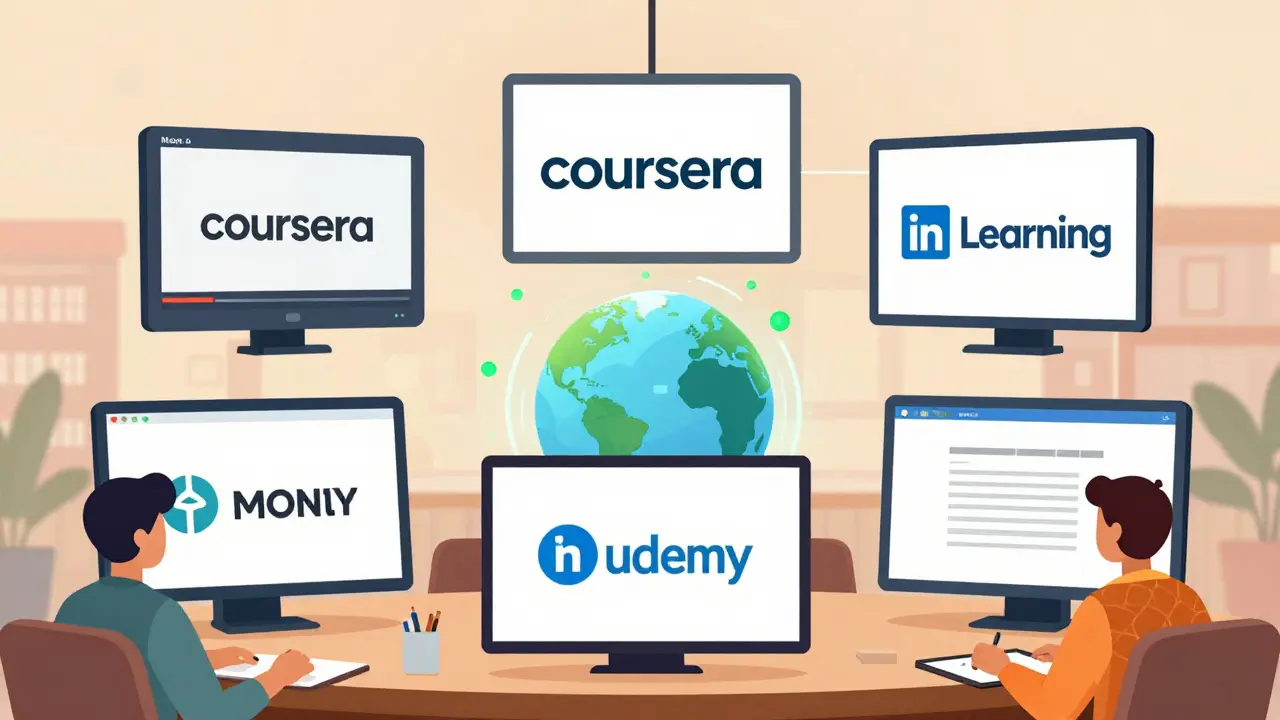
Not all platforms are created equal. Here are the five that consistently deliver for international learners and distributed teams:
1. Coursera
Coursera stands out because it partners with universities in over 50 countries and offers financial aid to 80% of applicants without requiring a credit card. It supports mobile data-saving modes, lets you download videos for offline viewing, and has localized versions in Spanish, Portuguese, French, and Mandarin. Its corporate learning suite, Coursera for Business, lets companies assign courses to teams in any country and track progress without requiring employees to use company email.
2. Udemy
Udemy’s strength is volume-over 210,000 courses in 75 languages. It’s not perfect: some courses are poorly produced, and customer support can be slow. But it handles payments via local methods like Boleto in Brazil, Paytm in India, and GCash in the Philippines. It also allows instructors to upload audio-only versions of lectures, which helps users with weak internet. Teams using Udemy for Business report 30% higher completion rates than with other platforms, especially in Southeast Asia and Latin America.
3. LinkedIn Learning
LinkedIn Learning shines for professional upskilling. It integrates with company directories, so HR teams can assign training based on roles-not locations. The platform automatically adjusts video quality based on connection speed and offers transcripts in 12 languages. It’s especially strong for leadership and communication courses, which global teams need more than technical skills. Companies like Siemens and Unilever use it to train teams in 40+ countries.
4. edX
Backed by Harvard and MIT, edX is ideal for learners seeking accredited credentials. It offers free audit tracks for most courses and supports payment via bank transfer in over 100 countries. Unlike other platforms, edX allows learners to submit assignments via SMS in regions where internet access is unreliable. Its MicroMasters programs are recognized by employers in Europe, Africa, and Asia. Teams working in supply chain, public health, and engineering often use edX because the content is rigorously peer-reviewed and culturally adapted.
5. FutureLearn
FutureLearn is designed with collaboration in mind. Its discussion boards are threaded by region, so learners from Nigeria, Poland, and Indonesia can connect with peers who face similar challenges. The platform doesn’t require a credit card to sign up-users can join with just an email. It offers mobile-first design, offline access, and courses translated into Arabic, Swahili, and Bahasa Indonesia. For teams focused on soft skills like cross-cultural communication, FutureLearn’s peer-reviewed feedback system is unmatched.
What to Avoid
Some platforms look impressive but exclude global users. Here are three red flags:
- Only accepts credit cards-no PayPal, Apple Pay, or local e-wallets. This rules out 60% of the global workforce.
- No offline mode-if your internet cuts out during a quiz, you lose progress.
- English-only interface-even if the course content is translated, the navigation being in English creates friction.
Platforms like Skillshare and Pluralsight often fall into these traps. They’re great if you’re in a developed market with fast internet and a credit card. They’re not built for the rest of the world.
How to Choose for Your Team
Before buying a subscription, ask your team:
- What’s the most common internet speed where people work?
- Which payment methods do they use daily (mobile wallets, bank transfers, cash vouchers)?
- Do they prefer video, audio, or text-based learning?
- Are they learning for personal growth or company-mandated upskilling?
For example, if your team is mostly in Nigeria and Indonesia, go with Udemy or FutureLearn. If you’re training engineers in Germany and Brazil, edX offers accredited credentials that hold weight locally. If leadership development is the goal, LinkedIn Learning’s structured paths outperform others.
Real-World Example: A Team in 14 Countries
A tech startup in Austin, Texas, had employees in Kenya, Vietnam, Poland, and Peru. They tried Coursera first but ran into issues: employees in Nairobi couldn’t pay because their bank didn’t support international transactions. They switched to Udemy, enabled mobile data mode, and allowed payments via mobile money. Within three months, course completion rates jumped from 22% to 76%. The team also started using discussion boards to share local examples-like how to manage remote teams during power outages in Lagos or how to handle time-zone conflicts in Manila. That cultural exchange became part of the learning.

Future Trends
By 2027, platforms will increasingly use AI to auto-detect connection speed and adjust content delivery. Some are testing SMS-based quizzes for users with no internet. Others are partnering with local telecoms to offer zero-rated access-meaning you can use the platform without using your data plan. The winners will be those who treat global access not as a feature, but as a requirement.
Final Tip: Test Before You Buy
Don’t commit to an annual license without testing. Most platforms offer free trials. Sign up with a team member from each major region. Ask them to:
- Download a course
- Pay using their usual method
- Watch a video on 3G or slower
- Complete a quiz offline
If they can do all four without frustration, you’ve found a platform built for the real world-not just Silicon Valley.
Can I use these platforms if I don’t have a credit card?
Yes, several platforms accept alternative payments. Coursera offers financial aid without requiring a card. Udemy supports mobile money, bank transfers, and local e-wallets like Paytm and GCash. FutureLearn lets you sign up with just an email. Even LinkedIn Learning allows company billing for teams, so individuals don’t need to pay personally.
Are these platforms suitable for non-English speakers?
Some are, some aren’t. Coursera, edX, and FutureLearn offer full interfaces in Spanish, French, Portuguese, Mandarin, and Arabic. Udemy has courses in 75 languages, but the platform itself is mostly in English. LinkedIn Learning offers transcripts and subtitles in 12 languages. Always check if the interface-not just the course-is available in your language.
Do any of these platforms work offline?
Yes. Coursera, Udemy, edX, and LinkedIn Learning all let you download videos, readings, and quizzes for offline use. This is essential for learners in areas with unreliable internet. FutureLearn allows offline access to course materials, though not full video downloads. Avoid platforms that require constant streaming.
Which platform is best for corporate training across borders?
For corporate teams, LinkedIn Learning and Coursera for Business lead. Both integrate with HR systems, allow role-based assignments, and support team billing. LinkedIn excels for leadership and communication training. Coursera offers accredited credentials and is better for technical fields like data science or engineering. Avoid platforms that require employees to use personal accounts or credit cards.
How do I know if a platform is truly global or just marketed as one?
Look for three things: 1) Can you pay without a credit card? 2) Can you download content for offline use? 3) Is the platform interface translated into at least three major non-English languages? If the answer is no to any of these, it’s not built for global access-it’s just available in other countries.
Jess Ciro
March 3, 2026 AT 02:06saravana kumar
March 3, 2026 AT 19:47Tamil selvan
March 4, 2026 AT 17:33Mark Brantner
March 6, 2026 AT 00:47Kate Tran
March 7, 2026 AT 22:24amber hopman
March 8, 2026 AT 14:37Jim Sonntag
March 10, 2026 AT 11:46Deepak Sungra
March 12, 2026 AT 02:14Samar Omar
March 14, 2026 AT 00:44chioma okwara
March 14, 2026 AT 03:28John Fox
March 15, 2026 AT 00:45Tasha Hernandez
March 15, 2026 AT 17:35