Business Fundamentals Course Content Structure and Syllabus
 Mar, 20 2026
What makes a business fundamentals course actually stick? Too many programs throw around terms like "core competencies" and "strategic thinking" without showing you what you’ll actually learn day by day. If you’re signing up for a business course-whether online, at a community college, or through your employer-you want to know exactly what’s on the table. Not vague promises. Not buzzwords. Real structure. Here’s what a solid business fundamentals course should cover, broken down by module, week, and practical outcome.
Week 1: Understanding Business Systems
You can’t manage what you don’t understand. This isn’t about memorizing definitions. It’s about seeing how businesses actually work from the inside. Start with the business system: inputs, processes, outputs, feedback loops. Use a simple example-a local coffee shop. What goes in? (beans, labor, rent). What happens? (brewing, serving, collecting payment). What comes out? (coffee, customer satisfaction, profit). What feedback tells them to change? (low sales on rainy days, long lines at 8 a.m.).
Then introduce the three core functions: operations, finance, marketing. Show how they connect. If marketing runs a promotion, operations must adjust inventory. Finance tracks the cost of that promotion and whether it hit the target ROI. No function works alone. This week ends with a simple exercise: map out a small business you interact with regularly using this model. Most people walk away seeing their favorite store in a whole new way.
Week 2: Financial Literacy for Non-Financial Roles
You don’t need to be an accountant. But you do need to read a P&L statement like a story. This section skips complex accounting jargon and focuses on three numbers that drive every business decision: revenue, gross profit, and net income.
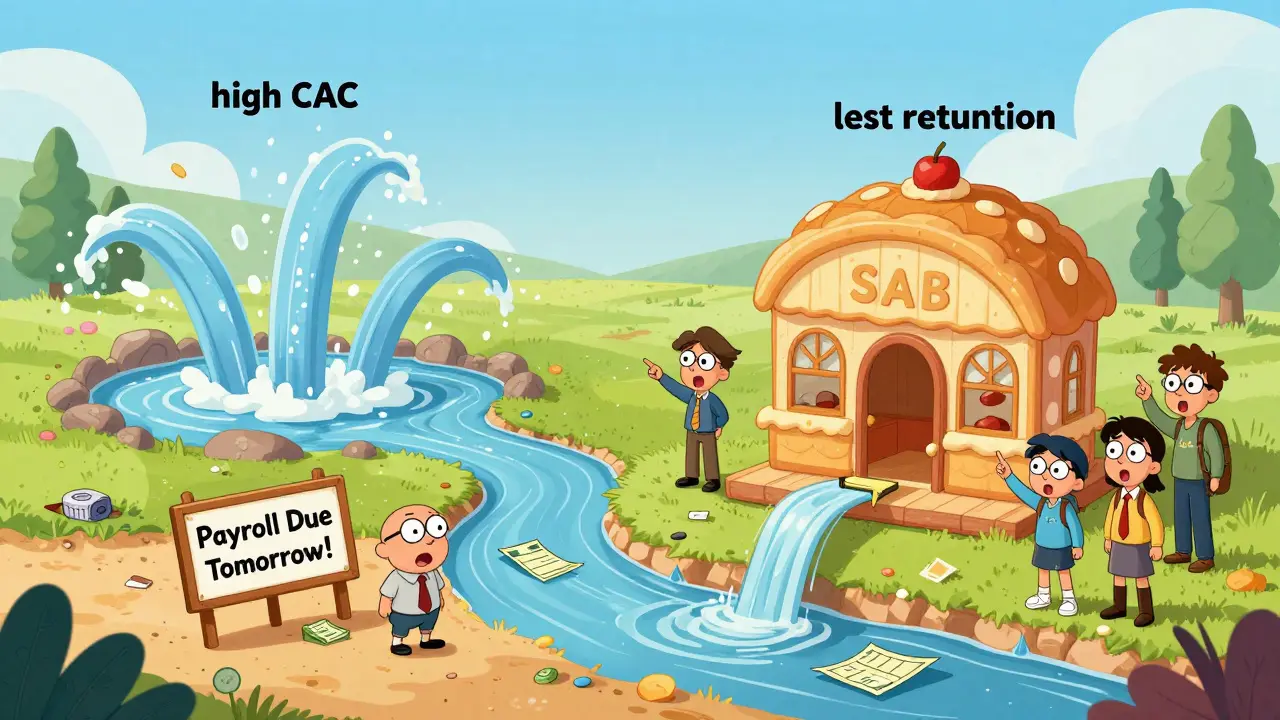
Use real examples: A SaaS company with $500K in monthly revenue but only $80K net profit. Why? High customer acquisition cost and low retention. A bakery with $200K revenue but $15K net profit. Why? Low overhead, high volume, tight ingredient control. Students compare these cases. They learn to ask: Where’s the money going? What’s eating the profit?
Introduce cash flow separately. Too many businesses die not because they’re unprofitable, but because they ran out of cash before profits kicked in. Show a simple 30-day cash flow projection for a startup hiring its first employee. Highlight the gap between when payroll is due and when the first client invoice clears. This isn’t theory-it’s survival.
Week 3: Marketing That Actually Moves the Needle
Forget "branding." Focus on customer acquisition cost (CAC) and lifetime value (LTV). If your CAC is $120 and your LTV is $110, you’re losing money on every customer. That’s the brutal truth most courses ignore.
Break down the customer journey: awareness → interest → decision → action → loyalty. For each stage, give one real tactic. Awareness: Google Ads or TikTok shorts. Interest: email nurture sequences. Decision: free trials or demos. Action: one-click checkout. Loyalty: referral bonuses.
Use a case study: A local fitness studio. They lowered churn by 30% in six months by sending personalized workout tips after the third class-not just a reminder to renew. That’s marketing rooted in behavior, not slogans.
Week 4: Operations and Process Efficiency
Operations is where most businesses leak money. This week teaches how to map a process, find waste, and fix it. Use the DMAIC framework (Define, Measure, Analyze, Improve, Control) in plain language.
Example: A delivery service was losing 15% of packages due to wrong addresses. They defined the problem, measured error rates by driver and zip code, analyzed why-turns out, drivers were manually typing addresses from handwritten slips. They switched to digital扫码 (scan-to-enter) labels. Errors dropped to 2%. No new hires. No new tech. Just better process design.
Students build a simple process map for a task they do at work-ordering supplies, scheduling meetings, handling returns. They identify one bottleneck. That’s their homework.
Week 5: Leadership, Teams, and Communication
Leadership isn’t about titles. It’s about influence. This section covers three non-negotiable skills: giving feedback, resolving conflict, and aligning teams.
Use the SBI model (Situation-Behavior-Impact) for feedback. Instead of "You’re always late," say: "In yesterday’s 9 a.m. stand-up (situation), you showed up 12 minutes late (behavior), which delayed the whole team’s plan (impact)." It’s specific. It’s factual. It’s not personal.
Conflict isn’t bad. Avoided conflict is deadly. Teach the Thomas-Kilmann model: competing, collaborating, compromising, avoiding, accommodating. Show how each style works in real situations. A project manager who always compromises ends up with half-baked deliverables. A team that avoids conflict never voices concerns until the product fails.
End with a role-play: Two team members disagree on a deadline. One says it’s impossible. The other says it’s critical. Students practice using SBI and choosing a conflict style to move forward.
Week 6: Strategy and Decision-Making
Strategy isn’t a PowerPoint deck. It’s a series of choices about where to play and how to win. Introduce the three-layer model: corporate (what businesses to be in), business (how to compete in one market), functional (how to execute day-to-day).
Use a simple framework: SWOT isn’t enough. Use the Strategy Canvas instead. Plot your business against competitors on key factors. For example, a budget airline might compete on price, speed, and frequency-but not on legroom or meals. That’s intentional. They’re not trying to be United. They’re trying to be easyjet.
Students analyze a real company: Target vs. Walmart. What does each prioritize? How do their trade-offs create competitive advantage? Then, they build their own canvas for a business idea they care about.
Week 7: Ethics, Risk, and Compliance
Every business decision has an ethical shadow. This isn’t about rules-it’s about judgment. Use real scandals: Volkswagen’s emissions cheat, Theranos’ fake tech, Facebook’s data misuse. Ask: What went wrong? Who had the power to stop it? Why didn’t they?
Teach risk assessment as a daily habit. Not just "what if the server crashes?" but "what if our supplier gets sued? What if a key employee leaves with client lists?" Create a simple risk matrix: likelihood vs. impact. High impact, high likelihood? Fix it now. Low both? Monitor.
Compliance isn’t boring. It’s protection. Show how GDPR, OSHA, or state labor laws aren’t red tape-they’re shields. One student works in retail. They learn that failing to document overtime hours isn’t just a paperwork issue-it’s a lawsuit waiting to happen.
Week 8: Putting It All Together
Final project: Build a one-page business plan for a real or fictional startup. Not a 30-slide deck. One page. Cover: problem, solution, target customer, revenue model, key operations, one risk, one ethical concern.
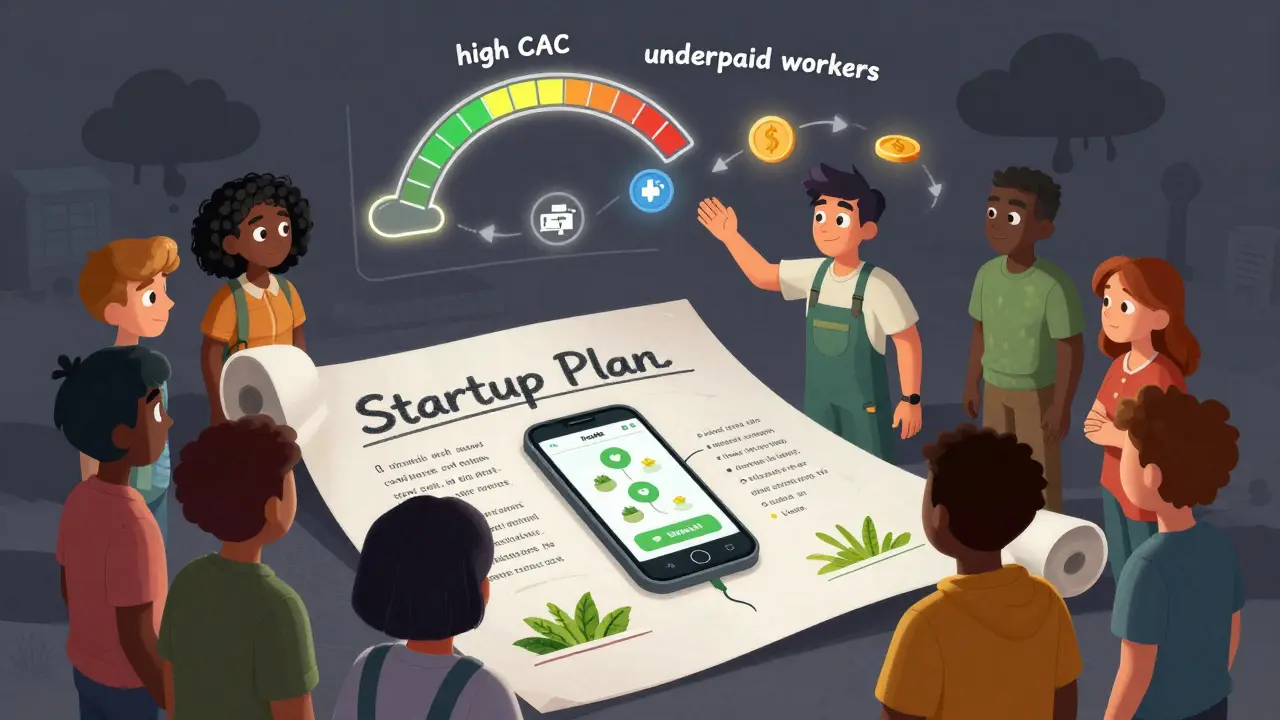
Example: A student creates a mobile app that connects local gardeners with homeowners needing lawn care. Revenue: subscription. Operations: vetting gardeners, scheduling, payment handling. Risk: customer acquisition cost too high. Ethical concern: underpaying gig workers.
Presentations are short-five minutes each. The goal isn’t perfection. It’s clarity. Can you explain your idea so someone who’s never thought about it gets it? If yes, you’ve learned the fundamentals.
What’s Missing? (And Why It’s Okay)
Some courses cram in HR policies, supply chain logistics, or international trade. That’s not wrong-but it’s not fundamentals. Fundamentals are the core that every business, big or small, needs to survive. You don’t need to know how to negotiate a global tariff deal to run a bakery. But you do need to know how to read a profit statement and manage cash flow.
This syllabus cuts fluff. It focuses on what happens in real businesses every day. No theory without practice. No buzzwords without examples. No lectures without application.
If you walk away from this course able to look at a small business and say, "Here’s where the money comes from, here’s where it’s leaking, and here’s how to fix it," you’ve learned more than most people with MBA degrees ever will.
Flannery Smail
March 21, 2026 AT 06:11Emmanuel Sadi
March 23, 2026 AT 01:35Samuel Bennett
March 23, 2026 AT 22:49Rob D
March 24, 2026 AT 00:21Franklin Hooper
March 24, 2026 AT 01:16Jess Ciro
March 24, 2026 AT 19:09saravana kumar
March 25, 2026 AT 12:13Tamil selvan
March 25, 2026 AT 17:34Mark Brantner
March 26, 2026 AT 12:58Kate Tran
March 27, 2026 AT 17:57amber hopman
March 28, 2026 AT 11:00Jim Sonntag
March 29, 2026 AT 23:47