Certification Paths for Employees: How Internal Badges and Continuing Education Drive Career Growth
 Jan, 20 2026
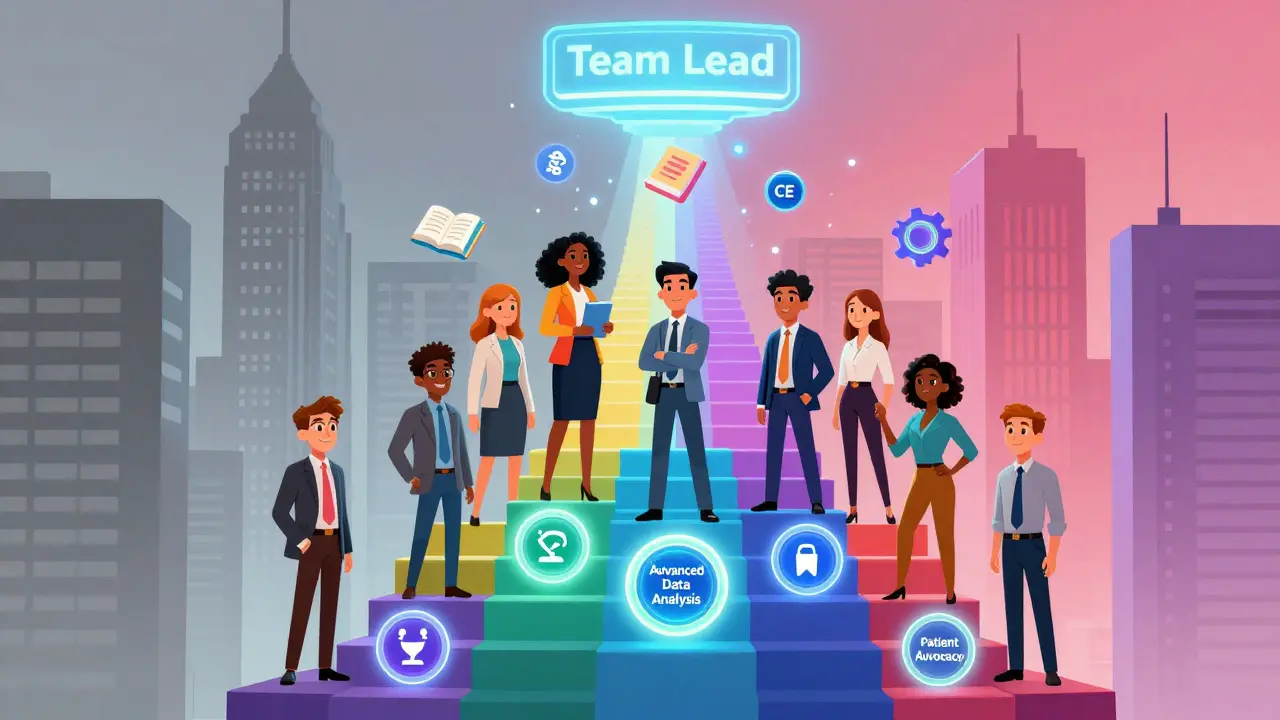
Most companies say they want employees to grow. But how many actually show them how?
Too often, training programs feel like checkbox exercises-mandatory modules nobody remembers, certificates that collect dust, and no clear path forward. That’s not development. That’s distraction. Real growth happens when employees see a direct line between what they learn and where they can go. That’s where internal badges and continuing education (CE) come in.
Why Employee Certification Paths Matter More Than Ever
In 2026, the average employee changes roles within their company every 2.8 years. That’s not because they’re job-hopping. It’s because they’re looking for growth-and companies that don’t offer clear paths lose them faster than ever.
Internal certification systems aren’t just about compliance. They’re about signaling competence. When an employee earns a badge in advanced data analysis or workplace safety leadership, it’s not just a digital sticker. It’s proof they’ve mastered something valuable. And when that badge is tied to real opportunities-like promotion, project lead roles, or cross-departmental moves-it changes everything.
Companies like Salesforce and Adobe have seen internal mobility rates jump by 40% after launching structured badge systems. Why? Because employees know what to aim for. They don’t have to guess what skills matter. The path is laid out.
What Are Internal Badges, Really?
Internal badges are digital credentials awarded by your company for completing specific training, demonstrating skills, or achieving performance milestones. Unlike LinkedIn badges or Coursera certificates, these are built for your organization’s unique needs.
They’re not just for IT or engineering teams. Marketing teams earn badges in CRM analytics. HR earns badges in DEI implementation. Operations earn badges in lean process improvement. Each badge has:
- A clear skill being validated
- A defined assessment (project, quiz, peer review)
- A visible reward (promotion eligibility, bonus points, project selection priority)
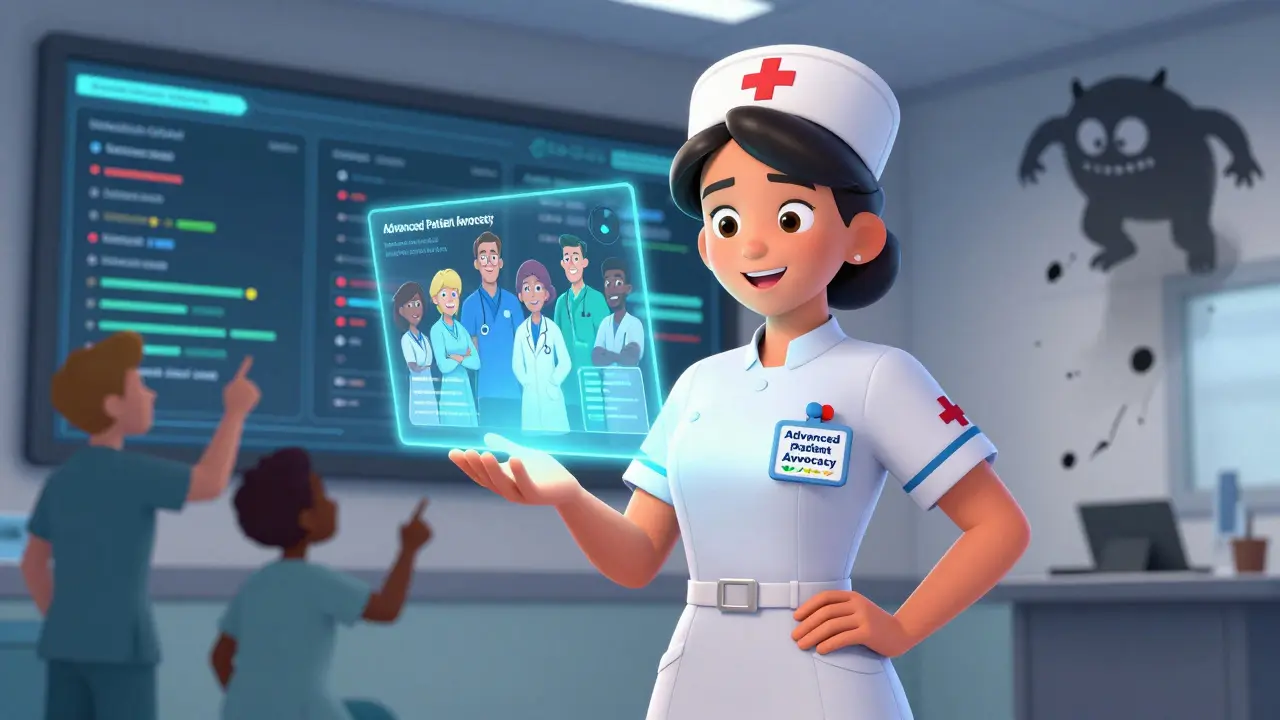
At a mid-sized healthcare provider in Arizona, nurses who earned the "Advanced Patient Advocacy" badge were automatically eligible for mentorship roles. Within six months, turnover in their ICU dropped by 22%. Why? Because recognition became part of the culture.
Badges work because they’re immediate, visual, and tied to action. No waiting for annual reviews. No vague feedback. Just: "You did this. Here’s what it means. Here’s what’s next."
Continuing Education: More Than Just Compliance Hours
Continuing education (CE) is often treated as a legal obligation-"You need 10 hours of ethics training by December." But when done right, CE becomes the engine of long-term career growth.
Effective CE programs don’t just check boxes. They build stacks. Each course adds to a skill stack that unlocks the next level.
For example:
- Level 1: Basic cybersecurity awareness (required for all staff)
- Level 2: Secure data handling (for finance and HR)
- Level 3: Incident response coordination (for IT and compliance leads)
- Level 4: Policy design and audit preparation (for managers)
At a tech firm in Tempe, employees who completed the full stack of cybersecurity CE modules were given first pick on high-visibility projects. That’s not a perk. That’s a career accelerator.
The key is linking CE to roles-not just rules. If your compliance training doesn’t connect to actual job advancement, it’s just noise.
How to Build a Certification Path That Actually Works
Building a certification path isn’t about buying a learning platform. It’s about designing a ladder.
Here’s how to do it:
- Map out key roles in your company. What skills define success in each? Don’t guess-talk to top performers.
- Break skills into tiers. What’s entry-level? What’s expert? What’s leadership?
- Assign badges and CE credits to each tier. A badge for mastering Slack workflows. CE for leading a cross-functional project.
- Link to real rewards. Promotion eligibility. Higher bonus potential. Access to executive shadowing.
- Make it visible. A dashboard where employees see their progress. A monthly spotlight on certified staff.
One manufacturing company in Ohio didn’t just add badges-they redesigned their internal job postings. Now, every role lists required certifications. Employees don’t ask, "How do I get promoted?" They ask, "Which badge do I need next?"
Common Mistakes That Kill Certification Programs
Most internal programs fail-not because they’re poorly designed, but because they’re half-hearted.
Here are the top three killers:
- Badges without consequences. If earning a badge doesn’t change your workload, pay, or access, people stop caring.
- CE that feels like punishment. Mandatory 8-hour compliance sessions in the middle of the workday? That’s not education. That’s a time tax.
- No alignment with leadership. If managers don’t know what the badges mean or how to use them in reviews, the system collapses.
Also avoid overcomplicating it. Don’t create 50 badges for 50 skills. Start with 5-7 that map to your top 3 career tracks. Refine later.
Real Impact: What Happens When It Works
At a regional bank in Texas, they launched a "Financial Compliance Path" with 4 badge levels and 12 CE modules. Within 18 months:
- Internal promotions in compliance roles increased by 67%
- External hires for those roles dropped by 40%
- Employee satisfaction scores in the compliance team jumped from 3.2 to 4.6 on a 5-point scale
Why? Because employees felt seen. They knew what to do. And they saw people like them move up.
It’s not magic. It’s clarity.
What Comes Next? Beyond Badges and CE
The next step isn’t just more badges. It’s integration.
Top companies are now connecting certification data to:
- Performance reviews
- Succession planning
- Project assignments
- Leadership pipelines
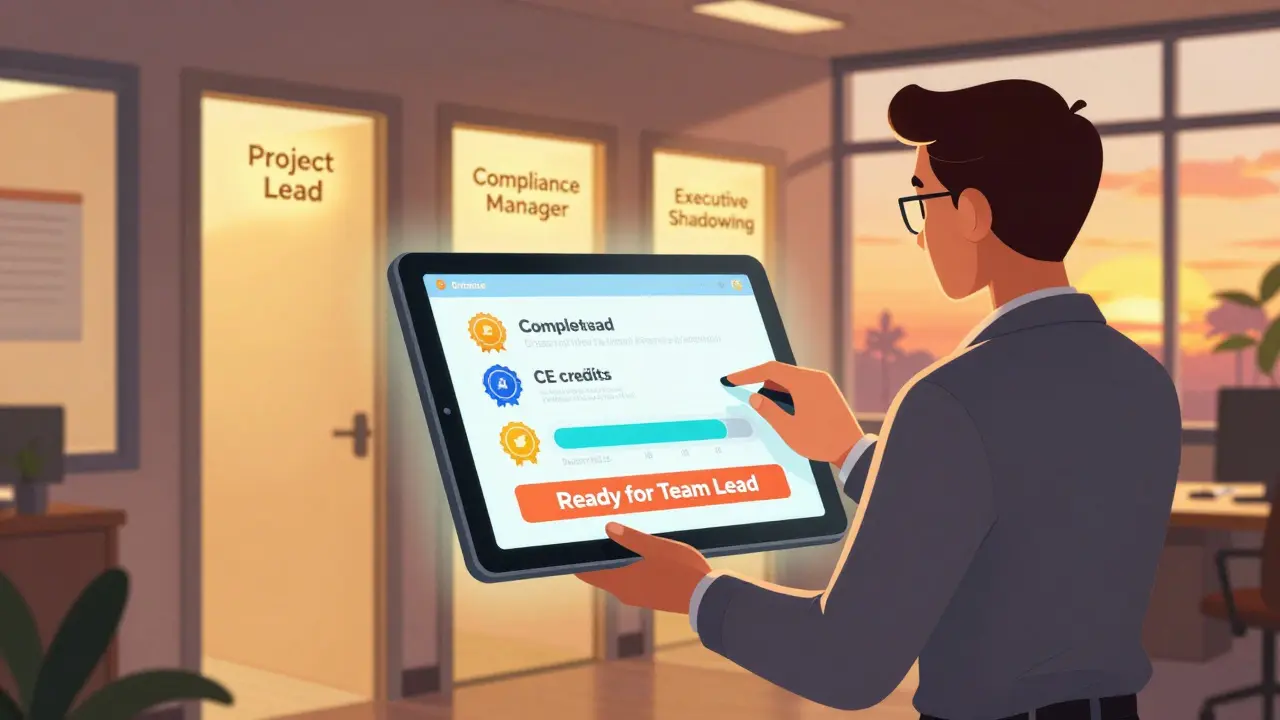
Imagine a manager opening an employee’s profile and seeing:
- Completed: Advanced Negotiation Badge
- CE Credits: 14/20 (in progress)
- Ready for: Team Lead Role
That’s not HR tech. That’s talent strategy.
Start small. Pick one department. Pick one skill. Build one path. Show the impact. Then scale.
The best training programs don’t just teach. They transform how people see their future.
Are internal badges the same as professional certifications?
No. Professional certifications like PMP, CFA, or CISSP are issued by external organizations and often require exams, fees, and ongoing renewal. Internal badges are created and awarded by your employer to recognize skills specific to your company’s tools, processes, or culture. They’re not replacements-they’re complements. Many employees earn both.
How do I get my company to adopt an internal badge system?
Start by identifying a high-turnover or high-skill area where people struggle to grow-like customer service, compliance, or IT support. Gather data: How many people leave because they don’t see a path? How many roles go unfilled internally? Then propose a pilot: pick one skill, create one badge, tie it to one reward (like priority on a project). Show results in 90 days. Leadership responds to proof, not proposals.
Can continuing education count toward external certifications?
Sometimes. Some external bodies, like PMI or SHRM, allow company-specific training to count toward continuing education credits if it’s documented and relevant. Always check the requirements. But even if it doesn’t count externally, internal CE builds skills your company values-and that’s often more valuable for your career inside the organization.
What if my company doesn’t offer any certification paths?
Create your own. Track the skills you’re learning, the projects you’re leading, and the feedback you’re receiving. Build a personal "badge portfolio"-a one-page document listing your competencies with examples. Share it with your manager. Ask: "What would it take to get recognized for this?" You’re not waiting for permission-you’re showing initiative. That’s how paths get built.
Do internal certifications help with job hunting outside the company?
Yes-if you frame them right. On your resume or LinkedIn, don’t just list "Advanced Data Visualization Badge." Say: "Earned internal certification in advanced data visualization by completing a company-wide project that improved reporting efficiency by 30%." That tells employers you solved real problems. External recruiters care more about outcomes than badge names.
Final Thought: Growth Isn’t Given. It’s Built.
Companies don’t owe employees career paths. But the ones that help them build them? They keep them. They attract them. They outperform the rest.
Badges and continuing education aren’t HR trends. They’re the quiet infrastructure of a learning culture. And in 2026, that’s not optional. It’s the difference between staying relevant and falling behind.
Dmitriy Fedoseff
January 21, 2026 AT 23:09Companies act like they care about growth but keep treating learning like a prison sentence. You don’t build culture by forcing 8-hour compliance videos at 3 PM on a Friday. You build it by letting people see the ladder-and then handing them a flashlight. I’ve seen nurses in Arizona earn a badge and suddenly become mentors. That’s not HR magic. That’s human dignity.
Meghan O'Connor
January 22, 2026 AT 19:05Grammar alert: 'badge systems' isn't a phrase-it's 'badging systems.' Also, 'CE' is confusing. Continuing Education? Corporate Entertainment? Pick one. And why are you assuming everyone has access to digital dashboards? Not everyone works in a Silicon Valley echo chamber. This reads like a consultant’s PowerPoint.
Morgan ODonnell
January 23, 2026 AT 01:16My cousin works in logistics in Dublin. They just rolled out a badge for route optimization. He got it last month. Now he leads the new warehouse team. No promotion letter. No meeting. Just a little icon on his login screen. He said it felt like someone finally noticed he was good at his job. That’s all it takes sometimes.
Liam Hesmondhalgh
January 23, 2026 AT 02:11Another American corporate fantasy. We don’t need badges in Ireland. We need better wages. You think a digital sticker is gonna fix burnout? Nah. It’s just another way to make workers feel guilty for not hustling harder. This whole post smells like a LinkedIn ad written by someone who’s never held a real job.
Patrick Tiernan
January 24, 2026 AT 17:13Badges? Really? I got a badge once for finishing a 20 min module on ‘professional email etiquette’ and then got yelled at for using ‘hey’ instead of ‘dear sir.’ This system is a joke. They give you a trophy and then punish you for breathing too loud.
Patrick Bass
January 25, 2026 AT 01:25Just a quick note: you say ‘CE’ a lot without defining it first. Could be confusing for readers outside HR. Also, ‘lean process improvement’-maybe spell that out once? Not everyone knows the jargon.
Tyler Springall
January 26, 2026 AT 14:59Let me guess-this was written by someone who got a ‘Leadership Excellence’ badge after attending a three-hour Zoom seminar. Congratulations. You’ve turned human potential into a gamified loyalty program. Next they’ll give us points for not crying during performance reviews.
Colby Havard
January 27, 2026 AT 09:11While the sentiment is commendable, the underlying assumption-that internal certification systems inherently foster equity and mobility-is empirically unsupported. Numerous longitudinal studies (e.g., Harvard Business Review, 2023) indicate that such systems often reinforce existing hierarchies, particularly when access to training is unevenly distributed across departments or demographic groups. Furthermore, the conflation of visibility with meritocracy is a dangerous rhetorical fallacy.
Amy P
January 28, 2026 AT 13:52OH MY GOD YES. I WORK IN MARKETING AND WE JUST GOT A BADGE FOR CRM ANALYTICS-AND I GOT TO LEAD THE Q3 CAMPAIGN BECAUSE OF IT. I’VE BEEN HERE 4 YEARS AND NO ONE EVER ASKED WHAT I COULD DO UNTIL THEY SAW THAT LITTLE ICON. I CRIED IN THE BATHROOM. THIS ISN’T HR FLUFF. THIS IS LIFE CHANGING.
Ashley Kuehnel
January 28, 2026 AT 19:22Just wanted to say-this is the most practical thing I’ve read all year. My team at the hospital started a ‘Patient Communication’ badge last year. Nurses who earned it got to skip the 3-hour mandatory training on ‘de-escalation’ (which was basically a PowerPoint of yelling faces). We saved 200 hours of pointless time and actually improved patient scores. Small wins matter!
adam smith
January 30, 2026 AT 15:23It is important to note that the implementation of internal certification pathways must be conducted in a manner that adheres to established human resource protocols and organizational governance standards. Without proper oversight, such initiatives may inadvertently create disparities in opportunity.
Mongezi Mkhwanazi
January 31, 2026 AT 21:23Let me be blunt: this entire system is a distraction. You think badges solve retention? You think employees care about a digital sticker when their manager takes credit for their work? In my country, we have real problems-wages, healthcare, job security. You’re putting lipstick on a pig. And don’t get me started on ‘leadership pipelines’-that’s just corporate speak for ‘we’re grooming clones of the CEO.’
And let’s not forget: most of these ‘badges’ are awarded by the same people who gave you a 2% raise last year. Who are they to judge your competence? The system is rigged. Always has been. Always will be.
I’ve seen it. I’ve lived it. You don’t build loyalty with badges. You build it with trust. And trust? Trust isn’t digital. It’s human. And it’s dying in these corporate cages.
Mark Nitka
January 31, 2026 AT 22:11I work in IT at a mid-sized firm. We rolled out a cybersecurity stack like the one mentioned. Took 6 months. People thought it was a joke. Then we gave the top 3 people first pick on the AI project. Suddenly everyone was doing the modules. Not because they were forced. Because they saw it mattered. It’s not about the badge. It’s about the opportunity behind it.
Kelley Nelson
February 2, 2026 AT 11:17While the article presents a compelling narrative, it lacks critical engagement with the socio-economic implications of internal credentialing systems. One must question whether such systems further commodify labor under the guise of empowerment. The rhetoric of ‘growth’ is often deployed to mask the erosion of collective bargaining power.
Aryan Gupta
February 3, 2026 AT 06:01They’re watching you. Every badge. Every CE hour. Every click. This isn’t about growth-it’s about surveillance. The same people who gave you this ‘system’ are also the ones tracking your screen time, your keystrokes, your Slack activity. They don’t want you to grow. They want you to be predictable. This is control dressed up as opportunity.
Fredda Freyer
February 4, 2026 AT 11:38I’ve been in HR for 22 years. I’ve seen every trend come and go. Badges? They’re just the latest flavor. But here’s what’s different this time: people are actually using them. Not because they’re forced to-but because they’re meaningful. I had an employee last year who earned a ‘Conflict Resolution’ badge, then went on to mediate a team feud that had lasted 18 months. No manager stepped in. She did it because the badge gave her permission to lead. That’s power. Real power.
Don’t underestimate the quiet revolution happening in places nobody’s watching. This isn’t about tech. It’s about trust. And trust? It’s earned one badge at a time.
Gareth Hobbs
February 6, 2026 AT 07:40Typical US corporate nonsense. In the UK we have proper unions and proper pay scales. You don’t need badges to know who’s good at their job-you need a pay rise and respect. This whole thing feels like a distraction from the fact that your bosses are too cheap to actually promote people. Badges won’t fix a broken system. Only collective action will.
Zelda Breach
February 8, 2026 AT 07:31Oh please. Another ‘growth hack’ written by someone who’s never had to work a 60-hour week and still get yelled at for using the wrong font. I earned a ‘Project Leadership’ badge. Guess what? My manager still gave the promotion to his buddy from college. This isn’t meritocracy. It’s theater. And I’m tired of being the audience.
Dmitriy Fedoseff
February 9, 2026 AT 05:25And that’s exactly why systems fail. Not because they’re bad-but because leaders don’t follow through. A badge means nothing if the people who control promotions don’t believe in it. You can’t just build a ladder and walk away. You have to guard it. You have to defend it. You have to make sure the person at the top doesn’t lock the door behind them.