Community Features in Course Platforms: Forums, Live Chat, and Cohorts Compared
 Oct, 25 2026
You paid for a course. You watched the videos. Maybe you even took notes. But did you actually learn? For most people, the answer is no. Passive consumption fails because it lacks friction, feedback, and connection. That’s where community features come in. They are the difference between finishing a certificate and mastering a skill.
Course platforms offer three main ways to build this connection: asynchronous forums, real-time live chat, and structured cohorts. Each serves a different psychological need and fits different learning styles. Choosing the wrong one leads to ghost towns or chaotic noise. Choosing the right one turns your course into a thriving ecosystem. Let’s break down how these tools work, when to use them, and which one your students actually need.
Why Community Matters More Than Content
We tend to think of online learning as a content delivery problem. Upload video, add quizzes, done. But research from the Online Learning Consortium consistently shows that social presence is a primary predictor of completion rates. When learners feel isolated, they drop out. When they feel seen, they stay.
Social presence is the sense of being "real" and connected to others in an online environment. It reduces cognitive load by allowing learners to offload questions to peers and creates accountability through visible progress. Without it, a course is just a Netflix subscription with homework.
The goal isn’t just to let students talk. It’s to facilitate specific interactions that deepen understanding. A forum allows for deep reflection. Live chat offers instant support. Cohorts provide structure. Understanding the mechanics of each helps you design a platform that supports actual learning, not just activity.
Forums: The Deep Dive Engine
Forums are the oldest form of digital community, but they remain powerful for complex topics. Think of a forum as a library reference desk. It’s quiet, organized, and searchable. Students post a question, and answers accumulate over time.
This format excels at asynchronous communication, which allows participants to respond at their own pace, enabling deeper thought and less pressure. If you’re teaching coding, legal concepts, or advanced theory, forums win. A student can read a thread, think about it overnight, and return with a nuanced reply. This depth is impossible in a fast-moving chat stream.
However, forums have a high barrier to entry. New users often lurk without posting. To combat this, successful platforms use gamification-badges for helpful answers-or require a minimum number of posts to unlock certain resources. Moderation is also critical. Without active moderators, forums become dumping grounds for unanswered technical errors.
Live Chat: The Instant Support Network
If forums are libraries, live chat is a synchronous messaging system designed for immediate interaction and quick troubleshooting. It’s the water cooler of the internet. Tools like Discord, Slack, or native platform chats allow students to ask, "Did anyone else get error code 404?" and get an answer in seconds.
Live chat builds rapid rapport. Hearing a peer say, "I’m stuck on module 3 too," validates a student’s struggle instantly. This emotional validation keeps motivation high during difficult sections. It’s ideal for short courses, bootcamps, or highly technical subjects where quick fixes prevent frustration from turning into dropout.
The downside? Noise. In a large cohort, important announcements get buried under memes and side conversations. Archiving chat history is notoriously difficult. If a solution to a common bug is posted at 2 AM, it might be lost forever unless pinned or moved to a FAQ section. Live chat requires strict channel management to remain useful.
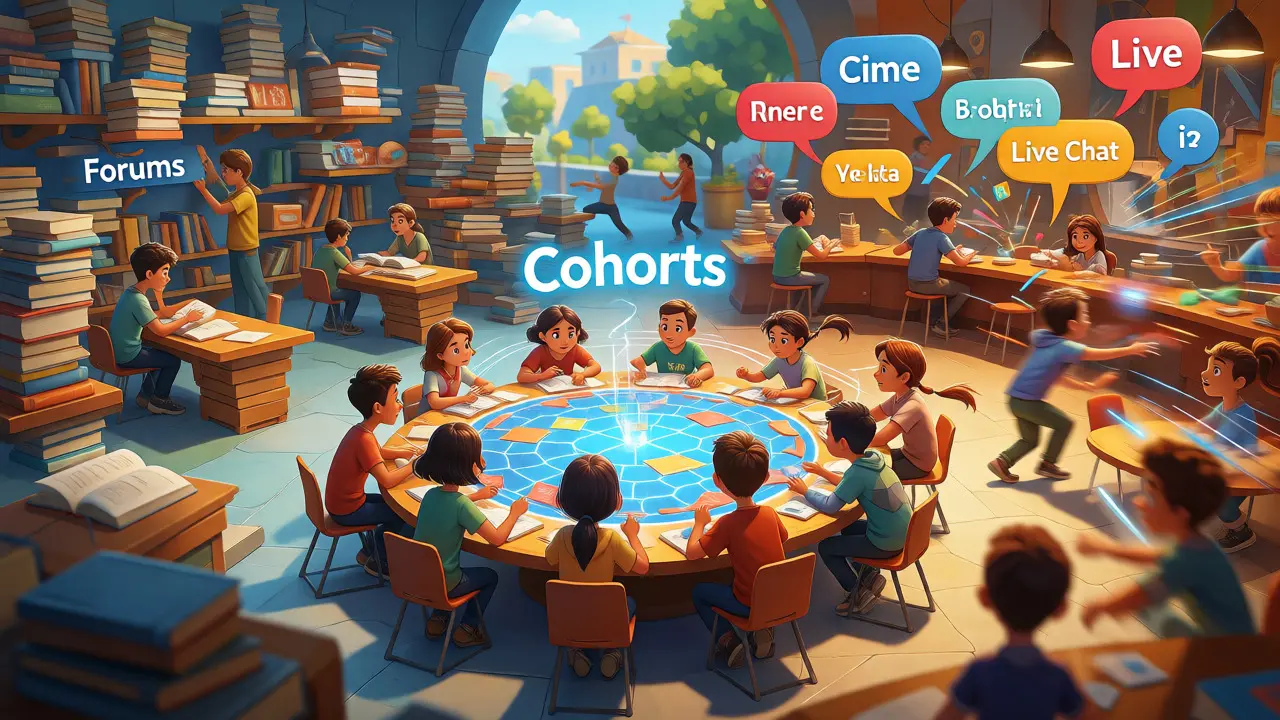
Cohorts: The Accountability Structure
A cohort is a group of students who start and finish a course together on a fixed schedule. Unlike self-paced forums or open chats, cohort-based learning is a model where learners progress through material simultaneously, fostering shared deadlines and collective momentum.
Cohorts leverage social proof and FOMO (fear of missing out). If everyone else submits their assignment by Friday, you’re more likely to do it too. This structure mimics traditional university dynamics, which many adults find comforting. It transforms learning from a solitary chore into a team sport.
But cohorts are expensive to run. They require facilitators, scheduled events, and rigorous coordination. They don’t scale infinitely. If you have 10,000 students, you can’t put them all in one room. Cohorts work best for premium products where the price point justifies the human touch. They fail when the schedule is too rigid for working professionals with unpredictable lives.
Comparing the Three Models
How do you choose? It depends on your content complexity, audience size, and business model. Here’s a breakdown of how these features stack up against key performance indicators.
| Feature | Engagement Type | Scalability | Best For | Main Risk |
|---|---|---|---|---|
| Forums | Asynchronous, Reflective | High (Searchable) | Complex Theory, Coding Debugging | Ghost Towns (Low Activity) |
| Live Chat | Synchronous, Reactive | Medium (Noisy) | Quick Troubleshooting, Peer Support | Information Loss, Distraction |
| Cohorts | Structured, Collaborative | Low (Human-Led) | Premium Courses, Bootcamps | Scheduling Conflicts, High Cost |

Hybrid Strategies That Actually Work
You rarely need to pick just one. The most successful platforms blend these approaches. Consider a tiered model. Basic subscribers get access to the forum. Premium members join a monthly cohort with live Q&A sessions. VIP clients get direct access to a private Slack channel.
Another effective tactic is using chat to feed the forum. When a great discussion happens in Discord, a moderator summarizes it and posts it to the forum. This captures the energy of real-time interaction while preserving the longevity of written knowledge. It solves the "lost chat history" problem without killing the spontaneity.
Also, consider the timing. Launch new cohorts with heavy live chat support to build initial bonds. As the cohort matures, shift emphasis to forums for deeper project discussions. Finally, archive the cohort’s insights into permanent course materials. This turns temporary community effort into long-term content assets.
Implementation Pitfalls to Avoid
Don’t launch a feature before you have the traffic to sustain it. An empty forum looks worse than no forum at all. It signals failure. Seed the space with staff members or beta testers who ask questions and answer them themselves if needed.
Ignore moderation at your peril. One toxic comment can poison a well-intentioned space. Establish clear community guidelines early. Use automated filters for spam, but rely on humans for tone checks. Remember, moderation is the process of enforcing rules and curating quality within a user-generated content environment. It’s not censorship; it’s curation.
Finally, measure what matters. Don’t just count posts. Look at response times, repeat participation rates, and correlation with course completion. If forum users complete courses at a 20% higher rate than non-users, you know the feature works. If not, iterate or remove it.
Frequently Asked Questions
Which community feature is easiest to manage?
Forums are generally easier to manage asynchronously because they don't require real-time staffing. However, they require consistent seeding to avoid looking empty. Live chat demands immediate attention, which can be resource-heavy for small teams.
Do cohorts improve completion rates significantly?
Yes, studies suggest cohort-based models can boost completion rates by 50-70% compared to self-paced alternatives. The shared deadline and social accountability create external motivation that intrinsic motivation alone often cannot sustain.
Can I replace forums with Discord servers?
You can, but you lose searchability and long-term archiving. Discord is excellent for community building and quick help, but poor for referencing past solutions. Many educators use both: Discord for daily chatter and a linked forum for structured Q&A.
How many students do I need for a viable community?
There is no magic number, but a rule of thumb is that you need enough active users to ensure questions are answered within 24 hours. For forums, this usually means at least 50-100 active weekly users. For chat, you need enough volume to keep channels alive during peak hours.
Is gamification necessary for community engagement?
It helps, but it's not mandatory. Authentic recognition, such as featuring student projects or highlighting helpful answers, often drives engagement better than points and badges. Gamification works best when it rewards contribution, not just presence.