Community Features That Boost Online Course Engagement
 Dec, 24 2025
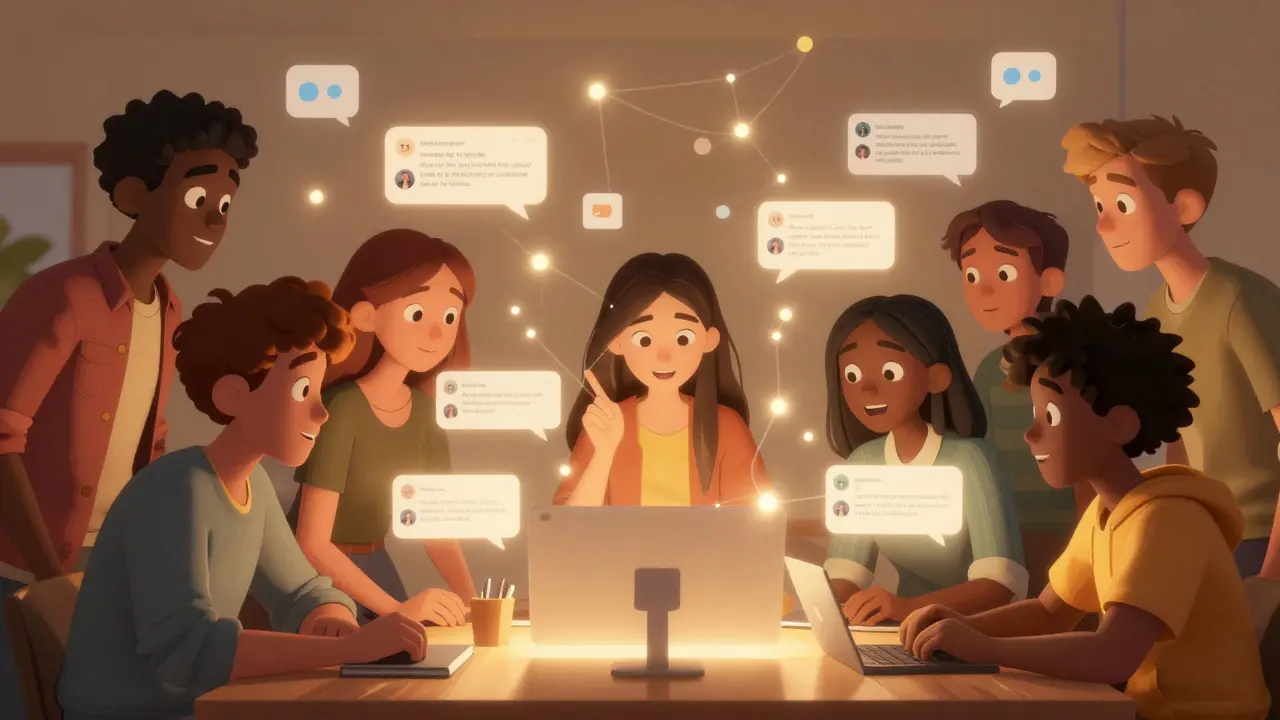
When students sign up for an online course, they’re not just buying content-they’re looking for connection. Without the hallway chats, group study sessions, or quick questions after class, many learners feel isolated. That’s why the most successful online courses don’t just deliver videos and quizzes-they build real community. The difference between a course that gets completed and one that gets abandoned often comes down to one thing: how well it fosters belonging.
Discussion Forums That Actually Get Used
Most platforms offer discussion boards, but they’re often dead zones. Why? Because they’re optional, unmoderated, and feel like homework. The key is to make them mandatory in a meaningful way. Top courses require at least one thoughtful reply per module-not just "I agree," but "I tried this and it didn’t work because..."For example, a digital marketing course might ask learners to analyze a real brand’s social media post and share their critique. Others respond with counterpoints, resources, or personal stories. Within days, threads turn into mini-networks. People start replying to each other outside of assignments. That’s when engagement becomes organic.
Structure helps. Use prompts like:
- "What’s one thing you’d change about this strategy?"
- "Share a time you failed at this-and what you learned."
- "Tag someone in this course who’d find this useful."
These aren’t just questions-they’re invitations to connect. And when instructors jump in early with personal stories or tough questions, students follow.
Live Sessions That Feel Human
Live Q&As, office hours, or weekly check-ins aren’t extras-they’re anchors. Students show up when they know someone will be there waiting. Even 30 minutes once a week makes a difference.Don’t just broadcast. Turn it into a conversation. Start by asking students what they’re struggling with right now. Let them vote on the next topic. Record the session, but don’t treat it like a lecture. Say things like, "I saw Maria’s post about the budget tool-can you walk us through how you used it?"
One data science course saw completion rates jump 40% after adding a 20-minute weekly Zoom call where students shared one win from the week. No slides. No scripts. Just people talking about what worked. That’s the power of visibility. When learners see others pushing through, they believe they can too.
Peer Feedback Loops
Grading isn’t the only way to give feedback. Peer review builds accountability and deepens understanding. When students evaluate each other’s work, they’re forced to engage with the material at a higher level.Set up simple, structured rubrics. For a writing course, ask reviewers to answer:
- What’s one sentence that stuck with you?
- Where did you feel confused?
- What would you add or cut?
Include anonymity to reduce bias, but also allow optional public comments. Some learners post their work with a note: "I’m nervous about this-please be kind." Others respond with encouragement, resources, or even personal stories. That’s not just feedback-that’s emotional support.
Studies from Stanford’s Graduate School of Education show that learners who give feedback are 3x more likely to complete a course than those who don’t. Why? Because teaching is the best way to learn.
Small Group Accountability Pairs
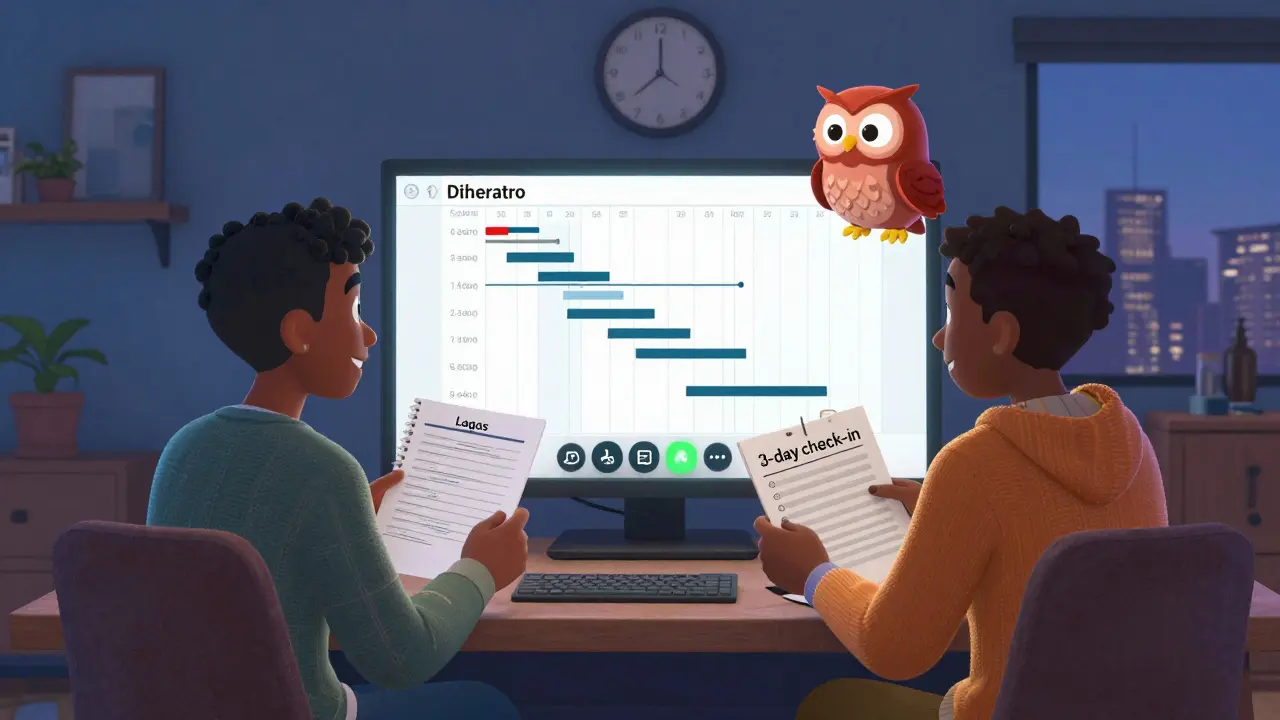
Big groups feel overwhelming. Small groups feel safe. Assign learners to pairs or trios at the start of the course. Give them a simple task: check in every 3 days with one question:- What’s your biggest win this week?
- What’s one thing holding you back?
- Can I help with anything?
These aren’t meant to be mentors or therapists. They’re just two people keeping each other honest. In a project management course, pairs were assigned to review each other’s Gantt charts. One student admitted she hadn’t started because she was overwhelmed. Her partner replied, "I’m stuck too. Let’s do 15 minutes together right now." They scheduled a call. Both finished their projects.
Platforms that let learners form their own groups see even higher retention. Let them choose based on time zones, goals, or interests. A learner in Lagos might team up with someone in Toronto because they both work full-time and want to finish in 8 weeks.
Recognition That Matters
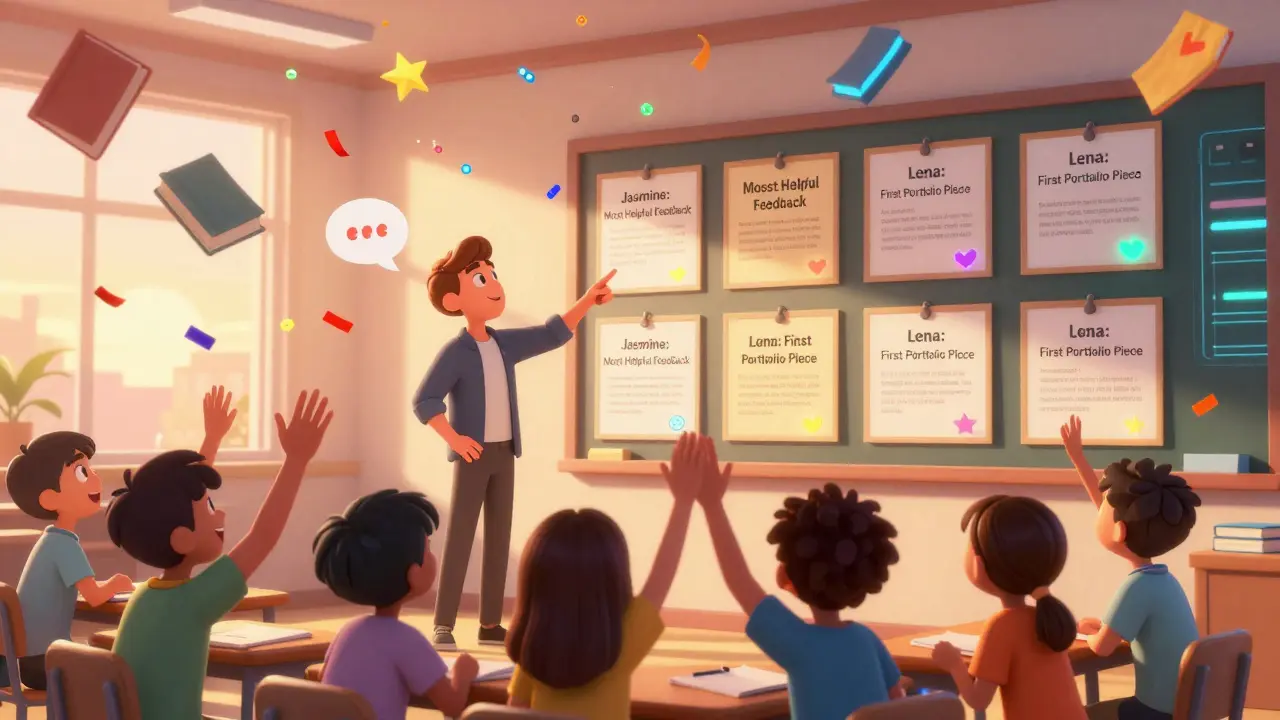
Badges and leaderboards can feel childish. But public recognition when it’s specific and meaningful? That sticks.Instead of "Top 10 Learners," highlight:
- "Jasmine gave the most helpful feedback this week-here’s why."
- "Carlos was the first to try the advanced tool and shared his results. Great job experimenting!"
- "Lena posted her first portfolio piece. Welcome to the community!"
These aren’t just compliments-they’re social proof. When someone sees their peer being recognized, they think, "I could do that too."
One course lets learners nominate each other for a "Helpful Helper" award each week. Winners get a short shout-out in the next live session. No prizes. Just visibility. Enrollment increased by 27% after this feature launched.
Community-Driven Content
The best courses don’t just teach-they evolve based on what learners need. Let students suggest topics, case studies, or tools they want covered.For example, a UX design course added a module on accessibility after three learners independently asked for it. The instructor didn’t just add content-they credited the students in the lesson title: "How Maria, David, and Priya Pushed Us to Improve Accessibility."
That kind of recognition doesn’t just make people feel seen-it makes them feel like owners. When learners believe they’re shaping the course, they invest more time, energy, and emotion into it.
What Doesn’t Work
Not every feature builds community. Avoid these traps:- Forcing interaction with bots or AI chatbots that mimic human replies
- Using generic prompts like "Post your thoughts below" without direction
- Letting discussions go silent for weeks without moderator follow-up
- Only rewarding top performers-everyone else feels excluded
Community isn’t about volume. It’s about depth. One real conversation beats ten empty posts.
Why This Works
The science is clear: humans learn better when they feel connected. A 2024 meta-analysis of 127 online learning studies found that courses with intentional community features had 52% higher completion rates than those without.It’s not about fancy tech. It’s about design choices that prioritize people over content. When learners know someone is watching, listening, or waiting for their reply-they show up. Not because they have to. But because they want to.
Online learning isn’t about delivering information. It’s about creating a space where people feel safe to grow. That’s what keeps them coming back.
Do I need a big team to build community in my course?
No. One instructor can build strong community with simple, consistent actions. Reply to a few posts daily. Run a 20-minute live session weekly. Assign peer pairs. You don’t need moderators or bots-just presence. Students notice when someone they respect shows up.
What if students don’t participate at first?
Start small. Ask one question in the first module that’s personal but low-pressure: "What’s one skill you hope to gain from this course?" Make it required. Then respond to every answer personally. That first reply from you sets the tone. People mirror behavior. If you show up, they will too.
How do I keep the community alive after the course ends?
Create a permanent alumni group-like a private LinkedIn group or Discord server. Don’t just leave it empty. Post one new resource or question each month. Celebrate wins: "Congrats to Raj, who landed his first freelance client using the budget template from Module 3." Keep the door open. People stay because they still feel part of something.
Can community features work for technical courses like coding or data analysis?
Absolutely. In fact, they’re even more critical. Coding is isolating. A student stuck on a bug for hours won’t quit if they know someone else in the group is working on the same thing. Encourage sharing code snippets, debugging sessions, or even screen shares. One Python course added a "Fix This Code" thread every Friday. Learners posted broken scripts. Others helped. The instructor chimed in with tips. Completion rates hit 89%-way above the industry average.
Is it better to have one big community or smaller groups?
Both. Use small groups for accountability and deep interaction. Use a larger forum for broad sharing and discovery. Think of it like a neighborhood: your close friends live next door (small group), but you still wave to everyone on the block (big forum). The combination gives people both safety and scope.
Start with one community feature. Maybe it’s peer feedback. Or a weekly live check-in. Do it well. Then add another. Community doesn’t happen overnight-but it grows fast when you plant the right seeds.
John Fox
December 25, 2025 AT 12:18Been in a few online courses and this is spot on
Most just dump videos and call it a day
Real connection? That’s the magic ingredient
No fluff. Just people showing up for each other
Tasha Hernandez
December 26, 2025 AT 12:32Oh great another ‘community is everything’ sermon
Meanwhile my last course had a bot that said ‘great point!’ after every post
And the instructor never replied to anyone
Thanks for the placebo effect
Anuj Kumar
December 27, 2025 AT 22:22Community? What a scam
They just want you to think you’re part of something
Meanwhile the real goal is to sell you the next course
And the instructor? Probably just paid to post replies
Wake up people
Veera Mavalwala
December 29, 2025 AT 08:17Let me tell you something about online learning communities - it’s not just about prompts or live sessions, it’s about the quiet moments when someone reads your half-baked thought and says ‘I’ve been there too’ - and suddenly you’re not alone anymore
It’s not about the number of comments, it’s about the weight of the ones that land
And yes, I’ve seen courses where people started texting each other outside the platform - because the connection became real, not transactional
And that’s when learning stops being a chore and becomes a shared journey
It’s not about badges or leaderboards, it’s about someone remembering your name, your struggle, your win
And when they do, you don’t just finish the course - you become part of something that outlives it
That’s why I keep coming back to courses that treat me like a person, not a metric
And no, you can’t fake that with AI or forced discussion boards - it takes presence, vulnerability, and consistency
It’s exhausting, honestly - being that human - but it’s the only thing that makes learning stick
And if you think it’s too much work? Then you’re not ready to teach - you’re just selling content
Real teaching doesn’t happen in a video - it happens in the silence after someone says ‘I didn’t get it’ and you say ‘me neither - let’s figure it out together’
sampa Karjee
December 31, 2025 AT 02:46Community is a buzzword for lazy educators who don’t want to design proper curriculum
People don’t need to ‘feel belonging’ - they need to learn
Stop anthropomorphizing learning platforms
And stop pretending emotional manipulation is pedagogy
Patrick Sieber
December 31, 2025 AT 21:57I’ve run three courses and this is exactly what worked - no fluff
Just one weekly 20-min Zoom, no slides, just ‘what’s one thing you got this week?’
Students started showing up early just to chat
One guy even sent me a screenshot of him using the tool at his job - no one asked
That’s the moment you know it’s working
Not because of the feature - because of the trust
Kieran Danagher
January 1, 2026 AT 20:00‘Forced interaction’ is just another way of saying ‘I’m not interesting enough to earn attention’
And yeah, bots are pathetic - I’ve seen them reply to ‘I’m having a panic attack’ with ‘Great post!’
Real community doesn’t need prompts - it needs people who care enough to show up
Even if it’s just once a week
That’s all it takes
OONAGH Ffrench
January 3, 2026 AT 08:54There is a fundamental truth here that is rarely acknowledged
Learning is a social act
Even when done alone
The brain retains information better when it is contextualized through human exchange
It is not merely about motivation or completion rates
It is about the cognitive scaffolding provided by others
When we articulate our understanding to another person
We solidify it in our own mind
This is not new
It has been understood since Socrates
Yet we persist in treating education as a content delivery system
As if the mind were a hard drive
poonam upadhyay
January 4, 2026 AT 23:15OMG I HATE WHEN PEOPLE SAY ‘JUST BE PRESENT’ LIKE IT’S EASY
WHAT IF YOU’RE A SINGLE MOM WORKING 3 JOBS AND YOUR KID IS SICK AND THE COURSE IS AT 3AM BECAUSE YOU’RE IN INDIA AND THE INSTRUCTOR IS IN CALIFORNIA
AND THEN THEY SAY ‘OH JUST JOIN THE LIVE SESSION’
LIKE I HAVE TIME TO BE ‘HUMAN’ WHEN I’M JUST TRYING TO SURVIVE
AND DON’T EVEN GET ME STARTED ON ‘PEER FEEDBACK’
WHEN HALF THE PEOPLE ARE JUST COPY-PASTING ‘NICE WORK’
AND THE OTHER HALF ARE SPAMMING LINKS TO THEIR LINKEDIN
THIS ISN’T COMMUNITY - IT’S PERFORMATIVE TOXICITY
AND THE INSTRUCTORS? THEY JUST WANT TO LOOK GOOD IN THEIR COURSE OUTLINE
AND THEN THEY GET PAID TO TALK ABOUT ‘BELONGING’
WHILE I’M STILL STUCK ON MODULE 2 BECAUSE I HAD TO MISS 3 WEEKS BECAUSE MY INTERNET DIED
Shivam Mogha
January 5, 2026 AT 17:00Small groups work
Simple rules
Consistency
That’s it
mani kandan
January 7, 2026 AT 13:24What’s fascinating is how community transforms even the most technical subjects
Take coding - a student stuck on a bug for 8 hours will often quit
But if they know someone else is wrestling with the same issue, even silently
They keep going
It’s not about help - it’s about not feeling alone in the struggle
And that’s the quiet power of shared vulnerability
Not badges
Not leaderboards
Just knowing someone else is in the trenches too
Rahul Borole
January 7, 2026 AT 20:47It is imperative to recognize that the establishment of a structured and intentional community framework is not ancillary to pedagogical efficacy - it is foundational
Empirical evidence from cognitive psychology and social learning theory unequivocally supports the assertion that peer engagement significantly enhances knowledge retention and metacognitive development
Furthermore, the implementation of accountability mechanisms such as dyadic check-ins demonstrates measurable improvements in learner persistence and task completion
Therefore, it is not merely advisable - it is academically imperative to embed community-centric design into the architecture of any high-stakes online learning environment
Sheetal Srivastava
January 8, 2026 AT 06:34Let’s be real - most of these ‘community features’ are just gamified manipulation disguised as empathy
They’re using attachment theory to hook you
And then monetizing your emotional dependency
And don’t get me started on ‘peer feedback’ - it’s just a way to outsource grading to unpaid labor
And the instructors? They’re not ‘being present’ - they’re doing performative engagement to hit their KPIs
It’s all just corporate pedagogy wrapped in feel-good language
And you’re falling for it
Bhavishya Kumar
January 9, 2026 AT 01:07There are multiple grammatical errors in the original post
For instance, the phrase ‘they’re looking for connection’ should be ‘they are looking for connections’
Also, ‘feedback loops’ is incorrectly pluralized in context
And the use of em dashes without proper spacing is nonstandard
These errors undermine the credibility of the entire argument
Even if the ideas are sound, sloppy writing suggests a lack of rigor
Which is ironic for a piece about learning
ujjwal fouzdar
January 10, 2026 AT 23:00What if community is just a mirror?
What if we don’t need more features?
What if we just need to stop pretending that learning is something you consume?
What if the real problem is that we’ve turned education into a product
And now we’re trying to sell the soul of it back to us?
Maybe the answer isn’t more prompts
Maybe it’s less pretending
Maybe we need to admit that we’re all just trying to figure it out
And that’s enough
Anand Pandit
January 12, 2026 AT 06:23Just wanted to say - I started doing the weekly check-ins with my pair last month
We didn’t talk for the first week
Then one day she just sent ‘I’m scared I’m not good enough’
I replied ‘me too’
That was it
But now we message every Tuesday
She got a job last week
I’m finishing my project this weekend
It wasn’t the course that did it
It was someone who didn’t give up on me
Thanks for reminding me that matters
Reshma Jose
January 13, 2026 AT 00:14Y’all are overthinking it
Just ask one real question
Then reply to everyone
That’s it
No bots
No badges
No drama
Just you showing up
People will follow
rahul shrimali
January 13, 2026 AT 21:54One live session a week
That’s all it takes
People show up
That’s the magic
Bharat Patel
January 15, 2026 AT 03:04Community isn’t built - it’s discovered
When you stop trying to engineer connection
And start creating space for it to happen
That’s when the quiet moments become meaningful
Not because of the structure
But because of the silence between the words
That’s where the learning lives
Bhagyashri Zokarkar
January 15, 2026 AT 13:51i just wanna say i cried when someone said ‘i saw your post and i felt that’
it was like… someone finally saw me
not as a learner
not as a number
but as a person
who’s tired
who’s scared
who just wants to finish
and not be alone
thank you for writing this
i needed to read it