Course Packages and Certification Tracks: How to Get Real Value for Your Money
 Mar, 9 2026
Ever bought a course package and felt like you paid for a promise, not a payoff? You’re not alone. Thousands of learners shell out hundreds - sometimes thousands - for certification tracks that promise career growth, only to realize later that the content was outdated, the credential wasn’t respected, or the time investment didn’t move the needle. The truth? Not all course packages are created equal. And the price tag doesn’t always reflect the value.
What You’re Really Paying For
When you buy a course package, you’re not just paying for videos and quizzes. You’re paying for access, support, credibility, and time saved. A $299 certification track from a well-known provider like CompTIA or Google isn’t just a bundle of lessons - it’s a shortcut to being taken seriously by employers. But a $199 course from an unknown platform might leave you with a certificate no one recognizes.Let’s break it down. A solid certification track usually includes:
- Official exam vouchers (not just practice tests)
- Hands-on labs or real-world projects
- Access to a community or mentor network
- Guaranteed exam retakes
- Industry-recognized credential (not just a PDF)
Compare that to a basic Udemy bundle: video lectures, downloadable slides, maybe a quiz. No exam. No industry backing. No network. You pay less, but you get less - and that’s okay, if you know what you’re signing up for.
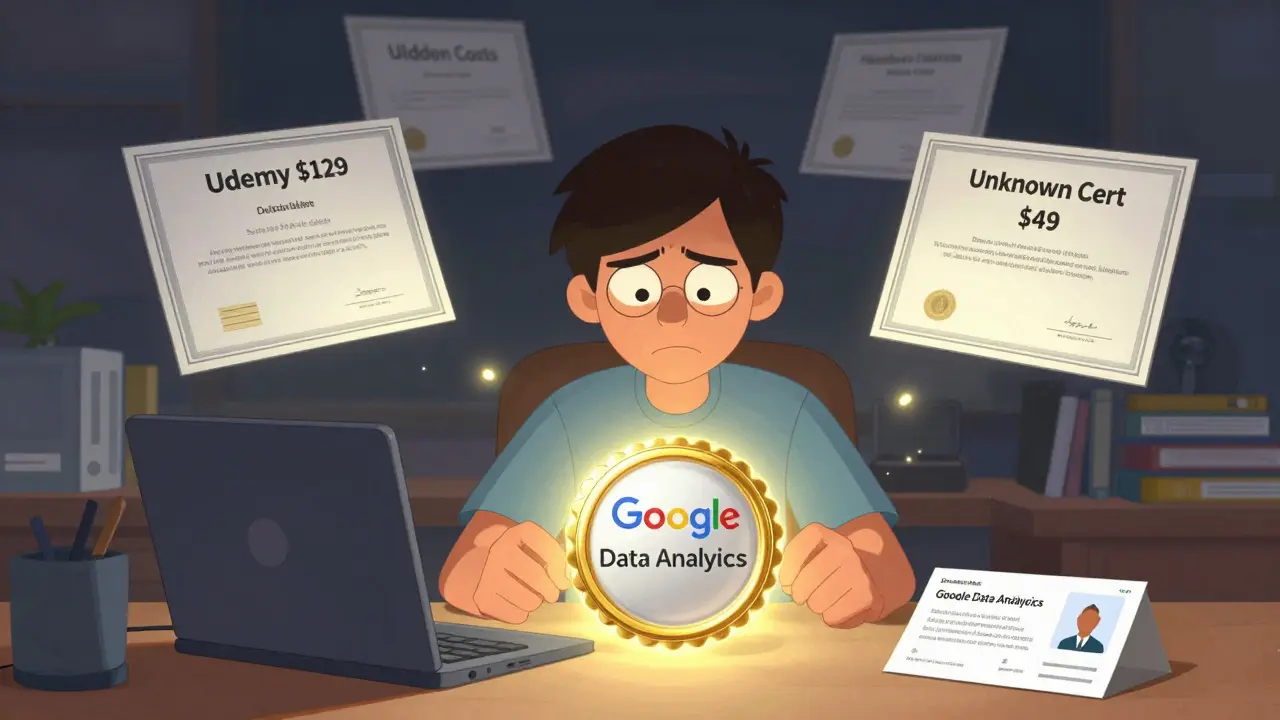
The Hidden Costs of Cheap Courses
The biggest mistake learners make? Choosing based on price alone. A $49 course might seem like a steal - until you realize you need to take it three times because the content doesn’t prepare you for the actual certification exam. Or worse - you pass the course but fail the real exam because the training didn’t cover the latest standards.Take the AWS Certified Solutions Architect exam. It costs $150 to take. But if you buy a $200 course that doesn’t include practice exams based on the 2025 exam blueprint, you’re wasting money. You’ll need to buy another course, or worse - pay the exam fee twice. That’s not saving money. That’s paying twice.
According to a 2025 survey of 2,300 IT professionals, 68% of those who passed their certification on the first try used training that included official practice exams and updated content from the past 12 months. The rest spent an average of $370 more in retakes and supplemental materials.
How to Spot a High-Value Package
Not all expensive courses are worth it. And not all cheap ones are junk. Here’s how to tell the difference:- Check who issues the credential - Is it a company employers actually hire from? Microsoft, Google, AWS, PMI, and CompTIA? Those carry weight. A "Certified Data Analyst" from a random site? Probably not.
- Look for exam vouchers - If the course doesn’t include the actual certification exam fee, add that cost to your total. A $499 package that excludes the $300 exam isn’t $499 - it’s $799.
- Ask for syllabus alignment - Does the course map directly to the official exam objectives? Most reputable providers list this. If they don’t, walk away.
- Read reviews from people who passed - Not just "Great course!" - look for "I passed on my first try because the labs matched the real exam" or "The instructor updated the content after the 2025 changes."
- Check renewal requirements - Some certifications expire. A $1,000 package that requires a $200 renewal every two years? That’s a long-term investment. A $200 package with no renewal? Even better.
Real Examples: What’s Worth It
Let’s look at three real-world packages from 2025:| Package | Price | Includes Exam? | Industry Recognition | Renewal Cost | Time to Complete |
|---|---|---|---|---|---|
| Google Data Analytics Professional Certificate | $49/month | Yes | High (Google, IBM, Accenture) | $0 (no renewal) | 6 months |
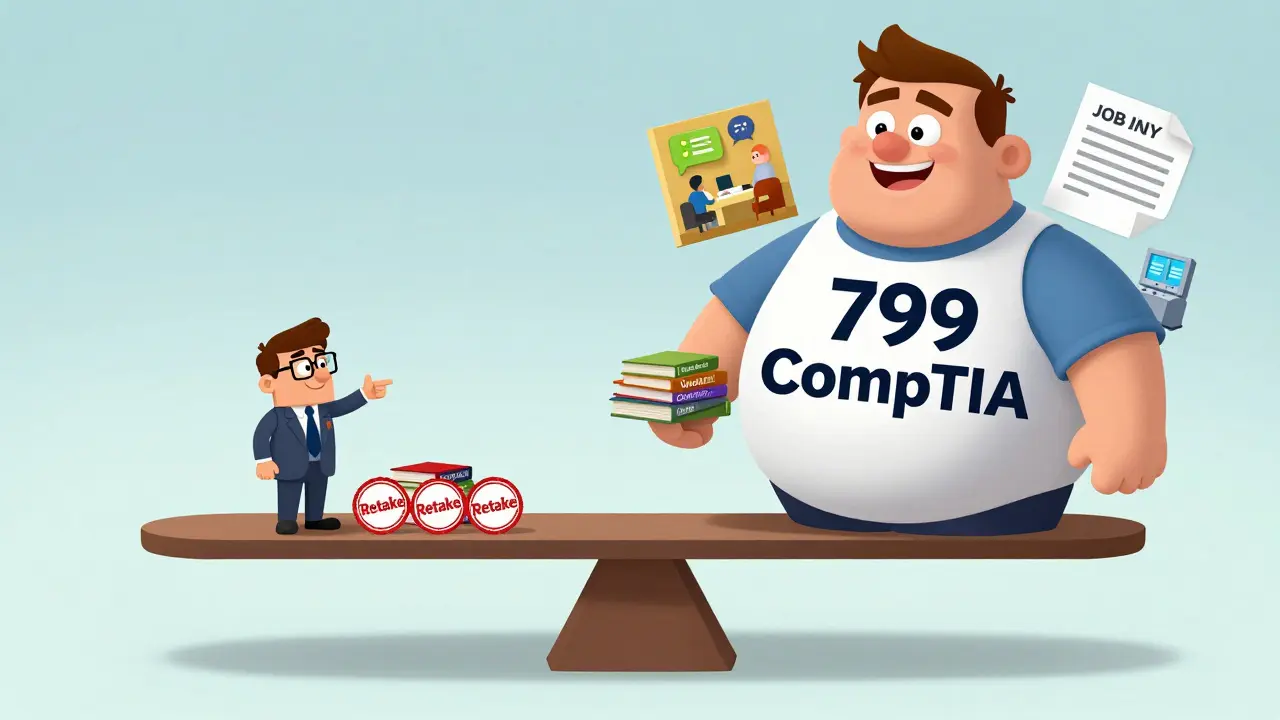
| CompTIA A+ Certification Bundle | $799 | Yes (2 vouchers) | Very High (global IT support) | $200 every 3 years | 3-5 months |
| Udemy "Complete Python Developer" | $129 | No | Low (personal project use) | $0 | 2 months |
Notice the difference? The Google certificate costs less upfront, includes the exam, and has zero renewal - and it’s accepted by over 150,000 employers. The CompTIA bundle costs more, but it’s the gold standard for entry-level IT jobs. The Udemy course? It’s great for learning, but won’t get you hired unless you pair it with a portfolio.
When to Skip the Package Altogether
Sometimes, the best investment isn’t a course at all. If you’re already working in the field, you might not need a certification. A GitHub repo, a case study, or a freelance project can be more convincing than a certificate.For example, if you’re a marketer trying to get into Google Ads, you don’t need a $500 course. Google’s own Skillshop is free. Pass the exam. Get certified. Done. That’s $0 spent and real credentials.
Same goes for project management. PMI’s PMP costs over $1,000. But if you’ve managed five real projects, written up your results, and can show ROI - you’re already ahead of someone who just paid for a course.
How to Budget for Certification
Don’t just pick the cheapest. Pick the smartest. Here’s a simple formula:Total Cost = Course Price + Exam Fee + Renewal Cost (over 3 years) + Time Cost
Time cost? That’s the hours you spend studying instead of working. If you’re learning part-time, estimate $20-$50/hour of your time. Multiply that by 50-100 hours. That’s your hidden cost.
Example: A $600 course with a $300 exam, $150 renewal every 3 years, and 80 hours of study time at $30/hour = $600 + $300 + $150 + $2,400 = $3,450 over three years.
Compare that to a $1,200 bootcamp that includes everything and cuts your study time to 40 hours. That’s $1,200 + $1,200 = $2,400. You save $1,050 and get hired faster.
What Employers Actually Care About
Employers don’t care how much you spent. They care if you can do the job. A 2025 LinkedIn hiring report showed that 73% of recruiters prioritize demonstrated skills over certifications - but 89% of those same recruiters said certifications help them filter resumes faster.So certifications aren’t the goal - they’re the shortcut. They help you get past the ATS (applicant tracking system) and into the interview. Once you’re in, your portfolio, your communication, your problem-solving - those win the job.
That’s why the best strategy isn’t "get every certificate." It’s: get the right one, at the right time, with the right support.
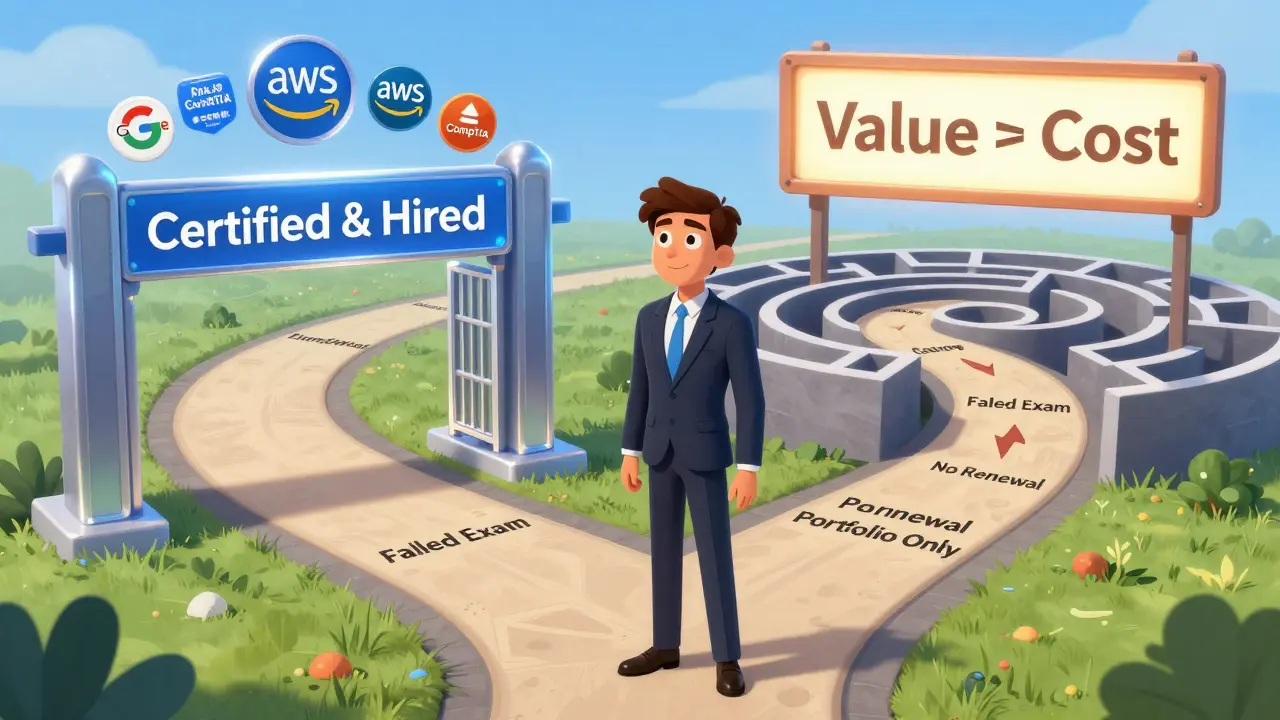
Final Rule: Value > Cost
A $10,000 course isn’t automatically better than a $300 one. But a $300 course that doesn’t prepare you for the real exam? That’s a trap. The key isn’t spending less - it’s spending wisely.Ask yourself:
- Will this get me hired or promoted in the next 12 months?
- Does the credential expire? How much will renewal cost?
- Is the exam included? Or am I paying extra?
- Can I find someone who passed this exact track and ask them what it was like?
If the answer to the first question is "probably not," keep looking. The right certification doesn’t just cost money - it pays you back.
Are certification courses worth the money?
Yes - but only if they’re tied to a recognized credential and include the actual exam. A $50 course with no exam or industry backing won’t help your resume. A $600 package that includes the exam, practice labs, and renewal coverage can pay for itself in higher pay or faster hiring.
Can I skip certification and just build a portfolio?
Absolutely. Many tech and marketing roles now prioritize portfolios, GitHub repos, or freelance work over certificates. But certifications help you get past automated screening systems. The smartest approach? Do both - build your work and earn one key certification to open doors.
Why do some certifications require renewal?
Fields like cybersecurity, cloud computing, and data science change fast. Renewal ensures you’re keeping up. For example, AWS updates its exams every 12-18 months. A certification without renewal is often outdated. Paying $100-$200 every few years is cheaper than being out of date and losing job opportunities.
Is a more expensive course always better?
No. Price doesn’t equal quality. A $2,000 bootcamp might have better support, but a $400 course from an official provider like Google or Microsoft can deliver the same credential with less fluff. Focus on what’s included - exam, labs, community - not just the price tag.
How do I know if a certification is respected by employers?
Check job postings. Look for roles in your target industry and see which certifications are listed as "preferred" or "required." Also, search LinkedIn for people in your target role - if they have the cert, it’s likely valued. Avoid certifications with names like "Certified Master" or "Expert Level" from unknown organizations - they’re usually marketing.
Eric Etienne
March 11, 2026 AT 06:01Amanda Ablan
March 13, 2026 AT 00:43Yashwanth Gouravajjula
March 13, 2026 AT 21:38Janiss McCamish
March 15, 2026 AT 02:09Kendall Storey
March 16, 2026 AT 14:42Sandy Pan
March 16, 2026 AT 15:05Kevin Hagerty
March 16, 2026 AT 22:38Pamela Tanner
March 18, 2026 AT 01:10Megan Blakeman
March 19, 2026 AT 02:05Akhil Bellam
March 19, 2026 AT 05:48Amber Swartz
March 20, 2026 AT 23:21Kristina Kalolo
March 22, 2026 AT 02:14Robert Byrne
March 23, 2026 AT 05:55Richard H
March 24, 2026 AT 12:10Ashton Strong
March 25, 2026 AT 18:29ravi kumar
March 27, 2026 AT 08:08Dylan Rodriquez
March 27, 2026 AT 23:26Steven Hanton
March 28, 2026 AT 02:33Meredith Howard
March 29, 2026 AT 10:08