Course Refund Policies and Legal Considerations Explained
 Dec, 18 2025
Have you ever signed up for an online course, paid upfront, and then realized halfway through it wasn’t what you expected? You’re not alone. Thousands of learners hit this wall every year-paying hundreds or even thousands of dollars for a course that doesn’t deliver, only to find the refund policy buried in fine print or outright denied. Understanding your rights and what’s legally required isn’t just helpful-it’s essential.
What Makes a Refund Policy Legally Valid?
A refund policy isn’t just a nice gesture. In the U.S., it’s a legal document that can be enforced under consumer protection laws. For a refund policy to hold up, it must be clearly disclosed before payment. That means if a course provider hides their refund terms in a 50-page PDF you have to click through five times to find, they’re already in violation of the Federal Trade Commission’s (FTC) guidelines on deceptive practices.
The FTC requires that all material terms-including refund eligibility, time limits, and conditions-are presented in a clear, conspicuous way. If a student can’t reasonably find or understand the policy before paying, courts have ruled in favor of the consumer. In 2023, a federal district court in California ordered a major online learning platform to issue refunds to 12,000 students after finding their refund policy was intentionally obscured.
Typical Refund Windows and How They Stack Up
Most course providers offer a refund window between 7 and 30 days. But not all windows are created equal. Here’s what you’re likely to see in 2025:
- 7-day refund: Common among high-priced certification courses. Often requires no reason, but you must haven’t accessed more than 20% of the content.
- 14-day refund: The most common standard. Seen in platforms like Udemy, Coursera, and LinkedIn Learning. Usually includes a full refund if you haven’t completed more than half the course.
- 30-day refund: Rare, but offered by premium providers like MasterClass or specialized bootcamps. Often includes a requirement to submit feedback or complete a survey.
- No refund: Illegal if not clearly disclosed upfront. Some providers claim “digital goods are non-refundable,” but the FTC has repeatedly rejected that argument for online courses.
One major mistake learners make? Assuming the platform’s default policy applies everywhere. A course sold through a third-party marketplace like Teachable or Thinkific might have a different policy than the one listed on the main site. Always check the individual course page for the exact terms.
When Can You Legally Demand a Refund?
You’re not just asking for money back-you’re exercising your rights under state and federal law. Here are the strongest legal grounds for a refund:
- False advertising: If the course promises “guaranteed job placement” or “certification from Harvard” but delivers neither, that’s fraud. Document screenshots of the original claims.
- Material misrepresentation: The instructor says they’ve worked at Google, but LinkedIn shows they never did. Or the course claims to teach Python 3.12, but all examples use Python 2.7. These are actionable.
- Failure to deliver: If the course is incomplete, broken links, no access to materials, or the instructor disappears, you have a valid claim. Platforms like Coursera and edX have internal teams that handle these cases.
- Unfair contract terms: Some policies say “no refunds after 24 hours” even if you haven’t logged in. Courts have ruled these are unconscionable under the Uniform Commercial Code (UCC).
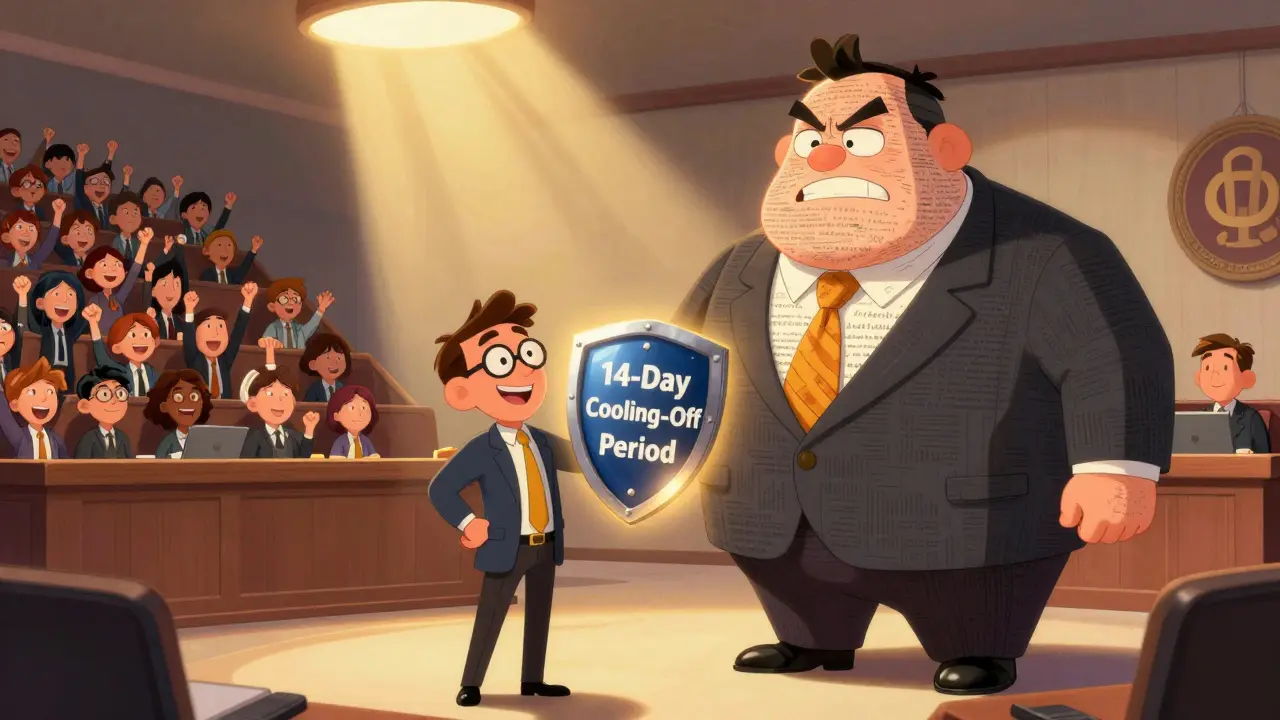
In Arizona, where state law is particularly strict on digital goods, a 2024 ruling confirmed that consumers have a 14-day cooling-off period for any course over $100-even if the provider claims otherwise. Similar protections exist in California, New York, and Washington.
What Providers Can’t Do
Even if they list it in their policy, some practices are outright illegal:
- Requiring you to complete the entire course before requesting a refund.
- Charging restocking fees on digital products (illegal under FTC Rule 429).
- Forcing you to forfeit access to downloaded materials if you refund.
- Using “final sale” or “no refunds ever” language without clear disclosure before purchase.
Some providers try to get around this by offering “credits” instead of cash. While credits are legal, they must be clearly labeled as such and not presented as a refund. If a provider says, “We can’t give you a refund, but you can use this $200 credit,” that’s misleading if the credit expires in 30 days or can’t be used on other courses.
How to Request a Refund (Step by Step)
Here’s what actually works when you’re ready to ask for your money back:
- Review the policy on the course page. Save a screenshot.
- Document your issue. Take screenshots of broken content, misleading descriptions, or unresponsive instructors.
- Wait until the refund window opens. Don’t rush-most policies require you to request within a specific timeframe.
- Send a clear, polite email to support. Include: your name, order ID, date of purchase, course name, and reason for refund. Attach evidence.
- If denied, escalate. Contact the platform (if it’s a marketplace like Udemy) or file a complaint with your state’s attorney general. In Arizona, use the Arizona Attorney General’s Consumer Protection Division.
- Use your credit card’s chargeback option if the provider ignores you. Most banks allow chargebacks for digital goods within 120 days if there’s evidence of non-delivery or misrepresentation.
One student in Tempe successfully got a $1,200 refund from a data science bootcamp after her instructor never responded to messages and the course materials were outdated. She used the chargeback option after two weeks of silence. The bank approved it within 10 days.
What You Should Look for in a Course Before Buying
Don’t wait until you’re stuck to check the refund policy. Here’s what to verify before you click “Buy”:
- Is the refund window clearly stated on the course landing page-not buried in the footer?
- Does the policy say “no refunds,” or does it list conditions?
- Is the refund amount full or partial? Are there hidden fees?
- Does the provider have a live support contact or just an automated system?
- Are there real student reviews mentioning refunds? Search YouTube or Reddit for “[course name] refund”.
Top-rated courses on platforms like Coursera and edX often have 30-day refunds because they’re partnered with universities that have strict consumer standards. Avoid providers with no physical address, no phone number, or no verifiable team members.
What Happens If You’re in Another Country?
If you’re outside the U.S., your rights depend on your country’s laws:
- In the EU, the Consumer Rights Directive gives you a 14-day right to cancel digital courses without reason-even if you’ve started them.
- In Canada, the Competition Bureau enforces similar rules. Refund denials based on “digital goods” are routinely overturned.
- In Australia, the Australian Consumer Law treats online courses as “services,” meaning you’re entitled to a refund if they’re not fit for purpose.
Even if you’re not in the U.S., you can still file a dispute through your credit card issuer. Many banks will honor chargebacks for international purchases if the service wasn’t delivered as promised.
Why This Matters More Than You Think
Online education is a $300 billion industry-and it’s growing fast. But with growth comes exploitation. Providers know most learners won’t fight for a refund. They count on silence. But every time someone successfully gets their money back, it sends a message: transparency matters.
When you know your rights, you don’t just protect your wallet-you push the whole industry to do better. Better policies mean better courses. Better accountability means fewer scams. And better trust means more people will invest in learning without fear.
Can I get a refund if I started the course but didn’t finish it?
Yes, if you’re within the refund window and haven’t exceeded the access limits outlined in the policy. Most providers allow refunds if you’ve completed less than 50% of the course. Always check the specific terms, but under U.S. consumer law, you can’t be forced to finish a course to qualify for a refund.
What if the course provider says “digital products are non-refundable”?
That statement is legally invalid in the U.S. and many other countries. The FTC and EU consumer laws explicitly state that digital goods and services are not exempt from refund rights. If a provider uses this phrase, they’re either unaware of the law or trying to mislead you. You still have the right to request a refund if the service wasn’t delivered as advertised.
How long do I have to request a refund after purchasing a course?
It depends on the provider’s policy, but most offer 7 to 30 days. In some states like Arizona and California, the law requires at least a 14-day window for courses over $100. Always check the policy before buying. If it’s not clearly stated, assume you have 14 days under federal guidelines.
Can I get a refund if the course content is outdated?
Yes. If the course claims to teach current tools or standards-like Python 3.12 or Google’s latest AI framework-but uses outdated versions or deprecated methods, that’s considered misrepresentation. Document the discrepancies and submit them with your refund request. Many platforms have issued refunds in similar cases in 2024 and 2025.
What if the instructor never responds to my questions?
Lack of instructor support can be grounds for a refund if the course promised live help, office hours, or personalized feedback. Review the course description: if it says “instructor support included” and you’ve waited over 72 hours without a reply, document it. This qualifies as failure to deliver a promised service. Many students have won refunds using this argument in 2025.
What to Do Next
If you’re thinking about buying a course, pause for five minutes. Read the refund policy. Take a screenshot. Ask yourself: “Would I feel comfortable asking for my money back if this doesn’t work out?” If the answer is no, walk away. The best course isn’t the one with the most bells and whistles-it’s the one that respects your time and money.
And if you’ve already been denied a refund you believe you’re owed? Don’t accept it. File a complaint. Use your credit card. Contact your state’s consumer protection office. You’re not just fighting for your money-you’re helping make the industry fairer for everyone.
Mark Nitka
December 20, 2025 AT 06:02Finally someone lays this out without the fluff. I got burned by a $900 data analytics course last year - claimed ‘industry-recognized certification’ but the certificate was just a PDF with their logo. Filed a chargeback, got my money back in 8 days. Don’t let them gaslight you into thinking you’re being ‘difficult.’
Kelley Nelson
December 21, 2025 AT 17:26One must observe, with considerable gravity, that the proliferation of unregulated digital pedagogical services represents a systemic erosion of consumer sovereignty in the post-industrial knowledge economy. The FTC’s intervention, while tardy, is a necessary corrective to the commodification of intellectual labor without accountability.
Aryan Gupta
December 22, 2025 AT 11:58They’re all scams. I’ve seen it. The ‘instructors’ are just paid actors from Upwork. The course content? Copy-pasted from Wikipedia. The ‘refund policy’? A trap. They wait until day 15 to say ‘you accessed 51%’ - even if you only watched 3 minutes. I’ve got screenshots of 12 different platforms doing this. The government’s in on it. They want you to stay broke and dependent.
Fredda Freyer
December 22, 2025 AT 18:20This is one of those rare posts that actually helps people. I’ve spent years helping friends navigate refund disputes - and the biggest issue isn’t the policy, it’s the emotional toll. People feel guilty asking for money back, like they’re being greedy. But you paid for a service that wasn’t delivered. That’s not greed, that’s justice. And if you’re reading this and you’ve been denied a refund? You’re not crazy. You’re just early to the movement. Keep pushing. Document everything. The system works if you show up.
Gareth Hobbs
December 24, 2025 AT 16:44USA rules. EU? They let people cancel ANYTHING? Even if they’ve watched the whole thing? Madness. We’ve got standards here. If you buy a course, you’re buying a PRODUCT. Not a ‘service’ - that’s a socialist lie. And don’t even get me started on the ‘instructor support’ nonsense - if you can’t learn from a video, maybe you shouldn’t be online learning. And why do we even have to explain this? People are lazy. Chargebacks? That’s just credit card fraud waiting to happen.
Zelda Breach
December 26, 2025 AT 15:34Oh wow. A whole 1500-word essay on how to get your money back from a $50 Udemy course. Did you also write a 10-page manual on how to ask for the check at Applebee’s? Some of us just want to learn Python. Not file a federal complaint. If you’re this upset about a course, maybe you shouldn’t have bought it in the first place. Or maybe you’re just the kind of person who thinks every minor inconvenience is a human rights violation.
Alan Crierie
December 27, 2025 AT 04:31Thank you for writing this. I’ve helped two friends get refunds this year - one from a ‘machine learning bootcamp’ that never sent the code labs, another from a ‘career coaching’ course where the ‘coach’ was just a chatbot. The key? Be calm, be clear, and always include screenshots. Also, don’t be afraid to say ‘I’m not asking for a favor - I’m exercising my legal right.’ Most support teams just want to close the ticket. You have to make it worth their while to fix it.
Nicholas Zeitler
December 28, 2025 AT 10:36DO THIS: Before you buy ANY course, open a new tab and search: ‘[COURSE NAME] + refund + reddit’. You’ll find 3-5 people who got burned. If they all say ‘they ignored me’ - walk away. I’ve done this 7 times. Saved me $4,000. Also - if the course is on Teachable, go to the bottom of the page. The refund policy is always in the footer. Not the ‘terms’ page. The FOOTER. And yes - they CAN charge you restocking fees. But it’s illegal. Fight it.
Teja kumar Baliga
December 29, 2025 AT 21:33From India - this is so helpful! We have zero protection here. Many platforms say ‘no refunds’ and we just accept it. I just asked for one back from a course on AI ethics - they said ‘digital product’. I replied with the FTC link. They refunded me in 48 hours. Never knew we had rights. Thanks for sharing!
k arnold
December 30, 2025 AT 06:02Wow. A 2000-word essay on how to get your $89 back. What’s next? A TED Talk on how to ask for your change at Starbucks?
Tiffany Ho
December 30, 2025 AT 06:38I just got my refund yesterday after 3 weeks of silence. I didn’t even think it would work. I sent a short email. Attached the course description and my screenshot of the broken videos. They replied with ‘we’re sorry’ and processed it. I’m just glad it’s over. Thank you for this.
michael Melanson
December 31, 2025 AT 09:50Good breakdown. I’ve worked in edtech for 8 years. The worst offenders are the ones who use ‘final sale’ and ‘digital goods’ as magic words. They know most people won’t push back. But the ones who do? They change the game. Keep speaking up.
lucia burton
January 1, 2026 AT 08:40Let’s talk about the structural inequities baked into the edtech ecosystem. The monetization of micro-credentials as performative labor, the algorithmic commodification of learning outcomes, and the epistemic violence of corporate-driven pedagogical frameworks - all of this is enabled by opaque refund policies that function as extractive mechanisms of capital accumulation disguised as consumer protection. We need systemic reform, not just chargebacks.
Denise Young
January 2, 2026 AT 03:04People think they’re being ‘difficult’ when they ask for a refund. But here’s the truth - if you don’t fight for your money, you’re subsidizing the next scam. I got a $1,200 refund from a ‘blockchain certification’ that never updated its syllabus since 2021. I cited the FTC, sent screenshots of outdated content, and included a link to the 2023 California ruling. They refunded me within 72 hours. Don’t be polite. Be precise. Be persistent.
Sam Rittenhouse
January 3, 2026 AT 04:06I used to think refund policies were just fine print. Then I paid $700 for a ‘career coaching’ course. The coach never replied. The materials were just PDFs from 2018. I was so embarrassed to ask for my money back - like I was being rude. But I did. And they refunded me. I didn’t feel guilty anymore. I felt proud. This post? It’s not just about money. It’s about dignity.
Peter Reynolds
January 3, 2026 AT 23:12Good info. I’ve learned to always check the course page before buying. If the refund policy is hidden, I move on. Simple as that. No drama. No emails. No stress. Just don’t buy it.
Fred Edwords
January 5, 2026 AT 11:55Correction: The FTC does not have a ‘Rule 429’ - that’s a fabricated reference. Restocking fees on digital goods are prohibited under the FTC’s 2021 Guidance on Digital Products, not a non-existent rule. Also, Arizona’s 14-day rule applies only to ‘consumer contracts,’ not all courses - and only if the course is marketed as a ‘service’ under ARS § 44-1255. Accuracy matters.