Creating Culturally Responsive Online Course Content
 Feb, 7 2026
When you design an online course, you’re not just teaching facts-you’re shaping how people see the world. If your course only shows one cultural perspective, you’re leaving out half the story. And worse, you’re making learners from other backgrounds feel like they don’t belong.
Why Cultural Responsiveness Matters
Think about a student in Lagos taking a business course that only talks about Silicon Valley startups. Or a nurse in Manila learning healthcare protocols based solely on U.S. guidelines. These learners aren’t just confused-they’re disengaged. Research from the University of Michigan found that students from underrepresented cultures are 40% more likely to drop out of online courses when content doesn’t reflect their experiences.
Culturally responsive content isn’t about checking a diversity box. It’s about building trust. When learners see their language, values, and daily realities reflected in your course, they pay attention. They ask questions. They stick around.
Start with Your Learners
You can’t design for everyone. But you can design for the people who are actually taking your course. Look at your enrollment data. Where are your learners from? What languages do they speak at home? What cultural norms shape how they learn?
For example, in many East Asian cultures, direct criticism is avoided. In parts of Latin America, group consensus matters more than individual answers. In Indigenous communities, storytelling is a primary way of passing down knowledge. If your course only uses multiple-choice quizzes and lecture videos, you’re missing the mark.
Instead, ask: What does success look like for this learner? Is it mastering a skill? Solving a real problem in their community? Connecting with peers who understand their background?
Replace Generic Examples with Real Ones
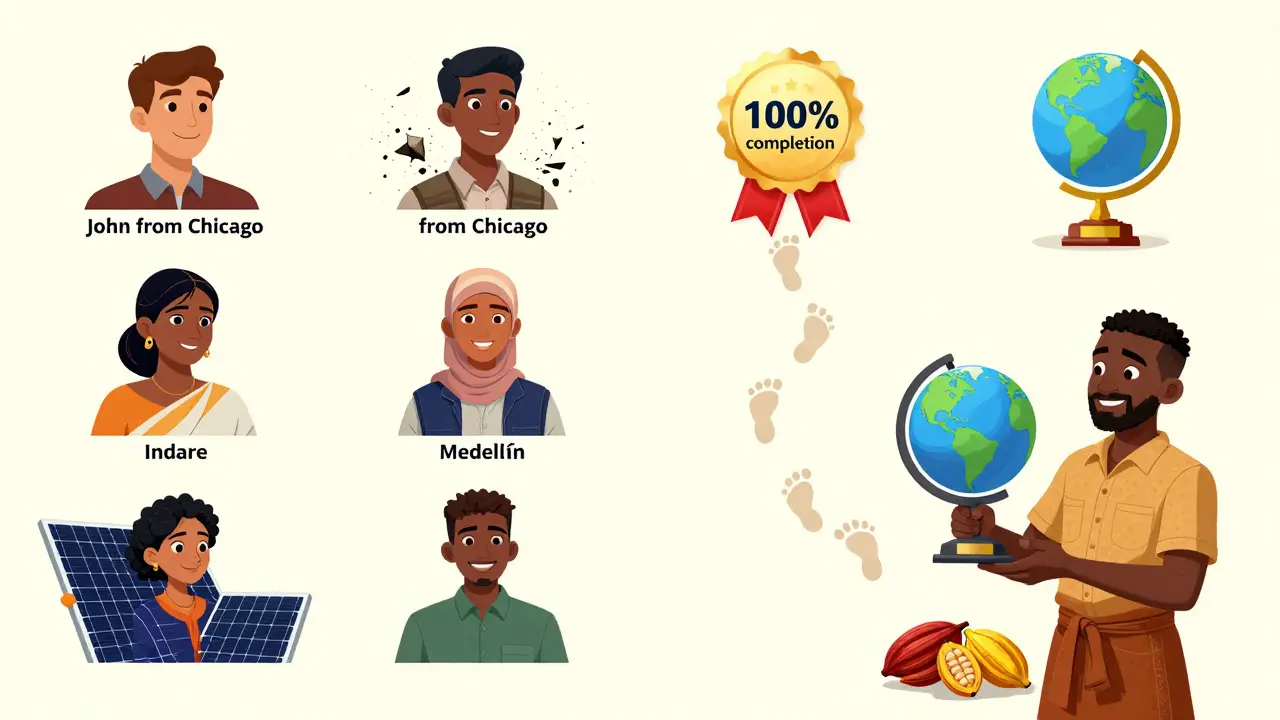
Stop using “John from Chicago” as your default example. Replace it.
Need to explain supply chain logistics? Show a small family-owned farm in Ghana exporting cocoa beans. Teaching financial literacy? Use a case study from a street vendor in Jakarta managing daily income without a bank account. Explaining communication styles? Compare how feedback is given in a German corporate meeting versus a Moroccan family council.
These aren’t just “diverse examples.” They’re accurate, lived experiences that make abstract concepts stick. A study from Stanford’s Graduate School of Education showed that learners retained 65% more information when examples matched their cultural context.
Language Isn’t Just Translation
Translating your course into Spanish or Mandarin doesn’t make it culturally responsive. It just makes it accessible in another language.
Consider idioms. In English, we say “think outside the box.” In Arabic, the equivalent is “think beyond the roof.” In Swahili, it’s “see beyond the fence.” If you translate literally, learners get confused.
Same goes for humor. Sarcasm doesn’t translate. Irony falls flat. Jokes based on U.S. pop culture? Irrelevant to a learner in Nairobi.
Use simple, clear language. Avoid idioms. When you need to explain a concept, use visuals, stories, or analogies rooted in everyday life-like how a rice farmer in Vietnam manages water flow, or how a street vendor in Medellín keeps track of change without a calculator.
Design for Different Learning Styles
Not everyone learns by reading. Some learn by talking. Others by doing. And some by listening to elders.
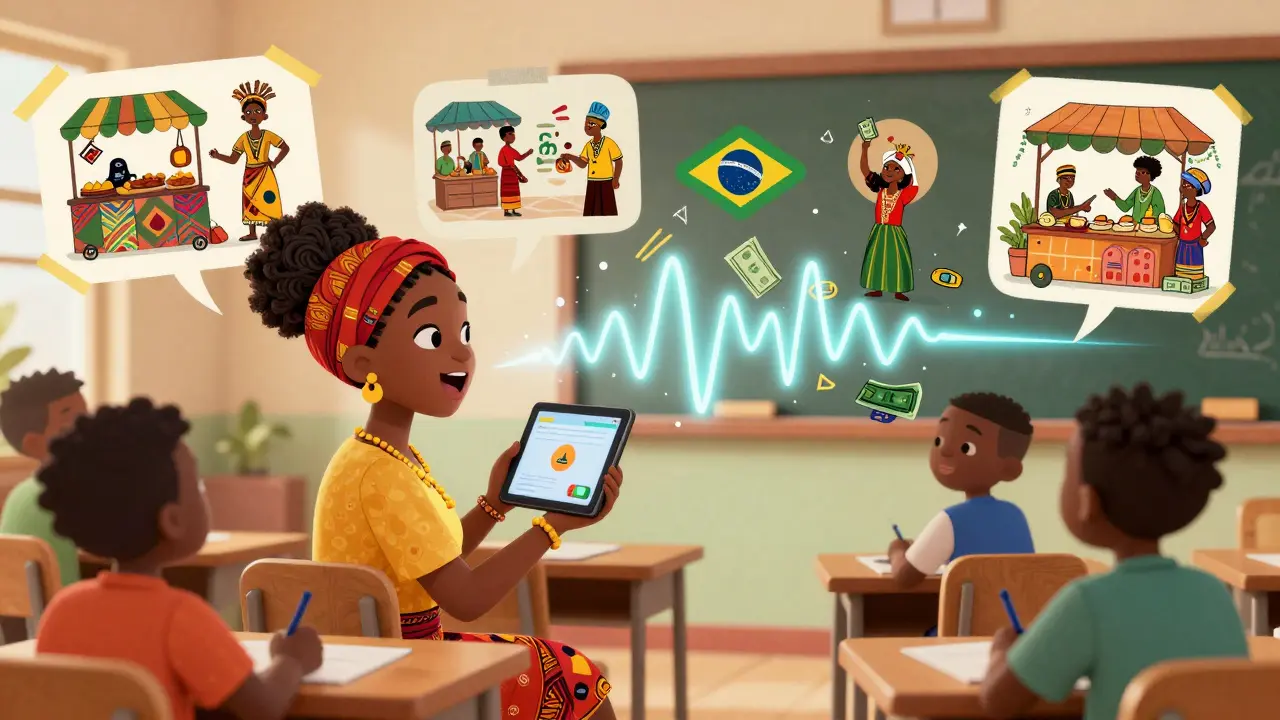
In many African and Indigenous communities, oral tradition is the foundation of learning. If your course only has text and video, you’re excluding learners who rely on storytelling and dialogue.
Try this: Add audio stories from real people. Create discussion prompts that invite personal experience: “Tell us about a time you solved a problem with limited resources.” Let learners submit voice notes or short video reflections. You don’t need fancy tech-just a simple upload button.
Also, avoid forcing individual competition. In many cultures, group success is valued more than individual achievement. Replace leaderboards with collaborative goals: “Let’s get 80% of learners to complete this module together.”
Include Diverse Voices in Your Content
Who’s speaking in your videos? Are they all from the same country, same background, same accent? If so, you’re sending a message: “Only people like us belong here.”
Invite guest speakers from different regions. Feature instructors who speak with accents. Show learners from varied cultures solving problems in their own way. A course on renewable energy should include a woman in rural India installing solar panels, not just a white engineer in Germany.
And don’t just add one token voice. Include multiple perspectives. One example from Brazil. One from Bangladesh. One from Sweden. One from a First Nations community in Canada. Diversity isn’t a checklist-it’s a pattern.
Test, Listen, Adapt
You can’t predict every cultural nuance. So don’t try. Instead, build feedback loops into your course.
Add anonymous surveys: “Did any part of this course feel unfamiliar or confusing?” “Was there something you wished was included?”
Set up a simple discussion board where learners can share what’s missing. Respond. Thank them. Act on their feedback.
One course creator in Nigeria noticed that learners kept skipping a module on budgeting. She asked why. Turns out, the examples used monthly paychecks. But most of her learners got paid weekly in cash. She rewrote the entire section using market vendor income patterns. Completion rates jumped from 52% to 89%.
What to Avoid
- Don’t stereotype. Not all Middle Eastern learners are business owners. Not all Latin American learners are family-oriented. Avoid generalizations.
- Don’t tokenize. Don’t add one Black instructor just to “look diverse.” Include them because their perspective adds depth.
- Don’t assume your culture is neutral. Your way of teaching isn’t the default. It’s just one way.
- Don’t wait for perfection. Start with one change-swap one example. Then another. Progress matters more than polish.
Small Changes, Big Impact
You don’t need to overhaul your entire course. Start small.
- Change one example in your next module.
- Add one voice note from a learner in another country.
- Use a local currency instead of USD in your exercises.
- Ask learners what they’d like to see next.
Each change builds trust. Each change tells a learner: “You’re not just a number here. You belong.”
And that’s what makes learning stick-not perfect slides. Not fancy animations. Just the quiet certainty that someone out there sees you, understands you, and designed this course with you in mind.
What does culturally responsive course content look like?
Culturally responsive course content reflects the backgrounds, languages, values, and real-life experiences of learners. It uses examples from diverse regions, includes voices from multiple cultures, avoids stereotypes, and adapts teaching methods to fit different learning traditions-like storytelling, group collaboration, or oral discussion. It doesn’t just translate content-it transforms it to feel relevant and respectful.
Can I make my existing course more culturally responsive without rebuilding it?
Yes. Start by replacing one or two generic examples with real-world scenarios from different cultures. Add a short audio story from a learner in another country. Change currency symbols, names, or locations in quizzes. Ask learners for feedback. Small, intentional changes build over time-and they’re far more effective than waiting for a full redesign.
Do I need to hire experts from every culture to create this content?
No. You don’t need a team from every country. But you do need to listen. Partner with learners, ask open-ended questions, and use real stories they share. Many platforms now allow learners to upload video reflections or written stories. These firsthand accounts are more valuable than any expert checklist. Your role is to create space for their voices-not to speak for them.
How do I avoid cultural stereotypes in my course?
Avoid broad generalizations like “all Asians value hard work” or “Latin Americans are collectivist.” Instead, show specific people solving specific problems. Use real names, real places, and real challenges. Let learners see complexity-not tropes. If you’re unsure, ask someone from that culture to review your content. Even one honest reviewer can prevent major missteps.
Is this only important for global courses?
No. Even courses for learners in one country are culturally diverse. In the U.S., for example, learners come from over 300 ethnic backgrounds, speak 400+ languages, and have vastly different educational experiences. A course designed for “everyone” often ends up serving only one group. Cultural responsiveness means recognizing that diversity exists everywhere-even in a single classroom.
Aditya Singh Bisht
February 7, 2026 AT 08:38Just finished redesigning my econ module with real examples from Mumbai street vendors and Kerala fisherfolk. Completion rates shot up by 60%.
Turns out, when learners see themselves in the material, they don’t just engage-they care.
Simple swap. Huge impact. Stop overcomplicating it.
Agni Saucedo Medel
February 8, 2026 AT 12:33Yes!! 🙌 I added a voice note from my cousin in Varanasi explaining how she budgets with daily cash earnings-no bank, no app, just memory and trust.
Learners LOVED it. One wrote: ‘This is the first time my life was seen in a course.’
Small change. Big heart.
ANAND BHUSHAN
February 10, 2026 AT 08:28Good points. Changed one example. Used a Delhi auto-rickshaw driver instead of ‘John from Chicago.’
Done.
Amit Umarani
February 10, 2026 AT 10:30Technically, the term ‘culturally responsive’ is often misused. It’s not about replacing ‘John from Chicago’ with ‘Maria from Mexico.’
It’s about epistemological humility. Are you centering learner epistemic frameworks, or just tokenizing geography?
Most so-called ‘diverse examples’ are still framed through a Western pedagogical lens.
vidhi patel
February 12, 2026 AT 05:54It is imperative that educators refrain from employing colloquialisms such as ‘stop using John from Chicago’ when addressing pedagogical design. Such phrasing lacks academic rigor and undermines the professional credibility of instructional development.
One must adopt a systematic, evidence-based methodology grounded in cross-cultural pedagogy theory, not anecdotal substitutions.
Priti Yadav
February 13, 2026 AT 01:30Wait-so you’re telling me this whole ‘culturally responsive’ thing isn’t just a woke corporate scam to get more funding?
Because last year, my university ‘diversified’ our course and now we have a video of a woman in Nepal holding a goat while explaining budgeting.
She didn’t even have shoes on. Was that ‘real’ or just poverty porn?
Who decided she was the ‘authentic’ voice?
Who gets paid for this?
Ajit Kumar
February 14, 2026 AT 14:41While the sentiment behind culturally responsive design is laudable, the implementation is often superficial. The author conflates geographical representation with cultural depth. A case study from Jakarta does not automatically confer cultural responsiveness if the underlying pedagogical structure remains rooted in individualistic, Western, linear learning models.
True responsiveness requires dismantling the assessment paradigm itself-replacing standardized quizzes with community-based performance evaluations, integrating intergenerational knowledge transfer, and allowing for non-linear progression through content.
Most institutions lack the structural capacity to do this. They’re just swapping stock photos.
Diwakar Pandey
February 16, 2026 AT 09:54I started by adding one audio story from a learner in Odisha who built a solar charger from scrap parts.
She didn’t speak English fluently-her voice was soft, her accent thick.
But her story? It changed everything.
Not because it was ‘diverse’-but because it was human.
One story. One upload button. That’s all it took.
Now I ask every new learner: ‘What’s a problem you solved that no textbook ever taught?’
And I listen.
That’s the work.
Geet Ramchandani
February 17, 2026 AT 05:41Let’s be real. This whole ‘culturally responsive’ movement is just a distraction. You think changing ‘John from Chicago’ to ‘Ravi from Pune’ fixes systemic inequality in education?
Meanwhile, your LMS still tracks every click, penalizes slow learners, and sells anonymized data to edtech startups.
And you’re proud of swapping a stock photo?
Wake up. The problem isn’t your examples-it’s the entire capitalist machine that turns learning into a product.
Stop trying to make oppression look inclusive. It’s still oppression.
Jen Deschambeault
February 18, 2026 AT 01:41I’m from Canada, but I teach in rural Bangladesh. The moment I stopped using USD and started using taka, and asked learners to describe their own ‘emergency fund’-not a bank account, but a neighbor who lends rice-they lit up.
One student said, ‘You finally stopped talking at us.’
That’s the goal.
Not perfection. Just presence.
Kayla Ellsworth
February 18, 2026 AT 23:51So let me get this straight. You want us to replace ‘John from Chicago’ with ‘Aisha from Lagos’… and call that diversity?
Isn’t that just diversity theater?
Like putting a Black Lives Matter sticker on a police car.
At least admit it’s performative. Don’t pretend this is transformative.
Dave Sumner Smith
February 19, 2026 AT 04:55This is all just a psyop by UNESCO and the UN to erase Western education standards.
They’re using ‘cultural responsiveness’ to dumb down curriculum so non-Western learners don’t get left behind.
But here’s the truth: Western education works because it’s universal.
Everything else is just emotional manipulation wrapped in buzzwords.
Stop pandering. Teach the truth.
Cait Sporleder
February 21, 2026 AT 01:45The profundity of this framework cannot be overstated. It transcends pedagogical utility and enters the realm of epistemic justice.
By centering lived experience over abstract theory, we dismantle the colonial scaffolding of knowledge production.
Consider the ontological weight of a voice note from a rice farmer in the Mekong Delta-how it reconfigures the learner’s relationship to authority, to expertise, to truth itself.
When we replace the ‘corporate case study’ with the ‘market vendor’s ledger,’ we do not merely modify content-we reconstruct the very architecture of learning.
And yet, most institutions remain trapped in the neoliberal paradigm, treating this as a compliance checkbox rather than a revolutionary act.
The future of education is not in algorithms, but in ancestral wisdom-whispered, not dictated.
Paul Timms
February 22, 2026 AT 07:18Changed one example. Added one voice note. Asked for feedback.
That’s all.
Still works.
Jeroen Post
February 22, 2026 AT 07:27Who decides what’s authentic?
Who gets to speak?
What if the ‘real’ voice is the one that’s been silenced?
What if the real solution is not more stories-but less control?
Maybe the course shouldn’t be designed at all.
Maybe it should just… be a space.
Let them build it.