Episodic vs Continuous Learning Models: Which Approach Wins in 2026?
 May, 17 2026
Imagine you are trying to learn a new language. One approach is to memorize entire conversations-every nuance, every context-and replay them when needed. The other is to constantly update your understanding of grammar and vocabulary as you hear new words, blending old knowledge with new input seamlessly. This tension between storing distinct memories and updating a single evolving model defines the core debate in modern artificial intelligence: episodic learning versus continuous learning.
In 2026, as AI systems become more integrated into daily life, how these models retain information without forgetting or becoming confused is critical. You might wonder why this matters if you aren't building neural networks. The answer lies in reliability. When an AI assistant gives you advice based on yesterday's news but forgets last year's context, or worse, mixes up two different contexts entirely, it fails you. Understanding the difference between episodic and continuous learning helps us predict which AI tools will be trustworthy partners and which will remain fragile novices.
The Core Difference: Memory Banks vs. Fluid Adaptation
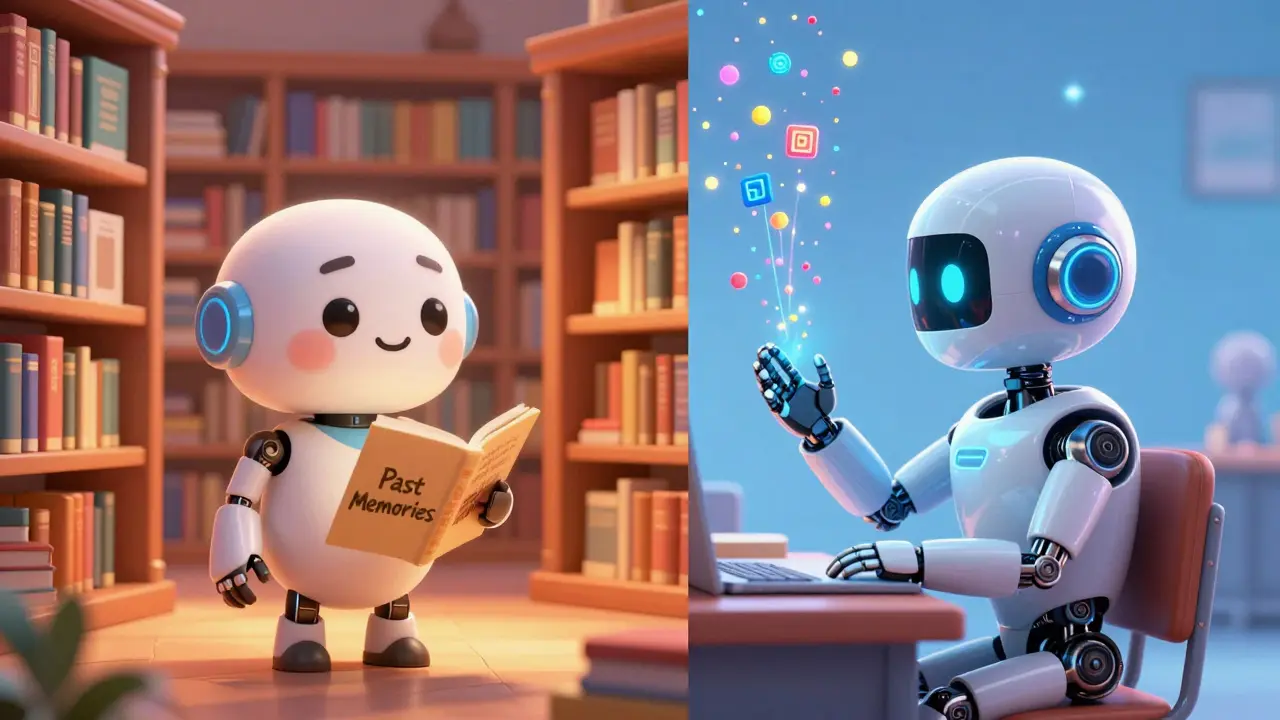
To grasp the distinction, we need to look at how each model handles data over time. Episodic learning, often referred to in technical circles as Exemplar-based learning, works by storing specific examples of past experiences. Think of it like a library. When the system encounters a new problem, it searches its "library" for similar past cases and applies the solution that worked before. It doesn't necessarily change its internal rules; it just retrieves relevant memories.
Continuous learning, also known as Lifelong learning, operates differently. Here, the model updates its internal parameters continuously as new data arrives. It’s like a student who refines their understanding of physics with every new experiment. The goal is to integrate new knowledge into existing frameworks without starting from scratch. However, this creates a massive challenge: the risk of "catastrophic forgetting."
| Feature | Episodic Learning | Continuous Learning |
|---|---|---|
| Memory Mechanism | Stores raw examples (exemplars) | Updates model weights/parameters |
| Forgetting Risk | Low (data is preserved) | High (catastrophic forgetting) |
| Storage Cost | High (requires large buffers) | Low (compact model representation) |
| Adaptability | Rigid unless retrained | Fluid and dynamic |
| Privacy Concerns | High (stores user data directly) | Lower (abstracted knowledge) |
Why Catastrophic Forgetting Breaks Continuous Models
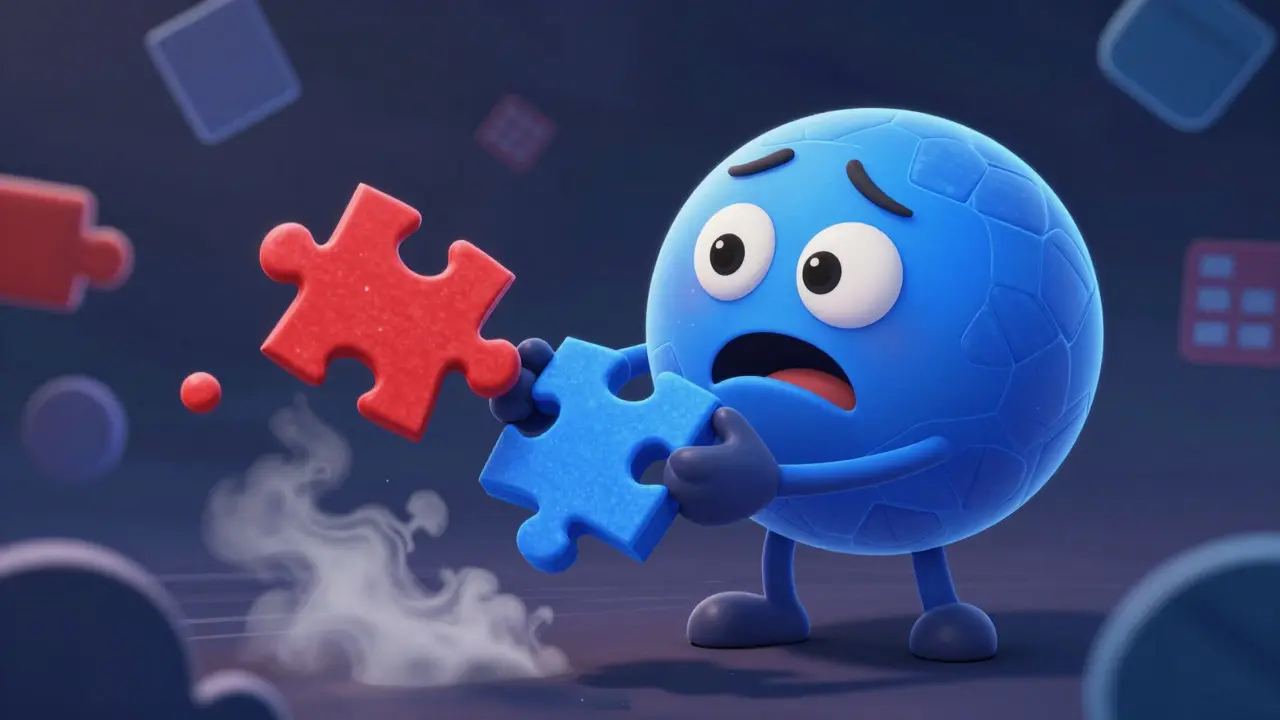
The biggest hurdle for continuous learning is a phenomenon called catastrophic forgetting. In traditional deep learning, when a neural network learns a new task, it adjusts its weights to fit the new data. Unfortunately, these adjustments often overwrite the patterns learned from previous tasks. Imagine learning Spanish after mastering French. If your brain rewires itself entirely for Spanish verbs, you might suddenly lose your ability to conjugate French ones. In AI, this happens rapidly and completely.
Researchers have tried various fixes. Regularization techniques, such as Elastic Weight Consolidation (EWC), attempt to identify which weights are important for old tasks and freeze them while allowing others to change. But this is a delicate balancing act. Freeze too much, and the model can't learn anything new. Freeze too little, and it forgets the past. As of 2026, EWC and similar methods improve stability but haven't eliminated the trade-off between plasticity (learning new things) and stability (keeping old things).
The Storage Burden of Episodic Systems
If continuous learning struggles with forgetting, episodic learning struggles with space. Storing every experience requires significant memory resources. A self-driving car using pure episodic learning would need to store terabytes of video footage and sensor data for every mile driven. Retrieving the right memory from millions of stored clips in real-time is computationally expensive.
This approach relies heavily on Nearest Neighbor Search algorithms. The system must quickly find the most similar past scenario to the current one. While effective for small datasets, scalability becomes a nightmare. Furthermore, there is a privacy issue. If an AI stores exact copies of user interactions, it holds sensitive personal data. Under regulations like GDPR and CCPA, deleting a user's "right to be forgotten" is straightforward in continuous models (just stop training on their data) but nearly impossible in episodic models where their specific data points are embedded in the memory buffer.
Hybrid Approaches: The Best of Both Worlds?
Given the limitations of both extremes, the industry is moving toward hybrid architectures. These systems use episodic memory to store rare or critical events while relying on continuous learning for general pattern recognition. This mimics human cognition remarkably well. Humans don't remember every meal they've ever eaten (continuous abstraction), but they vividly recall their wedding day (episodic storage).
One prominent framework is the Dual-Process Theory applied to AI. System 1 handles fast, intuitive responses via continuous learning models, while System 2 engages slower, deliberate reasoning by retrieving specific episodic examples. Companies building customer service bots are adopting this. The bot uses continuous learning to understand general sentiment and intent, but switches to episodic retrieval when a customer mentions a specific past complaint or transaction ID.
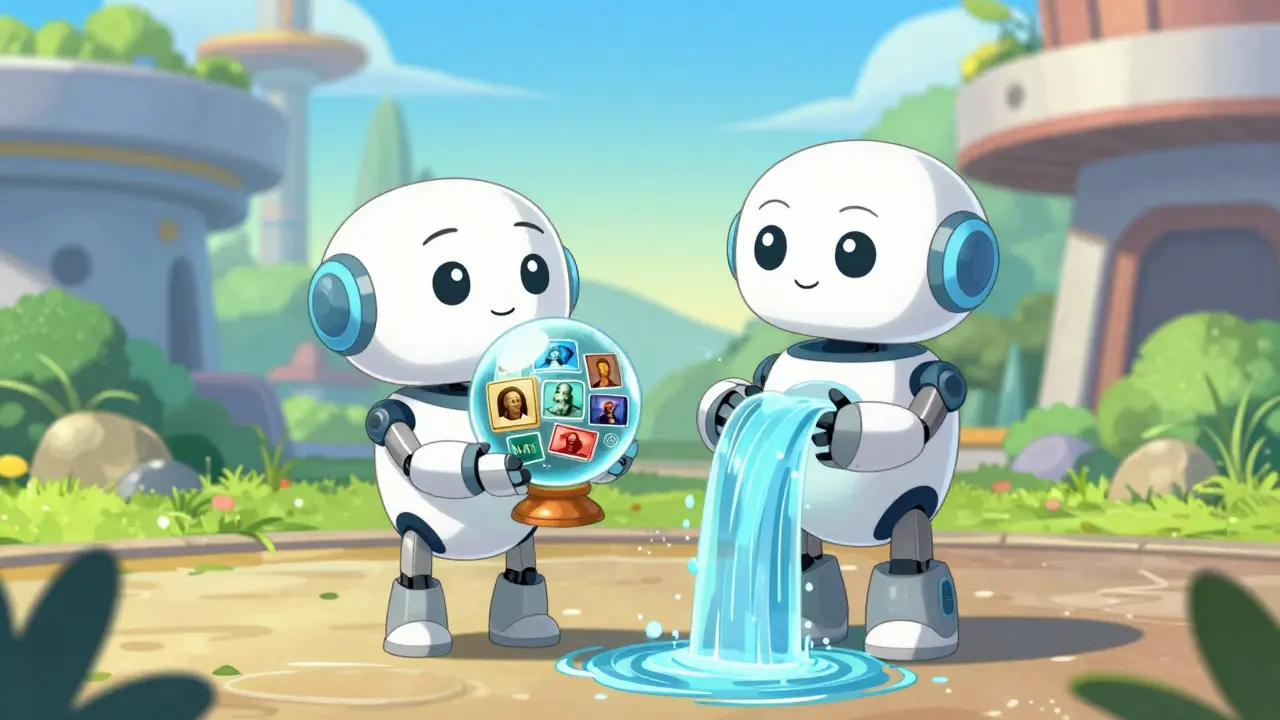
Another emerging technique involves Generative Replay. Instead of storing raw data, the AI generates synthetic examples of past tasks using a generative model. It then practices on these fake examples alongside new real data. This reduces storage needs compared to pure episodic learning while mitigating catastrophic forgetting in continuous models. It’s not perfect-the generated images can sometimes drift from reality-but it’s a promising middle ground.
Real-World Applications in 2026
Where do you see these models in action today? Healthcare is a prime example. Diagnostic AI systems benefit from episodic learning because medical cases are often unique. A rare disease presentation shouldn't be smoothed over by general trends. By storing specific patient outcomes, doctors can retrieve analogous cases for consultation. However, for common conditions like hypertension, continuous learning allows the model to adapt to new treatment guidelines instantly without needing to reference every past patient file.
In finance, fraud detection relies on a mix. Continuous learning helps the model adapt to new fraud tactics in real-time. But episodic memory is crucial for auditing. When a bank needs to explain why a transaction was flagged, it can point to a specific, stored instance of a similar past fraud rather than an opaque weight adjustment in a neural network. Explainability is a key driver here.
Personalized education platforms also leverage this dichotomy. An adaptive tutoring system uses continuous learning to adjust difficulty levels based on aggregate performance. But it uses episodic storage to remember specific mistakes a student made three weeks ago, allowing it to revisit those weak points strategically. This combination creates a tutor that feels both responsive and personally attentive.
Choosing the Right Model for Your Project
If you are designing an AI system, the choice isn't always binary. Consider your constraints. Do you have unlimited storage? Can you afford high computational costs for memory retrieval? Is privacy paramount? If yes to privacy and no to storage, lean toward continuous learning with strong regularization. If accuracy on rare events is critical and storage is cheap, episodic learning wins.
Most successful deployments in 2026 use a modular approach. They separate the "knowledge base" (episodic) from the "reasoning engine" (continuous). This architecture allows you to update the reasoning engine frequently without losing access to historical facts. It also simplifies maintenance. You can prune old episodic memories that are no longer relevant without retraining the entire model.
Look at the nature of your data. Is it static or dynamic? Static data, like historical legal precedents, suits episodic storage. Dynamic data, like stock market fluctuations, demands continuous adaptation. Misjudging this balance leads to systems that are either too rigid or too unstable.
Future Trends: Beyond Binary Choices
The next frontier is neuro-symbolic AI, which combines neural networks (good at continuous learning) with symbolic logic (good at structured, episodic-like rule storage). This aims to give AI the ability to reason logically about stored facts while still adapting to sensory input. Early prototypes show promise in robotics, where robots need to follow strict safety protocols (symbolic/episodic) while navigating unpredictable environments (continuous).
We are also seeing advances in meta-learning, or "learning to learn." These models don't just store data or update weights; they learn how to optimize their own learning process. This could eventually allow an AI to decide dynamically whether to store an episode or abstract a concept, depending on the situation. It’s the ultimate flexibility, though it requires immense computational power currently only available in large-scale cloud environments.
What is catastrophic forgetting in continuous learning?
Catastrophic forgetting occurs when a machine learning model learns new information and inadvertently overwrites or destroys previously learned knowledge. In continuous learning, as the model updates its weights to fit new data, the changes can disrupt the patterns established by older data, causing performance on previous tasks to drop significantly.
Is episodic learning better for privacy?
No, episodic learning is generally worse for privacy. Because it stores raw examples of past interactions or data points, it retains potentially sensitive user information. Deleting specific user data requires finding and removing those exact instances from the memory buffer, which can be complex. Continuous learning abstracts data into model weights, making it harder to extract individual user records, though not impossible.
How do hybrid models work?
Hybrid models combine episodic and continuous learning strategies. They typically use a continuous learning component for general pattern recognition and adaptation, while maintaining an episodic memory buffer for storing specific, rare, or critical examples. This allows the system to generalize well while retaining precise details when needed, mimicking human dual-process cognition.
What is Generative Replay?
Generative Replay is a technique used to mitigate catastrophic forgetting in continuous learning. Instead of storing actual past data, the model uses a generative network (like a GAN or VAE) to create synthetic samples of previous tasks. The model then retrains on these synthetic samples along with new data, helping it retain old knowledge without requiring massive storage for raw data.
When should I use episodic learning over continuous learning?
Use episodic learning when accuracy on specific, rare cases is critical, storage costs are low, and privacy concerns are minimal. It is ideal for applications like medical diagnosis, legal case retrieval, or audit trails where referencing exact past instances is necessary for decision-making and explainability.