Ethical AI in Educational Technology: Principles and Practice
 Mar, 25 2026
Imagine a classroom where every student gets a tutor that knows exactly how they learn. Sounds perfect, right? That is the promise of Educational Technology powered by Artificial Intelligence. But there is a catch. When algorithms decide who gets help and who gets flagged, mistakes can hurt real people. We are standing at a crossroads in 2026. The tools are here, but are they safe? Are they fair? This is not just about code; it is about trust.
Many schools are rushing to adopt these systems without asking the hard questions. A principal in Texas might buy a grading tool to save time, not realizing it penalizes non-native speakers. A developer might build a recommendation engine that pushes harder content to students who struggle, creating a feedback loop of failure. We need to talk about Ethical AI is the framework ensuring AI systems act in ways that align with human values, fairness, and safety. It is the guardrail that keeps innovation from becoming exploitation.
What Does Ethical AI Mean in Schools?
When people talk about ethics in tech, they often sound like lawyers. In education, it is much more personal. It is about the student sitting in the back row. It is about the data collected on a tablet during a math quiz. Machine Learning is a subset of AI that allows systems to learn from data without being explicitly programmed. In schools, this means software that adapts lessons based on past performance.
However, adaptation requires data. That data includes test scores, attendance, and sometimes even behavioral notes. If the system learns from biased historical data, it will repeat those biases. For example, if a school historically underperformed a specific demographic, an AI trained on that data might assume students from that group will struggle, regardless of their actual ability. Ethical AI demands we interrupt this cycle. It requires us to ask not just what the technology can do, but what it should do.
Consider the difference between a tool that helps a teacher and a tool that replaces judgment. An ethical system flags a student who is missing homework so the teacher can check in. An unethical system automatically lowers the grade without human context. The line is thin, but the impact is huge. We must define the role of the human in the loop. The teacher is the decision-maker; the AI is the assistant.
Core Principles for Responsible Implementation
To build trust, we need a shared set of rules. These are not suggestions; they are requirements for any system entering a classroom. Here are the four pillars that every educational institution should demand from vendors.
- Fairness: The system must treat all students equally, regardless of race, gender, income, or disability. This means testing the algorithm on diverse datasets before deployment.
- Transparency: Schools and parents need to know how decisions are made. If an AI recommends a specific course, the logic behind that recommendation must be explainable.
- Privacy: Student data is sensitive. It should be collected only for specific educational purposes and protected from commercial misuse.
- Accountability: Someone must be responsible when things go wrong. If an algorithm makes a harmful error, there must be a clear path to appeal and correction.
Let's look at transparency more closely. In 2026, we see a lot of "black box" models where even the developers cannot fully explain why a specific output was generated. This is unacceptable in education. If a student is flagged for cheating by a proctoring tool, the system must provide evidence, not just a probability score. The student deserves to understand the accusation.
Fairness is equally critical. A study conducted by the National Education Policy Center highlighted that automated writing evaluation tools often penalize dialects different from standard English. This is not just a technical glitch; it is a cultural bias embedded in the training data. Ethical AI requires active auditing to find and fix these hidden prejudices. It is an ongoing process, not a one-time check.
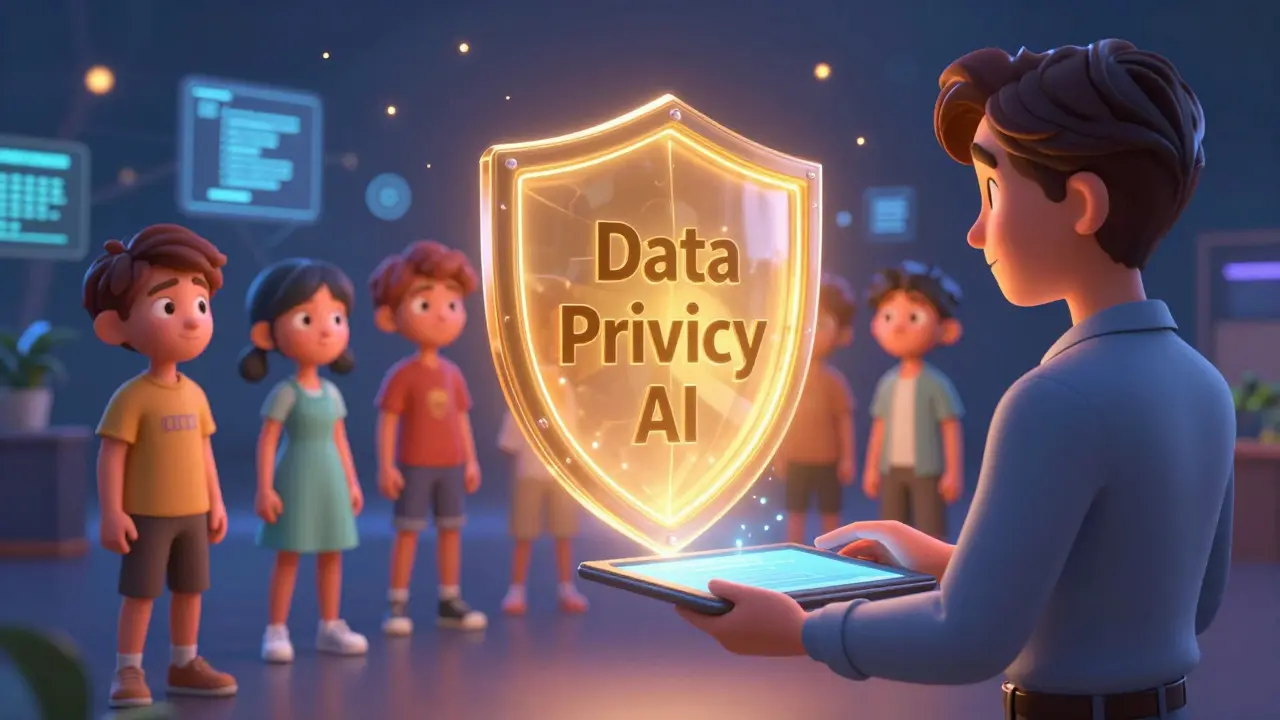
The Data Problem: Privacy and Security
Data is the fuel for AI, but in schools, it is also a liability. Student Data Privacy is the protection of personally identifiable information collected from students during their education. We are not talking about just names and grades. Modern tools track keystrokes, time spent on tasks, and even eye movement.
Regulations like FERPA in the US and GDPR in Europe set the baseline. However, compliance does not always equal ethics. A vendor might legally sell aggregated data, but is it right to sell insights about learning patterns to third parties? Many EdTech companies monetize data by selling insights to advertisers or other service providers. This creates a conflict of interest.
Schools need to demand data minimization. Only collect what is absolutely necessary. If a reading app needs to know a student's gender to function, that is a red flag. Most educational software does not require demographic data to improve literacy. When data is collected, it should be encrypted and stored securely. Breaches happen. In 2025 alone, several major learning management systems suffered leaks. The cost of a breach is not just financial; it is the loss of trust from parents and students.
Parents often sign consent forms without reading them. They assume the school is protecting their child. Schools must be the gatekeepers. Administrators should review data sharing agreements with legal counsel. They need to ask: Who owns the data? How long is it kept? Can it be deleted if the student leaves? If the vendor cannot answer clearly, the deal should not happen.
| Practice | Ethical Standard | Risky Practice |
|---|---|---|
| Data Collection | Minimal necessary data only | Collecting everything possible |
| Data Usage | Strictly for educational improvement | Selling insights to third parties |
| Retention | Deleted after purpose is met | Stored indefinitely |
| Access | Role-based access control | Open access for all staff |
Understanding Algorithmic Bias
Bias is the silent killer of ethical AI. It creeps in through the training data. Algorithmic Bias is systematic and repeatable errors in a computer system that create unfair outcomes. In education, this can determine a student's future.
Consider a college admission tool. If the historical data shows that students from private high schools get accepted more often, the AI might learn to prioritize private school graduates. This reinforces existing inequality. The system isn't "thinking" it is right; it is simply reflecting the past. To fix this, developers must use diverse datasets and actively test for disparate impact.
Another example involves special education. Tools designed to identify learning disabilities often struggle with students from non-English speaking backgrounds. The algorithm might flag a language barrier as a cognitive deficit. This leads to inappropriate placements. Teachers need to be trained to recognize these limitations. They should treat AI recommendations as suggestions, not diagnoses.
Regular audits are essential. Schools should require vendors to publish bias audit reports. These reports should show how the system performs across different demographic groups. If there is a significant gap in accuracy between groups, the tool should not be used until fixed. Silence on this issue from a vendor is a warning sign.

Practical Steps for Schools and Developers
Knowing the principles is one thing; applying them is another. Here is a practical guide for moving forward in 2026.
- Form an Ethics Committee: Include teachers, parents, students, and tech experts. This group reviews all new tools before purchase.
- Request Transparency Reports: Ask vendors for documentation on how their algorithms work and what data they use.
- Train the Staff: Professional development should cover AI literacy. Teachers need to know how to spot bias and when to override the system.
- Start Small: Pilot programs in one classroom before rolling out district-wide. Monitor for unintended consequences.
- Establish Appeal Processes: If a student is affected by an automated decision, there must be a human review process available.
For developers, the responsibility starts in the design phase. Use Generative AI is AI systems capable of creating new content, including text, images, and code. responsibly. If you are building a chatbot for students, ensure it does not hallucinate facts. In a history class, incorrect information can be misleading. Implement guardrails that prevent the AI from answering questions outside its knowledge base.
Collaboration is key. Schools and vendors should work together to define success metrics. Is success a higher test score, or is it a more engaged student? If the metric is only test scores, the AI might encourage rote memorization. If the metric is engagement, it might encourage critical thinking. Define what you value before you build the tool.
The Future of Learning in 2026 and Beyond
As we look ahead, the integration of AI will only deepen. Personalized Learning is an instructional approach that customizes learning for each student. will become the standard. But the standard must be ethical. We are moving towards a model where AI handles the administrative load, freeing teachers to focus on mentorship and emotional support.
However, the risk of over-reliance is real. If students depend too much on AI for answers, they might lose the ability to think critically. We need to design systems that encourage struggle and growth, not instant gratification. An ethical AI tool should ask guiding questions rather than giving direct answers.
Regulation will likely tighten. Governments are waking up to the risks. Expect more strict guidelines on data usage and algorithmic accountability in the coming years. Schools that get ahead of this curve will build stronger trust with their communities. Those that ignore it will face backlash and potential legal challenges.
The goal is not to stop innovation. It is to steer it. We want technology that empowers students, not one that limits them. By prioritizing ethics, we ensure that the future of learning is bright for everyone, not just a select few. The technology is powerful, but our values must be stronger.
What is the biggest risk of using AI in schools?
The biggest risk is algorithmic bias, where the system makes unfair decisions based on flawed training data. This can lead to students being misidentified as struggling or being denied opportunities based on demographic factors rather than actual ability.
How can parents protect their child's data?
Parents should ask schools about data privacy policies and which third-party vendors are used. They can request to see consent forms and ask if data is being sold or shared for commercial purposes.
Should teachers trust AI grading tools?
Teachers should use AI grading tools as a support mechanism, not a final authority. Human review is essential to catch context errors, bias, or creative nuances that algorithms might miss.
What laws protect student data in 2026?
In the US, FERPA remains the primary federal law. However, many states have passed stricter laws like the Student Data Privacy Act. In Europe, GDPR applies to all data processing involving EU citizens.
How do we know if an AI tool is ethical?
Look for transparency reports, third-party audits, and clear privacy policies. An ethical tool will explain how it makes decisions and allow for human oversight and appeal processes.
Geet Ramchandani
March 27, 2026 AT 07:21It is absolutely infuriating that these companies continue to push these tools without any real oversight whatsoever. You people act like this is a benevolent innovation when it is clearly just another way to harvest data. The excuses about efficiency are a joke and everyone knows it. We are talking about children here and you are treating them like data points in a spreadsheet. If a system flags a kid for cheating based on eye movement that is an invasion of privacy on a massive scale. I have seen these tools fail in real world scenarios and the consequences are devastating for the students involved. No amount of code can replace the intuition of a trained educator who actually cares about the outcome. Stop pretending that algorithms are neutral when the training data is inherently biased against marginalized groups. The lack of accountability is the real problem and nobody is willing to hold these vendors responsible. We need strict legislation that penalizes companies for using these systems without proper audits. It is time to stop the bleeding and demand better standards from the industry before it is too late.
Kayla Ellsworth
March 27, 2026 AT 19:35Oh sure because nothing says ethical like a black box algorithm making life changing decisions for teenagers. We all know the privacy policies are just there for show and nobody reads them anyway. The idea that schools will actually enforce these guidelines is laughable at best. They will just sign whatever contract the vendor hands them without asking questions. It is nice to dream about fairness but the reality is profit always wins in the end. You can write all the principles you want but it does not change the business model. I guess we should just trust the developers to do the right thing without any incentive. This whole conversation is just noise to distract from the fact that the data is already gone.
Sumit SM
March 29, 2026 AT 14:00This is SO important!! We need to act NOW!!! The data is EVERYTHING!!! Schools need to wake up!!!
Pooja Kalra
March 30, 2026 AT 21:45Most people do not understand the depth of the issue. It is about control more than anything else. Teachers should not be replaced by machines. It is a slippery slope that we are on.
Soham Dhruv
April 1, 2026 AT 15:09i think this is gonna be huge for schools but we gotta be carful about privacy stuff
Bob Buthune
April 3, 2026 AT 10:58This makes me so sad 😢 we need to protect our kids 😡 but the tech is advancing so fast 🤔 I worry about what happens next 😞 we have to be careful with our information 🛡️
Jane San Miguel
April 3, 2026 AT 22:03The discourse regarding algorithmic governance within educational institutions requires a sophisticated understanding of epistemological frameworks. One must consider the ontological implications of delegating pedagogical judgment to non-sentient systems. It is a nuanced landscape that demands intellectual rigor rather than simplistic moralizing. The integration of such technology necessitates a reevaluation of our fundamental assumptions about learning and assessment.
Kasey Drymalla
April 4, 2026 AT 13:55they are tracking everything you do and selling it to advertisers just like they always said they would
Dave Sumner Smith
April 5, 2026 AT 04:05They want to own your mind from the start and this is how they do it. You think they care about fairness but they just want the data. Every click is tracked and stored for the deep state. Wake up and realize what is happening to your children. This is not about education it is about surveillance. They are building a profile on every single student. Do not let them trick you with these ethical guidelines. It is all a lie to get you to sign away your rights. Fight back before it is too late.
Jeroen Post
April 6, 2026 AT 12:19the system is rigged against us and they know it. we are just data points to them. nothing changes ever. they watch everything
Cait Sporleder
April 8, 2026 AT 00:06The integration of artificial intelligence into pedagogical frameworks necessitates a rigorous examination of underlying algorithmic structures. Many proponents fail to recognize the subtle nuances of data collection practices that permeate modern educational institutions. It is imperative that we consider the long-term implications of storing sensitive behavioral metrics on cloud servers. Furthermore, the lack of standardized auditing processes creates a vacuum where unethical practices can flourish unchecked. We must demand transparency from vendors who claim to prioritize student welfare above profit margins. The historical precedent of technological overreach suggests that caution is warranted in these implementations. Educators require comprehensive training to identify when a system is making erroneous assumptions about student capability. Without such safeguards, the potential for harm is substantial and often irreversible. Parents should be empowered with the knowledge to opt out of data harvesting initiatives that offer little educational value. The current regulatory landscape is insufficient to protect the vulnerable populations within our school systems. We need a paradigm shift towards human-centric design principles that place empathy at the forefront of development. Technology should serve as a tool for enhancement rather than a mechanism for control or surveillance. The discourse surrounding this issue often lacks the depth required to address systemic inequalities effectively. We cannot allow corporate interests to dictate the future trajectory of our children's learning experiences. It is time to establish robust ethical guidelines that are enforceable across all jurisdictions.
Paul Timms
April 9, 2026 AT 19:17I appreciate the detailed breakdown of the risks involved. It is crucial that we listen to the concerns raised by educators. Human oversight remains the most important factor in this equation.
Jen Deschambeault
April 11, 2026 AT 10:40This is such a vital conversation to be having right now. We can build a better future if we stay vigilant. Keep pushing for these changes!
Nathaniel Petrovick
April 12, 2026 AT 01:48Totally agree with the points raised here about needing more human oversight.