Export Controls in Education: Managing Sanctions and Restricted Parties
 Apr, 15 2026
Here are the key takeaways for staying compliant:
- Deemed Exports: Sharing technical data with a foreign national on campus is legally treated as exporting that data to their home country.
- Screening: You must check students, faculty, and collaborators against government 'Denied Persons' and 'Entity' lists.
- Fundamental Research: Most basic academic research is exempt, but the moment a project has a restricted end-use or a private corporate sponsor, the rules change.
- Risk Mitigation: Implement a clear vetting process for visitors and a strict access control system for sensitive data.
The Invisible Line: What Actually Constitutes an Export?
Most people think of exports as a crate on a cargo ship. However, in the eyes of the law, an export happens whenever controlled technology, software, or technical data is shared with a non-U.S. person. In a university setting, this often happens through a Deemed Export is the release of technology or software to a foreign national in the United States, which is "deemed" to be an export to the individual's country of citizenship.
If you are teaching a class on advanced quantum cryptography and your syllabus includes data protected by the ITAR is the International Traffic in Arms Regulations, which control the export and import of defense-related articles and services, you aren't just teaching; you're potentially exporting defense technology. This is why universities need a robust Export Controls framework to ensure that the open exchange of ideas doesn't accidentally violate national security laws.
Navigating the Maze of EAR and ITAR
Depending on what you're researching, you'll likely fall under one of two major regulatory regimes. The first is the EAR is the Export Administration Regulations, which govern "dual-use" items that have both commercial and military applications. These are managed by the Department of Commerce. Most university-related issues fall here-think high-end computers, certain chemicals, or advanced sensors.
Then there is ITAR, managed by the State Department. This is much stricter. If your research involves items on the U.S. Munitions List, the restrictions are severe. Even talking about the specifics of a project over a casual coffee can be a violation if the person you're talking to is a foreign national and the information is restricted.
| Feature | EAR (Commerce Dept) | ITAR (State Dept) |
|---|---|---|
| Scope | Dual-use items (Civil & Military) | Defense-related items only |
| Flexibility | More exceptions for academia | Very rigid; strict licensing |
| Common Examples | Encryption software, specialized alloys | Missile guidance, satellite tech |
| Penalties | Heavy fines, loss of grants | Severe fines, potential imprisonment |
Dealing with Restricted Parties and Sanctions
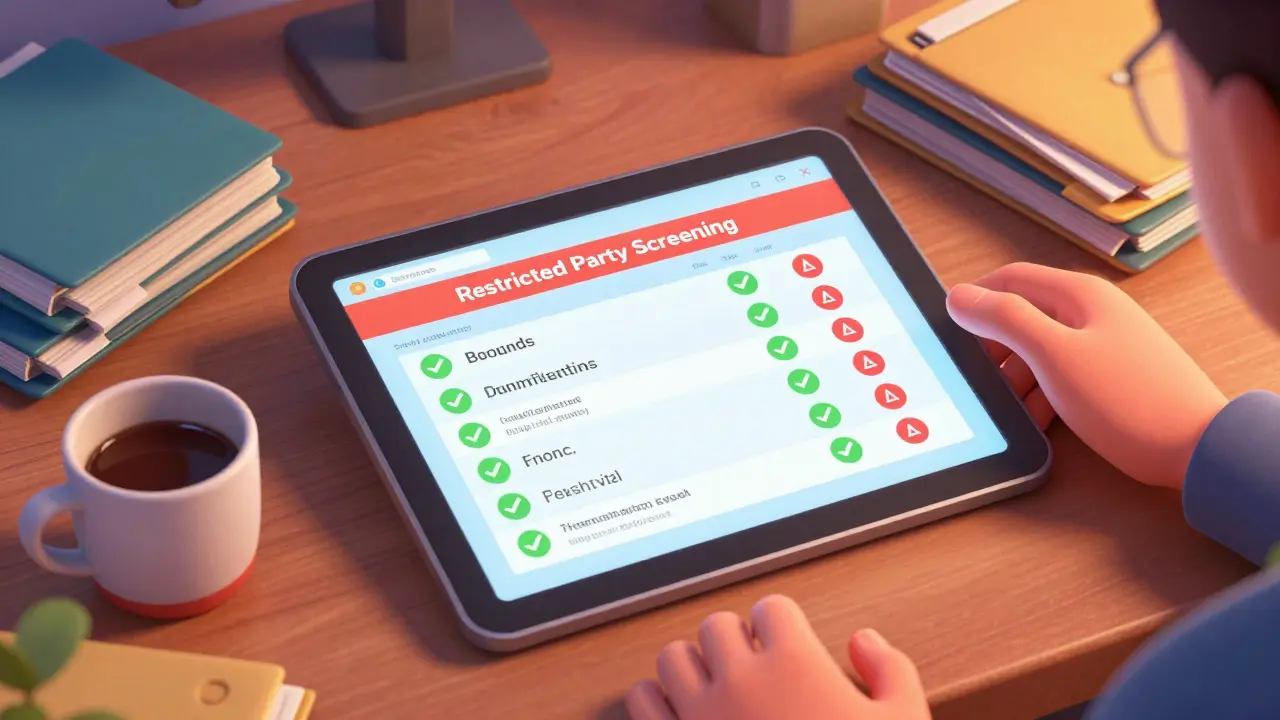
It's not just about what you are sharing, but who you are sharing it with. The U.S. government maintains several lists of individuals and companies that are banned from receiving exports. This is where Restricted Party Screening is the process of checking individuals or organizations against government lists to ensure they are not sanctioned or prohibited from receiving controlled items comes into play.
You might encounter the Specially Designated Nationals (SDN) list, managed by the OFAC is the Office of Foreign Assets Control, which administers and enforces economic and trade sanctions. If a prospective visiting professor is on the SDN list, you cannot engage in a financial transaction with them, and you certainly cannot share controlled data. Even if the person isn't on a list, the country they represent might be under a comprehensive embargo, making any academic collaboration illegal without a special license.
Wait, does this mean you can't collaborate with anyone from a "risky" country? No. But it means you need a systematic way to vet them. Using a manual Google search isn't enough. Most institutions now use automated screening software that cross-references names against dozens of global lists in real-time to avoid the human error of missing a name variation.

The 'Fundamental Research' Safe Harbor
The good news is that most of what happens in a university is protected by the Fundamental Research Exclusion is a regulatory provision that exempts basic research from export controls if the resulting information is intended for publication and there are no restrictions on the foreign dissemination of the results. If your project is designed to be published in an open journal and doesn't involve proprietary data from a defense contractor, you're generally in the clear.
However, the line blurs quickly. If a corporate sponsor adds a clause to your grant saying, "No data can be shared with foreign nationals," your research is no longer "fundamental." It is now restricted. The moment you accept a restriction on who can see the results, you've stepped out of the safe harbor and into the world of required licenses and strict controls.
Practical Steps for Compliance Officers and PIs
So, how do you actually manage this without slowing down your research to a crawl? The key is to integrate screening into the onboarding process. Don't wait until the student is in the lab to check their citizenship.
- Identify the Data: Before starting a project, determine if the technology or data is listed on the Commerce Control List (CCL) or the U.S. Munitions List (USML).
- Screen Everyone: Run every new hire, student, and visiting scholar through a restricted party screening tool.
- Create Access Tiers: If you have sensitive data, keep it on a separate, password-protected server with limited access. Don't just give every grad student the master key to the database.
- Train Your Staff: Ensure that Principal Investigators (PIs) know that "open science" doesn't override national security law. A simple workshop on the difference between a public lecture and a technical data transfer can save a university millions in fines.
Consider a scenario where a lab is working on high-efficiency solar cells. The research is generally fundamental. However, they start using a specific vacuum chamber that is ITAR-controlled. Suddenly, the foreign national student helping with the experiment is technically "accessing" controlled technology. The fix? Either get an export license from the government or move the controlled equipment to a restricted-access area where only U.S. persons can enter.
Does the Fundamental Research Exclusion apply to all students?
Not necessarily. It applies to the research itself. If the research is fundamental, the exclusion applies regardless of the student's nationality. However, if the student is working on a specific project that has restrictive clauses (like a classified government contract), the exclusion is void, and you must treat their access as a deemed export.
What happens if we accidentally share restricted data?
The consequences can be severe, including massive civil fines and, in cases of willful negligence, criminal charges. The best course of action is "voluntary self-disclosure." Reporting the error to the government before they find it often leads to significantly reduced penalties.
Are online courses exempt from export controls?
Generally, yes, if the information is "publicly available" or meets the criteria for fundamental research. However, if you are providing specialized training on how to operate a restricted weapon system or high-end encryption software via a private portal, that could be considered an export of technical data.
How often should we screen our existing collaborators?
Screening should be an ongoing process, not a one-time event. People can be added to sanction lists at any time. Most compliance experts recommend re-screening your list of active collaborators and employees at least once a year or whenever there is a major shift in geopolitical sanctions.
What is the difference between a 'foreign national' and a 'foreign person'?
For export control purposes, a "U.S. Person" is a citizen, a lawful permanent resident (Green Card holder), or a protected person (asylee/refugee). Anyone who does not fit these criteria is considered a "foreign person," regardless of where they are currently living or their visa status.
Kevin Hagerty
April 15, 2026 AT 20:46oh great just what we need more red tape to make actual science impossible lol good luck to anyon actually tryin to get a degree in a STEM field now
Megan Blakeman
April 17, 2026 AT 07:18This is so important...!! I really think we all need to work together to make sure everyone stays safe and legal!!! 😊✨
Akhil Bellam
April 17, 2026 AT 18:46The sheer banality of these bureaucratic constraints is truly exhausting...!! One wonders if the pursuit of enlightenment is even possible when shackled by such pedestrian concerns as 'regulatory regimes' and 'screening lists'...!! How utterly pedestrian!
Rae Blackburn
April 18, 2026 AT 19:42this is just a front for the government to track every single person on campus and monitor who talks to who they probably have bugs in the vacuum chambers too
Tia Muzdalifah
April 20, 2026 AT 18:54it is kinda wild how much this affects internashunal students’ experience on campus lol
Aafreen Khan
April 21, 2026 AT 23:33honestly who even cares about these laws lol 🙄 they just want to keep the best minds from sharing stuff 💅
Robert Byrne
April 23, 2026 AT 20:07You completely ignored the ethical disaster that happens when we prioritize state security over human intellect, and frankly, your lack of outrage is pathetic!
Albert Navat
April 24, 2026 AT 07:51The compliance overhead for ITAR is a total nightmare. We're talking full-blown compartmentalization and strict siloed access to the codebase just to avoid a massive audit fail. Totally kills the agile flow of the lab.
LeVar Trotter
April 24, 2026 AT 14:43I totally agree that the compliance overhead can feel stifling, but we have to maintain these guardrails to protect the institutional integrity of our research frameworks. It's all about finding that sweet spot where we maximize the inclusivity of our global talent pool while adhering to the strictures of the Commerce Control List. We can implement tiered access without alienating our international colleagues if we just be transparent about the why behind the policy. Education on these regulations is the first step toward a more seamless onboarding process for all our scholars regardless of their origin. Let's focus on building a supportive environment that respects both the law and the academic spirit.
King Medoo
April 25, 2026 AT 03:04It is truly a matter of grave moral imperative that we uphold these laws to ensure the safety of our sovereign nation, for if we allow our intellectual property to leak through the cracks of academic negligence, we are essentially betraying the very citizens we are sworn to protect in our positions of leadership and trust 🛡️🏛️🇺🇸. The failure to rigorously screen foreign nationals is not merely a procedural error but a fundamental lapse in ethical responsibility that could jeopardize the global balance of power ⚖️. We must be vigilant and uncompromising in our application of the SDN lists to prevent bad actors from infiltrating our hallowed halls of learning 🎓🚫. Only through strict adherence to the rule of law can we truly claim to be operating in the interest of the greater good 🌟.
Zoe Hill
April 25, 2026 AT 16:46I think we can all find a way to make this work without too much stress!! maybe some more workshops would help’en everyone feel better about the rules 🌸
Amber Swartz
April 27, 2026 AT 05:18The absolute audacity of thinking a 'manual Google search' is how people do this is just laughable. Give me a break! This is literally the most basic part of the job for any admin with half a brain!
Tyler Durden
April 28, 2026 AT 18:20Keep pushing for more clarity on the Fundamental Research Exclusion...!! It's the only way we keep the spirit of discovery alive...!