Gamification in Instructional Design: Mechanics That Matter
 Apr, 23 2026
The Quick Win: Key Takeaways
- Gamification is about motivation, not just adding points to a boring quiz.
- The most effective mechanics balance rewards with genuine challenge (Flow State).
- Meaningful gamification focuses on the journey and mastery, not just the leaderboard.
- Over-reliance on extrinsic rewards can actually kill long-term curiosity.
Beyond the Points: Understanding Game Mechanics
When people hear 'gamification,' they usually think of a leaderboard and some digital badges. In reality, those are just surface-level components. To build something that actually works, you need to look at the deeper engine. In the world of Game Design, we distinguish between mechanics, dynamics, and aesthetics. Mechanics are the rules-the 'how' of the system. Dynamics are how the players interact with those rules, and aesthetics are the emotional response the learner has.
Take Points as an example. A point is a simple mechanic. But when points are tied to a specific skill-like 'Accuracy Points' in a safety training module-the dynamic changes. The learner isn't just collecting numbers; they are receiving immediate feedback on their precision. This transforms a passive activity into an active pursuit of mastery. If you just give points for logging in, you're rewarding attendance, not learning.
Another powerful tool is the Progress Bar. It leverages the Zeigarnik Effect-the psychological phenomenon where people remember uncompleted tasks better than completed ones. When a learner sees a bar at 80%, their brain screams at them to close that gap. It's a simple visual cue that creates a psychological need for closure, pushing them to finish the module without needing a manager to nag them.
The Science of Motivation: Extrinsic vs. Intrinsic
If you only use badges and rankings, you're relying on extrinsic motivation. This is like giving a kid a piece of candy every time they read a page of a book. It works for a while, but the moment the candy stops, the reading stops. For gamification to truly land, you have to pivot toward intrinsic motivation-the internal desire to do something because it is inherently rewarding.
This is where Self-Determination Theory comes into play. This psychological framework suggests that people are most motivated when they feel three things: autonomy, competence, and relatedness. If your instructional design gives the learner a choice in their path (autonomy), provides a challenging but achievable goal (competence), and lets them collaborate with peers (relatedness), you've moved beyond 'points' and into true engagement.
| Mechanic Type | Examples | Primary Driver | Long-term Impact |
|---|---|---|---|
| Extrinsic | Leaderboards, Badges, Coupons | External Reward | Short-term burst, potential burnout |
| Intrinsic | Branching Scenarios, Unlocking New Levels, Narrative | Internal Satisfaction | Sustained engagement, deeper mastery |
Designing for Flow: The Balance of Challenge and Skill
Ever played a game that was so hard you quit in frustration, or so easy you fell asleep? That's a failure of 'flow.' Flow State is that mental zone where you're so immersed in an activity that time seems to disappear. In instructional design, achieving flow requires a precise balance: the task cannot be so hard that it causes anxiety, nor so easy that it causes boredom.
To implement this, use scaffolding. Start with a low-stakes environment where the learner can fail safely. Let them make a mistake in a simulated customer call, show them exactly where it went wrong, and then give them a slightly harder scenario. As their skill increases, the challenge must increase in lockstep. If you keep giving them 'Easy' levels after they've mastered the material, they'll check out mentally.
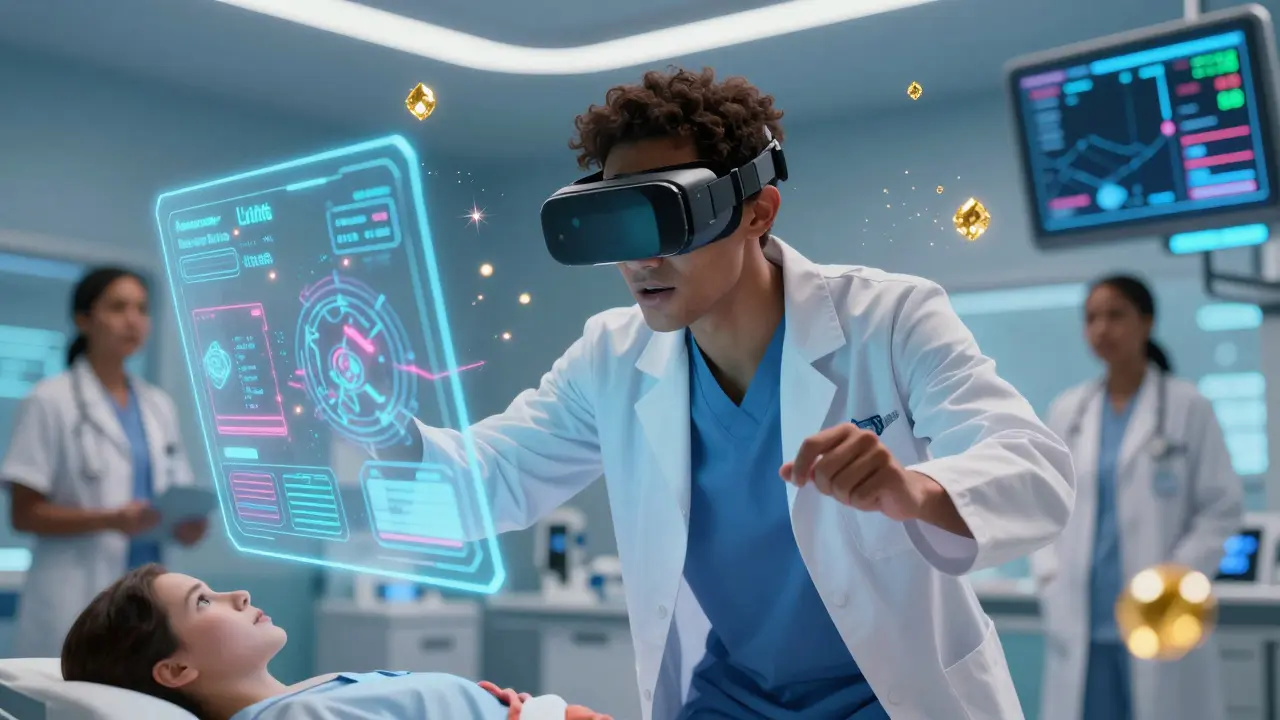
Consider a medical training simulation. Instead of a multiple-choice test on symptoms, put the learner in a virtual ER. Give them a patient with vague symptoms. As they correctly identify the issue, introduce a complication-maybe the patient's blood pressure drops. The challenge evolves based on the learner's success, keeping them locked in that flow state where the most intense learning happens.
Narrative and Storytelling: The Glue of Engagement
Mechanics are the bones, but Narrative is the skin. Without a story, points are just numbers. With a story, points become 'credits to rebuild a futuristic colony' or 'experience points to rank up in a secret agency.' Narrative gives the learner a reason to care about the mechanics.
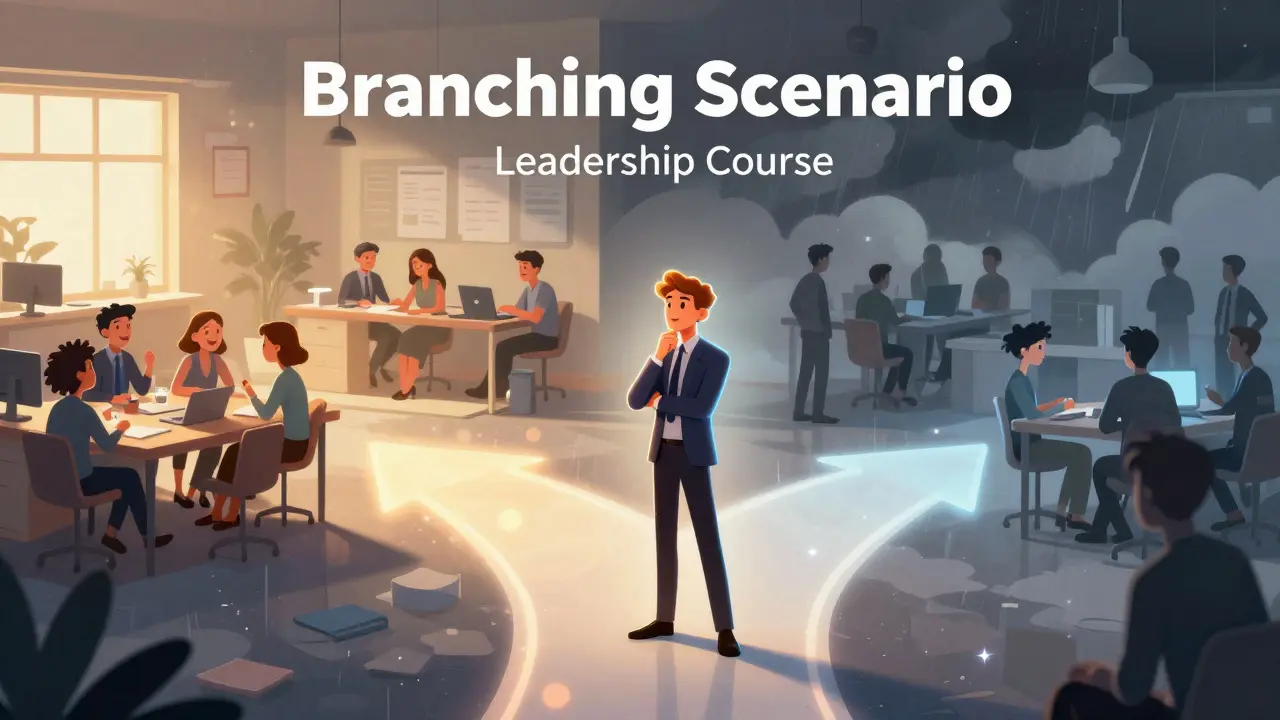
One of the most effective narrative structures is the Branching Scenario. Instead of a linear path, the learner makes decisions that affect the outcome of the story. For example, in a leadership course, a learner might choose how to handle a conflict between two employees. If they choose an aggressive tone, the 'story' progresses to a scene where the employees stop cooperating. The learner doesn't just read about leadership; they experience the consequences of their choices in a safe environment.
This approach transforms the learner from a spectator into a protagonist. When you are the main character in the learning journey, you're no longer just absorbing information-you're solving a problem. This shift in perspective is what turns a mandatory training session into an experience the learner actually remembers six months later.
The Pitfalls of Bad Gamification
Not all gamification is good gamification. There's a phenomenon known as 'pointification'-the act of slapping a leaderboard on a bad course and calling it innovative. This often backfires. When you put a high-pressure leaderboard in a learning environment, you can actually trigger anxiety in low-performers, making them avoid the material entirely. Moreover, if the reward is too high, learners will find the shortest path to the reward, often by guessing or gaming the system, rather than actually learning the content.
Another mistake is ignoring the Learning Management System (LMS) constraints. Some designers dream up complex RPG-style quests only to find their LMS can't support anything more than a quiz and a PDF. The mechanics must fit the technology. If your platform doesn't support real-time leaderboards, don't try to force it with a manual spreadsheet that you update once a week-that kills the immediate feedback loop that makes games work.
Finally, avoid 'over-gamifying.' If the game mechanics become more complex than the subject matter, you've failed. The learner should be thinking about the material, not struggling to understand how the point system works. The mechanics should be intuitive and fade into the background, leaving the learning front and center.
Putting It All Together: A Practical Checklist
If you're redesigning a course right now, don't start with the badges. Start with the objective. Ask yourself: 'What is the one thing I want the learner to be able to do?' Once you have that, map the mechanics to that goal.
- Identify the 'Core Loop': What is the repetitive action the learner takes? (e.g., Read info $ ightarrow$ Apply in scenario $ ightarrow$ Get feedback $ ightarrow$ Adjust approach).
- Define the Win Condition: What does 'mastery' look like? Is it a score, a completed project, or a successful simulation?
- Choose the Right Rewards: Use points for immediate feedback, but use 'unlocks' (access to advanced content) for long-term motivation.
- Build in a Safety Net: Ensure there is a way to fail and try again. Learning happens in the gap between a mistake and a correction.
- Test for Flow: Run a pilot with a small group. If they're bored, crank up the challenge. If they're stressed, add more scaffolding.
Does gamification actually improve test scores?
Yes, but not by magic. It improves scores by increasing 'time on task.' When learners are engaged by game mechanics, they spend more time interacting with the material and iterating on their mistakes. A study on medical students using gamified simulations showed a significant increase in diagnostic accuracy compared to those using traditional textbooks because the simulation forced them to apply knowledge in real-time, mimicking the pressure of a clinical setting.
Isn't gamification just for kids or 'easy' topics?
Absolutely not. Some of the most complex systems in the world-like flight simulators for pilots or cybersecurity wargames-are essentially high-level gamification. The 'game' part isn't about making it 'childish'; it's about creating a feedback loop that allows a professional to fail, learn, and recover without real-world catastrophe. High-stakes industries benefit the most from these mechanics because the cost of failure in the real world is too high.
What is the difference between gamification and game-based learning?
Gamification adds game-like elements to a non-game environment (like adding a badge system to a corporate compliance course). Game-based learning (GBL) uses an actual game as the primary vehicle for learning (like using 'Minecraft' to teach urban planning or 'Kerbal Space Program' to teach orbital mechanics). One enhances an existing structure, while the other is the structure itself.
Can leaderboards be harmful to learning?
They can be. For learners who are struggling, seeing themselves at the bottom of a list can be demoralizing and lead to disengagement. To fix this, use 'relative leaderboards' where the learner only sees the people immediately above and below them, or create 'team-based' leaderboards where the group's collective effort is rewarded. This shifts the focus from individual competition to collective success.
How do I know if my gamification is working?
Look beyond completion rates. Check your 'drop-off' points in the course. If learners are quitting at the same spot, your challenge is likely too high (causing anxiety) or too low (causing boredom). Also, track 'voluntary engagement'-are learners returning to the module to try and get a higher score or unlock a secret? If they are engaging with the content when they aren't being forced to, your mechanics are working.
Rahul U.
April 24, 2026 AT 23:42The distinction between extrinsic and intrinsic rewards is so crucial here. 🌟 I've seen too many corporate modules try to force engagement with a leaderboard that just feels like a chore. It's the branching scenarios that actually make me feel like I'm gaining a skill! 🚀
James Boggs
April 26, 2026 AT 18:35I completely agree with the points regarding the Zeigarnik Effect. It is a remarkably efficient way to encourage completion.
E Jones
April 27, 2026 AT 02:24Sure, it sounds great on paper, but let's look at the darker side of this psychological manipulation, where they're basically using the same dopamine-loop tactics that casinos use to keep you chained to a slot machine in a windowless room while some shadowy corporate entity harvests your biometric data to see exactly when your brain peaks. It's a slippery slope from a 'progress bar' to full-blown cognitive conditioning, and frankly, the fact that they're openly discussing 'addictive' psychology in education is just a neon sign flashing that we're being groomed for a digital panopticon where even our learning is just another metric for some algorithm to chew on until there's nothing left of our actual human curiosity.
selma souza
April 27, 2026 AT 23:30The lack of precision in some of the terminology here is grating. One does not simply 'slap' a leaderboard on a course; one implements a flawed metric system. Furthermore, the colloquialisms used in this discourse are beneath the subject matter.
Lissa Veldhuis
April 28, 2026 AT 10:56honey please we all know the lms is the real villain here trying to do rpg quests in a tool made for spreadsheets is just a tragedy in the making and honestly who even cares about the flow state when the ui looks like it was designed in 1998 lol
Frank Piccolo
April 29, 2026 AT 03:11Typical academic fluff. Just make the content not suck and people will learn. You don't need a 'narrative' to teach someone how to use a fire extinguisher. This is just over-complicating basic training for the sake of looking innovative.
Megan Ellaby
April 30, 2026 AT 18:16totally agree with the part about failing safely!! i think its so importent that people feel okay making mistakes before the real deal hits. do u think this works for soft skills too or mostly just technical stuff?
David Smith
May 1, 2026 AT 13:50Absolute nightmare. I tried to implement a 'branching scenario' once and the whole thing crashed during a live demo. It's just a recipe for disaster when you try to be too fancy with corporate software.
Barbara & Greg
May 1, 2026 AT 18:15One must consider the ethical implications of treating education as a game. By reducing the pursuit of knowledge to a series of 'unlocks' and 'rewards,' we risk stripping the intellectual endeavor of its inherent dignity and moral weight.
Addison Smart
May 1, 2026 AT 20:18While I understand the concern about ethics, I believe we can find a middle ground where we respect the learner's autonomy while still utilizing these psychological triggers to help them overcome the initial hurdle of boredom. We have to remember that different cultures perceive 'competition' and 'play' differently, so a leaderboard might be motivating in one region but alienating in another, which is why a flexible, inclusive design is the only way forward if we actually want global scalability in corporate training.
Thabo mangena
May 3, 2026 AT 04:11This is a truly inspiring perspective on instructional design. It is heartening to see a focus on mastery and the human element of learning. I am certain that these methods will greatly benefit professionals across the globe.
Karl Fisher
May 4, 2026 AT 22:57Oh, darling, it's simply divine to see the 'pointification' tragedy finally addressed. I've spent years watching executives treat badges like they're Olympic gold medals while the actual content is a snooze-fest. Truly, the drama of a poorly executed leaderboard is the only thing that keeps some of these corporate meetings interesting!