Global Certification Recognition: What Employers Really Look For
 Feb, 9 2026
When you finish a certification from a school or online platform halfway across the world, do employers even care? You’ve spent months studying, paid hundreds of dollars, and maybe even sacrificed weekends to earn that credential. But when you send your resume to a hiring manager in Berlin, Toronto, or Sydney, will they even recognize it? The truth is, not all certifications are created equal - and employers know it.
It’s Not the Name, It’s the Process
Many people assume that if a certification has a big brand name - like Google, Cisco, or PMP - it automatically carries weight everywhere. But that’s only half the story. What really matters is what the certification requires to earn. Employers aren’t just looking at the logo on your resume. They’re asking: Did you prove you can do the work?
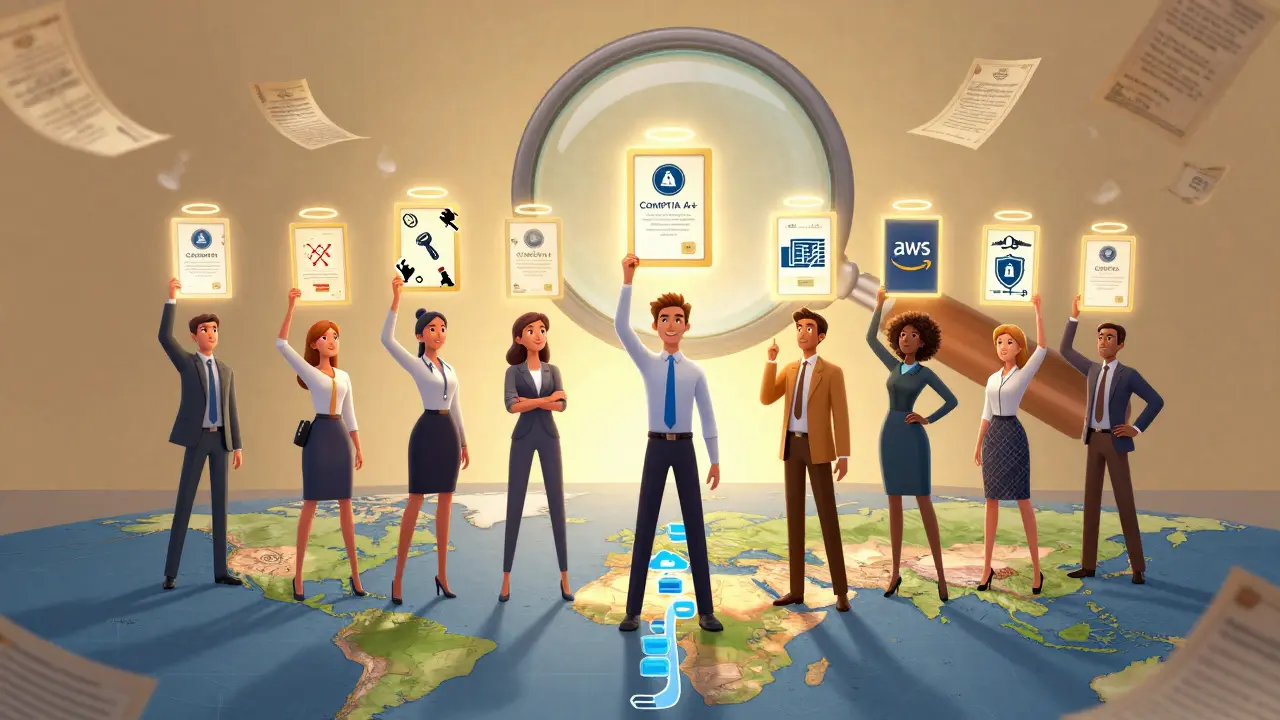
Take the CompTIA A+ certification. It’s accepted globally because it’s not just a multiple-choice test you can pass by memorizing flashcards. You have to pass two exams, including hands-on performance-based questions. You can’t fake the troubleshooting tasks. That’s why companies from Tokyo to Johannesburg trust it. The same goes for AWS Certified Solutions Architect. It’s not popular because Amazon says so. It’s popular because the exam forces you to design real cloud systems under pressure.
On the flip side, some certifications have no practical component. They’re just online quizzes you can complete in an hour. Employers have learned to spot those. They don’t reject you outright - but they don’t take them seriously either.
Accreditation Matters More Than Country
Here’s something most candidates don’t realize: employers don’t care if your certification came from France, India, or the U.S. What they care about is whether the issuing body is accredited by a recognized authority.
For example, if you earned a project management certification from a small online school in Brazil, it might mean nothing to a U.S. hiring manager. But if that same certification is accredited by the Project Management Institute (PMI), it’s treated like a global standard. Same goes for ISO/IEC 17024 accreditation - it’s the gold standard for certification bodies. If a certification program meets those benchmarks, employers know the assessment is fair, consistent, and validated by independent experts.
Think of it like this: a university degree from a small college in Finland is still respected because it’s accredited by the Finnish National Agency for Education. The same logic applies to certifications. The country doesn’t matter. The oversight does.
Industry-Specific Certifications Have the Most Weight
Not all jobs care about the same credentials. A cybersecurity role in London will prioritize CISSP or CEH. A data analyst in Singapore will value Google Data Analytics or Microsoft Certified: Data Analyst Associate. A supply chain manager in Germany will look for APICS CPIM or CSCP.
Why? Because these certifications are tied to real job tasks. CISSP isn’t just about knowing security theories - it’s about designing enterprise access controls, auditing systems, and responding to breaches. Employers know that if you passed the CISSP exam, you’ve done the work. They don’t need to guess.
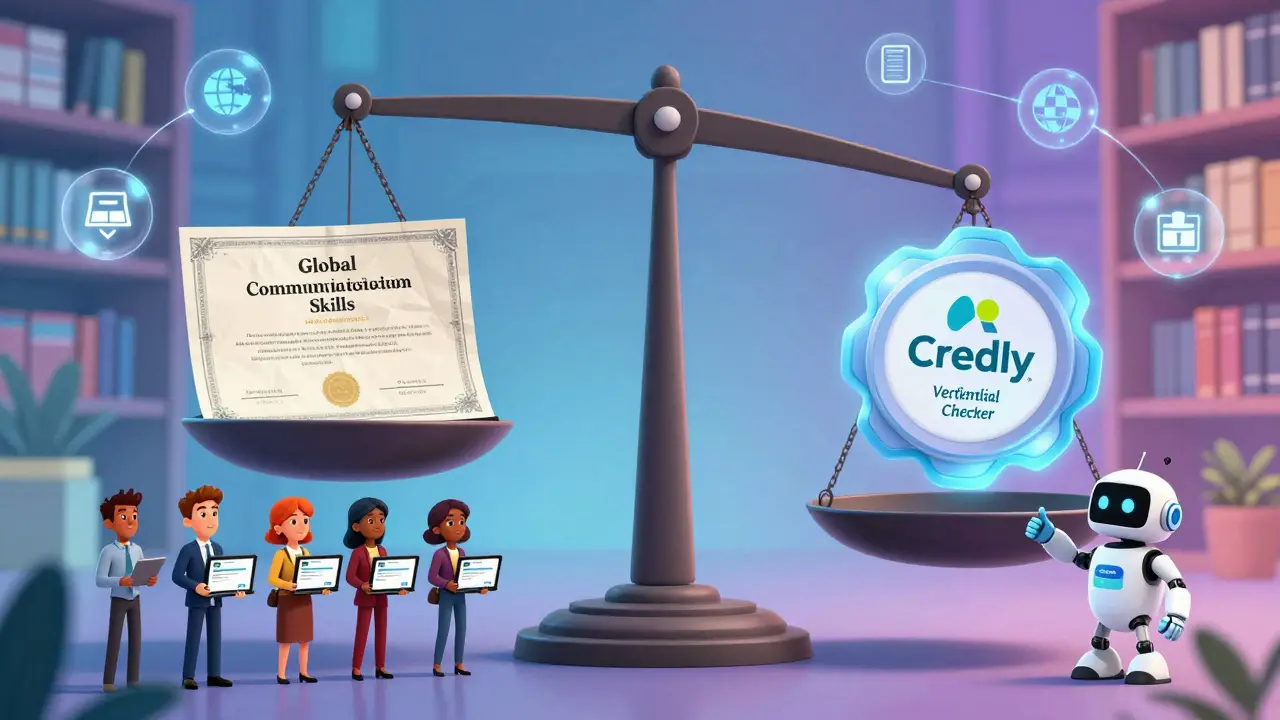
On the other hand, generic certifications like "Leadership Excellence" or "Global Communication Skills" from random online platforms? They’re often ignored. They don’t link to measurable skills. They’re buzzwords wrapped in a certificate.
Language and Regional Barriers Are Real - But Surmountable
Let’s be honest: if your certification is only offered in Mandarin or Arabic, and you’re applying for a job in Toronto, there’s a hurdle. But it’s not insurmountable.
Many global certifications now offer exams in multiple languages. The CFA Institute, for example, offers its Level I exam in English, Spanish, French, Portuguese, Chinese, Japanese, and Korean. The same is true for Oracle and SAP certifications. If you’re certified in a non-English language, include a note on your resume: "Certified in [Language] - official credential recognized internationally."
Also, don’t assume employers won’t understand foreign credentials. Many HR teams use platforms like Credential Evaluation Services (CES) or WES to verify international qualifications. They’ve seen certifications from every corner of the world. What they need is clarity - not translation.
Proof Over Prestige
Here’s the hard truth: employers don’t care how fancy your certificate looks. They care about proof.
Do you have a digital badge linked to a verifiable credential? Many modern certifications - like those from Coursera, edX, or Google - now issue blockchain-backed badges through Credly or Acclaim. These badges let employers click through and see exactly what you learned, what projects you completed, and even your exam scores.
That’s why someone with a Google Career Certificate in IT Support has a real shot at a tech job in Poland - even without a degree. The employer can verify their skills in real time. No guesswork. No assumptions.
On the other hand, a printed certificate with no digital trail? It’s just paper. And paper doesn’t scale.
What Employers Actually Check
When a hiring manager reviews a resume with global certifications, here’s what they’re scanning for:
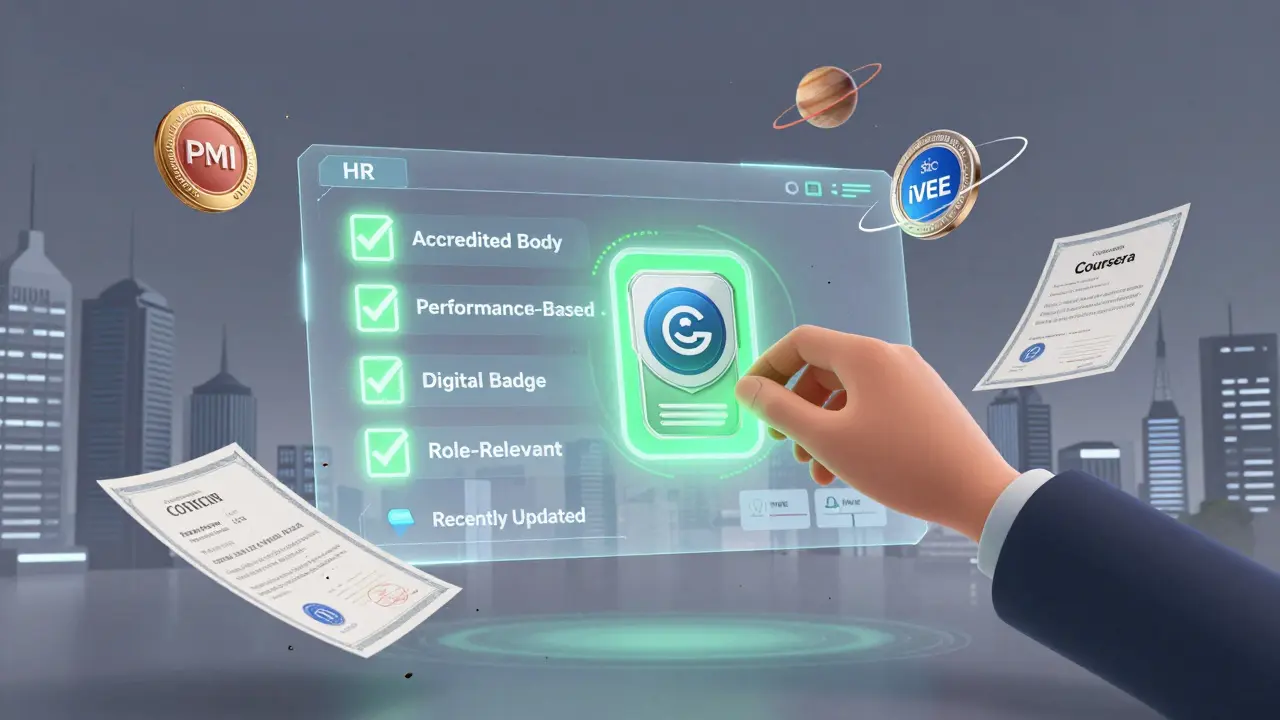
- Is the certification tied to a recognized body? (PMI, CompTIA, IEEE, etc.)
- Does it require hands-on or performance-based assessment? (Not just multiple-choice)
- Is there a digital, verifiable credential? (Credly, Acclaim, blockchain badge)
- Is it relevant to the role? (Not just "certified in leadership")
- Was it earned within the last 3-5 years? (Old certifications lose value unless they’re lifetime credentials)
If you check all five boxes, your certification will stand out - no matter where you earned it.
What Doesn’t Work
Here are three common mistakes that make global certifications meaningless to employers:
- Listing certifications without context. Don’t just write "Certified in Cloud Computing." Say: "AWS Certified Solutions Architect - Passed Jan 2025, verified at [link]."
- Using expired credentials. If your certification expired in 2022 and you haven’t renewed, don’t list it. Employers will assume you’re not keeping up.
- Claiming "international recognition" without proof. Saying "globally recognized" means nothing. Show them the accreditation body or the digital badge.
Where Global Certifications Shine
Global certifications matter most in industries with standardized practices:
- Technology - Cloud, cybersecurity, networking
- Finance - CFA, FRM, CPA (international versions)
- Healthcare - WHO-certified training, clinical safety standards
- Engineering - PE license equivalents, ISO standards
- Supply Chain & Logistics - APICS, Six Sigma
In these fields, certifications aren’t optional - they’re baseline requirements. A company in Dubai hiring a cybersecurity analyst will expect CISSP or CISM. Period. It’s not about nationality. It’s about standards.
What You Should Do Next
If you’re serious about global recognition, here’s your action plan:
- Choose certifications backed by accredited bodies (look for ISO/IEC 17024).
- Prefer those with performance-based exams, not just quizzes.
- Always claim your digital badge - link it on LinkedIn and your resume.
- Update your certification every time it expires.
- Only list certifications that directly relate to the job you’re applying for.
There’s no magic formula. But there is a clear pattern: verifiable skills > brand names > country of origin.
Do employers recognize online certifications from platforms like Coursera or Udemy?
Yes - but only if they’re from verified providers and come with a digital badge. Google Career Certificates, IBM Data Science Certificates, and AWS training from AWS Academy are widely accepted because they’re tied to industry standards and include verifiable assessments. Generic Udemy courses without official credentials or exams are rarely taken seriously.
Are certifications from developing countries respected?
Absolutely - if they’re accredited. A certification from a university in Kenya or Vietnam is just as valid as one from the U.S. or Germany - as long as it’s issued by an organization with ISO/IEC 17024 accreditation or recognized by a global body like PMI, IEEE, or ISACA. Employers care about the assessment, not the zip code.
Should I list certifications in a different language on my resume?
List them in English unless you’re applying in a non-English-speaking country. Add a note like: "Certified in Spanish (2024) - Official credential recognized internationally." Most HR systems use automated translation tools, but clarity matters more than translation.
How long do global certifications stay valid?
Most expire after 2-3 years (e.g., AWS, Google) and require renewal through continuing education or retesting. Some, like PMP or CFA, last longer but still require ongoing credits. Lifetime certifications (like CompTIA A+ before 2011) are rare now. Always check the issuer’s renewal policy.
Can I use a global certification to get a job without a degree?
Yes - increasingly so. Companies like Google, IBM, and Apple now hire based on certifications alone for entry-level tech roles. In cybersecurity, IT support, and data analysis, a verified certification can replace a bachelor’s degree. What matters is proving you can do the job - not where you went to school.
Global certifications aren’t about where you learned - they’re about what you proved. And in today’s workforce, proof is the only thing that travels.
Aimee Quenneville
February 10, 2026 AT 12:06So let me get this straight… you spent 3 months studying, paid $600, and sacrificed your entire Netflix queue… just so some HR bot in Berlin can scan for "CompTIA" and move on? 😅 I mean, I get it - but honestly, most hiring managers don’t even read past the first line of your resume. Your certification? It’s just glitter on a cardboard box. Unless you’ve got the digital badge linked? Then maybe. Maybe.
Cynthia Lamont
February 11, 2026 AT 05:31NO. NO. NO. You don’t just "have" a certification. You HAVE TO PROVE IT. If your certificate doesn’t have a verifiable link? It’s WORTHLESS. Plain. And. Simple. I’ve seen resumes with "Google Certified" and NO LINK. ZERO. NADA. That’s not a credential - that’s a fantasy. Employers aren’t dumb. They’ve seen 1000 of these. If you’re not linking your Credly badge? You’re not even in the game. Stop lying to yourself.
Fred Edwords
February 11, 2026 AT 19:21I’ve hired 17 people in the last year using only certifications - no degrees. One guy from Lagos had an AWS cert with a blockchain badge. He aced the technical interview. We hired him on the spot. The country doesn’t matter. The proof does. If you’re putting your certification on your resume without a link? You’re doing it wrong. Fix it. Today.
Tyler Springall
February 13, 2026 AT 14:19Let me just say this - if you think a "global certification" means anything without a PMI or IEEE stamp, you’re living in a fantasyland. I’ve reviewed 3000+ resumes. The ones with "Certified in Leadership Excellence" from some random Udemy course? I delete them before coffee. The ones with ISO/IEC 17024? I call the candidate. There’s a reason. It’s not branding. It’s accountability. And if you don’t get that? You’re not ready for the real world.
Mongezi Mkhwanazi
February 15, 2026 AT 10:38Look, I’m from Johannesburg, and I’ve spent the last five years trying to get my CompTIA A+ recognized internationally. I had to email three different HR departments just to prove I didn’t cheat. The truth? Most employers don’t care about your country - but they DO care about your exam’s structure. If your test was multiple choice with no labs? They’ll assume you’re a memorizer. If it had performance tasks? They’ll assume you can fix a router at 2 a.m. with no manuals. That’s the difference. Don’t just get certified. Get certified the right way - with hands-on, time-bound, proctored, real-world challenges. Otherwise, you’re just another name on a list that gets auto-deleted.
Ananya Sharma
February 17, 2026 AT 08:37Oh please. You think accreditation matters? Tell that to the guy in Mumbai who got his CFA from a local institute that’s been around since 1989. No ISO stamp. No Credly badge. Just pure, hard-earned knowledge. And guess what? He’s now managing $200M in assets. The system is rigged. The big brands own the narrative. But real skill? Real skill doesn’t need a logo. It needs results. Stop worshipping accreditation like it’s a religious text. The world runs on competence - not bureaucracy.
Sarah McWhirter
February 17, 2026 AT 18:05Wait… so you’re telling me that if I get a certification from a university in Nepal that’s accredited by PMI, but I took it in Hindi… and then I move to Toronto… and I don’t translate it… and I don’t add a note… that I’m just… GONE? Like… erased? Like my entire life’s work? I’m starting to think this whole system is a government plot to keep people like me out. Who even controls Credly? Is it Big Tech? Is it the Illuminati? Why can’t I just say "I know how to code" and be trusted? Why do we need 17 layers of verification? I’m not a criminal. I’m just trying to get a job.
kelvin kind
February 17, 2026 AT 23:07Accreditation > brand. Hands-on > theory. Digital badge > paper. That’s the checklist. Done. No drama. Just facts.
Kenny Stockman
February 18, 2026 AT 01:43Man, I love this post. I went from working at a gas station in Ohio to a cloud engineer in Austin - all because I got the Google IT Support Certificate, linked the badge, and showed up ready to prove it. No degree. No connections. Just a laptop and a stubborn attitude. If you’re reading this and thinking "I can’t do it" - you’re wrong. You can. Just don’t just get the cert. Own it. Link it. Talk about it. And don’t stop until they see you.
Sandy Dog
February 19, 2026 AT 03:04OH MY GOSH. I JUST GOT MY CISCO CCNA AND I’M SO EXCITED!!! 🥳 I SPENT 6 WEEKS STUDYING, I CRIED WHEN I PASSED, I TOLD MY DOG, I TOOK A SELFIE WITH MY CERTIFICATE AND PUT IT ON INSTAGRAM!!! BUT… I FORGOT TO LINK THE BADGE… OH NOOOOOOOO!!! WHAT DO I DO??? 😭😭😭 PLEASE HELP ME!! I DON’T WANT TO BE ONE OF THOSE PEOPLE WHO JUST HAS PAPER!!!
Tina van Schelt
February 20, 2026 AT 10:40There’s a quiet revolution happening - and it’s not in the boardrooms. It’s in the GitHub repos, the Credly dashboards, the LinkedIn posts where someone says, "Passed AWS SA Pro - here’s my lab project." That’s the new resume. The paper certificate? It’s the floppy disk of job hunting. You can still use it… but no one’s got a drive anymore. The future isn’t about where you studied. It’s about what you built. And if you can show it? You’re already ahead.
Patrick Bass
February 20, 2026 AT 21:24Just a quick note - if you’re applying in Europe, make sure your certification’s name is spelled correctly. I once saw "CompTIA A+" written as "Comptia A+" - lowercase c, no T. It looked like a scam. Employers notice these things. It’s not about being pedantic. It’s about attention to detail. If you can’t get the name right… why should they trust you with their network?