Guardrails for Plagiarism and AI-Assisted Cheating Prevention in Modern Classrooms
 Nov, 28 2025
Students are turning to AI tools to write essays, solve math problems, and even generate code - not because they’re lazy, but because the tools are fast, free, and eerily good. By 2025, over 60% of college students admit to using AI to complete assignments, according to a survey by the Center for Academic Integrity. But here’s the problem: most schools are still using 2010-era plagiarism checkers that can’t tell the difference between a human-written paragraph and one spit out by ChatGPT. If you’re an educator, you’re not just fighting cheating - you’re fighting a tide of technology that’s outpaced your tools, your policies, and sometimes your confidence.
Why Old Plagiarism Tools Don’t Work Anymore
Turnitin, Grammarly, and other classic detectors were built to catch copy-paste plagiarism. They looked for exact matches between student text and existing web pages or journal articles. But AI doesn’t copy - it rewrites. It takes a prompt like “Explain the causes of the Civil War” and generates something original in structure, vocabulary, and flow. The result? A paper that passes every plagiarism check but was never written by the student.
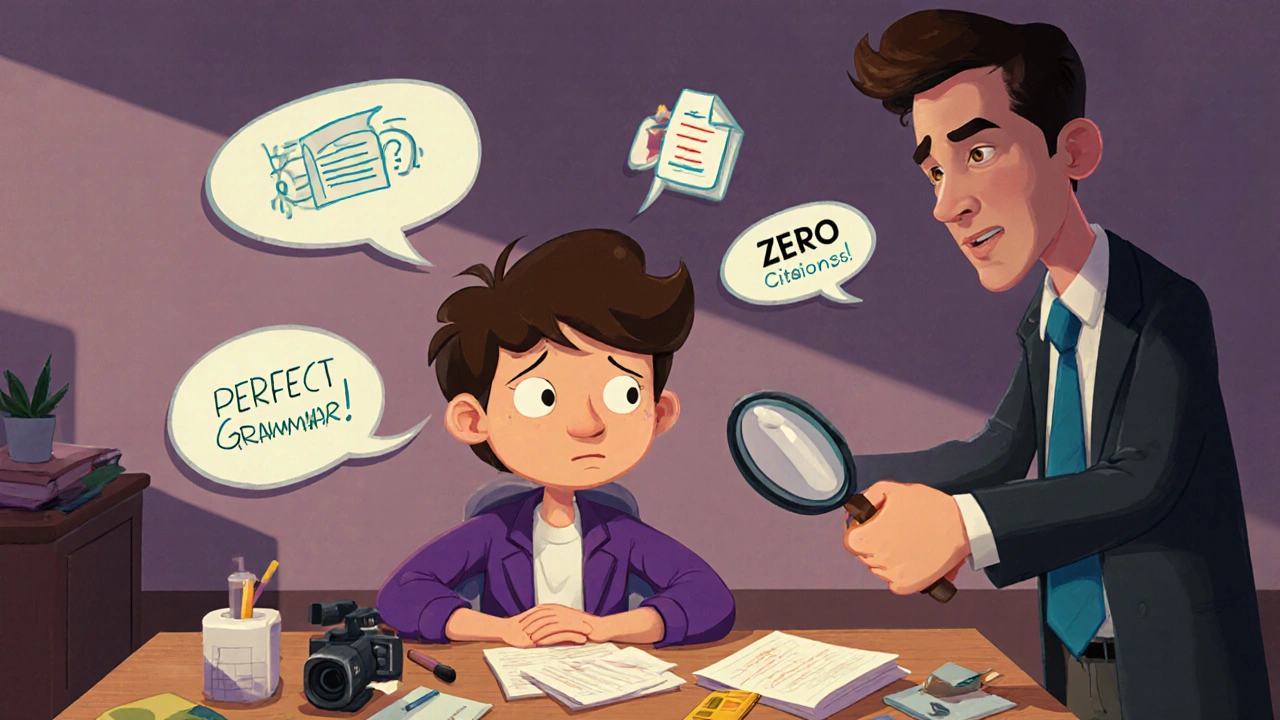
Here’s what happens in real classrooms: A student submits a 1,200-word essay with perfect grammar, consistent tone, and zero citation errors. The system flags nothing. The professor assumes it’s strong work - until they ask the student to explain a single sentence from paragraph three. The student freezes. That’s when you know: the paper was AI-generated.
Traditional detection tools are blind to this. They’re like security cameras that only spot stolen cars - but ignore someone driving a rental with a fake license plate.
What Works: Behavioral Guardrails, Not Just Software
The real solution isn’t better AI detectors. It’s changing how assignments are designed. The most effective guardrails aren’t technical - they’re pedagogical.
Start by asking for process over product. Instead of “Write a 1,500-word essay on climate policy,” try this:
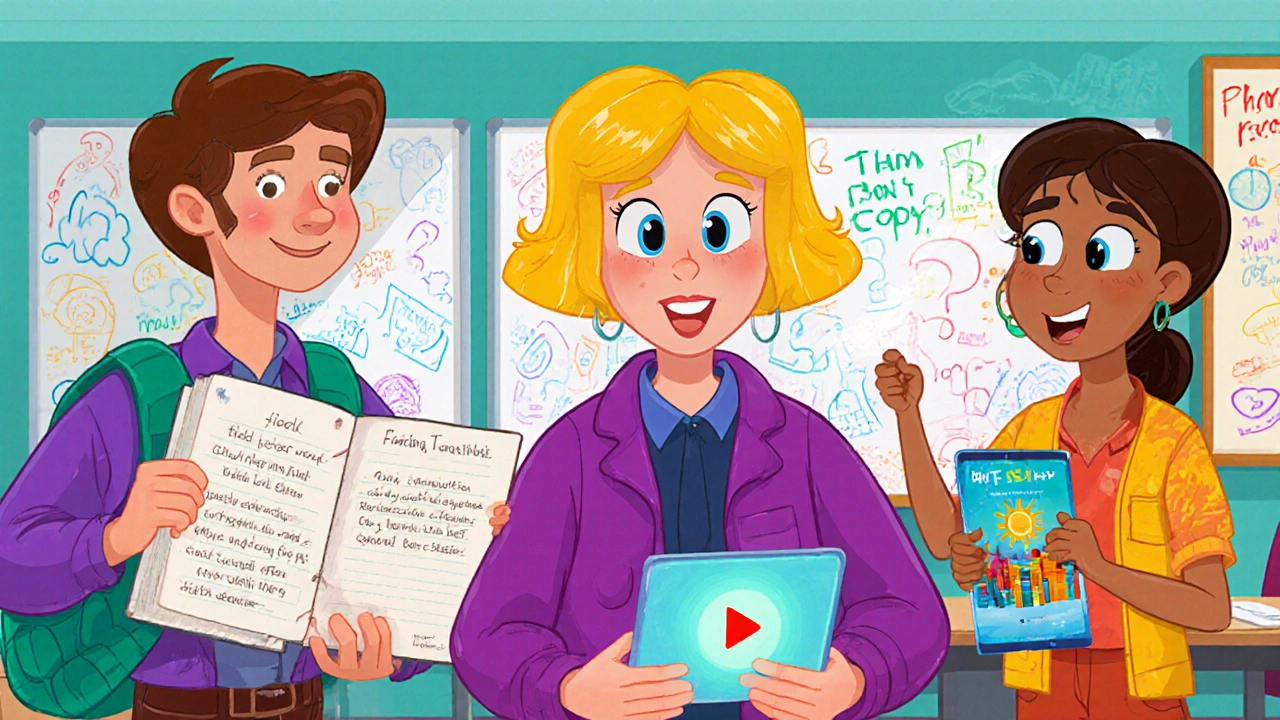
- Submit a rough draft with handwritten notes or annotated screenshots of your research process.
- Record a 3-minute video explaining your main argument and why you chose those sources.
- Answer three follow-up questions live in class - no notes allowed.
This approach works because AI can’t simulate the messy, personal, iterative work of learning. It can’t explain why you picked a specific study from 2019 over a newer one. It can’t describe how your cousin’s experience with air pollution changed your perspective on environmental policy.
At Arizona State University, instructors who switched to this model saw a 47% drop in suspected AI use within one semester. Why? Because students realized they couldn’t outsource the thinking.
Design Assignments That Can’t Be AI-Generated
Some assignments are AI-proof by design. Here’s how to build them:
- Personal reflection prompts: “How did your family’s experience with healthcare shape your view of policy?” AI doesn’t have a family.
- Real-time data analysis: “Collect 10 local tweets about public transit and analyze the sentiment.” AI can’t access your phone or your neighborhood.
- Collaborative projects with peer review: Require students to critique each other’s work in real time. AI can’t fake the back-and-forth of group dynamics.
- Oral presentations with Q&A: If a student can’t defend their work verbally, it’s likely not theirs.
- Fieldwork or observation logs: “Visit a local library and document how five people search for information.” AI doesn’t go to libraries.
These tasks aren’t harder to grade - they’re just different. They reward engagement, not perfection. And they make cheating pointless.
Use AI Detection Tools - But Only as a Last Resort
Some tools, like Originality.ai, GPTZero, and Turnitin’s AI Detection, have improved. They analyze patterns like sentence length variation, lexical density, and predictability of word choice. But they’re still wrong about 1 in 5 submissions - especially with non-native English speakers or students who edit AI output heavily.
Don’t use these tools to accuse. Use them to investigate. If a paper raises a red flag, don’t call it cheating. Ask the student: “I noticed your writing style shifted here. Can you walk me through how you developed this section?”
This approach builds trust. It turns suspicion into dialogue. And it gives students a chance to learn - not just be punished.
Teach Students How to Use AI Ethically
Blocking AI is like banning calculators because they make math too easy. The real goal isn’t to stop AI - it’s to teach students how to use it responsibly.
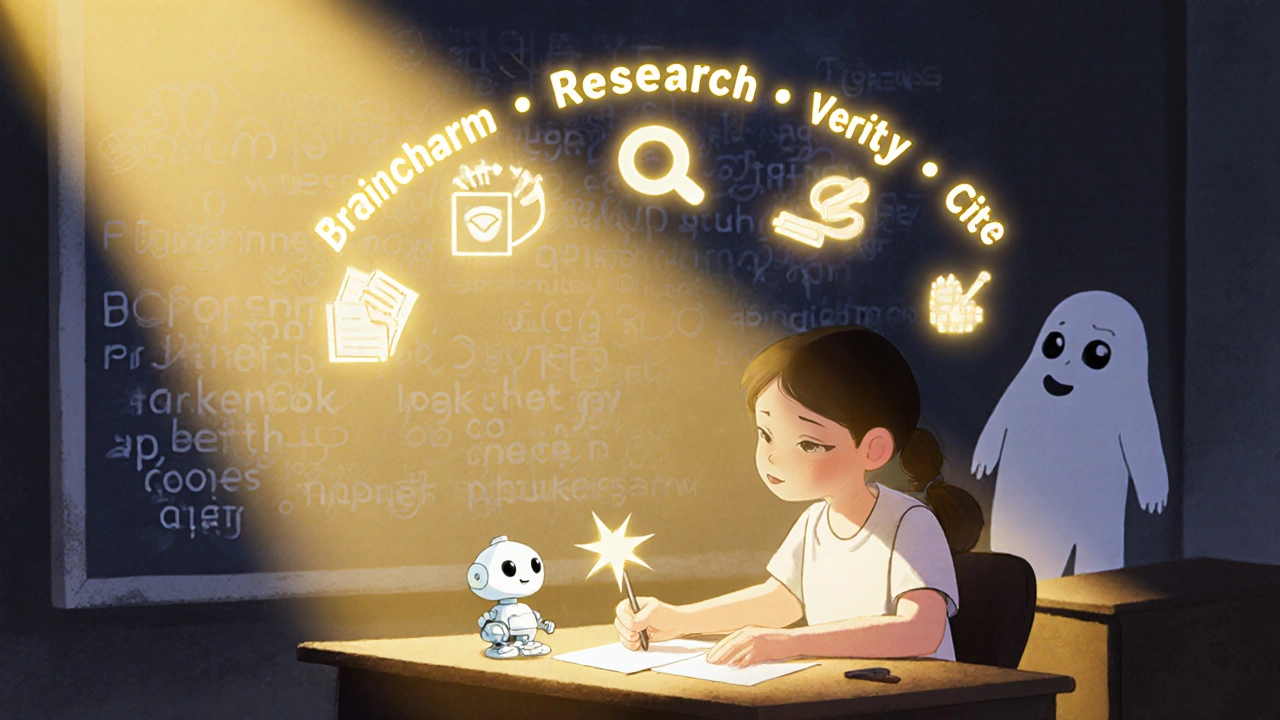
Introduce a simple framework:
- Brainstorm: Use AI to generate ideas, not answers.
- Research: Let AI summarize sources, but always go back to the original.
- Write: Draft your own version - AI is your assistant, not your author.
- Verify: Ask: “Would I say this if no AI helped me?”
- Cite: If you used AI to rephrase, structure, or edit, say so.
At the University of Michigan, students who completed a 30-minute module on ethical AI use were 68% less likely to submit AI-written work without disclosure. They didn’t need to be scared - they needed to be taught.
Policy Isn’t Enough. Culture Is.
Having an “AI Use Policy” on your syllabus won’t stop cheating. But having a conversation about integrity might.
Start class with a simple question: “If you used AI to write this, would you feel proud showing it to your parents?”
Most students won’t lie. They’ll pause. And that pause? That’s where learning begins.
Build a culture where honesty is easier than cheating. Reward thoughtful drafts. Celebrate improvement over perfection. Make it clear: your job isn’t to produce flawless papers - it’s to become a thinker.
What Happens When You Don’t Act
Ignore this problem, and you’re not just letting students cheat - you’re letting them believe that thinking is optional. That skills can be outsourced. That learning is a transaction, not a transformation.
By 2030, employers won’t care if you wrote your college essay. They’ll care if you can solve real problems, communicate clearly, and adapt when things change. Those aren’t skills AI gives you. Those are skills you build through struggle, reflection, and effort.
If we don’t fix this now, we’re not preparing students for the future. We’re preparing them to be users of tools - not creators of ideas.
Can AI detection tools reliably catch AI-written student work?
No, not reliably. Current tools have false positive rates between 15% and 30%, especially with non-native speakers or edited AI output. They’re useful for flagging suspicious work, but never for proof of cheating. Always follow up with a conversation.
Should I ban AI tools in my classroom?
No. Banning AI is like banning calculators. Instead, teach students how to use it ethically. Show them how to use AI for brainstorming, research, and editing - but not for writing entire assignments. Build clear guidelines and model ethical use yourself.
What’s the difference between plagiarism and AI-assisted cheating?
Plagiarism is copying someone else’s exact words without credit. AI-assisted cheating is using AI to generate original content that the student didn’t think through or understand. The harm isn’t theft - it’s the loss of learning. The student didn’t engage with the material.
How do I grade AI-assisted work if a student admits they used AI?
Grade based on the quality of their thinking, not just the final product. Did they use AI to improve their draft? Did they reflect on its limitations? Did they explain their choices? If they show understanding and ownership, give partial credit - and use it as a teaching moment.
Are there assignments that AI can’t fake?
Yes. Assignments that require personal experience, real-time observation, live interaction, or physical presence can’t be replicated by AI. Examples: field notes, video reflections, peer interviews, in-class debates, and handwritten drafts with annotations. These force students to engage - not just produce.
Next Steps for Educators
Start small. Pick one assignment this semester and redesign it to be AI-resistant. Add a video explanation. Require a draft with notes. Include a live Q&A. Track the results. You’ll see a shift - not just in honesty, but in depth of thinking.
And remember: your goal isn’t to catch cheaters. It’s to help students become thinkers who don’t need to cheat.
Elmer Burgos
November 30, 2025 AT 06:17Man I love this post. Been telling my profs for years that turning in AI stuff is like using a calculator to do your taxes - it's not cheating if you understand the math. Just need to teach kids how to use it right.
Jason Townsend
December 1, 2025 AT 23:03AI is just the start. They're already embedding microchips in student ID cards to track brainwaves during exams. This is all part of the education cartel's plan to control thought. They don't want you thinking for yourself.
Antwan Holder
December 2, 2025 AT 18:23Think about it. We're raising a generation of hollow souls who outsource their thoughts to machines. The soul isn't in the essay-it's in the struggle. The late nights. The doubt. The messy scribbles on napkins. AI doesn't feel shame. It doesn't cry over a failed draft. And that's the real tragedy. We're not losing papers-we're losing the human spirit of learning.
Angelina Jefary
December 4, 2025 AT 09:05Whoever wrote this post used AI. The grammar is too perfect. The structure too clean. No human writes like this without editing. And you used 'AI-assisted cheating' like it's a real term. It's not. It's just plagiarism with extra steps.
Jennifer Kaiser
December 5, 2025 AT 14:24I've been doing the video explanation + live Q&A method for two years now. It works. Not because it catches AI-it catches disengagement. The kids who use AI are the ones who never show up to office hours, never ask questions, never say 'I don't get it.' When you make them talk, the truth comes out. And honestly? Most of them are just scared they're not smart enough. They need help, not punishment.
TIARA SUKMA UTAMA
December 6, 2025 AT 09:06Just ban AI. Done. No more drama.
Jasmine Oey
December 7, 2025 AT 23:51Oh my god this is so deep. Like, I cried reading it. I mean, have you ever thought about how AI is just a metaphor for our entire culture? We outsource everything-relationships, feelings, even our pain. Students aren't cheating-they're just mirroring the world. We taught them to consume, not create. And now we're mad they bought the product? We're the problem.
Marissa Martin
December 9, 2025 AT 23:30I tried the handwritten draft thing. One kid turned in a 12-page essay with 3 scribbles on the side. He said he 'used AI to brainstorm.' I didn't know whether to laugh or cry. Maybe we're just too late.
James Winter
December 10, 2025 AT 19:36USA is soft. In Canada we just make them write by hand in class. No tech. No excuses. If you can't write it, you don't deserve the grade. Simple.
Aimee Quenneville
December 12, 2025 AT 01:51Wow, so the solution is… make students do more work? Groundbreaking. I'm sure the 16-year-old who works 30 hours a week to help pay rent is just thrilled to record a video and answer questions after school. Thanks for the insight, professor.
Cynthia Lamont
December 12, 2025 AT 16:29AI detection tools are 80% accurate. That means 1 in 5 students get falsely accused. That's a civil rights violation. And yet, schools still use them like truth machines. This isn't education-it's surveillance capitalism dressed up as pedagogy.
Kirk Doherty
December 12, 2025 AT 23:08My prof let us use AI but we had to cite it like a source. Like 'AI helped me structure this argument.' Weird at first but now I think it's normal. Kinda like using Google.
Dmitriy Fedoseff
December 13, 2025 AT 20:13In my village in Nigeria, we used to write essays with ink and paper. No internet. No AI. But we had teachers who cared. Who asked us why we chose a word. Who made us rewrite until it sounded like us. That’s what’s missing now. Not tools. Not policies. Presence. A human being who sees you, not just your output.
Meghan O'Connor
December 15, 2025 AT 19:17You say 'AI can't simulate personal experience.' That's naive. I've seen AI generate 2000-word memoirs about losing a parent. It's trained on grief. It doesn't feel it-but it can mimic it better than most college students. Don't overestimate humans.
Morgan ODonnell
December 16, 2025 AT 14:30My buddy used AI to write his essay. Got an A. Then he sat down with me and explained every point. He didn't know it before. Now he does. AI didn't replace learning-it just gave him a jumpstart. Maybe we're just bad at teaching.
Elmer Burgos
December 17, 2025 AT 23:48That's exactly my point. AI is the new pencil. We don't punish kids for using pencils to write faster. We teach them to write better. Same thing here.