Haptics and Tactile Feedback: How Hands-On VR Learning Builds Real Skills
 Dec, 29 2025
Imagine learning to perform surgery without ever touching a real body. Or practicing how to fix a jet engine while standing in your living room. This isn’t science fiction anymore-it’s happening right now, thanks to haptics and tactile feedback in virtual reality.
What Haptics Actually Does in VR Learning
Haptics isn’t just vibration. It’s the science of touch. In VR, haptic devices give you physical sensations that match what you see. When you grab a virtual wrench, your hand feels resistance. When you press a virtual button, you feel a click. When you brush against a virtual wire, your skin tingles with the sensation of contact.
This isn’t just for fun. Real skills require muscle memory. You can watch a video of a surgeon stitching a wound a hundred times, but your hands won’t learn unless they move and feel the tension, the drag, the resistance. That’s where haptics bridges the gap between observation and execution.
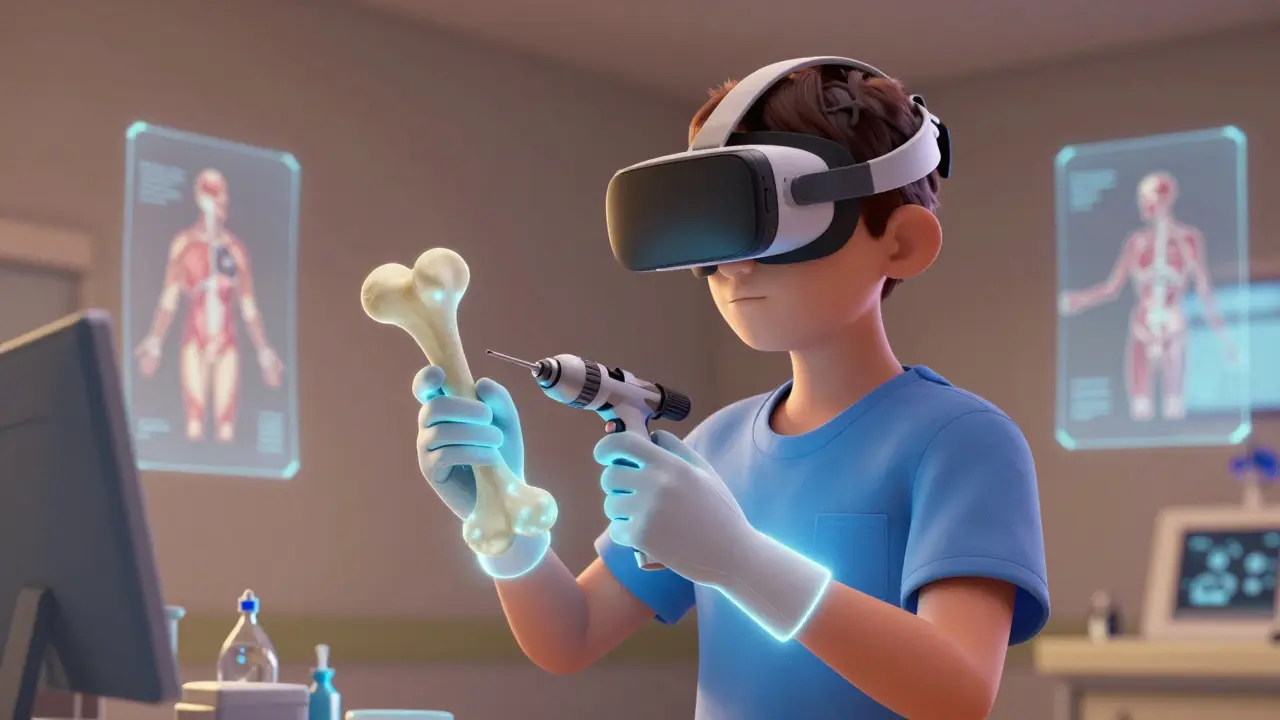
Companies like Osso VR and SimX use haptic gloves and controllers to train orthopedic surgeons. Trainees don’t just see a bone-they feel the crunch of a drill, the give of soft tissue, the snap of a screw tightening. A 2024 study by the Journal of Surgical Education found that surgeons trained with haptic VR performed procedures 30% faster and made 40% fewer errors compared to those using traditional video-based training.
Why Touch Matters More Than You Think
Our brains don’t learn skills the same way they learn facts. Facts go into memory. Skills go into your muscles, your nerves, your reflexes. That’s called procedural memory. And it’s built through repetition with sensory feedback.
Think about learning to ride a bike. No amount of reading about balance will help if you never feel the sway of the handlebars, the push of your feet on the pedals, the sudden lurch when you tilt too far. Haptics gives VR learners that same physical feedback loop.
In manufacturing, workers use haptic VR to learn how to assemble complex machinery. One aerospace company replaced weeks of on-the-job training with a 4-hour VR module. Trainees reported higher confidence, and error rates dropped by 52% in the first month after deployment.
Even soft skills benefit. Nurses practicing patient communication in VR can feel the subtle pressure of a patient’s hand gripping theirs during a difficult conversation. That tactile cue triggers empathy responses in the brain that pure audio or video can’t replicate.
How Haptic Systems Work
Not all haptics are the same. There are three main types used in training:
- Exoskeleton gloves - Fit over your hand and use motors to push your fingers into the right position. Used in surgical and precision assembly training.
- Force-feedback controllers - Like VR remotes that resist your grip. Used in mechanical repair and tool handling.
- Tactile suits or patches - Small pads that vibrate or heat up on your skin. Used in fire response training or emergency medical scenarios.
Each system pairs with software that maps real-world physics to virtual interactions. A hammer hitting a nail isn’t just simulated visually-it’s modeled with real-world force, vibration frequency, and rebound. The haptic device then replicates those exact inputs in your hand.
The best systems use real-time calibration. If you’re a small-framed nurse, the system adjusts resistance so you’re not fighting a force designed for a larger body. If you’re a mechanic with arthritis, it reduces strain while keeping feedback accurate.

Real-World Applications Beyond Medicine and Engineering
Haptic VR isn’t just for high-tech fields. It’s reshaping how we train in everyday jobs.
Firefighters in Phoenix use haptic suits to practice crawling through smoke-filled rooms. They feel heat pulses on their arms when they near a hot surface, and pressure on their chest when they push through a blocked door. No real flames. No risk. Just realistic physical cues.
Restaurant staff train with haptic VR to handle fragile dishes and hot cookware. One chain reduced breakage by 67% after implementing VR modules where workers felt the weight and slip of a greasy plate, or the sudden heat spike when a pan overheats.
Even artists and craftspeople are using it. Ceramicists practice throwing clay on virtual wheels that resist their hands just like real clay. They feel the suction, the wobble, the stickiness-without wasting materials or waiting for kiln time.
What’s Holding Haptic VR Back?
It’s not perfect yet. The biggest hurdle? Cost. High-fidelity haptic gloves can run $1,500 to $5,000 per unit. That’s why most deployments are in corporate training, not schools.
Another issue: latency. If your hand moves and the feedback lags even 50 milliseconds, your brain notices. It feels fake. The best systems now operate under 20ms delay, but not all hardware can do that.
Also, not all skills need haptics. Learning to write code, understand accounting principles, or memorize legal statutes doesn’t require touch. Haptics shines where physical interaction is core to the outcome.
And there’s still a learning curve for instructors. Many training managers don’t know how to design haptic scenarios. They try to turn a PowerPoint into VR and wonder why it doesn’t work. Effective haptic training needs to be built from the ground up-like choreography for the hands.

What to Look for in a Haptic VR Training System
If you’re considering haptic VR for your team or organization, here’s what actually matters:
- Real physics - Does the system use actual force, friction, and weight data, or just pre-set animations?
- Adjustable resistance - Can it scale for different body types and skill levels?
- Feedback precision - Can it distinguish between a light tap and a firm press? Or does it just vibrate on contact?
- Integration - Does it work with your existing LMS or training records?
- Support - Is there a team that helps design custom scenarios, or are you stuck with canned content?
Don’t be fooled by flashy demos. Ask for a pilot. Run a side-by-side test: half your team trains with haptic VR, half with traditional methods. Measure speed, accuracy, and confidence after two weeks. The data will tell you if it’s worth the investment.
The Future Is Touch-Enabled
By 2027, haptic VR training will be standard in industries where precision, safety, or repetition matter. The cost will drop as mass production kicks in. New materials like graphene-based actuators will make gloves lighter, more responsive, and cheaper.
What’s more exciting? Haptics is starting to connect with AI. Imagine a system that watches your hand movement, notices you’re gripping too tight, and adjusts the resistance in real time to correct your technique. That’s already being tested in robotics labs.
This isn’t about replacing teachers or trainers. It’s about giving them a tool that turns abstract knowledge into muscle memory. The best VR learning doesn’t just show you how to do something-it lets you feel it.
When your hands remember, your brain doesn’t have to work as hard. And that’s how real skills stick.
Morgan ODonnell
December 29, 2025 AT 22:45This is actually kind of wild. I never thought about how much of learning is in your hands, not just your head. Feels like VR finally got something right.
Amy P
December 30, 2025 AT 17:04OMG YES. I did a VR trauma simulation last year and when the haptic glove made my fingers tingle like I was pressing on a real pulse-it hit me like a truck. No video, no textbook, no lecture ever made me feel that real. This isn't training. This is muscle memory hacking.
Meghan O'Connor
January 1, 2026 AT 13:50Stop. Just stop. You people are acting like this is the second coming of Christ. Haptics? Really? You think feeling a fake wrench vibration makes you a surgeon? I’ve seen interns in real ORs who couldn’t hold a scalpel right-and they didn’t need VR to fail. This is just overpriced gamification for corporate buzzword bingo.
Liam Hesmondhalgh
January 3, 2026 AT 06:37Of course Americans love this nonsense. We don’t train people anymore-we just slap on a headset and call it education. In Ireland we used to learn by doing, not by pretending to do. This is why our kids can’t fix a bike anymore. All they know is buttons and vibrations.
Alan Crierie
January 3, 2026 AT 23:48Actually, the science behind this is solid. Procedural memory is wired through sensory feedback-neurology 101. The haptic feedback isn’t the gimmick; it’s the bridge between knowing and doing. You don’t learn to ride a bike by watching YouTube. You learn by falling. Haptics lets you fall safely.
Gareth Hobbs
January 5, 2026 AT 10:25They’re hiding something… I’ve read reports-haptic feedback systems are being used to subtly condition workers. The vibrations? They’re not just simulating pressure-they’re syncing with biometric sensors to monitor stress levels. This isn’t training. It’s surveillance with a VR headset. The government’s behind this. You think they’d let this tech be free?
Teja kumar Baliga
January 6, 2026 AT 12:28In India, we train electricians by letting them work on real wires under supervision. But I’ve seen kids in rural areas who never touch live circuits until they’re 25. Haptic VR could save lives. No need to wait for someone to get shocked to learn. This is progress.
k arnold
January 6, 2026 AT 20:4530% faster? 40% fewer errors? Sure. And I’m the Queen of England. Where’s the peer-reviewed study with a control group that didn’t just get a fancy toy? Also, who paid for this research? Oculus?
Nicholas Zeitler
January 7, 2026 AT 15:33Love this. But don’t forget the human element. Tech doesn’t replace mentors-it gives them better tools. I’ve used haptic VR with new nurses. They’re scared. The system lets them practice holding a trembling patient’s hand before they ever meet one. That’s not tech. That’s compassion, coded.
Patrick Tiernan
January 9, 2026 AT 06:10So we’re spending thousands on gloves that vibrate so you can pretend to fix a jet engine? Meanwhile, my cousin’s mechanic learned everything from a 1987 Haynes manual and a bottle of WD-40. This is what happens when you let engineers design education
Tiffany Ho
January 9, 2026 AT 12:16I work in a kitchen and we tried the VR plate-handling thing. Honestly? It helped. I didn’t drop a single dish for two weeks after. I didn’t even realize how much I was gripping too hard until the system told me. It felt weird at first but… yeah. It worked.
adam smith
January 10, 2026 AT 05:25It is my professional opinion, based on empirical observation and industry standards, that the integration of haptic feedback technology into vocational training environments represents a significant advancement in experiential learning paradigms. The tactile fidelity of modern systems, when calibrated to ergonomic norms, demonstrably enhances motor learning outcomes.
lucia burton
January 10, 2026 AT 12:34Let me tell you something about neuroplasticity and sensorimotor integration-this isn’t just about muscle memory, it’s about cortical remapping. When haptic feedback is synchronized with proprioceptive cues and visual fidelity at sub-20ms latency, you’re not just training a skill-you’re rewiring the cerebellum’s motor map. And when you layer in adaptive resistance algorithms that scale to anthropometric variance, you’re not just simulating physics-you’re creating a closed-loop somatosensory feedback architecture that transcends traditional apprenticeship models. This is the future of embodied cognition in professional training.
Denise Young
January 10, 2026 AT 15:43Oh wow. Another tech bro article pretending haptics is revolutionary. Let me guess-your company bought five $4,000 gloves and now you’re writing think pieces to justify the budget. Meanwhile, real nurses are still doing 12-hour shifts with no breaks and zero support. This isn’t innovation. It’s distraction with a price tag.
michael Melanson
January 12, 2026 AT 12:37I’ve used these systems in fire training. The heat pulses on your arms? They’re not perfect, but when you’re crawling through smoke and feel that sudden warmth-your body reacts before your brain processes it. That’s the moment it clicks. This tech doesn’t replace experience. It gives you experience without the burns.
Tyler Springall
January 14, 2026 AT 02:03Interesting. But let’s be honest-this is just Silicon Valley’s latest attempt to monetize the illusion of competence. You don’t become a surgeon by feeling a rubber glove vibrate. You become one by watching your mentor’s hands, by smelling the antiseptic, by feeling the weight of responsibility. No algorithm can replicate that. This is education as performance art.
Patrick Bass
January 14, 2026 AT 07:06Minor correction: the study cited was from the Journal of Surgical Education, 2024, volume 12, issue 3. Also, the term 'tactile suits' should probably be 'haptic suits' for technical accuracy. Otherwise, solid breakdown.