Honor Code Policies: Navigating Cheating, Plagiarism, and Proctoring
 Aug, 29 2026
You just finished a late-night study session. You’re tired, your eyes are burning, and you’re staring down the barrel of a timed online exam. The question pops up. You know the answer, but you also know that one quick tab-switch could verify it in seconds. Do you do it? For millions of students, this isn’t a hypothetical; it’s a daily moral and logistical dilemma governed by honor code policies. These aren't just dusty rulebooks buried in university handbooks anymore. They are the digital gatekeepers of your degree, enforced by algorithms that watch your mouse movements, scan your keystrokes, and compare your essay against billions of web pages.
The landscape has shifted dramatically since the early 2020s. What used to be a handshake agreement between student and professor has evolved into a high-stakes surveillance ecosystem. If you’re a student, understanding these rules isn’t just about avoiding expulsion-it’s about knowing how technology interprets your behavior. If you’re an educator or administrator, it’s about balancing trust with verification. Let’s break down what actually happens behind the scenes when you click "Start Exam" or submit a paper.
What Actually Counts as Cheating?
Most people think cheating is simple: you look at someone else’s paper, or you copy-paste from Wikipedia. But modern definitions are far more nuanced. An academic integrity violation occurs whenever unauthorized assistance is used to complete an assessment. This includes using AI tools like ChatGPT if they aren’t explicitly permitted, collaborating on individual assignments without permission, or even having a friend proofread your draft too heavily.
Here is where it gets tricky for students. Context matters. In a take-home essay, consulting a textbook is fine. In a closed-book online quiz, opening a PDF might trigger a flag. The core principle remains constant across institutions: you must produce work that reflects your own understanding. When you outsource that cognitive process to a tool or another person without disclosure, you violate the spirit of the evaluation.
| Scenario | Status | Why It Matters |
|---|---|---|
| Using Grammarly for basic spelling | Generally Acceptable | Focuses on mechanics, not content generation. |
| Using AI to generate thesis statements | Often Prohibited | Outsources critical thinking and argumentation. |
| Discussing concepts with classmates before writing | Context Dependent | Allowed unless the assignment specifies "individual work." |
| Submitting the same paper for two different classes | Self-Plagiarism | Requires prior instructor approval to avoid double-dipping credit. |
The Plagiarism Machine: How Detection Works
You’ve probably heard of Turnitin. It’s the name most students dread. But how does it actually catch you? It doesn’t have a human reading every sentence. Instead, it uses text-matching algorithms. When you upload a document, the system breaks your text into small strings of words-often called shingles-and compares them against its massive database. This database includes internet content, academic journals, and previously submitted student papers.
If a string of eight or more consecutive words matches a source in the database, it gets flagged. This is why changing a few synonyms often fails. If you keep the sentence structure identical but swap "happy" for "joyful," the algorithm still sees the structural fingerprint. True paraphrasing requires rewriting the idea entirely in your own voice, not just swapping vocabulary.
Then there is the new frontier: AI detection. Tools now analyze perplexity and burstiness. Perplexity measures how surprised an algorithm is by your word choices. Human writing tends to be unpredictable (high perplexity). AI writing is statistically probable and smooth (low perplexity). Burstiness looks at sentence variation. Humans write short sentences followed by long, complex ones. AI tends to write sentences of similar length. While these detectors aren’t perfect-and false positives happen-they add another layer of scrutiny to your submission.
Proctoring: Are You Being Watched?
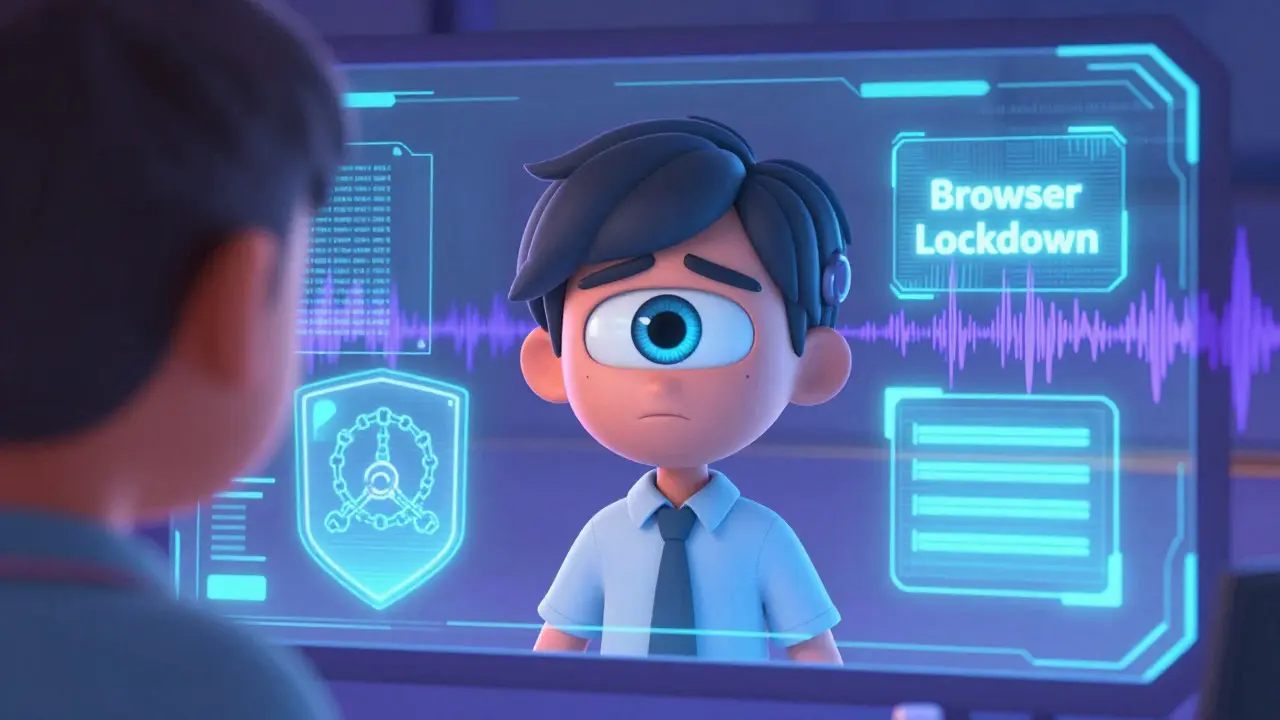
If plagiarism checks your past work, proctoring monitors your present behavior. Online proctoring software, such as Honorlock, ProctorU, or Respondus LockDown Browser, transforms your webcam and microphone into surveillance devices. But it goes deeper than video.
- Browser Lockdown: Prevents you from opening new tabs, accessing other applications, or copying/pasting text during the exam.
- Webcam Monitoring: Records your face and environment. Some systems use eye-tracking algorithms to flag when you look away from the screen repeatedly.
- Audio Analysis: Detects background voices. If someone whispers an answer, the system flags the timestamp.
- Keystroke Dynamics: Analyzes typing speed and patterns. A sudden shift from slow, thoughtful typing to rapid, erratic bursts might suggest copy-pasting or panic.
Privacy concerns are real here. These programs often require root-level access to your computer to prevent you from closing the browser window. Critics argue this creates a panopticon effect, where the fear of being watched alters performance. Students report higher anxiety levels when proctored, which can skew results. However, proponents argue that without some form of verification, online credentials lose their value. It’s a trade-off between convenience and credibility.
Consequences: Beyond the Zero Grade
What happens if you get caught? It varies wildly by institution, but the spectrum ranges from mild to severe. At the lower end, you might receive a warning or a zero on that specific assignment. Many schools allow a "redo" option where you retake the test under stricter conditions.
At the upper end, repeated offenses or egregious cases (like hiring a ghostwriter) can lead to suspension or expulsion. More importantly, a notation on your transcript can haunt you later. Graduate school admissions committees and employers increasingly check for academic integrity violations. A record of plagiarism suggests a lack of reliability, which is a hard sell in professional environments.
Don’t underestimate the psychological toll. The stress of an investigation process can be intense. You may need to attend hearings, provide evidence of your drafting process, or prove you didn’t have access to external resources. Keeping your research notes, draft versions, and browser history can save you if you’re falsely accused.
Navigating the Gray Areas: Best Practices for Students
How do you stay safe? First, read the syllabus. Seriously. If the professor says "no external sources," don’t peek at a blog post. Second, cite everything. Even if you paraphrase, give credit. It shows you engaged with the material rather than just consuming it.
Third, manage your tech. Before starting a proctored exam, close all unnecessary applications. Disable notifications. Ensure your room is well-lit so your face is clearly visible. If you wear glasses, make sure they don’t obscure your eyes from the camera angle. Small technical glitches can look like suspicious behavior to an automated flagging system.
Finally, ask questions. If you’re unsure whether you can collaborate with a peer, email the instructor. A quick clarification prevents a major misunderstanding. Transparency is your best defense. Most honor codes operate on the presumption of innocence, but once a flag is raised, the burden shifts to you to explain the anomaly.
The Future of Academic Integrity
We are moving toward a hybrid model. As generative AI becomes ubiquitous, educators are redesigning assessments. Instead of asking "Write an essay on X," they might ask "Critique this AI-generated essay on X." This shifts the skill from creation to evaluation. Proctoring will likely become less invasive as authentication methods improve, perhaps relying more on blockchain-based credentialing or continuous assessment portfolios rather than single high-stakes exams.
The goal isn’t to catch everyone. It’s to create a culture where honesty is the norm because it’s the easiest path. When the system trusts you, and you respect the system, the friction disappears. Until then, treat every submission as a public declaration of your competence. Because in the digital age, your reputation is data.
Is using ChatGPT considered cheating?
It depends on the assignment instructions. If the prompt allows AI assistance, it is acceptable. If the goal is to demonstrate independent critical thinking, using AI to generate content without disclosure is typically considered a violation of academic integrity.
How accurate are AI detection tools?
Current AI detectors have varying accuracy rates, often ranging between 60% and 90%. They are prone to false positives, especially with non-native English speakers or highly structured technical writing. Therefore, many institutions use them as a screening tool rather than definitive proof.
Can proctoring software see my private files?
Most proctoring software records your screen activity and browser interactions but does not index or store your entire hard drive. However, it captures screenshots and video of your desktop environment, so sensitive personal information should be hidden or minimized during exams.
What is self-plagiarism?
Self-plagiarism occurs when you reuse your own previous work without permission or citation. This includes submitting the same paper for two different classes or recycling paragraphs from a published article into a new assignment without acknowledging the original source.
Do I need special hardware for online proctoring?
Typically, you need a stable internet connection, a working webcam, and a microphone. Some systems require a second device (like a smartphone) to monitor your room from a different angle. Always run the system compatibility check provided by your institution before the exam day.
Quintin Franzese
August 30, 2026 AT 06:14Great post, but let's be real: if I have to install root-level software just to take a multiple-choice quiz, I'm switching majors.
The 'panopticon' bit is spot on though. We're trading privacy for the convenience of not driving to campus, and honestly? The anxiety spike from knowing an algorithm is judging my eye movements does more damage to my grade than the actual content ever could.
Amara Akbar
September 1, 2026 AT 05:12I completely agree with your perspective on the psychological toll, Quintin. It is vital that we acknowledge how these surveillance tools impact student well-being alongside academic integrity.
Perhaps institutions should consider hybrid models where proctoring is optional for low-stakes assessments, allowing students to build trust gradually. We must remain open-minded about balancing verification with respect for personal boundaries.
Anthony Miller
September 2, 2026 AT 16:50You are all missing the point entirely. This isn't about convenience or comfort; it is about the absolute degradation of intellectual standards.
If you cannot produce work without digital crutches then you do not deserve the degree. Period. These algorithms are necessary because the current generation lacks discipline. Stop complaining about 'privacy' when you can barely write a coherent sentence without AI assistance. The decline of education is self-inflicted.
alex kobri
September 4, 2026 AT 15:22interesting take anthony but i think you're conflating technology with laziness
the philosophical question here is whether knowledge exists in the head or in the ability to access and synthesize information quickly if the tool allows me to verify facts instantly why penalize that efficiency rather than teach better synthesis skills
we need to redefine what 'cheating' means in a networked age
Elizabeth Brooks
September 6, 2026 AT 10:47Hey everyone! Just wanted to add some context on the tech side since people are worried about false positives.
AI detectors like Turnitin or GPTZero use perplexity scores which can get super wonky with non-native speakers or highly technical writing styles. I've seen papers flagged as 90% AI that were totally human written because the student used very consistent sentence structures.
Also, don't forget that 'shingles' (those 8-word strings) catch accidental matches too. If you quote a common phrase, it might flag even if you cited it properly sometimes. Its always best to keep your draft history handy just in case!
michelle veluz
September 6, 2026 AT 15:01OH MY GOD, DO YOU REALIZE WHAT THEY ARE DOING??
It’s not just about cheating!! It’s about DATA HARVESTING!!! They want our keystrokes, our facial expressions, our voice patterns... they are building profiles on us before we even graduate!!
Why do they need ROOT ACCESS?! Why?! Are they looking at our tax returns while we take History 101?? I bet half these 'algorithms' are just random number generators designed to scare us into compliance. Wake up!!
Susan Cole
September 8, 2026 AT 05:32I appreciate the detailed breakdown. As someone who prefers working independently, I find the invasive nature of proctoring quite draining. I usually close all background apps and ensure my room is silent, but the constant awareness of being recorded changes how I think. It feels less like taking a test and more like performing under observation.
Tamara Miller
September 8, 2026 AT 18:31Well, obviously, if one actually READ the syllabus, none of this would be an issue!
People complain about 'gray areas,' but most professors are quite clear: 'No external sources.' If you choose to peek, that is YOUR choice. And regarding AI detectors-they aren't perfect, sure, but neither is human judgment. At least the machine doesn't have bias against your accent or your last name. Maybe try studying instead of blaming the tools?
Deb Kortyna, MBA
September 9, 2026 AT 16:07I must interject with a crucial distinction that seems to be overlooked in this heated debate.
We are witnessing a fundamental shift in the epistemology of assessment. When we allow AI to generate thesis statements, we are not merely outsourcing labor; we are abdicating the cognitive responsibility of argumentation. The drama lies not in the punishment, but in the erosion of the student's agency. If the machine thinks for you, who are you? A mere conduit for data? This existential crisis is far more severe than any zero grade.
Savara Gunn
September 10, 2026 AT 14:04yeah its rough but honestly just cite everything and dont stress too much about the bots. they make mistakes all the time.
keep your drafts safe and you'll be fine.
Zach Loescher
September 11, 2026 AT 03:40Quietly observing this thread, I think the core tension remains unresolved. Is the goal to prevent fraud or to measure learning? If a student uses AI to understand a concept faster, did they fail to learn? Or did they succeed in accessing knowledge efficiently? I lean towards the idea that we need new metrics, not just stricter policing. But that requires educators to adapt, which is slow.