How 5G and Edge Computing Are Transforming Mobile Learning
 Mar, 10 2026
By 2026, mobile learning isn’t just about watching videos on your phone. It’s about real-time AI tutors, immersive AR labs, and lessons that adapt as you walk from class to class-all powered by 5G and edge computing. These technologies aren’t just faster internet. They’re rewriting what’s possible in learning, especially for students on the move, in remote areas, or in high-traffic urban schools.
Why 5G Isn’t Just About Speed
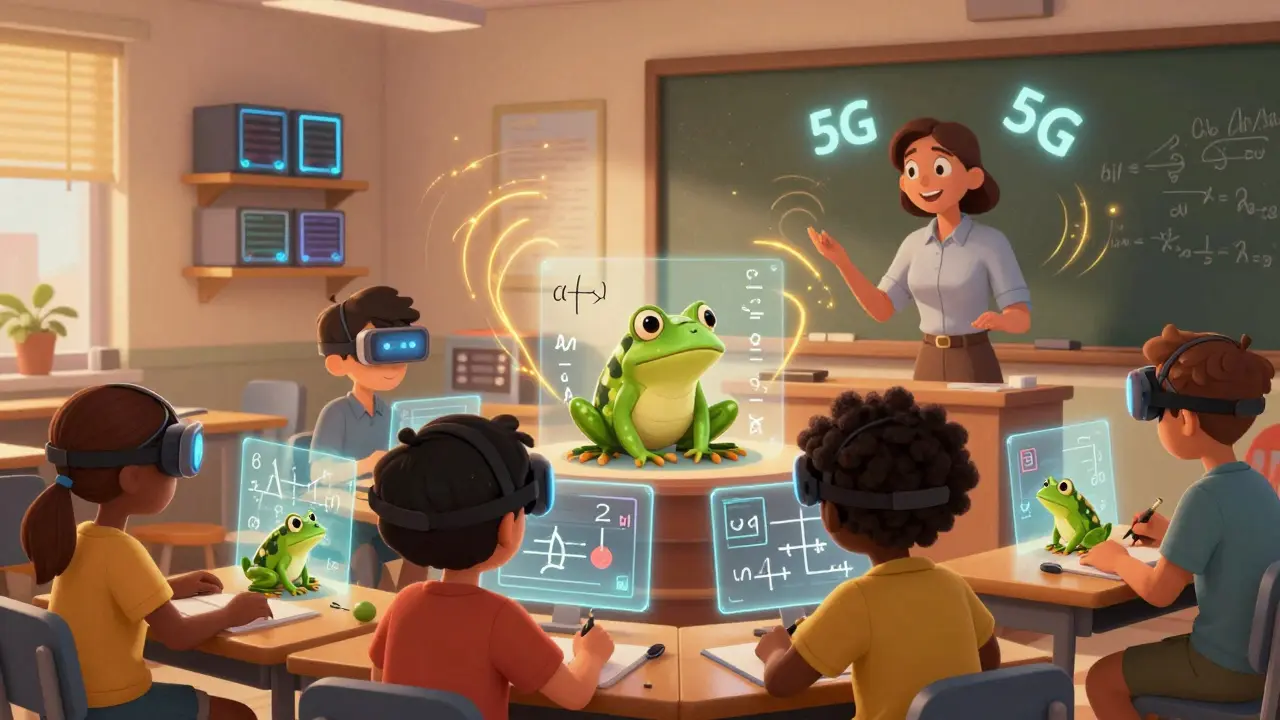
Most people think 5G means quicker downloads. But in education, the real win is latency. Where 4G took 50-100 milliseconds to send a signal, 5G does it in under 10. That’s the difference between a laggy video call and a seamless conversation with a virtual tutor. Imagine a student in rural Montana using an AR app to dissect a frog. With 4G, the image stutters. With 5G, it’s smooth, responsive, and interactive. No buffering. No delays. Just learning that feels real.
And it’s not just about video. 5G supports up to 1 million devices per square kilometer. That means every student in a crowded classroom can stream high-res simulations, use haptic feedback gloves for chemistry labs, or sync with a cloud-based AI tutor-all at the same time. Schools in Tokyo and Chicago are already testing this. One pilot in Chicago Public Schools saw a 32% drop in dropout rates among students using 5G-powered personalized learning apps.
Edge Computing: Learning That Lives Where You Are
5G gets the data to you fast. Edge computing keeps it close. Instead of sending every keystroke or quiz answer to a server in another state, edge computing processes data right on a nearby tower, router, or even a device in the classroom. This cuts latency even further and reduces bandwidth strain.
Think of it like having a personal assistant in your backpack. When a student answers a math question on their tablet, the edge server near their school instantly checks their work, identifies patterns in their mistakes, and adjusts the next lesson-all before they even tap "submit." No waiting. No cloud overload. Just smart, immediate feedback.
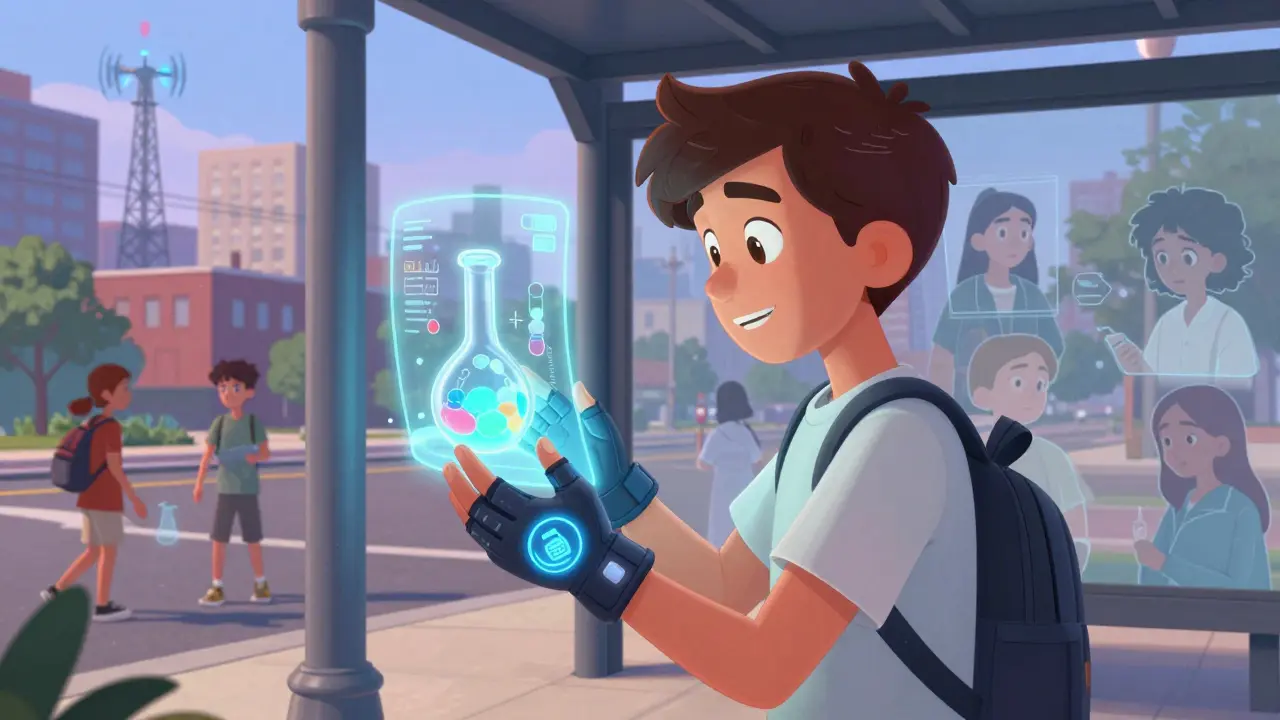
For schools without reliable high-speed internet, edge nodes can be installed on streetlights or bus stops. A student in Detroit can access a full physics simulation while waiting for the bus, and their progress syncs to their profile when they get home. This isn’t science fiction. The U.S. Department of Education funded 12 pilot programs in 2025 using edge servers in public transit hubs to deliver learning to students without home Wi-Fi.

Real-World Impact: What’s Changing in Classrooms Today
Here’s what’s actually happening in schools and training centers right now:
- AI tutors that know your learning style: Apps like EduBot and LearnFlow use 5G and edge processing to analyze your voice, typing speed, and answer patterns in real time. If you’re struggling with fractions, the system doesn’t just give you more problems-it changes how it explains them.
- AR field trips without leaving the classroom: Students in Oslo are exploring ancient Rome through AR headsets. The 3D models load instantly because edge servers in the school building handle the rendering. No downloading. No lag.
- Live collaboration across continents: A high school in Nairobi and another in Toronto are co-designing robots using shared AR workspaces. With 5G’s ultra-low latency, their code updates sync in under 20 milliseconds. They feel like they’re in the same room.
- Offline-first learning: Edge devices cache lessons, quizzes, and videos locally. If the network drops, learning continues. When it comes back, everything syncs automatically. This matters for students on the road, in disaster zones, or in areas with unstable infrastructure.
Who Benefits Most?
This isn’t just for elite schools. The real shift is in equity.
Students in rural communities, migrant families, and those without home internet are no longer at a disadvantage. With 5G-enabled hotspots on school buses and edge servers in community centers, learning follows them. A study by the National Education Policy Center in 2025 found that students in low-income districts using 5G-edge learning tools improved their science scores by 41% in one academic year.
Adult learners, too, are seeing benefits. Nurses in emergency rooms are using 5G-connected AR glasses to access real-time procedure guides. Factory workers in Germany are getting on-the-job training via edge-powered holograms that show them how to fix machinery without stopping the line.
The Hidden Challenges
It’s not all smooth sailing. Infrastructure costs are high. Installing edge servers and upgrading cellular towers isn’t cheap. Many districts still rely on outdated Wi-Fi routers that can’t handle 5G traffic. And not all devices are ready. Older tablets and smartphones can’t process edge data efficiently.
Privacy is another concern. With learning data processed locally, schools must ensure edge servers are secure. A breach in one edge node could expose hundreds of student profiles. The European Union’s 2025 Education Data Act now requires all edge systems in schools to meet strict encryption and anonymization standards.
There’s also the risk of over-reliance. If a student only learns through apps that adapt to them, do they lose the ability to struggle, think independently, or learn from failure? Educators are still figuring out the balance.
What’s Next? The Future in 2026 and Beyond
By 2027, we’ll see learning ecosystems where:
- 5G and edge computing power fully immersive VR classrooms with haptic feedback.
- AI tutors predict learning gaps before they happen, using real-time brainwave data from wearable headbands (yes, they’re now FDA-approved for classroom use).
- Students earn micro-credentials in real time as they master skills during field trips, internships, or even while working part-time jobs.
Imagine a student in Miami learning marine biology by collecting water samples, scanning them with their phone, and getting instant analysis from an edge server on a nearby dock. Their results are added to a global dataset. They earn a badge. Their transcript updates. Their college application gets a boost-all without a single grade or test.
This isn’t a distant dream. It’s already being tested in pilot programs across 17 countries. The future of learning isn’t about bigger screens or fancier apps. It’s about learning that’s always there, always responsive, and always tailored-right where you are.
Can 5G and edge computing replace traditional classrooms?
No, they enhance them. The goal isn’t to eliminate teachers or physical spaces-it’s to give teachers better tools and students richer experiences. A student using AR to explore the solar system still needs a teacher to guide their questions, connect concepts, and encourage critical thinking. Technology supports learning; it doesn’t replace the human element.
Do students need expensive devices to use 5G and edge learning?
Not necessarily. Many edge-powered apps work on mid-range smartphones and tablets. The heavy lifting happens on nearby edge servers, not the device itself. Schools are rolling out device loan programs and low-cost Chromebooks with 5G modems. The focus is on accessibility, not high-end hardware.
Is 5G mobile learning safe for kids?
Yes, when properly regulated. Modern 5G networks operate at non-ionizing frequencies, and exposure levels are well below international safety limits. The bigger concern is data privacy. Schools using these tools must follow strict guidelines-like encrypting student data, limiting third-party access, and ensuring edge servers are physically secure. The 2025 Education Data Act in the EU and similar rules in the U.S. and Canada now require this.
How is this different from online learning during the pandemic?
Early online learning was a stopgap: live Zoom calls, downloaded PDFs, and delayed feedback. Today’s mobile learning is interactive, immediate, and adaptive. It doesn’t just deliver content-it responds to you. With 5G and edge computing, learning feels alive. It’s not about being online-it’s about being connected in real time, anywhere.
What happens if the network goes down?
Edge systems are designed to keep working. Lessons, quizzes, and simulations are cached locally on the device or nearby edge server. Students can continue learning offline. When connectivity returns, all progress syncs automatically. This makes the system resilient-perfect for areas with unreliable infrastructure or during emergencies.
Meghan O'Connor
March 11, 2026 AT 18:50Also, '1 million devices per sq km'? That's not a feature, that's a nightmare. Network congestion will be insane. You think rural Montana is the problem? Wait till you try this in a NYC public school with 400 kids all streaming AR frogs at once.
And why is no one talking about the battery drain? My phone dies by 11 AM with TikTok and Spotify. Imagine adding real-time AI tutors and AR rendering. Kids will be carrying power banks like lunchboxes.
Morgan ODonnell
March 12, 2026 AT 13:30Liam Hesmondhalgh
March 13, 2026 AT 11:00And 'edge servers on streetlights'? You mean like the ones that get vandalized every other week? Brilliant. Let's put student data on a public pole. Genius.
Patrick Tiernan
March 14, 2026 AT 18:01And 'micro-credentials earned during part-time jobs'? Next thing you know, kids will be graded on how many TikToks they post about photosynthesis.
Also-no one mentioned the fact that most students don't even own a smartphone. But sure, let's build a future where only the rich have Wi-Fi and the rest get left behind. Classic.
Patrick Bass
March 16, 2026 AT 05:00Tyler Springall
March 17, 2026 AT 06:25And don’t get me started on 'brainwave data from wearable headbands'-that’s not innovation, that’s dystopian surveillance dressed in EdTech marketing speak. The EU’s 2025 Act? It’s too little, too late.
Colby Havard
March 17, 2026 AT 23:01Correlation is not causation. A 32% drop in dropout rates? Without controlling for socioeconomic variables, teacher quality, or curriculum design, this claim is statistically indefensible.
Furthermore, the normalization of real-time biometric data collection via FDA-approved headbands raises profound ethical concerns under the Fourth Amendment and FERPA. This is not progress-it is surveillance capitalism repackaged as pedagogy.
Amy P
March 19, 2026 AT 01:45Imagine if I had this as a kid? I would’ve loved history. I used to hate it because it was just names and dates. But this? This makes it feel alive.
And the part about the student in Miami collecting water samples and getting instant feedback? That’s the future. That’s what school should be. Not worksheets. Not tests. Real doing. Real science.
I’m telling all my friends. This is the change. This is it.
Ashley Kuehnel
March 19, 2026 AT 05:06One girl told me yesterday, 'I didn't think I was good at math until the app kept trying different ways to explain it.' That’s the magic. Not the tech-the way it listens.
Yeah, there are hiccups. Some devices are old. But we're working on it. And honestly? This feels like the first time tech actually helped, not just complicated things.
adam smith
March 20, 2026 AT 07:14Therefore, while the theoretical benefits are compelling, the practical implementation remains uneven. One must consider equity not only in access to technology, but in access to the technical support required to maintain it.
Nicholas Zeitler
March 21, 2026 AT 00:53Also, offline sync? That’s not a feature. That’s a lifeline. For kids in disaster zones, foster care, or mobile homes? This isn’t luxury. It’s access.
Teja kumar Baliga
March 21, 2026 AT 04:17k arnold
March 21, 2026 AT 05:57Tiffany Ho
March 21, 2026 AT 11:12michael Melanson
March 21, 2026 AT 16:41lucia burton
March 23, 2026 AT 06:57Denise Young
March 24, 2026 AT 07:41And 'micro-credentials earned during part-time jobs'? So now my 16-year-old’s fast-food shift counts as 'marine biology certification'?
Let me guess-the next article will be titled 'Why Your Dog Should Get a 5G-Enabled Homework Assistant.'