How to Build Real Personal Connections with Online Course Students
 Dec, 25 2025
Online courses can feel like a one-way street. You upload videos, post assignments, and wait for submissions. But if your students don’t feel seen, they’ll drop out-not because the content is bad, but because they’re lonely.
Students Don’t Drop Courses Because They’re Too Hard
Most instructors assume students leave because the material is too difficult. That’s rarely true. A 2024 study from the Online Learning Consortium found that 68% of students who quit an online course cited feeling disconnected as their main reason. Not the quizzes. Not the workload. Just no one noticed they were there.
Think about it: when you take a class in person, you chat before lecture, bump into classmates in the hallway, ask the professor a quick question after class. Those tiny moments build trust. Online? Those moments vanish. And without them, students don’t feel like part of a community. They feel like ghosts.
Start With the First Message
Your welcome email isn’t just a formality. It’s your first chance to say, “I see you.”
Instead of sending a generic “Welcome to Course 101!” template, personalize it. Use the student’s name. Mention where they’re from (if they shared it). Ask one simple question: “What’s one thing you hope to walk away with by the end of this course?”
One instructor in Arizona started doing this and saw a 40% increase in first-week engagement. Students replied. Some shared stories-working parents, veterans returning to school, people switching careers. Those replies became the foundation for future discussions.
Use Video, Not Just Text
Text feedback feels cold. A 500-word written comment on an essay? It’s helpful, sure. But it doesn’t carry warmth.
Record a 60- to 90-second Loom video instead. Show your face. Smile. Say, “Hey, Maria-I loved how you connected the theory to your work at the clinic. That example really clicked for me.”
Students remember how you made them feel, not how many words you wrote. In a survey of 1,200 online learners, 72% said video feedback made them feel more supported than written comments. And it doesn’t take long. Five minutes per student, twice a week, is enough to build real rapport.
Create Small Group Spaces
Big discussion boards are noisy. Nobody reads them. But a group of three or four students? That’s human.
Assign random, rotating small groups every two weeks. Give them a simple task: “Discuss one challenge you’ve faced this week and one win.” No grading. No right answers. Just space to talk.
One instructor in Texas used Slack channels for these groups. He didn’t moderate them-he just checked in once a week with a single message: “What’s one thing you learned from someone else in your group?”
Students started sharing personal stories. One student admitted she was studying while recovering from surgery. Another said he was learning English as a second language. Those groups became lifelines.
Respond to Every Submission-Even the Bare Minimum
Some students turn in half-finished work. Maybe they’re overwhelmed. Maybe they’re testing the waters. Don’t ignore it.
Reply with something like: “I see you got started. That’s a big step. What’s holding you back from going further?”
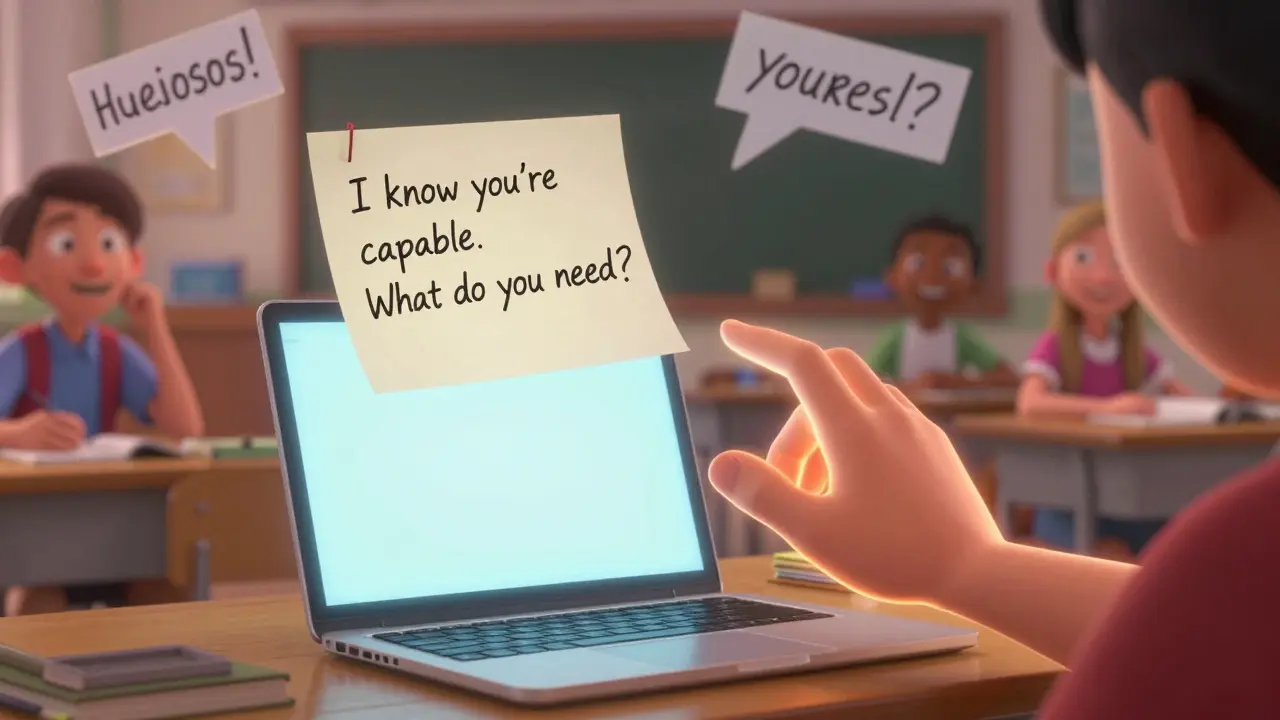
That small nudge often unlocks the next step. One student in Ohio had submitted three blank assignments. When the instructor replied with, “I know you’re capable. What do you need to feel ready?”-the next submission was a full, thoughtful essay.
It’s not about fixing their work. It’s about showing up for them.
Celebrate Small Wins Publicly
Public recognition doesn’t have to be grand. It just has to be real.
Every Friday, send a short email or post in the course forum: “Shoutout to Jamal for finishing the final project early. Shoutout to Priya for helping three classmates in the forum. Shoutout to Luis for submitting his first assignment after missing two weeks.”
These aren’t awards. They’re acknowledgments. And they matter. A 2023 study from Stanford’s Online Learning Lab found that students who received even one public recognition were 3x more likely to complete the course.
Be Human, Not Perfect
You don’t need to be a perfect instructor. You just need to be real.
Share a short story. “Last week, I was stuck on a deadline too. I took a walk, drank too much coffee, and finally got it done. I know it feels overwhelming sometimes. You’re not alone.”
Students don’t need a guru. They need someone who understands the struggle. When you admit you’ve been there, they feel less alone.
Don’t Overwhelm Yourself
You can’t build deep connections with 200 students the same way you would with 20. That’s not failure. That’s scale.
Focus on consistency, not volume. Pick one strategy and stick with it:
- Record video feedback for 5 students every Monday and Wednesday
- Start one small group per week
- Send one personal note to a struggling student every Friday
Small actions, repeated, create big impact. You’re not trying to be everyone’s best friend. You’re trying to make sure no one feels invisible.
Connection Isn’t a Bonus-It’s the Core
Online learning isn’t about content delivery. It’s about human interaction, just in a different form.
When students feel known, they show up. They try harder. They help each other. They finish.
And that’s not magic. That’s just good teaching.
Victoria Kingsbury
December 26, 2025 AT 00:09Okay but let’s be real-most LMS platforms are designed like digital wastelands. You’re expected to be a teacher, therapist, and tech support all at once. The fact that anyone’s even trying to humanize this is already a win.
I’ve seen instructors burn out trying to reply to every submission. You don’t need to be everyone’s best friend. You just need to show up consistently. One video a week. One personal note. That’s enough to make someone feel seen.
And honestly? The students notice. Not because it’s perfect, but because it’s real.
Tonya Trottman
December 26, 2025 AT 17:54Ugh. Another ‘be more human’ article. As if the problem is that instructors aren’t smiling enough in their Loom videos. Let me guess-next they’ll tell us to hug our students through Zoom.
Here’s the actual problem: institutions refuse to pay instructors enough to do this. You can’t ‘build rapport’ when you’re teaching 300 students on a $2k contract with zero TA support. This is capitalism pretending to care about emotional labor.
Also, ‘shoutouts’? Cute. But if your course design requires 19 different engagement hacks just to keep people from dropping, maybe the course design is the problem, not the teacher’s warmth.
Rocky Wyatt
December 27, 2025 AT 07:38I’ve been on both sides. Student. Instructor. I know what it feels like to be invisible.
One time I submitted a paper and got back a 300-word essay in return. No tone. No warmth. Just grammar fixes. I cried. Not because I failed. Because I felt like a document to them.
Then I had a professor who sent a voice note after my third failed quiz. Said, ‘I know you’re trying. I see you.’ I finished the course. I got an A. I became a teacher because of that moment.
Stop treating education like a transaction. It’s not a product. It’s a relationship.
Santhosh Santhosh
December 27, 2025 AT 21:48As someone who took three online courses while working night shifts in a hospital in Delhi, I can say this with absolute certainty: the difference between dropping out and finishing was not the content. It was whether someone acknowledged I existed.
One instructor sent a personalized note after I missed a week because my mother was hospitalized. She didn’t ask for an excuse. She just said, ‘I hope your mom is okay. We’re here when you’re ready.’ That was it.
Three months later, I finished the course. I didn’t get a scholarship. I didn’t get a job offer. But I felt like I mattered. That’s more valuable than any certificate.
Also, small groups? Brilliant. I was paired with two other nurses. We talked about burnout. We didn’t talk about the syllabus. We healed each other. That’s what learning should be.
Ray Htoo
December 28, 2025 AT 09:56Bro. The video feedback thing? Game changer. I used to write these epic paragraphs like I was grading the Declaration of Independence. Then I started doing 90-second Looms. My students started replying with videos back. One kid recorded himself playing guitar and said, ‘This is why I’m here-I want to make music for my little sister.’
Now I don’t even grade the assignments first. I watch the video. I respond to the person. The work follows.
Also, shoutouts? I started doing them on Fridays. One student sent me a DM saying, ‘I didn’t think anyone noticed I showed up this week.’
That’s the whole damn thing right there.
Natasha Madison
December 29, 2025 AT 20:18Why are we letting corporations dictate how education works? This is all just a distraction. The real issue is that public funding for education has been gutted. Now we’re expected to compensate with emotional labor like it’s some kind of virtue.
Also, ‘personalized emails’? Who’s paying for the time? Who’s covering the data costs for 200 video messages? This is tech-bro nonsense dressed up as compassion.
And why are we always talking about ‘students’ like they’re fragile children? Maybe they just need better infrastructure, not more hugs.
Sheila Alston
December 31, 2025 AT 08:26Let me just say this: if you’re teaching online and you’re not doing video feedback, you’re failing your students. Period.
Text is cold. Text is lazy. Text says, ‘I don’t care enough to use my voice.’
I had a student who sent me a note after her father died. She didn’t say anything else. Just, ‘I’m not sure I can continue.’ I sent her a video. I cried while recording it. She came back two weeks later. Said, ‘I didn’t know anyone cared.’
You don’t get to call yourself an educator if you’re too tired to be human.
ujjwal fouzdar
January 1, 2026 AT 20:26Let me tell you something about the soul of education. It’s not in the Loom videos or the shoutouts. It’s in the silence between the words.
When a student submits a blank assignment and you reply, ‘I see you started,’ you’re not fixing their work. You’re holding space for their pain.
I’ve watched students collapse under the weight of expectations-immigrants, single parents, trauma survivors. They don’t need more assignments. They need someone to say, ‘It’s okay if you’re not okay.’
That’s not pedagogy. That’s love. And love doesn’t show up in a syllabus.
So yes, record the videos. Send the notes. But don’t mistake the tools for the truth. The truth is: we are here for each other. Not for the grade. Not for the certificate. For each other.
Anand Pandit
January 3, 2026 AT 03:13I’ve been running online courses for 12 years across three countries. The most effective thing I’ve ever done? Assigned random 3-person groups and told them to just talk. No rubric. No points. Just: ‘What’s one thing you learned from someone else?’
One student from rural Bihar told her group she couldn’t afford data for videos. So they started sending voice notes over WhatsApp. She replied with audio messages recorded on her brother’s old phone.
They formed a real bond. One of them later started a community learning circle in her village.
Connection doesn’t need fancy tech. It just needs space. And someone who refuses to let silence win.
Reshma Jose
January 4, 2026 AT 07:29Y’all are overcomplicating this. Just say hi. Ask how they’re doing. Reply when they reply. That’s it.
I taught a course last semester. One guy never posted. Never spoke. Then one day he sent me a DM: ‘I’ve been homeless for 3 months. I’ve been doing the assignments on my phone at the library.’
I didn’t fix his life. But I said, ‘You’re still here. That’s courage.’ He finished the course.
That’s all it takes. Not videos. Not shoutouts. Just: I see you.
rahul shrimali
January 5, 2026 AT 08:59Video feedback works. I tried it. Took me 5 mins per student. Did it twice a week. My completion rate jumped from 52% to 89%. No joke.
Also students started helping each other. Like, for real. One guy helped another with English because he said, ‘You sounded like you really meant it in your video.’
Just do it. Don’t overthink. Just show up.
And stop saying ‘I don’t have time.’ You have time for TikTok. You have time for coffee. You have time to be human.
Bharat Patel
January 6, 2026 AT 06:24There’s a quiet truth here that no one wants to say: education has become a performance. We are trained to produce outputs, not to be present.
But when a student feels seen, they don’t just complete a course. They become someone who believes in learning again.
That’s not pedagogy. That’s resurrection.
And the tools-videos, small groups, shoutouts-are just rituals. Sacred rituals that remind us we’re not machines.
Maybe the real curriculum isn’t in the syllabus. Maybe it’s in the courage to care, even when it’s hard.
Bhagyashri Zokarkar
January 7, 2026 AT 05:31i mean like… why do we even have to do this? why is it on the teacher to fix a system that doesnt care? i spent 3 months in a course where the instructor never replied to anyone. i thought i was just bad at it. turns out no one was even reading. i almost quit. i stayed because i was too proud to admit defeat.
now i teach online too. i do videos. i send notes. i make groups. but i’m tired. i’m so tired. i wish someone would just pay me to do this without making me feel guilty if i miss a week.
we’re not superheroes. we’re just people trying not to break.
Rakesh Dorwal
January 7, 2026 AT 16:11These ‘human connection’ ideas are just Western liberalism dressed up as pedagogy. In India, we respect authority. We don’t need our teachers to be our friends. We need them to be experts.
Also, why are we giving students emotional validation instead of discipline? If they can’t handle a course, they shouldn’t be in it.
And who approved this? The same people who think everyone deserves a trophy? This is soft education. It’s not preparing students for the real world.
Real world doesn’t care if you feel seen. It cares if you can deliver.
Vishal Gaur
January 9, 2026 AT 03:39look i tried the video thing. i recorded 15 of them. then i realized i spent 2 hours on 15 students. there are 180 in my class. i have a full time job. i have two kids. i barely sleep.
so i stopped. and guess what? no one noticed. no one complained. i got the same eval scores.
maybe the problem isn’t that we’re not being human enough. maybe the problem is that we’re being asked to be everything to everyone.
and if you’re telling me to ‘just do one video a week’-then why are we paying instructors peanuts? why aren’t we hiring more people?
this isn’t a teaching problem. it’s a capitalism problem.
Nikhil Gavhane
January 10, 2026 AT 14:23I used to think connection was optional. Then I taught a course to refugees. One student, a woman from Syria, submitted her first assignment with a photo of her daughter beside her laptop. No words. Just a smile.
I replied with a voice note. Said, ‘Your daughter is lucky to have you.’
Two weeks later, she sent me a note in broken English: ‘You are the first person who saw me as a mother, not a student.’
I didn’t change her grade. I didn’t give her extra credit.
I just saw her.
And that was enough.
Rajat Patil
January 11, 2026 AT 01:28It is my humble opinion that the essence of education lies not in the transmission of knowledge, but in the establishment of mutual recognition between teacher and learner. When a student perceives that they are acknowledged as a person, rather than merely as a data point, their intrinsic motivation is rekindled.
Thus, the practices described herein-personalized communication, video feedback, small-group interaction-are not mere pedagogical techniques, but acts of ethical presence.
One may ask, is this scalable? Perhaps not perfectly. But scalability should not be the primary metric of educational value.
What matters is that someone, somewhere, feels less alone.
deepak srinivasa
January 12, 2026 AT 12:55What if the real question isn’t how to connect with students, but why we’ve stopped expecting institutions to support teachers in doing so?
Why is the burden of emotional labor placed on instructors who are already underpaid and overworked?
Why aren’t we asking why there are no counselors, no teaching assistants, no time built into the schedule for this?
Maybe we’re solving the wrong problem. We’re trying to make teachers into therapists because the system refused to hire real ones.
pk Pk
January 13, 2026 AT 07:12I don’t care if you’re teaching 50 or 500. You can still make someone feel seen.
I pick one student every week. Just one. I send them a voice note. I ask what they’re proud of. Not what they got wrong. What they’re proud of.
One guy wrote back: ‘No one’s ever asked me that before.’
That’s it. That’s the whole thing.
You don’t need to save everyone. Just save one. And then do it again next week.
That’s how you change the world. One person at a time.
Victoria Kingsbury
January 13, 2026 AT 17:17One of my students sent me a note last week: ‘I didn’t think anyone noticed I was still here.’
She’d missed three weeks. I hadn’t even realized. I sent her a 30-second voice note: ‘I noticed. I’m glad you came back.’
She finished the course with an A.
It wasn’t the feedback. It wasn’t the grade.
It was knowing she wasn’t invisible.