How to Collect and Analyze Qualitative Data for Better Course Design
 Jun, 23 2026
Numbers tell you what happened. They show you drop-off rates, quiz scores, and completion percentages. But they never tell you *why* a student clicked away from Module 3 or why half the class struggled with that one specific concept. That’s where qualitative data steps in. It captures the messy, human side of learning-the confusion, the 'aha' moments, and the friction points that spreadsheets miss entirely.
If you’re designing courses, whether for corporate training, university modules, or online platforms, ignoring qualitative insights is like driving with your eyes closed. You might know how fast you’re going, but you have no idea if you’re heading toward a cliff. This guide breaks down exactly how to gather these stories and turn them into actionable improvements for your curriculum.
Why Qualitative Data Matters in Course Analytics
We live in an era obsessed with metrics. Dashboards are filled with Key Performance Indicators (KPIs) like Net Promoter Scores (NPS) and average time-on-page. These are useful, sure. But consider this: a student might spend ten minutes on a video lecture. The quantitative data says "engagement." The qualitative reality? They were stuck on a broken link and couldn’t move forward.
Qualitative data is non-numerical information that provides context, meaning, and depth to user behavior. In the context of course analytics, it includes open-ended survey responses, interview transcripts, discussion forum posts, and even notes from observing students interact with the material.
When you combine this with hard numbers, you get a complete picture. You stop guessing and start understanding. For example, knowing that 40% of users quit at the payment page is alarming. Knowing they quit because the form asked for unnecessary personal details is solvable. That shift from observation to insight is the power of qualitative research.
Choosing Your Collection Methods
You don’t need a PhD in sociology to collect good qualitative data. You just need to pick the right tools for the job. Different methods reveal different layers of the student experience. Here are the most effective approaches for course creators:
- Open-Ended Surveys: Instead of just asking "Did you like the course?" add a text box that asks "What was the most confusing part of this module?" Keep it simple. People won’t write essays, but a few sentences can save your next iteration.
- One-on-One Interviews: Talk to five students who finished the course and five who dropped out. Ask them to walk you through their journey. You’ll hear hesitations and frustrations that surveys miss. This method is labor-intensive but yields high-value insights.
- Discussion Forums and Chat Logs: If your course has a community aspect, mine those conversations. Look for recurring questions. If ten people ask how to install the same software, your instructions are unclear. This is passive data collection that requires zero extra effort from the learner.
- Think-Aloud Protocols: Watch a student take the course while they speak their thoughts out loud. Do they click buttons randomly? Do they sigh when reading a paragraph? This observational method reveals usability issues in real-time.
The key is variety. Relying on only one source creates blind spots. A student might rate a video highly in a survey but complain about its pacing in a forum post. Cross-referencing these sources gives you credibility in your findings.

Turning Text Into Insights: Thematic Analysis
Collecting data is the easy part. Making sense of hundreds of paragraphs of feedback is where most educators get stuck. You can’t just read through everything once and hope something clicks. You need a structured approach called Thematic Analysis, which is a method for identifying, analyzing, and reporting patterns (themes) within data.
Here is a practical step-by-step process to analyze your qualitative data without getting overwhelmed:
- Familiarize Yourself: Read through all the responses multiple times. Immerse yourself in the data. Don’t try to code yet; just absorb the tone and content.
- Generate Initial Codes: Go through the data line by line. Highlight interesting features and give them a short label. For example, if a student says, "The audio was too quiet," code it as "Audio Quality Issue." If another says, "I couldn't hear the instructor clearly," code that as "Audio Clarity."
- Search for Themes: Look at your codes. Group similar ones together. "Audio Quality Issue" and "Audio Clarity" both fall under the broader theme of "Technical Audio Problems."
- Review and Refine Themes: Check if your themes work in relation to the coded extracts and the entire dataset. Does the theme capture something important? If a theme feels forced or vague, split it or merge it with another.
- Name and Define Themes: Give each theme a clear, concise name. Write a brief description of what the theme entails. For instance, "Theme: Navigation Confusion - Students struggle to find the quiz section due to non-intuitive menu labels."
This process transforms raw noise into structured intelligence. Instead of saying "students had issues," you can now say "60% of negative feedback relates to navigation confusion in the second module." That is a problem you can fix.
Common Pitfalls to Avoid
Even experienced analysts make mistakes when handling qualitative data. Being aware of these traps will keep your insights honest and useful.
| Pitfall | Why It Happens | How to Fix It |
|---|---|---|
| Confirmation Bias | You only notice feedback that supports what you already believe. | Actively look for evidence that contradicts your assumptions. Ask a colleague to review the coding. |
| Small Sample Size | Relying on three comments to change a whole course structure. | Aim for saturation. Keep collecting data until new responses stop revealing new themes. |
| Vague Questions | Asking "How was it?" leads to generic answers like "Good." | Ask specific questions: "Which slide was hardest to understand?" |
| Ignoring Context | Taking a comment out of context changes its meaning. | Always read the full response before coding. Note the student's background if relevant. |
Another major error is treating qualitative data as subjective opinion rather than objective fact. When ten students independently describe the same interface element as "confusing," that is not an opinion; it is a usability defect. Respect the pattern, not just the individual voice.
Tools to Simplify the Process
You don’t need expensive software to start, but as your course grows, manual coding becomes tedious. Several tools can help automate parts of the thematic analysis process.
For basic collection, Typeform or Google Forms allow you to create engaging surveys with logic jumps. If you want deeper insights, consider using AI-assisted analysis tools. Platforms like NVivo are industry standards for academic research, offering robust coding capabilities. However, they have a steep learning curve.
For course creators who want speed, modern LMS (Learning Management System) plugins often include sentiment analysis. These tools use Natural Language Processing (NLP) to automatically tag feedback as positive, negative, or neutral. While not perfect, they can help you prioritize which comments to read first. Always verify AI-generated tags manually, as nuance is often lost in automation.
From Insight to Action: Closing the Loop
Data gathering is pointless if it doesn’t lead to change. Once you’ve identified your themes, map them directly to course elements. Create a simple action plan:
- Theme: Content Overload in Week 2.
- Evidence: 15 students mentioned feeling overwhelmed by the volume of readings.
- Action: Split the Week 2 module into two smaller chunks. Add a summary infographic.
- Verification: Re-survey students in the next cohort to see if the stress level decreases.
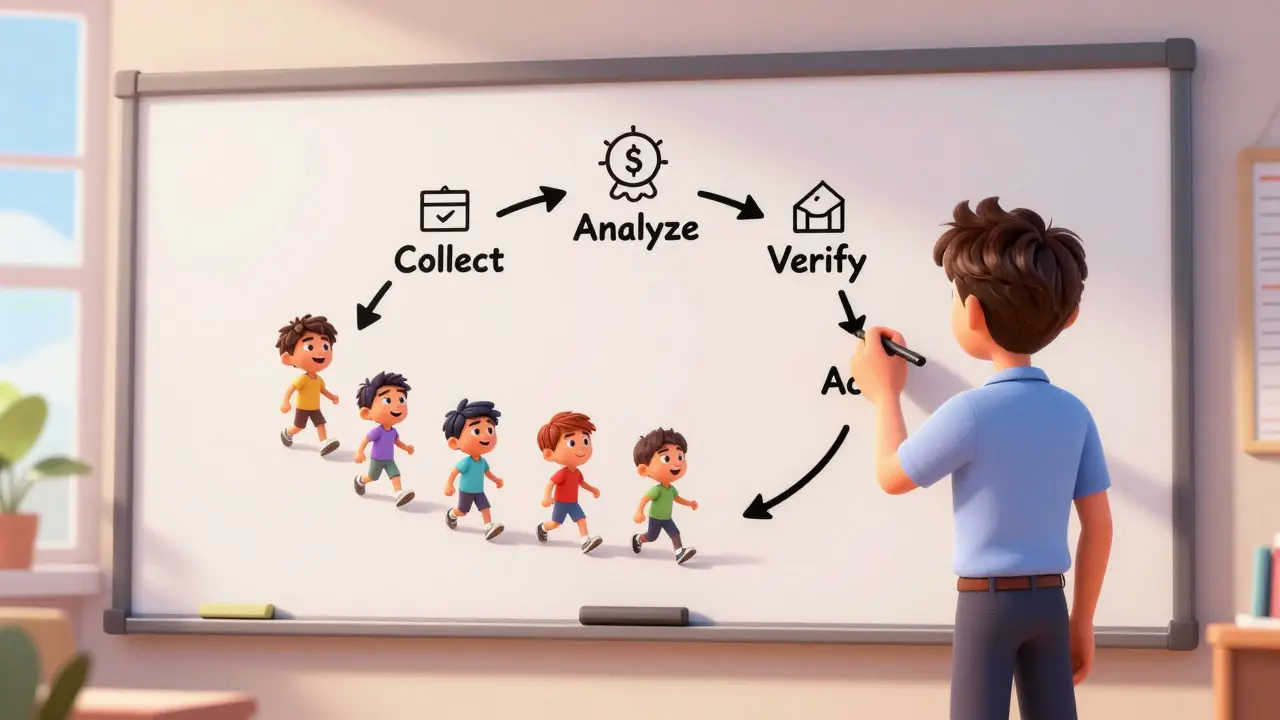
This cycle-collect, analyze, act, verify-is the heartbeat of continuous improvement. It turns your course from a static product into a living system that adapts to learner needs. By valuing the stories behind the scores, you build trust with your audience and significantly boost completion rates. After all, people stay engaged when they feel heard.
How much qualitative data do I need to collect?
There is no fixed number, but aim for "data saturation." This occurs when you stop seeing new themes or ideas in your responses. For small courses, 20-30 detailed responses might be enough. For larger programs, you may need 100+ interviews or survey entries to ensure you capture diverse perspectives.
Can I use AI to analyze qualitative feedback?
Yes, AI tools can help categorize large volumes of text quickly. However, AI often misses sarcasm, cultural nuances, or complex emotions. Use AI for initial sorting and tagging, but always have a human review the results to ensure accuracy and context.
What is the difference between qualitative and quantitative course data?
Quantitative data deals with numbers and statistics (e.g., test scores, completion rates). Qualitative data deals with words, meanings, and experiences (e.g., student comments, interview transcripts). Quantitative tells you *what* is happening; qualitative tells you *why*.
How do I handle negative feedback in qualitative analysis?
Treat negative feedback as valuable gold. It highlights specific pain points. Instead of dismissing it, group negative comments by theme to identify systemic issues. Address these in your course updates and communicate back to students that their input led to changes.
Is thematic analysis difficult to learn?
It requires practice but is accessible to beginners. Start with small datasets. Focus on consistency in your coding. Many online resources and tutorials provide step-by-step guides. The key is patience and attention to detail.