How to Use Gamification to Create Engaging Learning Activities
 Apr, 21 2026
Key Takeaways for Educators
- Gamification is the application of game-design elements in non-game contexts to improve motivation.
- Focus on intrinsic rewards (mastery, autonomy) over extrinsic ones (points, badges).
- Progress loops and immediate feedback are the primary drivers of learner persistence.
- Avoid 'pointsification'-adding points to a boring task doesn't make it an engaging activity.
The Psychology of Why Games Work
Why can a teenager spend an entire weekend mastering a complex boss fight in a game but struggle to read a ten-page chapter on history? It comes down to the Dopamine Loop is a neurological reward system that triggers a feeling of pleasure when a goal is achieved or a reward is received . In a traditional classroom, the reward (a grade) is delayed by weeks. In a game, the reward is instant. You kill a monster, you get gold. You solve a puzzle, you unlock a door.
To make learning engaging, we need to move toward Intrinsic Motivation is the drive to engage in an activity because it is inherently rewarding or satisfying, rather than for an external reward . When a learner feels a sense of competence and autonomy, they stop asking "Will this be on the test?" and start asking "How do I solve this?" This shift happens when we implement a clear progression system where the challenge perfectly matches the learner's skill level-a state often called "Flow."
Core Game Mechanics to Integrate
You don't need a fancy app to gamify a lesson. You just need to apply specific mechanics. Think of these as the building blocks of engagement. The most common mistake is focusing only on points, but true engagement comes from the structure of the activity.
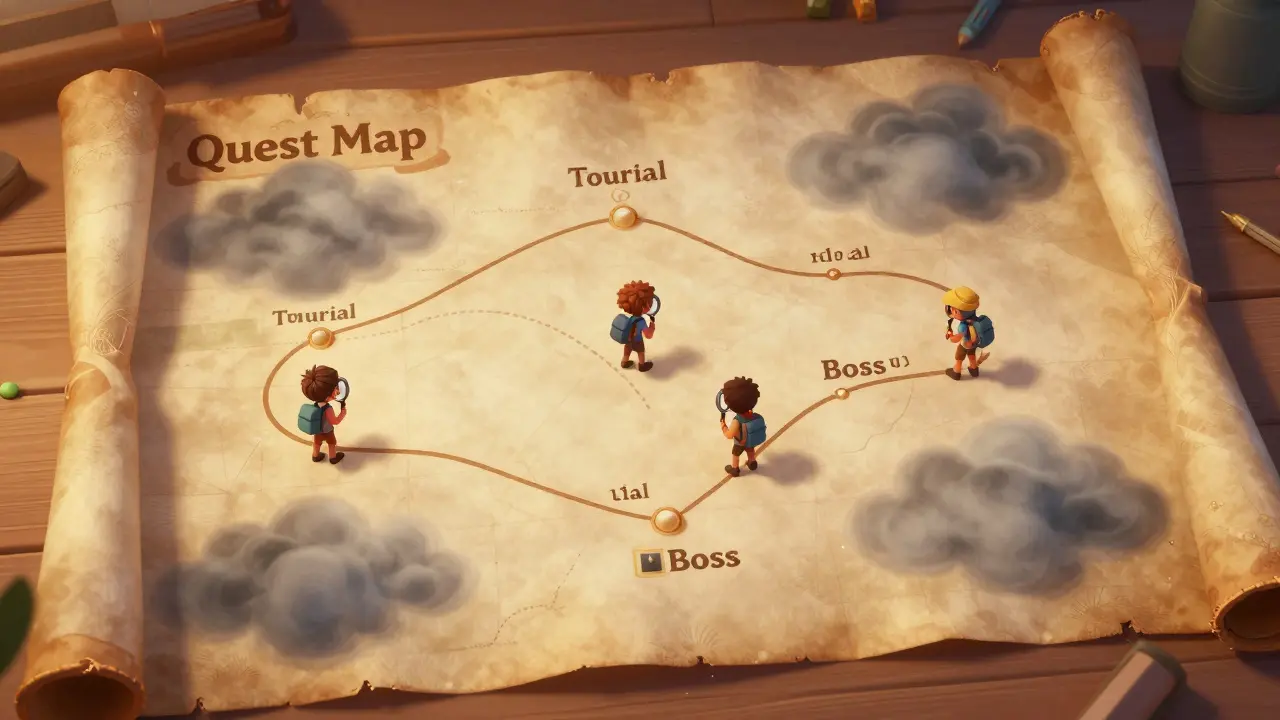
- Progression Bars: Instead of a syllabus, create a "Quest Map." Seeing a visual representation of how far they've come and what's left to unlock creates a psychological urge to complete the set.
- Immediate Feedback: In a game, if you jump off a cliff, you die instantly. You don't wait three weeks for a red pen to tell you that you jumped incorrectly. Use digital quizzes or peer-review systems that give a "Correct/Incorrect" signal immediately.
- Scaffolding (Leveling Up): Start with a "Tutorial Level"-a task so simple it's impossible to fail. Once they succeed, increase the difficulty slightly. This keeps the learner in the optimal zone between boredom and anxiety.
- Narrative Framing: Instead of "Unit 4: The Industrial Revolution," call it "The Great Urban Migration: Survival in the Smoke." Give the learners a role-they aren't students; they are investigators, architects, or diplomats.
| Feature | Traditional Approach | Gamified Approach | Impact on Learner |
|---|---|---|---|
| Feedback | Delayed (Graded papers) | Instant (XP, Badges, Alerts) | Faster correction of errors |
| Failure | Punitive (Lower Grade) | Iterative (Try Again) | Increased risk-taking |
| Structure | Linear (Page 1 to 100) | Non-linear (Unlockable Paths) | Higher sense of autonomy |
| Goal | Completion (Pass/Fail) | Mastery (Level Up) | Focus on skill acquisition |
Designing the 'Quest' for Your Learners
If you want to build an activity that actually sticks, stop thinking about "lessons" and start thinking about "missions." A well-designed learning mission consists of a clear goal, a set of constraints, and a reward for completion. Let's look at how to build this using Instructional Design is the practice of creating instructional experiences which make the acquisition of knowledge and skill more efficient, effective, and appealing principles.
- Define the Win Condition: What exactly does success look like? Instead of saying "Understand the water cycle," make the win condition "Create a working model that moves water through three distinct states."
- Introduce 'Fog of War': In strategy games, you can't see the whole map at once. Do the same with your content. Give them the basic tools, and only reveal the complex problems once they've proven they can handle the basics. This prevents learners from feeling overwhelmed.
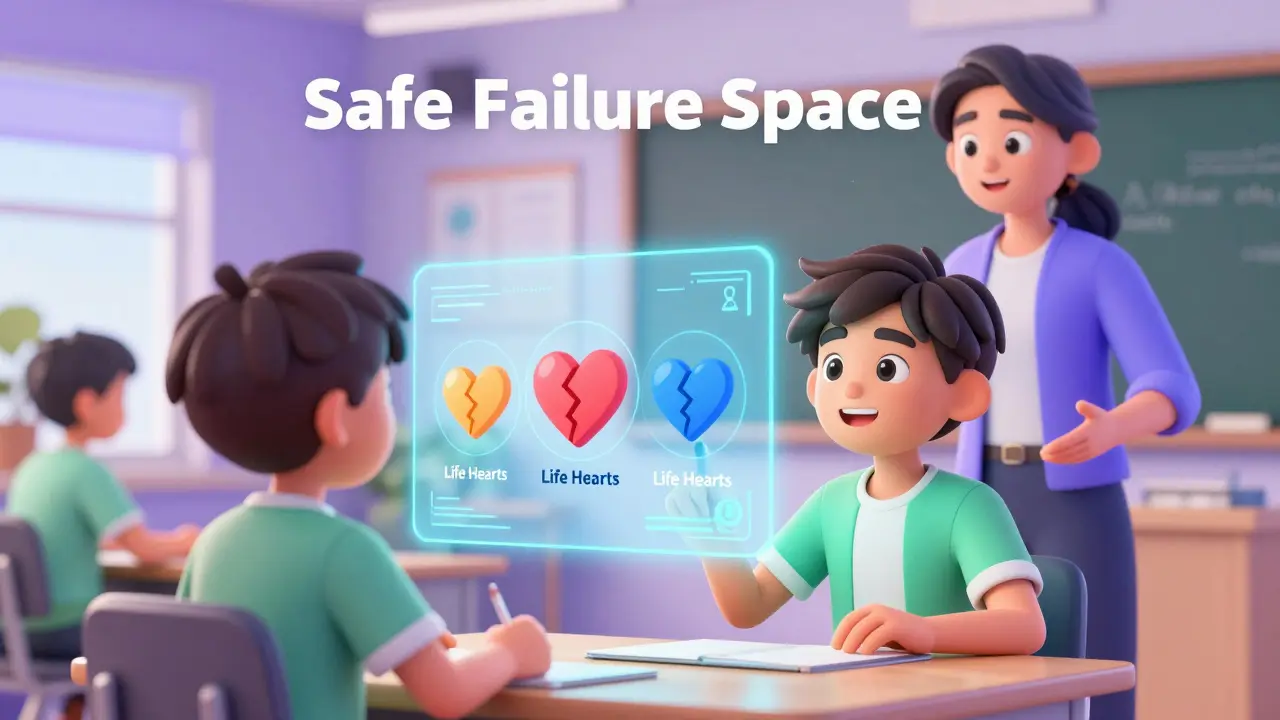
- Create a Safe Failure Space: The magic of games is that you can fail and restart. Implement "Life Hearts" or "Retry Tokens." Let students attempt a difficult problem three times before they have to ask for help. This removes the fear of being "wrong" and encourages experimentation.
- Implement Peer Competition and Collaboration: Use Leaderboards are visual rankings that display the top performers in a given activity to foster competition cautiously. While some love the spotlight, others are intimidated by it. Instead, use "Team Leaderboards" where students work in squads. This encourages the high-performers to coach the struggling students so the whole team rises.
Common Pitfalls: Avoiding 'Pointsification'
There is a dangerous trend called "pointsification." This is when an educator takes a boring worksheet and simply adds a point value to each question, calling it "gamification." This doesn't work because you haven't changed the activity; you've just added a layer of bookkeeping. If the core task is tedious, a digital badge won't make it exciting.
To avoid this, focus on the experience, not the reward. Ask yourself: Is the learner making choices? Is there a sense of discovery? Is there a tangible connection between the effort they put in and the progress they see? If the answer is no, you aren't gamifying; you're just grading with fancy names.
Scaling Gamification with Technology
While low-tech gamification (like stickers or quest maps) is great, Learning Management Systems (LMS) are software applications for the administration, documentation, tracking, report, and delivery of educational courses can automate the heavy lifting. Many modern platforms allow you to set up "Conditional Release" logic. For example, a student cannot access "The Advanced Alchemist's Guide" (Unit 3) until they have passed the "Basic Potion Quiz" (Unit 2) with a score of 80% or higher.
You can also integrate Educational Software is computer programs designed specifically to enhance the learning process through interactive and adaptive methods tools like Quizizz or Kahoot, which use music, timers, and competitive rankings to turn a review session into a high-energy event. The key is to use these as "spice," not the main course. The real learning happens when the game mechanics lead the student toward a deep dive into the subject matter.
Does gamification distract students from actual learning?
Only if the game elements are disconnected from the learning objectives. If students are focusing on winning the game rather than mastering the concept, you have a design flaw. The game mechanic should be a vehicle for the content, not a replacement for it. For example, a badge should be awarded for solving a complex problem, not just for clicking through a series of slides.
How do I gamify a subject that is naturally "dry"?
Shift the focus to a narrative or a mystery. If you're teaching accounting, don't just teach balance sheets; tell the students they are forensic accountants trying to find a missing million dollars in a company's books. By adding a "mission" and a goal, you create a reason for the students to master the dry tools required to solve the mystery.
What is the best way to handle students who are not competitive?
Move away from individual competition and toward collective goals or personal bests. Implement "Community Goals" where the entire class earns a reward if everyone reaches a certain level of proficiency. Alternatively, allow students to compete against their own previous scores, emphasizing growth over ranking.
Can gamification work for adult learners or professional training?
Absolutely. In professional development, this is often called "Simulation-Based Learning." Adults respond well to scenarios where they can test their decisions in a risk-free environment. Instead of a compliance presentation, give them a series of "What would you do?" branching scenarios where their choices lead to different organizational outcomes.
Do badges and points actually increase long-term retention?
Points and badges are "extrinsic motivators," which provide a short-term boost. For long-term retention, you must transition to "intrinsic motivators." Use the points to get them through the door, but ensure the activity itself provides a sense of mastery and autonomy. The badge is the trophy, but the skill is the real prize.
Next Steps for Implementation
If you're feeling overwhelmed, don't try to turn your entire curriculum into an RPG overnight. Start small. Pick one unit or one specific activity and apply a single game mechanic. Maybe start with a "Quest Map" for your next project or introduce a "Retry Token" for your most difficult quiz.
Once you see how your students respond, observe where they struggle. If they are bored, increase the challenge. If they are frustrated, add more scaffolding. The goal is to act as a "Game Master" for your classroom-constantly tweaking the environment to ensure that the path to success is challenging, yet achievable.
mark nine
April 23, 2026 AT 00:34tried the quest map thing with my middle schoolers last year and it actually worked
the key is keeping the map physical on the wall so they can see it every day
Scott Perlman
April 24, 2026 AT 08:48this is great
Ian Maggs
April 24, 2026 AT 15:19One must wonder... if we reduce education to a series of dopamine hits, do we lose the capacity for deep, silent contemplation??? The struggle itself is where the growth resides, is it not!!!
Flannery Smail
April 26, 2026 AT 09:20not sure about the whole narrative framing thing. sounds like a lot of extra work for the teacher just to put a fancy name on a boring lesson. a name change doesnt magically make a worksheet interesting
Eva Monhaut
April 27, 2026 AT 16:21The idea of a safe failure space is absolutely luminous. It transforms the classroom into a vibrant laboratory where students feel emboldened to dance with their mistakes. I've seen a dazzling shift in confidence when the fear of the red pen evaporates and is replaced by the thrill of the retry
Ronnie Kaye
April 28, 2026 AT 19:21oh yeah because adding a 'quest map' is exactly what every burnt-out teacher needs in their life right now. absolutely brilliant. let's just add more administrative overhead to the day and see how that goes
mark nine
April 29, 2026 AT 17:15honestly just a piece of poster board and some markers and youre good to go. not that much extra work
Michael Gradwell
April 30, 2026 AT 19:43most people just dont have the discipline to learn the hard way anymore. we're basically babying them with these game mechanics because nobody wants to put in the real grit it takes to actually master a subject
Emmanuel Sadi
May 2, 2026 AT 05:31Imagine thinking that 'Life Hearts' will fix a systemic failure in curriculum design. It's cute that you think a few tokens will distract them from the fact that the material is fundamentally flawed. Purely aesthetic changes for a crumbling structure
Rakesh Kumar
May 3, 2026 AT 12:59OH MY GOD this is exactly what I needed! I've been trying to make my history classes more exciting and the 'Forensic Accountant' idea is just genius! I can literally see my students' eyes lighting up already! This is a total game changer for my teaching style!
Bill Castanier
May 4, 2026 AT 07:12The focus on intrinsic motivation is spot on. It creates a sustainable path for lifelong learners.
Tony Smith
May 5, 2026 AT 10:31I find it utterly quaint that we must dress up basic knowledge as a diversion to ensure a student's attention. Truly, we are living in a golden age of educational sophistication where a 'badge' is the only currency that holds value in a child's mind
Priyank Panchal
May 6, 2026 AT 06:42This post is just fluff. Stop trying to make everything a game. Some things are just hard and you have to do them without a reward. Get over yourselves.
Nicholas Carpenter
May 7, 2026 AT 02:34It is definitely worth trying the 'Retry Tokens' approach. It allows students to build resilience and learn from their mistakes in a supportive way. Small changes often lead to the biggest breakthroughs in a student's journey