HVAC and Mechanical Systems Training: Course Outline
 Sep, 21 2026
Think about the last time your office AC broke down in July. You didn’t just want someone to show up; you wanted someone who understood HVAC is a complex integration of thermodynamics, electrical engineering, and fluid mechanics. That’s exactly what modern HVAC and Mechanical Systems Training aims to teach. It’s not just about swapping filters anymore. The industry has shifted toward smart controls, high-efficiency heat pumps, and rigorous environmental regulations. If you’re looking to enter this field or upgrade your skills, you need a roadmap that cuts through the noise.
The Core Foundation: Thermodynamics and Psychrometrics
You can’t fix what you don’t understand. Most entry-level failures happen because technicians skip the physics. A solid course outline starts here. You’ll spend the first few weeks mastering how air holds moisture and how refrigerants change state. This isn’t abstract theory; it’s the difference between a system that cools effectively and one that freezes its own coils.
Key topics include:
- Psychrometric Charts: Learning to read humidity, dry-bulb, and wet-bulb temperatures to calculate load requirements.
- Refrigeration Cycle: Understanding compression, condensation, expansion, and evaporation phases.
- Heat Transfer Methods: Conduction, convection, and radiation within ductwork and building envelopes.
Without this base, troubleshooting becomes guesswork. With it, you diagnose issues by looking at pressure readings and temperature differentials before you even touch a wrench.
Electrical Systems: The Nervous System of HVAC
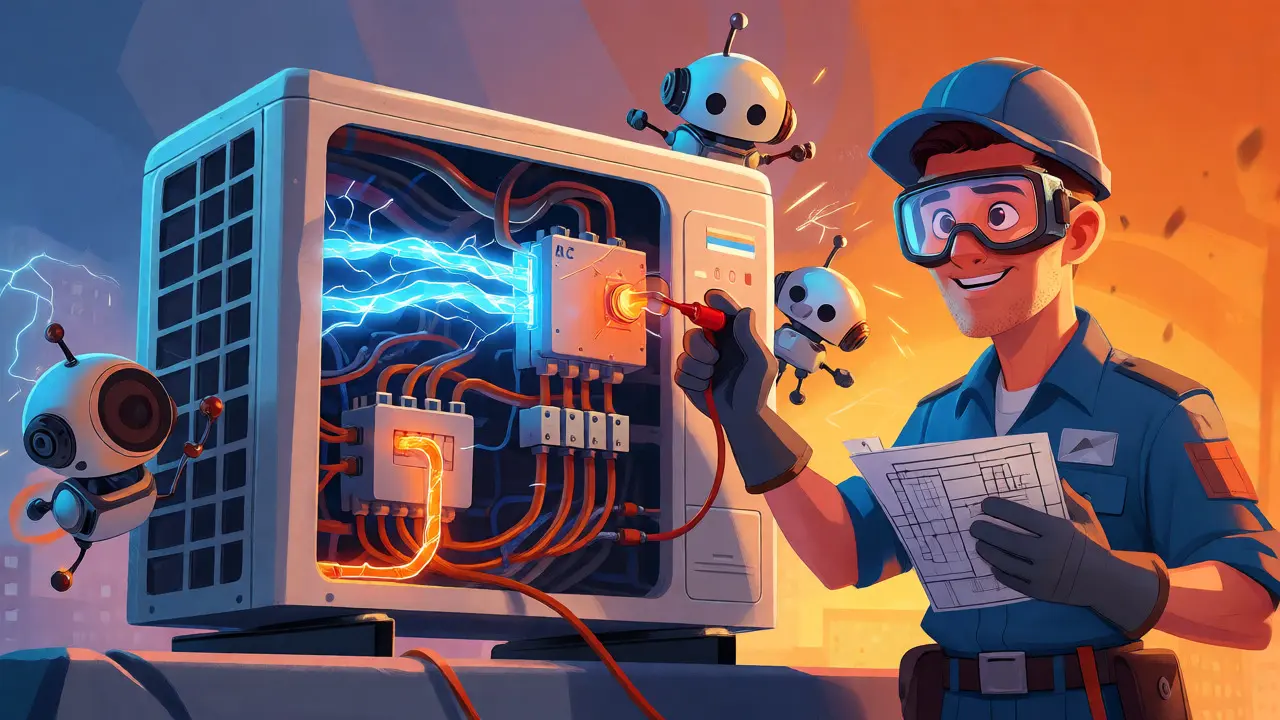
Here’s where many students hit a wall. HVAC is 50% mechanical and 50% electrical. If you can’t read a schematic, you’re flying blind. Modern units use low-voltage control circuits to manage high-voltage power loads. A comprehensive training program dedicates significant hours to AC and DC circuitry.
You’ll learn to use multimeters and clamp meters safely. More importantly, you’ll decode wiring diagrams for residential split systems and commercial rooftop units. Common pitfalls like short cycling, failed capacitors, and relay chatter are diagnosed electrically, not mechanically. Expect hands-on labs where you trace circuits from the thermostat to the compressor contactor.
Heating Technologies: From Furnaces to Heat Pumps
Gone are the days when every home had a simple gas furnace. Today’s heating systems range from traditional natural gas furnaces to advanced geothermal heat pumps. Your course outline must cover the maintenance and repair of each type.
For combustion systems, focus shifts to safety. You’ll test for carbon monoxide leaks, check burner efficiency, and inspect heat exchangers for cracks. For electric resistance heating, you’ll look at element continuity and airflow restrictions. But the real growth area is heat pumps. These systems move heat rather than generating it, requiring a deeper understanding of reversing valves and defrost cycles.
| System Type | Primary Fuel/Energy Source | Complexity Level | Common Failure Points |
|---|---|---|---|
| Gas Furnace | Natural Gas / Propane | Moderate | Igniter failure, heat exchanger cracks |
| Air-Source Heat Pump | Electricity | High | Reversing valve stuck, defrost board faults |
| Boiler (Hydronic) | Natural Gas / Oil | High | Circulator pump failure, zone valve leaks |
| Electric Resistance | Electricity | Low | Element burnout, limit switch trips |
Ventilation and Indoor Air Quality (IAQ)
Post-pandemic, ventilation isn’t an afterthought-it’s a primary service line. Clients now demand better air quality. Training modules on IAQ cover filtration standards like MERV ratings, ultraviolet (UV) light systems, and energy recovery ventilators (ERVs).
You’ll learn to measure static pressure in ducts to ensure adequate airflow. Poor ventilation leads to mold growth and sick building syndrome. Technicians trained in IAQ can recommend upgrades that reduce allergens and pathogens. This knowledge positions you as a consultant, not just a repair person.
Controls and Automation: Smart Thermostats and BAS
Manual dampers and analog thermostats are disappearing. In their place are digital controls and Building Automation Systems (BAS). A modern course outline includes programming smart thermostats and integrating them with Wi-Fi networks.
For commercial applications, you’ll touch on Direct Digital Controls (DDC). These systems monitor temperature, humidity, and occupancy across large buildings. Troubleshooting these requires software literacy alongside mechanical skill. You might spend a day configuring setpoints on a controller or debugging communication errors between sensors and the main unit.
Commercial vs. Residential: Different Worlds, Same Physics
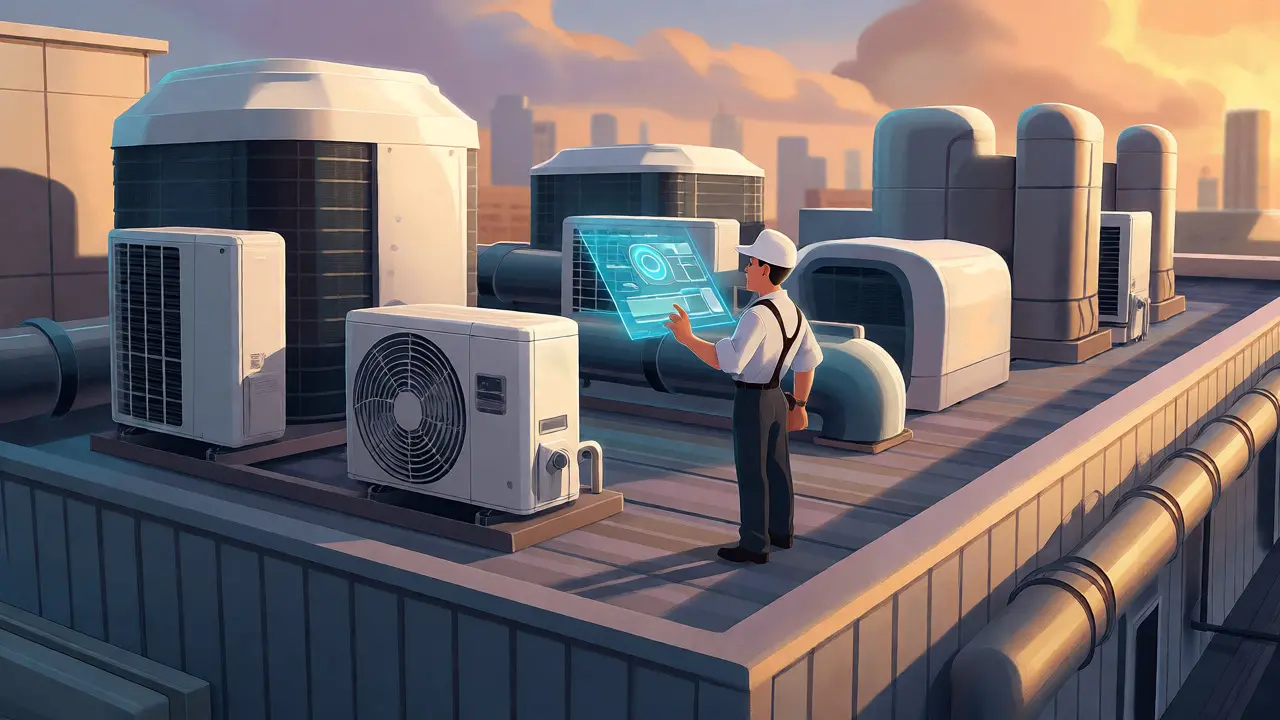
Residential work focuses on comfort and simplicity. Commercial work emphasizes scale, redundancy, and code compliance. Rooftop units (RTUs) are the backbone of commercial HVAC. They combine heating, cooling, and ventilation in one package, often weighing over a ton.
Training for commercial systems introduces larger components: centrifugal fans, belt drives, and variable frequency drives (VFDs). VFDs adjust motor speed to save energy, but they require specialized testing tools. You’ll also deal with complex zoning systems that serve multiple floors or departments. If you plan to work in facilities management, prioritize courses with heavy commercial lab time.
Safety Codes and EPA Certification
You cannot legally handle refrigerants without EPA Section 608 certification. This isn’t optional paperwork; it’s a federal requirement. Your training should prepare you for both Universal and Type II certifications, depending on your career path.
Beyond refrigerants, local building codes dictate installation standards. NEC (National Electrical Code) compliance ensures safe wiring. OSHA guidelines protect you from falls, chemical exposure, and electrical hazards. Always verify that your chosen program aligns with current ASHRAE standards and local jurisdictional rules.
Hands-On Labs: Where Theory Meets Reality
Lectures build knowledge; labs build competence. Look for programs offering access to functional cutaway units, live refrigerant systems, and electrical panels. You need muscle memory for tasks like brazing copper lines, evacuating systems with vacuum pumps, and charging refrigerant by weight.
Soft skills matter too. How do you explain a $2,000 repair to a homeowner? Role-playing customer interactions helps bridge the gap between technical expertise and client satisfaction. Employers value technicians who can communicate clearly under pressure.
How long does HVAC training take?
Duration varies by credential. Certificate programs typically last 6-12 months, while associate degrees take two years. Apprenticeships combine classroom learning with paid on-the-job training, often spanning 4-5 years.
Do I need a college degree to work in HVAC?
No, a bachelor’s degree is rarely required. Most employers prefer trade school certificates, apprenticeships, or military experience. However, an associate degree can help if you aim for engineering or management roles later.
What is the most important certification for beginners?
EPA Section 608 Universal Certification is mandatory for handling refrigerants. After that, NATE (North American Technician Excellence) exams are highly respected for validating specific skills like air conditioning or heat pumps.
Is math difficult in HVAC training?
You need basic algebra and geometry. Calculations involve ratios, percentages, and simple equations for load calculations and electrical values. It’s practical math, not abstract calculus.
Can I learn HVAC online?
Theory can be learned online, but hands-on skills require physical practice. Hybrid models work best: online lectures combined with weekend workshops or local lab sessions for tool usage and system testing.
Next Steps for Aspiring Technicians
Start by researching accredited local trade schools. Check their job placement rates and employer partnerships. Visit campuses if possible-talk to current students about their lab experiences. If you’re already working, ask your employer about tuition reimbursement or internal mentorship programs.
Remember, HVAC is a lifelong learning field. Technology evolves rapidly, from R-454B refrigerant transitions to AI-driven predictive maintenance. Choose a training path that builds a strong foundation so you can adapt to whatever comes next.
Art HND
September 22, 2026 AT 22:45Most of this is obvious filler. Skip the psychrometrics and just learn to swap capacitors.
Elisabeth Ballet
September 24, 2026 AT 19:55You cannot skip the physics, Art! That foundation is literally what separates a tech from a parts changer.
If you don't understand why the system fails, you'll be back in two weeks charging more for the same problem. The industry is moving too fast for that lazy approach anymore. You need to know your stuff to survive the smart building era.
Brannen Hall
September 26, 2026 AT 17:18Actually, most residential failures are electrical or airflow related, not complex thermodynamic mysteries. I've been doing this for fifteen years and I rarely pull out a psych chart for a standard split system repair. It's mostly about checking voltage drops and static pressure. This outline feels like it was written by someone who has never actually crawled into an attic.
Elizabeth Brooks
September 26, 2026 AT 22:57I agree with Brannen on the practical side but disagree on the training aspect. When i first started we did spend time on those charts and it helped me understand superheat better. Its hard to explain why a system is low charge vs underfilled without that base knowledge. Also dont forget about the new refrigerants coming out soon they have different properties so understanding the basics will help us adapt faster than people who just memorize codes.
Joanna Mucha
September 28, 2026 AT 12:51The reductionist view that HVAC is merely 'swapping filters' ignores the ontological weight of environmental stewardship. We are not just mechanics; we are custodians of atmospheric equilibrium within constructed spaces. To dismiss thermodynamics is to dismiss the very fabric of our existence in these concrete boxes. True mastery requires a philosophical engagement with heat transfer, not just rote memorization of schematics. The soul of the machine lies in its invisible flows.
Bonnie Watt
September 29, 2026 AT 03:53Oh please, spare me the philosophy lecture. Nobody cares about the 'soul of the machine' when their AC is blowing hot air at 2am. We care about getting paid and going home. If you can fix it, you're good. If you need a PhD to change a filter, you're overthinking it. Simple tasks should remain simple.
Sabrina Newland
September 29, 2026 AT 19:55i think both sides have a point here 🤔 maybe its about balance? like you need to know the theory so you dont break things but also be able to work fast because customers are impatient 😅 its tough being in the middle trying to do good work while dealing with budgets and expectations. its definitely not black and white though!
Amara Akbar
September 29, 2026 AT 19:56It is entirely reasonable to seek a balanced perspective, as Sabrina suggests. One must acknowledge that theoretical knowledge serves as the bedrock upon which practical efficiency is built. However, one must also respect the immediate demands of client satisfaction. A technician who understands the 'why' behind a failure is less likely to misdiagnose complex issues. Therefore, investing time in foundational learning is not a waste, but a strategic advantage for long-term career sustainability.
Mark Harvey
October 1, 2026 AT 07:11agreed totally keep practicing those skills dont let anyone tell you otherwise you got this 💪
Onyinyechi Nwosu
October 1, 2026 AT 15:51this is exactly what i needed before starting my apprenticeship next month thank you for breaking it down so clearly no fluff just real talk about what matters in the field
Chandan Singh
October 2, 2026 AT 23:00Technically, the EPA Section 608 certification mentioned is mandatory, but many states require additional licensure which this post glosses over. Furthermore, the distinction between Type II and Universal is critical for commercial technicians handling high-pressure systems. Ignoring local jurisdictional variations can lead to legal liabilities. One must also consider that R-454B transition timelines vary significantly across regions, affecting inventory and tool compatibility. Precision in regulatory compliance is non-negotiable in this trade.
Brenna Gonedrman
October 3, 2026 AT 08:22OMG YES THE MATH IS SCARY BUT ITS ACTUALLY EASY ONCE YOU GET IT!! I WAS SO AFRAID OF ALGEBRA BUT THEN I REALIZED ITS JUST RATIOS AND ITS FINE!!! DONT BE SCARED GUYS ITS TOTALLY DOABLE AND YOU WILL FEEL LIKE A GENIUS WHEN YOU CALCULATE LOADS CORRECTLY!!! ITS AMAZING HOW MUCH BETTER YOU FEEL WHEN YOU KNOW YOUR STUFF!!! GO GET EM TIGERS!!!
Deb Kortyna, MBA
October 4, 2026 AT 07:44While enthusiasm is commendable, Brenna, one must maintain professional decorum in technical discussions. The transition to R-454B refrigerants indeed necessitates rigorous preparation regarding safety protocols and equipment compatibility. It is imperative that aspiring technicians prioritize accredited training programs that adhere to ASHRAE standards. Neglecting these details may result in significant operational inefficiencies and potential safety hazards. Diligence in education yields superior professional outcomes.
Kim Edwards
October 5, 2026 AT 04:27THIS IS DRAMA!!! The industry is CHANGING!!! Smart thermostats are TAKING OVER!!! If you aren't learning BAS you are DYING!!! The old guard is clinging to their wrenches while the future passes them BY!!! Wake up!!! The robots are coming for your jobs unless you learn to code!!! It's terrifying!!! But exciting!!! Mostly terrifying!!!
Zach Loescher
October 5, 2026 AT 23:33I appreciate the passion, Kim, but perhaps the shift isn't quite so apocalyptic. Many facilities still rely heavily on traditional mechanical systems, and the integration of smart controls often happens incrementally rather than all at once. There is value in maintaining a diverse skill set that includes both legacy mechanical knowledge and emerging digital literacy. A calm, measured approach to upskilling might serve technicians better than panic-driven retraining.
Courtney Wagstaff
October 6, 2026 AT 04:14honestly though the IAQ stuff is super underrated right now especially since everyone is worried about mold and viruses after the pandemic its like the golden ticket for upselling services if you know how to talk about it nicely and not scare people to death lol
Susan Cole
October 6, 2026 AT 22:36I prefer to keep my focus on the core mechanical aspects. While IAQ is growing, I find that mastering the fundamental heating and cooling cycles provides a more stable career path. Specializing too early in niche areas can sometimes limit job mobility if market trends shift unexpectedly. Solid fundamentals allow for adaptation regardless of specific product lines.
Savara Gunn
October 7, 2026 AT 12:57you're absolutely right susan foundations are key but dont close yourself off to new opportunities either its okay to explore iaq even if you stick to basics mostly its just about finding what works for you personally no pressure just encouragement 💛
Brandon Olvera
October 7, 2026 AT 14:40Whatever. Just make sure you get your EPA cert. Don't mess around with illegal refrigerant handling. It's a federal offense. Keep it clean, keep it American-made tools where possible, and do the job right. No excuses.
tiffany King
October 8, 2026 AT 19:21This roadmap is such a great resource for anyone feeling overwhelmed! Remember that every expert was once a beginner. Take it one module at a time, celebrate small wins, and don't hesitate to ask for help. The field needs passionate people like you. You've got this! 🌟