International Credential Recognition: How to Get Your Qualifications Recognized Abroad
 Apr, 20 2026
Quick Takeaways
- Credential evaluation is the process of comparing your foreign education to a local standard.
- Professional licensing is separate from degree recognition and often requires additional exams.
- The Hague Apostille is the gold standard for verifying the authenticity of legal documents.
- Digital credentials and blockchain verification are speeding up the recognition process.
The Core of Credential Evaluation
Before you can apply for a job, you need to understand that Credential Evaluation is the process of assessing a foreign degree or certification to determine its equivalency to a domestic qualification. This isn't a simple one-to-one match. An evaluator looks at the accreditation of your school, the number of credit hours you earned, and the specific curriculum you followed. For example, a three-year bachelor's degree from the UK might be viewed differently in the US, where four years is the standard. If you're moving to Canada, you'll likely deal with an agency like the World Education Services (WES), which acts as a bridge between your home country's system and the Canadian labor market.
The process usually falls into two buckets: document-by-document and course-by-course evaluations. A document-by-document review simply confirms that your degree is real and from a recognized school. A course-by-course evaluation is much deeper; it breaks down every single class you took and assigns a local grade equivalent. If you're trying to enter a regulated profession like nursing or accounting, you'll almost always need the latter.
Navigating Professional Licensing and Regulations
Getting your degree recognized is step one, but it doesn't always mean you can start working. For "protected professions," you need Professional Licensing, which is the legal permission granted by a government or professional body to practice a specific occupation. In the US, for instance, a foreign-trained lawyer cannot simply walk into a courtroom. They must either pass a state bar exam or undergo a specific LLM program that bridges the gap between their home country's civil law system and the US common law system.
The friction here often comes from "national standards." Countries like Germany have a very strict system called Anerkennung, where they compare your specific modules against their national vocational standards. If you're missing one specific course on "Environmental Safety" that is required for German engineers, you might be asked to take a bridging course or pass a competency exam before you get your license. This is why it's a mistake to assume a "World Class" university degree automatically bypasses local laws.
| Pathway | What it Proves | Typical Timeline | Best For... |
|---|---|---|---|
| General Evaluation | Degree is legitimate | 2-6 Weeks | General corporate jobs |
| Course-by-Course | Academic equivalency | 1-3 Months | Graduate school admissions |
| Licensing Board Review | Professional competency | 6-24 Months | Doctors, Nurses, Architects |
Dealing with the Paperwork Nightmare
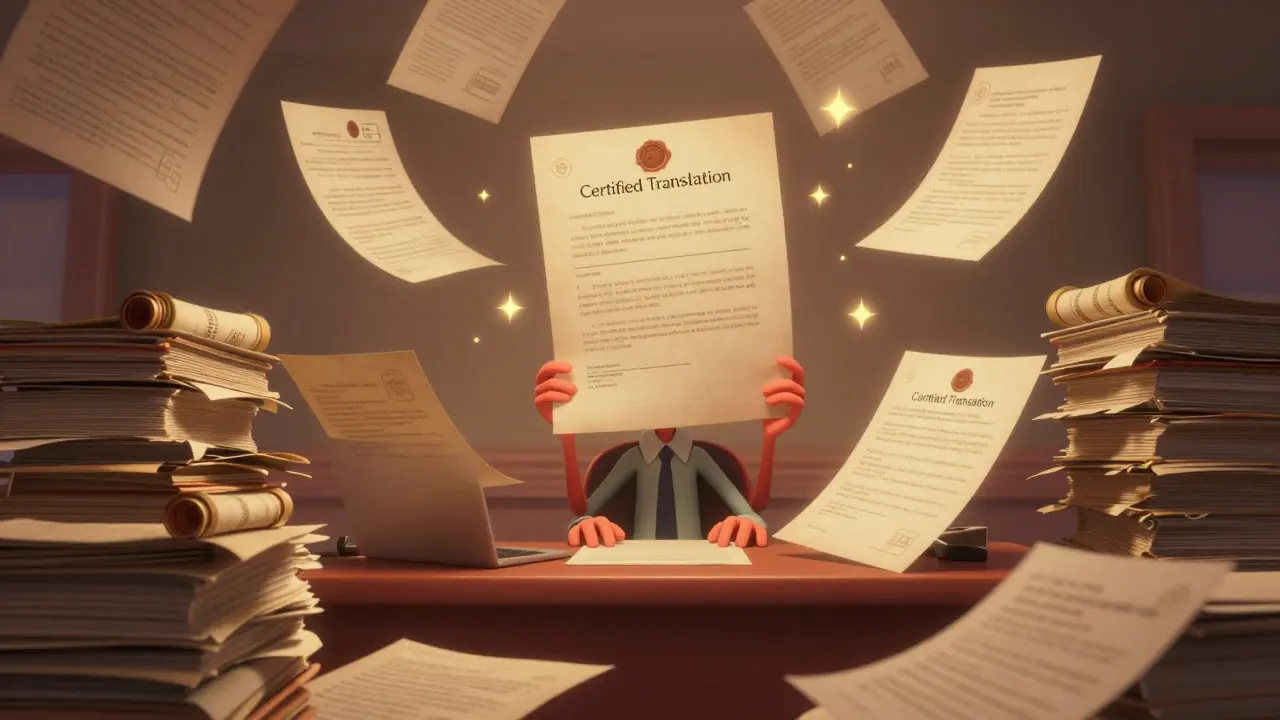
You cannot just scan a PDF of your diploma and email it. Most countries require an Apostille, which is a specialized certificate issued by a government authority that authenticates a document for use in another country. This stems from the Hague Convention of 1961. Without an Apostille, a foreign official has no way of knowing if your diploma is a forgery. If your country isn't part of the Hague Convention, you have to go through a slower process called "consular legalization," which involves multiple stamps from different embassies.
Then there's the translation. You cannot use a random translation app. You need a "certified translation." This means a professional translator signs a sworn statement asserting that the translation is an accurate representation of the original. In many European countries, this must be done by a "sworn translator" recognized by the local court system. If you submit a translation that isn't certified, expect your application to be rejected immediately without a refund of your processing fees.
The Shift Toward Digital Credentials
The old way of mailing physical transcripts is dying. We are moving toward Digital Credentials, which are verifiable digital representations of an achievement, often stored as secure data packets. Many universities now use Blockchain technology to issue certificates. Instead of calling a registrar's office in another time zone to verify a degree, an employer can simply click a link and see a cryptographically signed record that proves the degree was issued by that specific institution.
This is creating a new standard called the European Digital Credentials for Learning. The goal is to make a diploma from a university in Poland as easily verifiable as one from France, without the need for mountains of paperwork. While this is great for tech-savvy industries, the medical and legal fields are slower to adopt this because they still rely on heavily regulated, human-led review boards.
Common Pitfalls and How to Avoid Them
One of the biggest mistakes people make is starting the process too late. If you're planning to move in September, don't start your evaluation in August. Some agencies have backlogs that can stretch for months. Another common error is ignoring the "Accreditation" status of the home institution. If your degree comes from a school that isn't recognized by the Ministry of Education in your home country, no amount of translation will make it valid abroad.
You also have to watch out for the "equivalence gap." Just because your degree says "Bachelor of Science" doesn't mean it's a 4-year degree in the eyes of the destination country. Some countries recognize a 3-year degree as a full bachelor's, while others view it as an associate degree. Always ask for a "pre-assessment" or a preliminary review before paying for the full, expensive evaluation service.
Does a degree from a top-ranked university guarantee recognition?
Not necessarily. While prestige helps during the hiring process, legal recognition depends on the regulatory framework of the destination country. For example, a doctor from Harvard still needs to pass the USMLE and meet state-specific requirements to practice in a different US state or abroad.
What is the difference between an Apostille and Notarization?
Notarization is a local process where a notary confirms the identity of the person signing a document. An Apostille is an international certification that verifies the notary's signature is authentic, allowing the document to be recognized across borders in member countries of the Hague Convention.
How long does the credential evaluation process usually take?
It varies widely. A simple document-by-document review can take a few weeks, but a full course-by-course evaluation for a regulated profession can take several months, especially if the agency has to request additional transcripts directly from your university.
Are online degrees recognized internationally?
Yes, provided the institution is properly accredited. Most modern evaluators do not distinguish between an online degree and an on-campus degree if the accreditation is the same. However, some specific professional boards (like certain medical boards) may still require a percentage of in-person clinical hours.
What should I do if my degree is not recognized?
You can look for "bridging programs" or "top-up degrees" that allow you to take a few additional courses to meet the local requirements. Alternatively, you can seek a "Competency-Based Assessment" where you prove your skills through an exam rather than relying solely on your academic history.
Next Steps for Your Move
If you're planning a cross-border career move, start by identifying if your profession is "regulated." If it is, your first stop should be the professional board of the destination city, not a general agency. Collect your original transcripts and diplomas and check if they need an Apostille immediately, as this step often requires physical mail and government processing times.
For those in tech or creative fields, where formal licensing is rare, focus on building a portfolio and obtaining globally recognized certifications (like AWS, Google, or PMP). These often act as a "universal language" that bypasses the need for formal degree equivalence in the eyes of a hiring manager.
Ajit Kumar
April 21, 2026 AT 04:51It is an absolute travesty that the global community continues to uphold these arbitrary bureaucratic barriers which effectively disenfranchise talented professionals from developing nations, thereby perpetuating a cycle of systemic inequality where the mere geography of one's birth dictates the legitimacy of their intellectual achievements regardless of the rigor of their academic pursuits.
Soham Dhruv
April 23, 2026 AT 02:51man just deal with wes and you'll be fine... its a pain but worth it in the end
Jane San Miguel
April 23, 2026 AT 05:13The insistence on basic accreditation is hardly a barrier; it is a necessary filter to ensure that the professional standards of a developed society are not diluted by institutions that offer degrees without actual academic substance.
Geet Ramchandani
April 23, 2026 AT 07:03The absolute audacity of this guide to suggest that blockchain is actually speeding things up when in reality it is just another layer of tech-bro nonsense designed to mask the fact that the system is fundamentally broken and designed to make us jump through hoops for a decade while we waste our youth on paperwork that doesn't even matter in the real world.
Diwakar Pandey
April 24, 2026 AT 11:52Just a small heads up on the grammar there, but the point is solid. Everyone just take it slow with the docs.
Pooja Kalra
April 25, 2026 AT 15:16Degrees are merely shadows of knowledge, yet we spend our lives chasing the validation of a stamp.
Sumit SM
April 26, 2026 AT 04:40Exactly!!! The irony of the "modern" era is that we have the tech, but we still want the paper!!! Absolutely wild...!!!
Kayla Ellsworth
April 27, 2026 AT 23:33Oh sure, because nothing says "global efficiency" like paying a certified translator to tell the government that you actually went to school. It's almost as if the system is designed to be a nightmare for the sake of feeling important.
Kasey Drymalla
April 28, 2026 AT 09:37this is all just a way for the gov to track where we move and who we know using the blockchain thing to keep a digital leash on every professional
Dave Sumner Smith
April 28, 2026 AT 21:22Wake up people. The Apostille isn't about verification it's about establishing a global database of high-value targets for the international elite. They want to know exactly which doctors and engineers are moving where so they can control the labor flow and kill off independent practice. If you think a digital credential is "convenient" you're a fool, it's a tracking chip for your career.
Bob Buthune
April 30, 2026 AT 08:27I remember trying to do this five years ago and the stress was just unbearable 😭 I spent three months crying over a missing stamp from a ministry that didn't even exist anymore and I honestly felt like the universe was just trying to crush my spirit completely 💔 it is so draining to feel like your entire identity is being questioned by a clerk in an office who doesn't even look up from their desk 😩
Jen Deschambeault
May 2, 2026 AT 07:28You can do this! Just take it one document at a time!