Internationalization of Certification Exams: Language and Culture
 Nov, 14 2025
Think about the last time you took a certification exam. Maybe it was for IT, project management, or even a language proficiency test. Now imagine taking that same exam in a country where the test-takers don’t speak the same language, follow different social norms, or interpret questions based on a completely different cultural context. What happens when a certification designed in the U.S. is given to someone in Japan, Nigeria, or Brazil? The answer isn’t just translation-it’s internationalization.
Why Translation Isn’t Enough
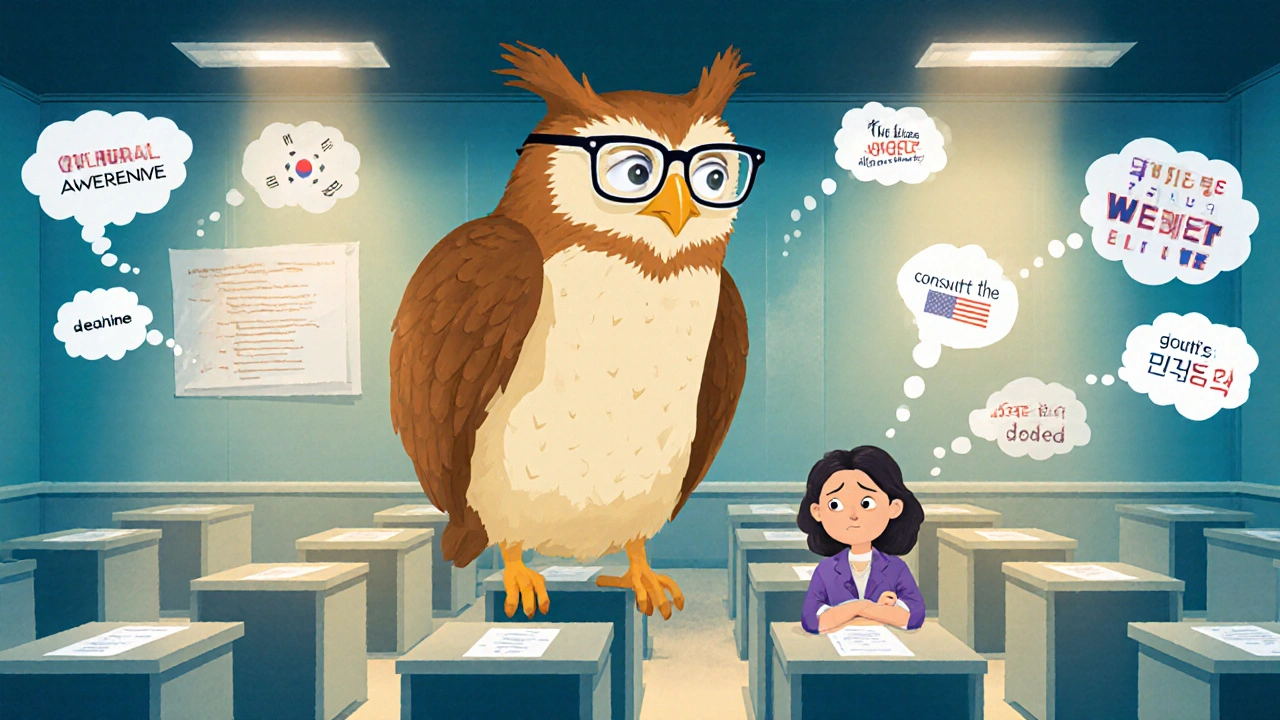
Many certification providers assume that translating exam questions from English into Spanish, Mandarin, or Arabic is enough to make them global. It’s not. A direct word-for-word translation can break the meaning, confuse test-takers, or even make questions culturally offensive. For example, a question asking about "taking the initiative" in a corporate setting might sound natural in American English. But in cultures where hierarchy is deeply respected-like in South Korea or Saudi Arabia-"taking the initiative" without explicit approval can be seen as disrespectful. If the exam doesn’t account for that, you’re not testing knowledge-you’re testing cultural familiarity. A 2024 study by the Global Certification Consortium found that 42% of non-native English speakers failed certification exams not because they lacked technical skills, but because they misunderstood the context of the questions. One candidate in Mexico misread a scenario about "negotiating a raise" because the exam assumed a Western-style performance review culture, which doesn’t exist in many Latin American workplaces.How Culture Shapes Exam Design
Certification exams are built on assumptions. Assumptions about how people learn, how they solve problems, even how they react to stress. These assumptions are often invisible to the creators-until they hit a global audience. Take multiple-choice questions. In Western cultures, test-takers are trained to eliminate wrong answers and pick the "best" one. In some Asian cultures, test-takers are taught to avoid selecting answers that might be seen as too bold or absolute. A question like "Which is the most effective solution?" might lead a candidate in India to pick a middle-ground answer, even if it’s technically incorrect, because they’re conditioned to avoid extremes. Even visual elements matter. A diagram showing a team standing in a circle around a whiteboard might be perfectly normal in the U.S. But in cultures where personal space is highly valued-like in Japan or Finland-this image can feel invasive or unrealistic. The same applies to gender roles: if a case study shows only male managers and female assistants, it doesn’t just feel outdated-it feels biased, and test-takers may distrust the whole exam.The Internationalization Process: Four Key Steps
Getting certification exams right across cultures isn’t magic. It’s a structured process. Here’s what top global providers like CompTIA, Cisco, and PMI actually do:- Conduct cultural audits-Before translating, hire local experts to review each question for cultural relevance. This includes native speakers who understand local work practices, not just translators.
- Use pilot testing-Roll out the exam in 3-5 target countries with small groups of real test-takers. Track which questions cause confusion, hesitation, or high failure rates.
- Adapt scenarios, not just words-Replace American-centric examples (like using a U.S. bank or a U.S. highway system) with local equivalents. A networking question shouldn’t assume familiarity with Comcast or Verizon-it should use a local ISP.
- Train item writers-Certification developers need training on cultural bias. They must learn to avoid idioms, humor, and references that don’t travel well.
One company, CertifyGlobal, redesigned its cybersecurity certification after pilot testing in Brazil revealed that 60% of candidates couldn’t relate to a question about "reporting a phishing email to IT"-because in many Brazilian companies, employees didn’t have direct access to IT departments. They rewrote the question to reflect a chain-of-command structure common in Latin American firms. Pass rates jumped 27%.
Language vs. Localization: What’s the Difference?
Language is the vehicle. Localization is the destination. Language localization means changing the words. Localization means changing the context. For instance, the term "deadline" in English carries urgency and pressure. In some cultures, "due date" or "target date" is preferred because it implies flexibility and collaboration, not punishment for missing a cutoff. A certification exam that uses "deadline" in its Arabic version might unintentionally create anxiety, even if the translation is technically correct. Even punctuation matters. In German, compound nouns are common. In English, we break them up. A question about "customerrelationshipmanagementsoftware" in a German translation could confuse English speakers who aren’t used to reading long compound terms. Localization means adapting structure-not just swapping words.What Happens When You Skip Internationalization?
Skipping proper internationalization doesn’t just hurt pass rates-it damages credibility. A major cloud provider launched a certification in India without localizing scenarios. Candidates were asked to troubleshoot a server issue using a U.S.-based data center naming convention. Many didn’t know what "US-EAST-1" meant. Some thought it was a fictional location. The pass rate in India was 18%-compared to 72% in the U.S. The company blamed test-takers. Later, they admitted they never consulted Indian IT professionals during development. The fallout? The certification lost trust. Companies in India stopped recognizing it. Candidates started choosing alternatives. The provider lost market share to a competitor who had localized their exam with local experts.
Best Practices for Global Certification Programs
If you’re designing or choosing a certification for an international audience, here’s what works:- Always use native-speaking subject matter experts-not just translators-for content review.
- Include at least one cultural reviewer per target region.
- Provide sample questions in each language before the full launch.
- Track performance by region and language in real time. Look for patterns in wrong answers.
- Allow test-takers to flag confusing questions during the exam. Use that feedback to improve.
- Update content every 12-18 months. Cultural norms shift. So should your exams.
Some providers now offer "cultural context guides" alongside their exams. These short notes explain why a question was framed a certain way and what the intent was. It doesn’t give away answers-it builds trust.
Who Benefits Most From Internationalized Exams?
It’s not just the test-takers. Everyone wins. Employers get more accurate signals of skill. A certified professional from Indonesia who passed a culturally adapted exam is more likely to perform well in a global team than someone who barely scraped by on a U.S.-centric test. Certification bodies build global credibility. When candidates from 50 countries say, "This exam felt fair," it becomes a selling point. And the candidates? They get recognition that doesn’t punish them for where they were born or what language they grew up with. That’s not just good business-it’s good ethics.Final Thought: Fairness Is a Design Choice
Internationalization isn’t a nice-to-have. It’s a requirement for any certification that wants to mean something beyond its home country. You can’t just translate a test. You have to redesign it-with empathy, research, and real input from the people who will take it. The most successful global certifications aren’t the ones with the most languages. They’re the ones that feel like they were made for you-no matter where you’re from.Why can’t I just translate certification exams into other languages?
Translation alone ignores cultural context. A question about "taking initiative" might be seen as positive in the U.S. but disrespectful in cultures with strong hierarchies. Words can be swapped, but assumptions about behavior, communication, and norms can’t. Without localization, you’re testing cultural knowledge, not technical skill.
How do I know if a certification is truly internationalized?
Look for evidence of local input. Does the provider list regional advisory panels? Do they publish pass rates by country? Do they offer sample questions adapted to your region? If the exam was only translated without pilot testing or cultural review, it’s not truly internationalized.
Are there certification exams that do this well?
Yes. CompTIA, Cisco, and PMI all have well-documented internationalization processes. They use native-speaking SMEs, conduct pilot tests in multiple countries, and update exam content regularly based on global feedback. Their pass rates remain consistent across regions, which is a strong sign of good localization.
What should I do if I’m taking a certification exam in a non-native language?
Ask if the exam has been localized-not just translated. Look for sample questions in your language. If the scenarios feel unfamiliar or unrealistic, the exam may not reflect your real-world experience. Consider reaching out to local certification groups or forums to hear how others have experienced the test.
Does internationalization make exams easier?
No. It makes them fairer. The difficulty stays the same-it’s the context that changes. A question about managing a project might use a local company example instead of a U.S. one, but the underlying skill being tested-planning, communication, risk management-remains unchanged. The goal is to remove cultural barriers, not lower standards.
Mark Brantner
November 14, 2025 AT 17:14chioma okwara
November 16, 2025 AT 06:26Tamil selvan
November 16, 2025 AT 14:47Deepak Sungra
November 18, 2025 AT 02:19Kate Tran
November 19, 2025 AT 15:48Jim Sonntag
November 20, 2025 AT 07:19Tasha Hernandez
November 21, 2025 AT 03:15Christina Morgan
November 22, 2025 AT 16:31Bridget Kutsche
November 24, 2025 AT 16:19amber hopman
November 25, 2025 AT 01:31Jack Gifford
November 26, 2025 AT 11:30Samar Omar
November 28, 2025 AT 09:53Kathy Yip
November 29, 2025 AT 05:35John Fox
November 30, 2025 AT 18:49Anuj Kumar
December 2, 2025 AT 16:40