Online Learning Business Models Explained for Course Creators
 Mar, 23 2026
If you’ve ever built an online course and wondered why sales are flat, you’re not alone. Thousands of course creators spend months crafting content, only to watch their launch fizzle out. The problem isn’t your teaching skills. It’s your business model. Many assume that if you build it, they will come. But in 2026, that’s not how online learning works. The real edge goes to those who understand how to structure their revenue - not just their curriculum.
What Exactly Is a Business Model for Online Courses?
A business model answers one simple question: How do you make money? It’s not about your course topic, your teaching style, or even your website design. It’s about the system you use to turn knowledge into income. Think of it like a recipe. You can make the same cake with different ingredients and methods - and some will sell better than others.
There are five proven models used by top course creators today. Each has different costs, customer expectations, and growth potential. Picking the wrong one can drain your energy and your bank account. Picking the right one? It can turn your course into a steady income stream.
Model 1: One-Time Payment (Lump Sum)
This is the most common model. You create a course, set a price - say $97 - and sell it once. Buyers get lifetime access. Simple. Easy to explain. Easy to set up on platforms like Teachable or Thinkific.
But here’s the catch: you only earn once per customer. If 100 people buy your $97 course, you make $9,700. Then you’re back to square one. No recurring revenue. No scaling without constant marketing.
Who’s this best for? Solo creators with low production costs, niche topics (like “How to Fix Your Back Pain from Sitting All Day”), or people testing the market. It works if you have a strong email list or existing audience. But if you’re starting from zero, this model forces you to run ads or cold outreach every single month.
Model 2: Subscription (Membership)
Instead of selling one course, you sell ongoing access to a library. Think of it like Netflix for learning. Customers pay $29/month and get new lessons, live Q&As, downloadable templates, and community access.
This model flips the script. You earn $29 every month from each subscriber. Ten subscribers = $290/month. One hundred = $2,900. And if you keep them for a year? That’s $3,480 per person - more than 35 times what you’d make from a one-time sale.
Companies like Skillshare and MasterClass use this. But so do indie creators. For example, a yoga instructor in Portland built a $12k/month membership by offering weekly live sessions, downloadable routines, and a private Slack group. She doesn’t need to launch a new course every quarter. She just adds value.
Downside? You need to keep delivering. No content droughts allowed. And you’ll need a platform that supports recurring billing and member-only content. But if you can commit to consistency, this is the most scalable model for long-term income.

Model 3: Tiered Pricing (Packages)
Not everyone wants the same thing. Some just want the video lessons. Others want coaching. Some want certificates and templates. Tiered pricing lets you offer three (or more) versions of your course.
Here’s how it works:
- Basic: $97 - just the course videos and PDFs
- Pro: $297 - videos + worksheets + community access
- Premium: $797 - everything above + 3 one-on-one coaching calls + lifetime updates
Most people pick the middle option. That’s called the Goldilocks effect. You give them a clear upgrade path. The premium tier doesn’t need to sell often - even one sale a month makes it worth it.
This model works best when you have a clear progression. For example, a financial literacy course for young adults might start with budgeting basics, then add investing, then tax strategies. Each tier builds on the last.
Tools like Kajabi and Podia make this easy. You can set up automatic upsells. One customer buys the basic, then gets an email: “Want to add live feedback? Upgrade now.”
Model 4: Affiliate + Commission Partnerships
You don’t have to sell everything yourself. Partner with other creators, coaches, or tools you already use - and earn a commission every time someone buys through your link.
Example: You teach a course on “How to Start a Podcast.” In your curriculum, you recommend a specific microphone, editing software, and hosting platform. You get a 20% commission on each sale made through your unique affiliate link.
This isn’t just a side hustle. One course creator in Atlanta made $18,000 last year just from affiliate commissions. She didn’t change her course. She just added two trusted tools to her “Resources” page and linked them with affiliate codes.
Best partners? Tools that solve real problems your students have. Not random ads. If you’re teaching Canva design, link to Canva Pro. If you’re teaching copywriting, link to Grammarly or Jasper. Your audience trusts you - so your recommendation carries weight.
Platforms like ShareASale, Impact, and Amazon Associates make it easy to sign up. Just be transparent: “I earn a commission if you buy through this link.”
Model 5: Hybrid Model (The Winner)
The most successful course creators don’t use just one model. They combine them. This is called the hybrid approach.
Here’s what it looks like in practice:
- Offer a $97 one-time course as your entry point.
- After they complete it, invite them to join a $49/month membership for ongoing updates and community.
- Offer a $1,200 annual coaching package for those who want personal feedback.
- Add affiliate links to tools you recommend inside the course.
This creates a revenue funnel. You attract people with a low-cost option. You keep them with ongoing value. You upsell to high-ticket clients. And you earn passively through affiliates.
Take the example of a course creator in Austin who teaches “AI for Small Business Owners.” She started with a $79 course. Within six months, she had:
- 2,100 one-time sales
- 420 active members in her $39/month community
- 17 clients in her $1,500 coaching program
- $5,200 in affiliate commissions from AI tools
Her total annual revenue? Over $120,000. And she only spent 10 hours a week on it.
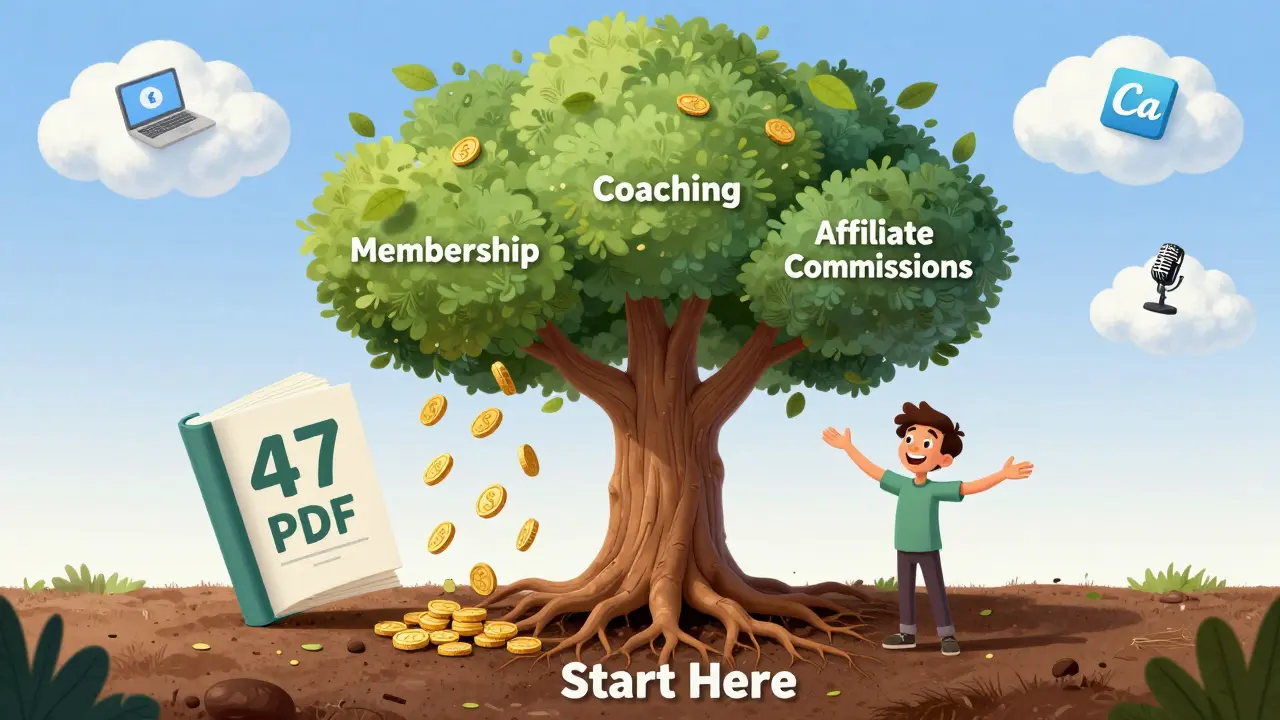
Which Model Should You Choose?
You don’t need to pick just one. But you do need to start with one. Here’s a quick guide:
- Start with one-time sales if you’re new, have a small audience, or are testing your topic.
- Move to subscription if you can create content monthly and enjoy community building.
- Add tiers if your audience has different needs - beginners vs. advanced, DIY vs. hands-on.
- Add affiliates if you already use tools that solve your students’ problems.
- Go hybrid once you have at least 200 paying students. That’s your launchpad.
Don’t wait for perfection. Launch the simplest version. Get feedback. Then layer in more models. The best course creators didn’t start with a membership. They started with a $47 PDF. Then they grew.
What to Avoid
Here are three deadly mistakes:
- Charging too little - $19 courses train people to expect cheap content. You’ll attract bargain hunters, not loyal customers.
- Ignoring retention - if your students never come back, you’re constantly selling to new people. That’s exhausting.
- Trying to do everything - don’t launch a membership, coaching, and affiliate program on day one. Pick one. Nail it. Then add.
Also, avoid platforms that take 30%+ of your revenue. Use your own website with Stripe or PayPal. You’ll keep more money - and own your customer relationships.
Final Thought: Your Course Is a Product - Not a Gift
Many creators feel guilty charging for knowledge. But here’s the truth: your expertise is valuable. Someone is already paying for it - through consultants, books, or workshops. You’re just offering a better, more scalable version.
Stop thinking of your course as a donation. Think of it as a service. You’re saving time. You’re reducing stress. You’re giving people a shortcut. That’s worth paying for.
Build your model. Test it. Track it. Then optimize. The people who win aren’t the ones with the best content. They’re the ones who built the best system.
Can I use multiple business models at once?
Yes - and you should. Most top creators use a hybrid model: a low-cost entry point (like a $49 course), a membership for ongoing value ($29/month), and a high-ticket coaching option ($1,000+). This creates a revenue funnel where customers naturally move up. Start with one model, then layer others once you have consistent sales.
What’s the easiest business model to start with?
One-time payment. It requires the least setup. You create your course, set a price, and sell it on platforms like Teachable, Gumroad, or even Etsy. You don’t need recurring billing, community tools, or coaching systems. Once you hit 50+ sales, then consider adding a membership or upsells.
How much should I charge for my online course?
Price based on value, not hours spent. A $97 course should solve a clear, urgent problem - like “Get Your First 100 Email Subscribers in 30 Days.” If your outcome is life-changing (e.g., “Land a Remote Job in 6 Weeks”), charge $497 or more. Most successful courses fall between $97 and $497. Avoid underpricing - it devalues your expertise.
Do I need a website to sell courses?
Not technically - you can sell on Udemy or Skillshare. But those platforms take 50%+ of your revenue and own your customer data. To keep more money and build a real business, you need your own website. Use a platform like Thinkific, Kajabi, or Podia. They let you own your audience, set your price, and email your buyers directly.
How do I know if my course idea will sell?
Before building anything, test demand. Post a free 30-minute webinar or a LinkedIn post asking: “Would you pay $97 for a course that helps you [solve X problem]?” If 20+ people say yes, you have a market. You can also run a $5 pre-sale landing page. If 10 people buy before you even create the course, you’re ready to build.
If you’re just starting out, focus on one model. Make it work. Then expand. The goal isn’t to be perfect - it’s to start earning. And with the right model, you can turn what you know into income that lasts.
Raji viji
March 24, 2026 AT 02:01Madhuri Pujari
March 24, 2026 AT 19:31Sandeepan Gupta
March 26, 2026 AT 02:24Rajashree Iyer
March 27, 2026 AT 06:15Tarun nahata
March 28, 2026 AT 04:00Aryan Jain
March 28, 2026 AT 19:16Nalini Venugopal
March 29, 2026 AT 09:18Pramod Usdadiya
March 30, 2026 AT 23:03Aditya Singh Bisht
April 1, 2026 AT 11:24Agni Saucedo Medel
April 2, 2026 AT 21:04ANAND BHUSHAN
April 2, 2026 AT 23:40Indi s
April 4, 2026 AT 07:45Diwakar Pandey
April 6, 2026 AT 05:20Geet Ramchandani
April 7, 2026 AT 07:10Pooja Kalra
April 8, 2026 AT 10:31Sumit SM
April 9, 2026 AT 23:30Jen Deschambeault
April 10, 2026 AT 12:09Kayla Ellsworth
April 11, 2026 AT 10:38Soham Dhruv
April 11, 2026 AT 18:33Parth Haz
April 12, 2026 AT 00:43