Peer Review Systems for Collaborative Course Assignments: A Practical Guide
 Sep, 5 2026
You’ve just finished grading forty essays. Your eyes are burning, your back hurts, and you’re wondering if the students actually read each other’s work or just swapped grades to get it over with. This is the classic struggle of managing collaborative course assignments in an online or hybrid environment. Without a structured way for students to evaluate one another, group projects often devolve into one person doing all the work while three others watch Netflix.
Peer review systems are the antidote. These aren’t just digital comment boxes; they are structured workflows that force accountability, improve critical thinking, and reduce instructor workload. But not all systems are created equal. Some are clunky legacy tools from 2010, while others use AI to flag plagiarism before a human even sees the draft. Choosing the right system depends on your class size, subject matter, and how much control you want to hand over to the students.
Why Peer Review Matters More Than You Think
It’s easy to view peer review as a time-saver for teachers. And sure, it cuts grading time by up to 50% in large lecture halls. But the real value lies in social learning. When a student critiques another’s argument, they have to understand the rubric deeply enough to apply it. They learn what “good” looks like by identifying flaws in someone else’s work.
Research from Stanford’s Graduate School of Education suggests that students who engage in structured peer feedback show higher retention rates than those who only receive teacher feedback. Why? Because peer language is often more accessible. A professor might say, "Your thesis lacks nuance," which sounds abstract. A peer might say, "I got confused here because you didn't explain why this matters." That concrete feedback sticks.
However, this benefit evaporates if the system is poorly designed. If students don’t know how to give feedback, or if they feel their input doesn’t count toward their grade, they’ll ignore the process. The system must enforce quality, not just quantity.
Core Features of Effective Peer Review Platforms
When you’re shopping for a tool, ignore the flashy dashboards. Look for these four non-negotiable features. If a platform misses any of these, walk away.
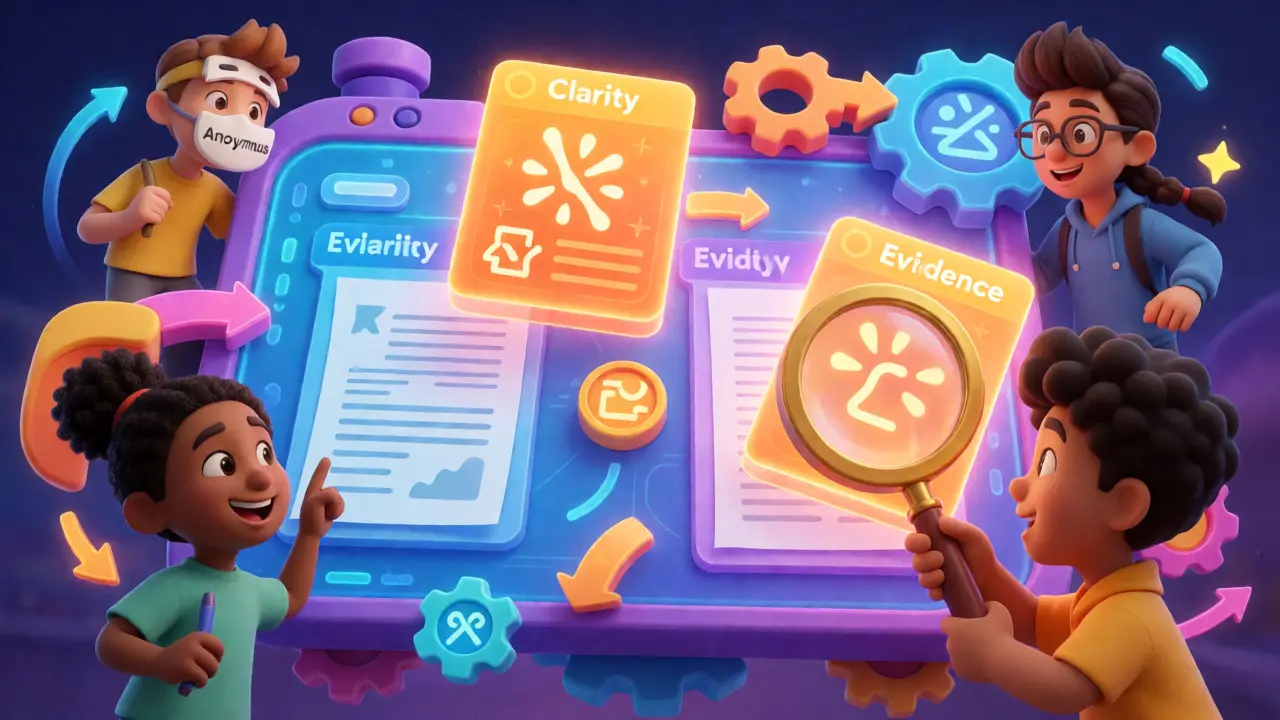
- Anonymity Controls: Students need to know whether they are reviewing anonymously or openly. Anonymity reduces bias and fear of retaliation, but open reviews build community. The best systems let instructors toggle this per assignment.
- Rubric Integration: Free-text comments are nice, but they’re hard to grade. A good system forces reviewers to score specific criteria (e.g., "Clarity," "Evidence") alongside their text. This makes aggregating scores easier for the instructor.
- Calibration Modules: Before the real review starts, have students practice on sample submissions. The system should compare their scores against a benchmark. This trains them to be consistent.
- Feedback Quality Metrics: How do you know if a review is helpful? Advanced platforms analyze word count, specificity, and tone. Some even use natural language processing to detect vague phrases like "Good job" versus actionable advice.
Comparing Popular Peer Review Tools
The market is crowded, but most institutions rely on a few key players. Here’s how the top contenders stack up for different teaching styles.
| Feature | Canvas Peer Assess | Turnitin Feedback Studio | Peergrade | Moodle Workshop |
|---|---|---|---|---|
| Best For | LMS-integrated courses | Writing-heavy classes | Scalable anonymous review | Open-source flexibility |
| Anonymity | Configurable | Partial (plagiarism focus) | Full anonymity default | Configurable |
| AI Assistance | Basic suggestions | Strong grammar/plagiarism | Review quality scoring | None native |
| Learning Curve | Low (if using Canvas) | Medium | Low | High |
| Cost Model | Included in LMS | Per-student license | Subscription per user | Free (hosting costs apply) |
Canvas is the go-to for many universities because it’s already embedded in the Learning Management System (LMS). It’s seamless but basic. If you need deep analytics on reviewer behavior, it falls short.
Turnitin dominates in writing-intensive fields. Its strength isn’t just plagiarism detection; its similarity reports help students see where they stand against peers. However, it’s less flexible for non-text assignments like code or design portfolios.
Peergrade specializes in scalable anonymous review. It uses algorithms to match reviewers and ensures every submission gets multiple reviews. It’s excellent for large classes where manual matching would be a nightmare.
Moodle Workshop is powerful but painful. It offers granular control over phases (submission, assessment, evaluation), but setting it up takes hours. Only choose this if you have a dedicated tech team.
Designing the Workflow: From Submission to Grade
A broken workflow kills engagement. Don’t just dump students into a review pool. Structure it in phases.
- Submission Phase: Set a strict deadline. Late submissions shouldn’t enter the review pool, or they disrupt the timeline.
- Review Assignment: Randomize matches, but ensure no student reviews their own work. For larger classes, assign 3-4 reviews per student. Fewer than two creates noise; more than five causes fatigue.
- Review Period: Give students at least one week. Rushed reviews are useless. Send automated reminders at 48-hour intervals.
- Author Response: Allow authors to reply to feedback. This turns monologue into dialogue. Did the reviewer misunderstand? The author can clarify.
- Evaluation Phase: The instructor evaluates the *quality* of the reviews, not just the content. Did Student A provide constructive criticism? That impacts their grade.
This structure prevents the "ghost reviewer" problem-students who click 'submit' without reading. By grading the review itself, you incentivize effort.
Overcoming Common Pitfalls
Even the best tools fail if cultural issues aren’t addressed. Here are three traps and how to dodge them.
The Halo Effect: Students rate friends higher. Solution: Use anonymous reviews. If anonymity isn’t possible, randomize pairs so students rarely see the same partner twice.
Reciprocity Bias: Students think, "If I’m harsh on their paper, they’ll be harsh on mine." Solution: Decouple the review score from the final grade initially. Or, use blind moderation where the instructor adjusts extreme outliers.
Vague Feedback: Comments like "Nice" or "Bad" help no one. Solution: Require minimum word counts and ban single-word responses. Provide sentence starters: "One strength is...", "A suggestion for improvement is...".
Integrating AI into Human Review
By 2026, AI isn’t replacing peer review; it’s augmenting it. Newer systems use Natural Language Processing (NLP) to pre-screen submissions. If a student submits a 50-word paragraph for a 1,000-word essay, the AI flags it before it wastes a peer’s time.
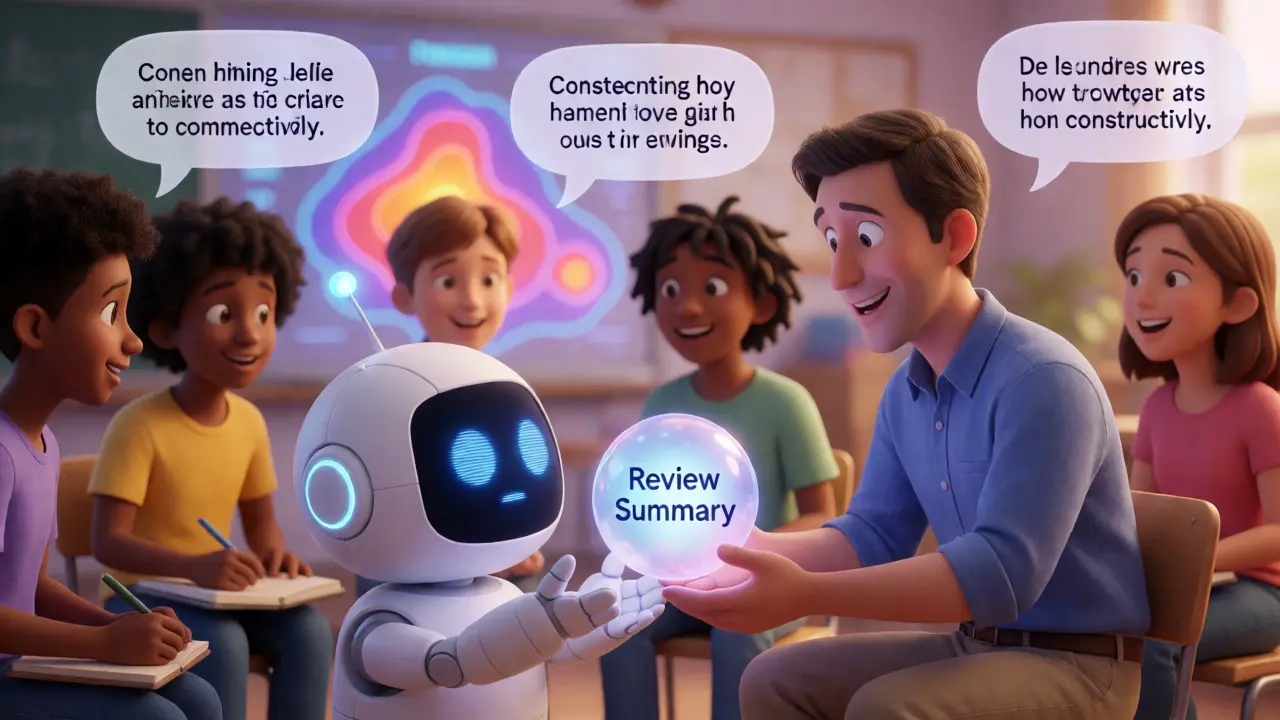
Some platforms also generate "review summaries." Instead of reading ten individual comments, the instructor sees a heatmap of common issues. Maybe 70% of the class struggled with citation formatting. That’s a signal to re-teach that module, rather than fixing it individually in ten different papers.
But don’t over-rely on AI. Machines miss nuance. They can’t tell if a sarcastic comment was meant kindly or cruelly. Keep humans in the loop for final judgments.
Measuring Success: What to Track
How do you know if your peer review system is working? Ignore vanity metrics like total comments posted. Focus on these indicators:
- Actionable Feedback Rate: What percentage of comments lead to revisions? If students change their drafts based on peer input, the system works.
- Reviewer Consistency: Are some students consistently rating high while others rate low? Large variance suggests calibration issues.
- Time-on-Task: How long do students spend per review? Under two minutes usually means skimming. Over fifteen minutes might indicate confusion or perfectionism.
- Student Satisfaction: Run a mid-semester survey. Ask: "Did the feedback help you improve?" If the answer is "No," tweak the rubric.
Remember, the goal isn’t perfect grades. It’s better learners. If students leave the course knowing how to critique constructively, you’ve won, regardless of the software used.
Is peer review fairer than instructor grading?
Not necessarily. Instructors have expertise; peers have empathy. The fairest approach is a blended model where peer reviews inform the instructor's final decision, or where peer accuracy is graded separately. Pure peer grading can lead to grade inflation or deflation depending on the cohort's mood.
How many peer reviews should each student complete?
Three to four is the sweet spot for most undergraduate courses. Fewer than two provides insufficient data for aggregation. More than five leads to reviewer fatigue and lower-quality feedback. Adjust based on assignment complexity; simple quizzes require fewer reviews than capstone projects.
Can peer review work for STEM subjects?
Yes, but the rubric must be objective. For math or coding, check for correct syntax, logical flow, and error identification rather than stylistic prose. Tools that support code highlighting and inline annotations are essential for effective STEM peer review.
What if a student gives bad feedback?
Instructors should monitor a sample of reviews. If a student consistently provides vague or unhelpful comments, deduct points from their participation grade. Calibration exercises at the start of the term help prevent this by showing examples of high-quality vs. low-quality feedback.
Do anonymous reviews increase honesty?
Generally, yes. Anonymity removes social pressure and fear of retaliation, leading to more candid critiques. However, it can also encourage rudeness if the platform lacks moderation tools. Always pair anonymity with clear guidelines on respectful communication.
Chris Neal
September 5, 2026 AT 21:52you're oversimplifying the tech stack here. canvas peer assess is barely functional for anything beyond basic text submissions and turnitin's plagiarism focus completely misses the point of collaborative learning which is about process not just final product integrity
if you actually want to measure success you need to look at longitudinal data on student retention in subsequent courses not just mid-semester satisfaction surveys which are notoriously biased by recency effect
also the claim that ai flags vague feedback is misleading because nlp models struggle with sarcasm and cultural nuance which are huge parts of human communication especially in diverse classrooms
most institutions use these tools as band-aids for understaffing rather than pedagogical enhancements so don't expect magic results from software alone
Vishnu Vardhan Reddy M S
September 7, 2026 AT 19:36haha oh wow thanks for the reality check chris really needed that dose of cynicism before i started hyperventilating over my lms setup
i love how you pointed out the sarcasm issue because i have had students literally roast each other in anonymous reviews thinking it was funny while the recipient cried in the library
but seriously though calibration modules are the unsung heroes here if you skip them you get chaos where one person gives 10/10 for typos and another gives 2/10 for lack of soul
keep fighting the good fight against bad software we are all suffering together in this digital trenches
Kyle Ware
September 9, 2026 AT 11:04agreed on the calibration part. without practice runs the variance is too high to trust the scores. also anonymity helps but you still need clear guidelines on tone otherwise people get weird about it. keep it simple and structured
Iva Grekova
September 9, 2026 AT 21:01this is such a helpful breakdown! i’ve been struggling with getting my students to take the review process seriously so the tip about grading the quality of the review itself is going to be a game changer for me next semester
i never thought about using sentence starters like "one strength is..." but that makes so much sense to guide them away from just saying "good job"
thanks for sharing this practical guide it feels really actionable
Onyinyechi Nwosu
September 11, 2026 AT 20:47love the emphasis on social learning. peer language really does stick better. the halo effect is real though. saw it happen in my own group projects back in school. anonymity helps but moderation is key
Chandan Singh
September 13, 2026 AT 12:23The comparison table is useful but lacks context regarding API integration capabilities which is crucial for institutions using custom LMS solutions. Furthermore the discussion on AI assistance underestimates the computational cost associated with running NLP models at scale for large cohorts. One must consider the total cost of ownership including server maintenance and potential downtime during peak submission periods.
Brannen Hall
September 15, 2026 AT 07:12nah this whole thing is overrated. students are lazy. they won't read the rubric even if you force them to. they'll just click submit and go back to netflix. technology doesn't fix human nature.
plus who cares about retention rates if they can't write a coherent email? peer review is just busy work for everyone involved. waste of time.
tiffany King
September 16, 2026 AT 21:20oh come on brannen give it a chance! when i used peergrade my students actually started helping each more outside of class too. it builds community! plus seeing their faces light up when they realize they caught a mistake is priceless. let's stay positive!
Brenna Gonedrman
September 17, 2026 AT 15:48OMG YES!!! The part about the Netflix watching students made me laugh SO HARD because that is literally every group project ever. I am definitely printing this out and putting it on my fridge. Thank you for saving my sanity!!
Courtney Wagstaff
September 19, 2026 AT 08:49the bit about 'review summaries' being heatmaps is super cool idea. imagine seeing exactly where the class is stumbling collectively instead of guessing. feels like cheating in the best way possible for teachers. def gonna try the moodle workshop despite the pain cause the control sounds juicy
Elisabeth Ballet
September 20, 2026 AT 15:13Listen, if you aren't training your students on HOW to give feedback, you are setting them up to fail. It’s not enough to just hand them a rubric. You need workshops. You need examples. You need to model what constructive criticism looks like. Don't blame the tool when the user doesn't know how to operate it!
Also stop letting students grade their friends anonymously if the class size is small. They will figure it out. Be smarter than them.
Brandon Olvera
September 20, 2026 AT 20:11Foreign software always has bugs. American made systems are better tested. Why are we relying on subscription services that charge per user anyway? Should be free for public schools. Waste of tax dollars.
alex kobri
September 22, 2026 AT 19:01it’s interesting how we treat feedback as a transactional commodity rather than a relational act. when we anonymize everything do we lose the empathy that comes from knowing who you’re talking to or do we gain the freedom to speak truthfully without social baggage
maybe the problem isn’t the system but our expectation that peers can replace the mentorship role entirely. they can supplement but never substitute
we are trying to automate wisdom and that usually leads to hollow results