Personalized Nudges and Notifications That Improve Learning Outcomes
 Jan, 18 2026
Most online courses fail not because the content is bad, but because learners stop showing up. You’ve probably felt it yourself: you sign up for a course, get excited on day one, and by day five, it’s buried under emails, chores, and distractions. That’s not laziness-it’s human nature. The solution isn’t more content. It’s smarter timing. Enter personalized nudges and notifications: small, timely prompts designed to keep learners on track without feeling nagging.
Why Generic Reminders Don’t Work
Ever gotten a flat, automated email saying, "Don’t forget to complete Module 3!"? It feels like a robot shouting into a void. Generic reminders ignore context. They don’t know if you’re stuck on a concept, overwhelmed with work, or just need a little encouragement. A study from Stanford’s Behavioral Lab in 2024 tracked 12,000 learners across five major platforms. Those who received generic reminders completed courses at a 28% rate. Those who got personalized nudges? 61%.
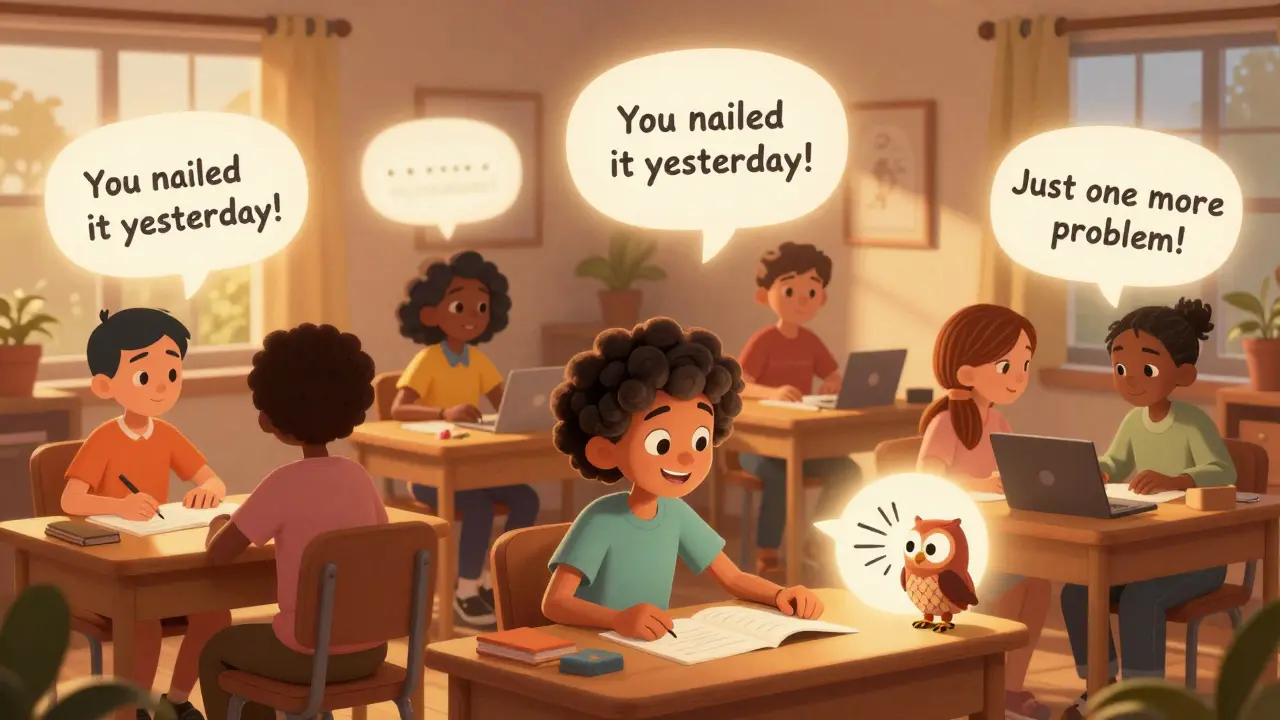
The difference? Personalized nudges use data-what you’ve done, how long you spent, where you paused, even what time of day you usually log in. They don’t just say "do this." They say, "You were doing great on quadratic equations yesterday. Try one more problem before lunch. You’ve got this."
How Personalized Nudges Actually Work
Think of nudges as digital coaching. They’re not about forcing action. They’re about reducing friction. Here’s how they’re built:
- Behavioral triggers: If you haven’t logged in for 48 hours, the system checks your past patterns. Did you usually return after a weekend break? Then it waits. Did you drop off after Module 2 last time? It sends a nudge now.
- Content relevance: If you struggled with a quiz on financial ratios, the next nudge isn’t about the next module-it’s a quick video recap of the same concept, but broken down differently.
- Timing optimization: Notifications aren’t sent at 9 a.m. just because it’s convenient. They’re sent when you’re most likely to act. For working adults, that’s often between 7-8 p.m. For students, it’s 6-7 p.m. after dinner.
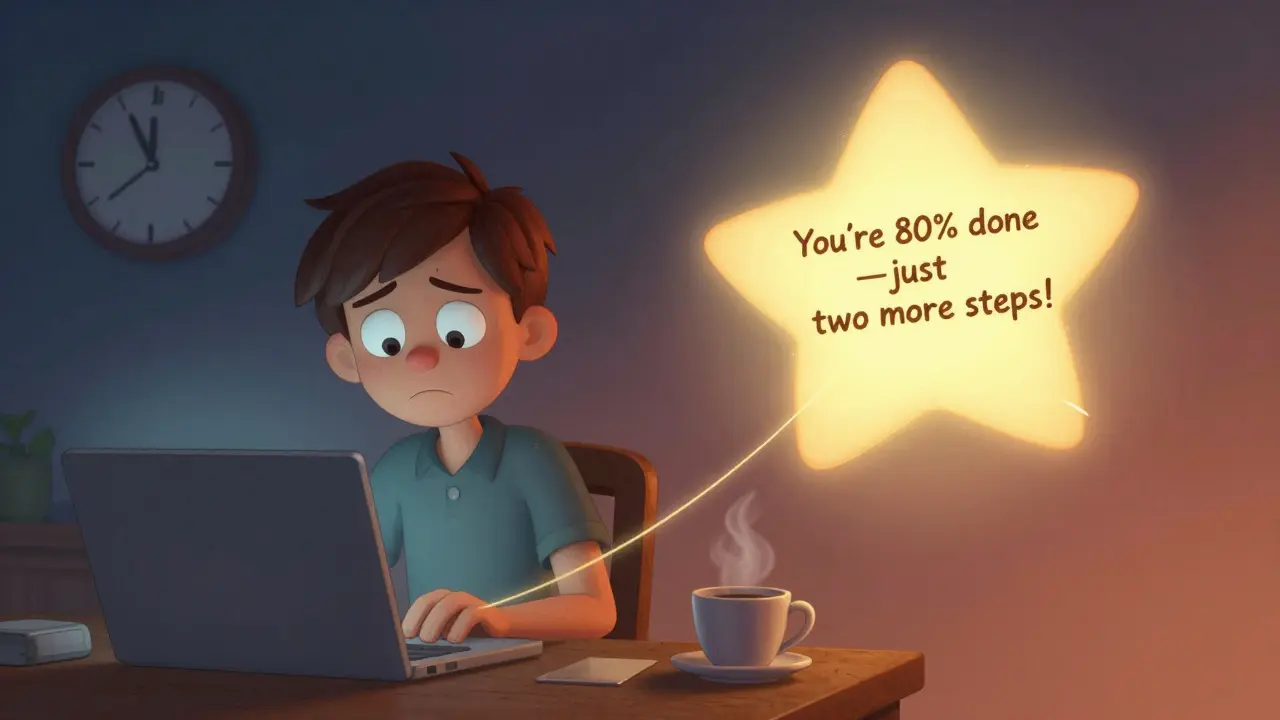
- Emotional tone: A nudge that says, "You’re falling behind," triggers guilt. One that says, "You’re 80% done-just two more steps," triggers momentum. The best systems adjust tone based on your past reactions.
One platform, LearnFlow, tested three versions of a nudge for learners stuck on calculus problems. Version A: "Complete the assignment." Version B: "You’ve solved 14 problems this week-let’s get to 15." Version C: "Stuck? Here’s a 90-second tip from someone who aced this last month." Version C had a 47% higher completion rate than A, and 22% higher than B. The emotional hook mattered as much as the content.
The Science Behind the Nudge
These aren’t random tricks. They’re based on decades of behavioral psychology. The concept comes from Richard Thaler and Cass Sunstein’s Nudge Theory, which showed that small changes in how choices are presented can dramatically influence decisions-without restricting freedom.
In learning, nudges work because they tap into three core human drivers:
- Progress tracking: Our brains love seeing movement. A simple "You’re 65% complete" message activates the same reward centers as checking off a to-do list.
- Social proof: "1,200 learners just finished this section" feels safer than going it alone.
- Loss aversion: "You’ve earned 3 badges-don’t lose them" is more motivating than "Earn more badges."
A 2025 meta-analysis of 43 studies on adaptive learning systems confirmed that learners exposed to well-designed nudges were 2.3 times more likely to finish a course and scored 19% higher on final assessments than those without them.
What Makes a Nudge Too Much?
Not all nudges help. Some feel like spam. The line between helpful and annoying is thin-and it’s different for everyone.
Here’s what breaks it:
- Too frequent: Two nudges in one day? You’ll start ignoring them all.
- Too vague: "Keep going!" doesn’t tell you what to do next.
- Too punitive: "You’re falling behind" triggers shame, not action.
- Too late: Sending a reminder after a deadline has passed? That’s a reminder of failure, not a nudge.
Top platforms now let users customize their nudge settings. You can say, "Only notify me on weekends," or "Don’t remind me after 9 p.m." That control is what turns a nudge from a nuisance into a partner.
Real Examples That Work
Here’s what actual personalized nudges look like in practice:
- For a coding learner: "You nailed the Python loops last night. Try refactoring your last script using functions-it’ll make your code cleaner. (Takes 5 minutes.)"
- For a language learner: "You practiced Spanish for 12 minutes yesterday. Today’s quick review will help you remember those 8 new words. Ready?"
- For a professional certification: "You’re 3 weeks from your exam. 72% of people who pass study 20 minutes a day. Want to lock in your 20-minute slot?"
Notice the pattern? Each nudge is:
- Specific to what the learner just did
- Time-bound ("5 minutes," "today")
- Low-pressure ("Want to?" not "You must")
- Linked to progress, not perfection
How to Build Better Nudges (Even If You’re Not a Tech Company)
You don’t need AI to make better nudges. If you’re a teacher, coach, or even a self-learner, you can apply these principles:
- Track your own patterns: When do you learn best? When do you quit? Use a simple notebook or app to log it.
- Set micro-goals: Instead of "Finish the course," aim for "Do one exercise before coffee."
- Use your phone: Set a daily reminder that says, "What’s one thing I learned today?" Not "Study."
- Find your accountability buddy: Text someone: "I’m doing Module 2 today. Wish me luck." That’s a human nudge-and it works.
Even small changes like these can boost retention by 30-40%. The goal isn’t to automate everything. It’s to make learning feel less like a chore and more like a habit you’re building.
The Future of Learning Is Quiet
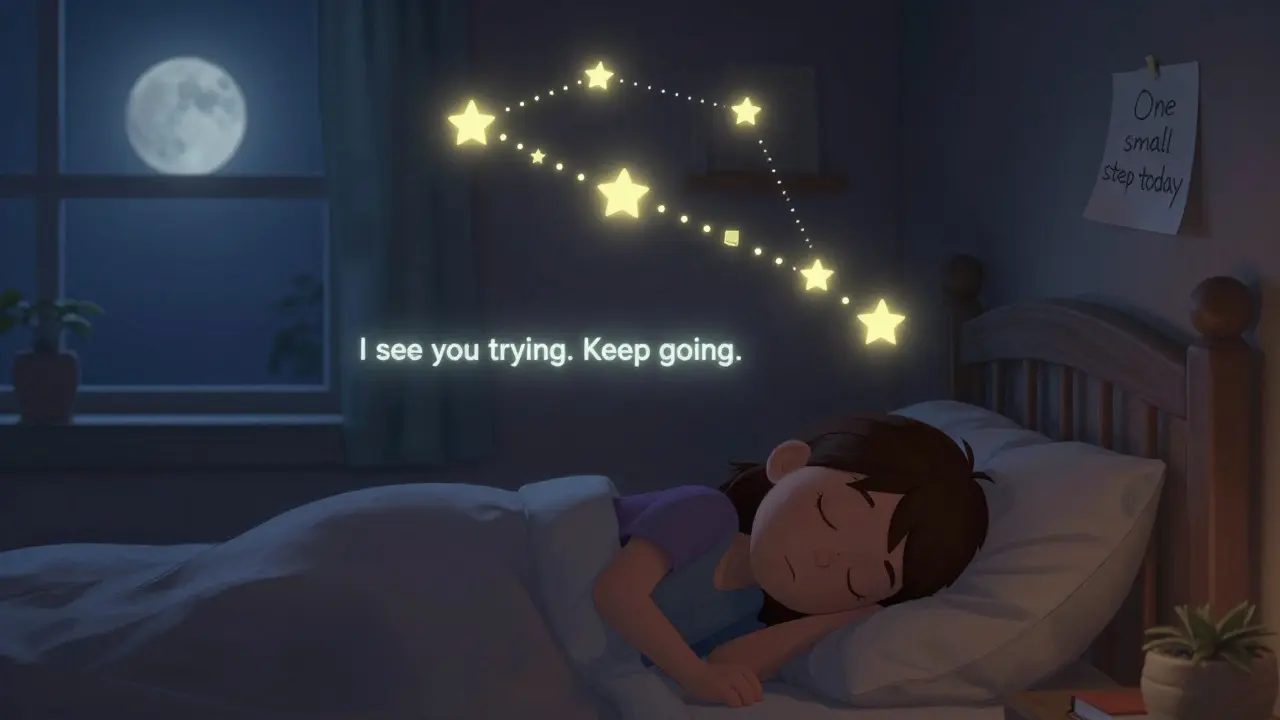
The most effective learning systems aren’t the ones with the flashiest dashboards or the most videos. They’re the ones that whisper when you need them and stay silent when you don’t. Personalized nudges don’t shout. They remind. They support. They say, "I see you trying. Keep going."
That’s what turns passive learners into persistent ones. Not pressure. Not guilt. Just a quiet, well-timed nudge that says: you’re not alone.
What’s the difference between a nudge and a reminder?
A reminder is a generic alert-"Do your homework." A nudge is personalized and contextual-it says, "You did well on yesterday’s quiz. Try one more problem now while it’s fresh." Nudges use your behavior, timing, and progress to feel like advice, not a demand.
Can personalized nudges work for adult learners with busy schedules?
Yes-better than for anyone else. Adult learners often struggle with consistency, not ability. Nudges that arrive at their preferred time (like after dinner or during a commute) and offer micro-tasks (5-10 minutes) fit into fragmented schedules. Platforms like Coursera and LinkedIn Learning now use time-of-day analytics to send nudges when users are most active.
Do personalized nudges actually improve test scores?
Multiple studies say yes. A 2025 analysis of 43 adaptive learning platforms found learners who received well-designed nudges scored 19% higher on final assessments. The reason? Nudges reduce procrastination, reinforce weak spots, and build daily habits-key factors in long-term retention.
Are there privacy concerns with personalized nudges?
Only if the data is misused. Reputable platforms use anonymized, aggregated data to shape nudges. They don’t track your location or personal messages. You can usually review what data is being used and opt out of behavioral tracking. Look for platforms that offer transparency controls-your learning data should belong to you.
Can I create my own nudges without using an app?
Absolutely. Write down your learning goals. Each morning, ask: "What’s one small step I can take today?" Then text yourself that step. Or leave a sticky note where you’ll see it. Human-powered nudges-like telling a friend your plan-can be just as effective as digital ones because they’re tied to real relationships and accountability.
What to Do Next
If you’re using an online course right now, check your notification settings. Are you getting generic alerts? Turn them off. Look for settings that let you customize frequency, timing, or type of nudge. If your platform doesn’t offer that, ask for it. Demand smarter systems.
If you’re designing a course or coaching program, start small. Pick one point where learners drop off. Craft one personalized nudge for that spot. Test it. Measure the difference. You don’t need AI to start. You just need to pay attention to what people actually need-not what you think they should want.
Learning isn’t about finishing fast. It’s about showing up, consistently. The right nudge doesn’t push you-it pulls you back in, gently, at the perfect moment.
Janiss McCamish
January 19, 2026 AT 10:24Richard H
January 19, 2026 AT 21:47Ashton Strong
January 20, 2026 AT 19:02Steven Hanton
January 22, 2026 AT 16:57Pamela Tanner
January 23, 2026 AT 05:04Kristina Kalolo
January 23, 2026 AT 06:46ravi kumar
January 24, 2026 AT 15:13Megan Blakeman
January 26, 2026 AT 13:54Akhil Bellam
January 28, 2026 AT 06:20Amber Swartz
January 29, 2026 AT 04:31Robert Byrne
January 31, 2026 AT 00:35Tia Muzdalifah
February 1, 2026 AT 23:20Zoe Hill
February 3, 2026 AT 01:02Albert Navat
February 4, 2026 AT 09:03King Medoo
February 4, 2026 AT 14:52Rae Blackburn
February 4, 2026 AT 21:09LeVar Trotter
February 5, 2026 AT 06:56Janiss McCamish
February 5, 2026 AT 18:46