Portfolio Projects: How to Design Capstones That Actually Showcase Course Skills
 Sep, 13 2026
You finished the course. You got the certificate. You learned the theory. But when you open your laptop to show a potential employer what you can actually do, all you have is a PDF of slides and a vague memory of a group presentation. This is the classic "tutorial hell" trap. You know how to follow instructions, but you haven't proven you can solve unstructured problems on your own.
The gap between "I took a class" and "I have experience" is bridged by one thing: a well-designed capstone project. It’s not just about checking a box for graduation; it’s about creating tangible evidence of your competence. Whether you’re in coding, design, marketing, or data analysis, the way you structure your final project determines whether hiring managers see a student who memorized facts or a professional ready to deliver value.
Why Your Capstone Needs to Be More Than an Assignment
Most students treat their capstone as a homework assignment with extra steps. They pick a topic because it’s easy, they build something functional but generic (like a To-Do list app or a basic e-commerce store), and they submit it. Then it dies on a hard drive.
Think of your portfolio project differently. It is a product. It needs a problem statement, a target audience, constraints, and a solution that works under pressure. When a recruiter looks at your GitHub repository or Behance profile, they aren’t looking for perfection. They are looking for decision-making. Did you choose React over Vue? Why? Did you use SQL instead of NoSQL? What trade-offs did you make?
A strong capstone answers three specific questions for the viewer:
- Can you apply the skills? Not just repeat them, but use them in a new context.
- Can you handle ambiguity? Real-world projects don’t come with perfect requirements.
- Can you communicate your process? Can you explain why you built it this way?
If your project doesn’t answer these, it’s just another file in your folder. If it does, it becomes a conversation starter in interviews.
Choosing a Project That Matches Industry Expectations
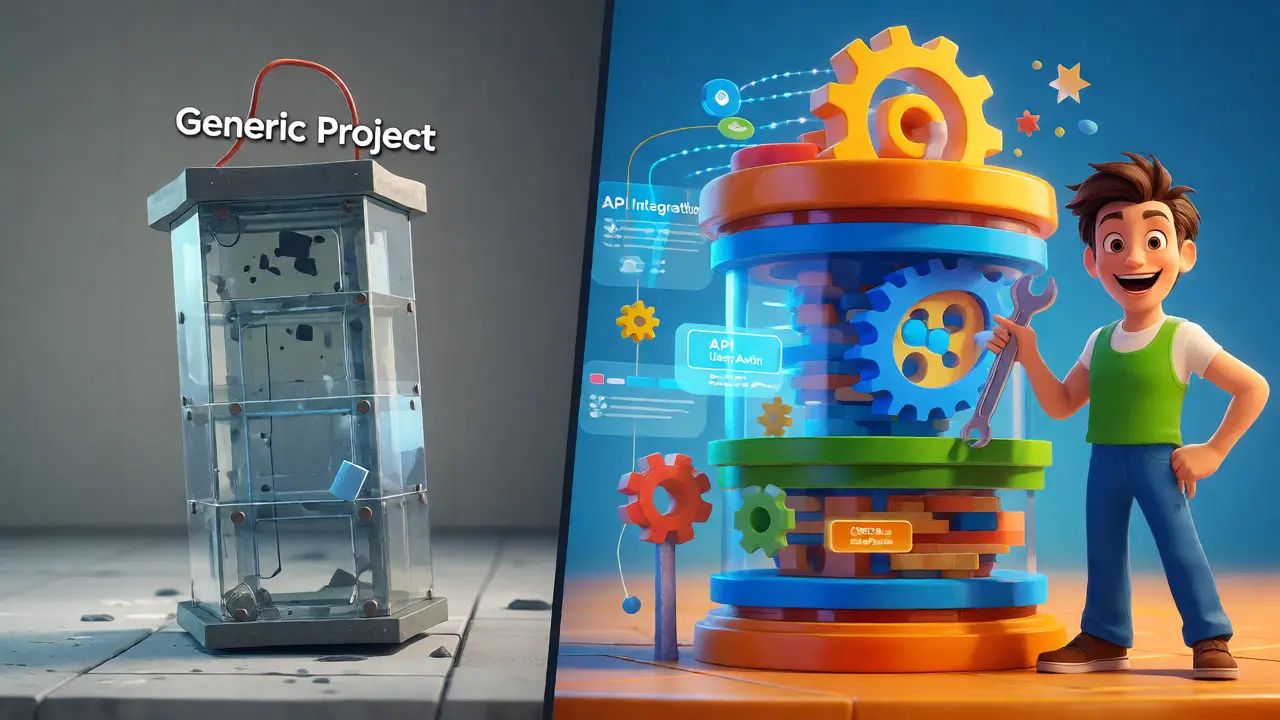
The biggest mistake learners make is picking a project that is too small or too isolated. A calculator app shows you know syntax. A weather dashboard that pulls from an API, stores user preferences, and visualizes trends shows you understand integration, state management, and user experience.
To ensure your project resonates with employers, look at job descriptions for the role you want. If you want to be a Data Analyst, companies aren’t asking for clean datasets. They are dealing with messy CSVs, missing values, and inconsistent formats. Therefore, your capstone shouldn’t use Kaggle’s perfectly cleaned Titanic dataset. Instead, scrape real data from a local government website, clean it yourself, and derive insights. The messiness is the feature, not the bug.
| Career Path | Generic Student Project | Industry-Ready Capstone | Key Skill Demonstrated |
|---|---|---|---|
| Web Developer | To-Do List App | E-Commerce Store with Payment Integration & User Auth | State Management, API Integration, Security |
| Data Scientist | Iris Flower Classification | Customer Churn Prediction using Imbalanced Real-World Data | Data Cleaning, Feature Engineering, Model Evaluation |
| UX Designer | Redesign of Existing App Screens | End-to-End Product Design with User Testing & Iteration Logs | User Research, Prototyping, Usability Testing |
| Digital Marketer | Social Media Calendar Template | Full-Funnel Campaign with Budget Allocation & ROI Analysis | Analytics, Copywriting, Strategic Planning |
Notice the shift from "static" to "dynamic." Static projects prove you know the tools. Dynamic projects prove you know how to use the tools to solve moving targets.
Defining Scope Without Killing Momentum
Scope creep kills more capstones than lack of skill. You start with a grand vision-a social network for dog owners-and six weeks later, you’re still trying to figure out how to upload images without crashing the server. You need a Minimum Viable Product (MVP) mindset.
Here is a practical rule of thumb: If you can’t describe the core value proposition of your project in one sentence, it’s too complex. For example, "A platform where users can track their daily water intake and visualize hydration trends over time" is clear. "A comprehensive health ecosystem" is a nightmare.
Break your project down into three tiers:
- Core Functionality (Must-Have): The bare minimum that makes the project useful. If this breaks, the project fails. For a blog, this is writing, saving, and displaying posts.
- Enhancements (Should-Have): Features that add polish but aren’t critical. Comments, search functionality, dark mode.
- Nice-to-Haves (Could-Have): Advanced features that impress but take disproportionate time. AI-generated summaries, real-time collaboration.
Build Tier 1 first. Get it working. Deploy it. Then move to Tier 2. This approach ensures you always have something to show, even if you run out of time. Employers prefer a simple, working product over a complex, broken prototype.
Documenting Your Process Is Half the Battle
You could build the best application in the world, but if nobody understands what you did, it doesn’t count. Documentation is often overlooked by technical learners who assume code speaks for itself. It doesn’t. Code explains how it works. Documentation explains why you built it.
Your README file (or case study) should follow a narrative structure. Don’t just dump screenshots. Tell a story.
Start with the Problem. "Local farmers struggle to find direct buyers for seasonal produce." Then the Solution. "I built 'FarmLink,' a mobile-first web app connecting farmers directly to consumers." Then the Tech Stack. "Built with Next.js for performance, Supabase for backend, and Tailwind CSS for rapid styling." Finally, the Challenges. "Integrating real-time inventory updates was difficult due to WebSocket latency issues. I solved this by implementing optimistic UI updates..."
This last part-the challenges-is gold. It shows resilience. Every developer faces bugs. Every designer faces client pushback. By documenting how you hit a wall and climbed over it, you demonstrate soft skills that certificates can’t measure.
Showcasing Soft Skills Through Collaboration
Even if you worked alone, frame your project within a collaborative context. Did you get feedback from peers? Did you conduct user testing? Did you iterate based on criticism?
Include artifacts of this process. A screenshot of a Figma comment thread where you debated button placement. A snippet of a Slack conversation where you discussed database schema changes. A video clip of you explaining your code to a non-technical friend.
These artifacts prove you are coachable. In a professional environment, ego is expensive. Hiring managers want people who listen, adapt, and improve. Your capstone is the perfect place to show that you don’t just build things; you build things with input.
Deployment and Accessibility Matter
A project living only on your localhost is invisible. You must deploy it. Use free tiers like Vercel, Netlify, Heroku, or AWS Amplify. Ensure the link works on mobile devices. Check load times. Make sure there are no console errors visible to the user.
Test your project on different browsers. Does it work on Safari? Firefox? Edge? These small details signal professionalism. If a recruiter clicks your link and sees a blank white screen because of a CORS error, they won’t dig deeper. They’ll click away.
Also, consider accessibility. Can someone using a screen reader navigate your site? Do your color contrasts meet WCAG standards? Adding these touches shows you care about the end-user experience, not just the code structure.
Turning One Project Into Multiple Assets
Once your capstone is done, don’t let it sit idle. Repurpose it across your professional footprint.
- LinkedIn: Write a post about what you learned. Tag the technologies used. Link to the live demo.
- GitHub/Portfolio Site: Pin the repository to the top. Add a GIF showing the app in action.
- Resume: List it under "Projects" with bullet points focusing on outcomes, not just tasks. "Reduced load time by 40% through image optimization" beats "Used HTML/CSS."
- Interviews: Prepare a 2-minute pitch. Practice explaining your architectural choices clearly and concisely.
Treat the capstone as a launchpad. It’s not the destination; it’s the proof that you’re ready for the next step.
Frequently Asked Questions
How long should a capstone project take to complete?
For most self-paced courses or bootcamps, aim for 4 to 8 weeks. This allows enough time to research, build, test, and document without burning out. If it takes longer than 3 months, your scope is likely too large. If it takes less than 2 weeks, it might be too shallow to demonstrate significant skill depth.
Is it better to do a team project or a solo project?
Both have merits. Solo projects prove you can manage the entire lifecycle independently, which is great for freelancers or junior roles. Team projects demonstrate collaboration, version control proficiency, and communication skills, which are vital for enterprise environments. Ideally, include one of each in your portfolio if possible. If you only have one, clearly define your specific contribution in a team setting.
What if my project isn't unique or innovative?
Uniqueness matters less than execution quality. A standard e-commerce site built with clean code, good error handling, and responsive design is impressive. A novel idea with buggy code and poor UX is not. Focus on polishing the fundamentals: performance, readability, and user experience. Innovation comes naturally once you master the basics.
Should I remove old projects from my portfolio?
Yes, curate ruthlessly. Keep your 3-5 best projects. Remove anything that looks outdated, has broken links, or demonstrates skills you no longer want to be hired for. Quality over quantity. A recruiter will spend less than 30 seconds scanning your portfolio; make every second count with high-quality, relevant work.
How do I handle proprietary code from internships?
You usually cannot share the actual code. Instead, create a case study. Describe the problem, your role, the technologies used, and the business impact. Include anonymized screenshots or mockups if allowed. Explain that the code is proprietary but offer to walk through the architecture during an interview.
Brannen Hall
September 14, 2026 AT 01:44Everyone acts like a capstone is this magical key to employment but honestly half of these projects are just bloated versions of what you could have done in an afternoon. The advice about scope creep is valid but the idea that a recruiter actually reads your README narrative is pure fantasy. They look at the tech stack and the live link. If it loads fast and looks okay they move on. This whole article overcomplicates the process to make people feel like they're doing something profound when they're really just building a toy.
Elisabeth Ballet
September 15, 2026 AT 11:30I completely disagree with the cynicism here because I've seen too many juniors fail interviews not because their code was bad but because they couldn't explain their decisions. That documentation part is critical. You need to show your thought process. Also stop saying recruiters don't read. Good ones do especially for junior roles where potential matters more than polish. Build the thing tell the story and own your choices.
Brenna Gonedrman
September 17, 2026 AT 05:28This is literally life-changing advice. I was drowning in tutorials feeling so lost and useless. Then I built one messy real project and suddenly everything clicked. It felt amazing. Don't be afraid of the mess. The mess is where the learning happens. Go build something ugly today.
Chandan Singh
September 18, 2026 AT 12:16Technically speaking, the distinction between 'tutorial hell' and actual competence is well documented in educational psychology literature regarding situated learning theory. However, the suggestion to scrape local government data introduces significant variable complexity regarding API stability and schema drift which often breaks student projects mid-interview cycle. A more robust approach would be using static snapshots of messy data to ensure reproducibility while still demonstrating cleaning skills. Also note that Vercel free tiers have cold start issues that can negatively impact first-load metrics if not optimized correctly which contradicts the advice on performance.
Courtney Wagstaff
September 19, 2026 AT 10:42love the vibe of this post 🌟 it’s so easy to get stuck in perfectionism paralysis. i think the best advice here is just to ship it. even if it’s janky. even if the colors clash. just put it out there. the feedback loop is way more valuable than staring at localhost forever. go forth and create some digital chaos!
Onyinyechi Nwosu
September 20, 2026 AT 07:40this hits home. i kept redoing my ui instead of finishing the logic. stopped trying to make it perfect and just made it work. feels lighter now
Kim Edwards
September 20, 2026 AT 19:02I am absolutely SHAKING reading this because it describes my exact trauma from last year! I spent three months agonizing over a database schema for a blog that nobody visited. Three. Months. And then I deployed it and realized I forgot to add SSL certificates so it showed up as insecure on Chrome. The shame! The absolute horror! But hey at least I learned how to debug certificate chains right? Or did I just waste my life? Who knows anymore.
Savara Gunn
September 21, 2026 AT 00:34It's okay to feel overwhelmed by the scope. Take a deep breath. You don't need to solve world hunger with your capstone. Just pick one small problem and solve it gently. Your worth isn't tied to the complexity of your app. Be kind to yourself during the build process.
Joanna Mucha
September 21, 2026 AT 11:57We must consider the ontological weight of the 'portfolio'. Is it merely a collection of artifacts or is it a mirror reflecting our professional soul? The author suggests practicality but ignores the existential dread of being perceived. When we deploy we expose ourselves to the gaze of the Other. The broken link is not just a technical error it is a metaphorical failure of connection. We are all just waiting for someone to click and understand us. The code is secondary to the vulnerability of existence.
tiffany King
September 22, 2026 AT 09:34Love this perspective! Especially the part about repurposing the project. I used my capstone to write a LinkedIn article and got two interview requests just from that! It really does open doors if you market it right. Keep going everyone you've got this!