Sustainable Online Learning: A Practical Guide for Institutions and L&D Teams
 Oct, 10 2026
Think about the last time you streamed a high-definition training video or downloaded a massive PDF manual. Did it feel heavy? Not emotionally, but physically. It shouldn't. Yet, the digital footprint of education is exploding. As we move deeper into 2026, institutions and Learning & Development (L&D) teams face a dual challenge: delivering engaging sustainable online learning experiences while minimizing the environmental impact of our digital habits. It’s not just about saving trees; it’s about reducing cognitive load, cutting costs, and future-proofing your educational infrastructure.
If you’re running an LMS or designing corporate training, you’ve likely noticed that "more" doesn’t always mean "better." More videos, more modules, and more data often lead to learner fatigue and higher server energy consumption. The shift toward sustainability isn’t a trend; it’s a necessity. This guide breaks down how to build learning ecosystems that are lighter on the planet and heavier on results.
The Hidden Cost of Digital Education
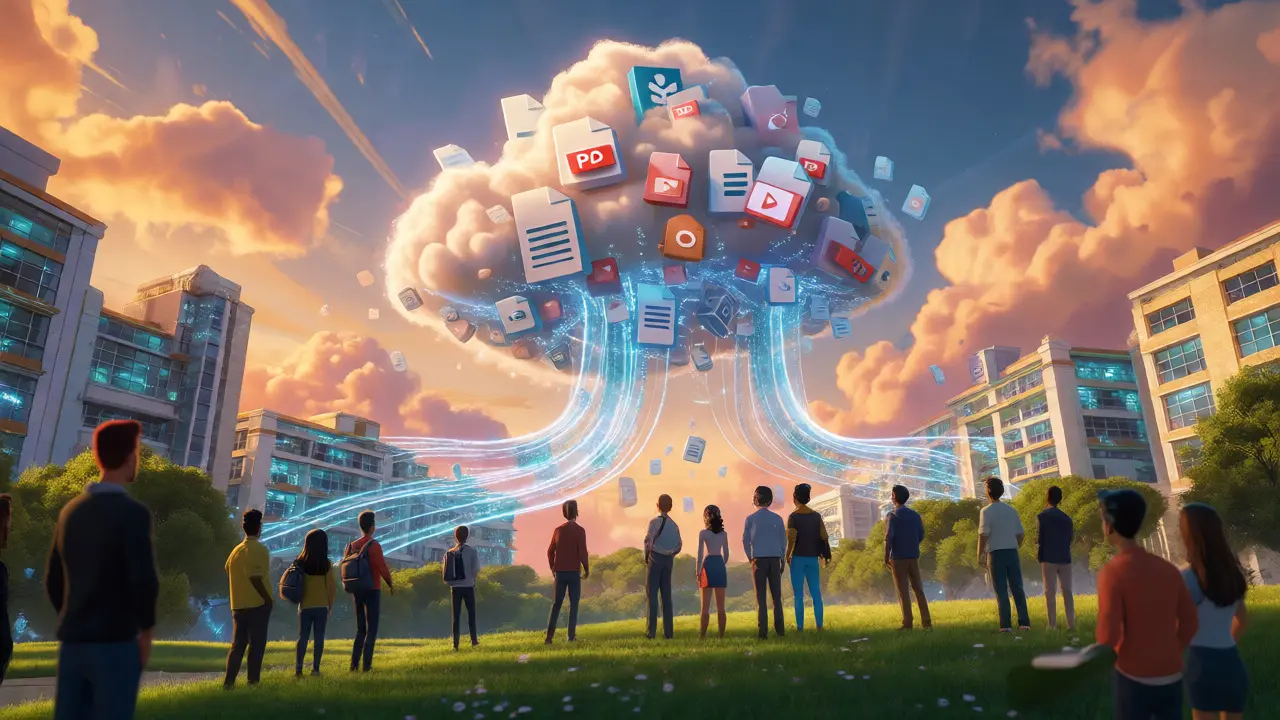
We tend to think of the cloud as ethereal, floating somewhere in the sky. In reality, it’s a network of massive data centers consuming electricity around the clock. When you upload a 4GB interactive simulation for every employee in a 10,000-person company, you aren’t just storing files; you’re generating carbon emissions through data transfer and storage processing. Studies indicate that the ICT sector contributes roughly 3-4% of global greenhouse gas emissions, a figure comparable to the aviation industry. For educational institutions, this means every click, stream, and download has an environmental price tag.
But the cost isn’t just ecological. There’s a human cost. Bloated course designs overwhelm learners. If a module takes ten minutes to load because of uncompressed assets, you’ve already lost the learner’s attention. Sustainable design forces us to ask: Is this asset necessary? Can it be optimized? Does it add value? By answering these questions, you create a leaner, faster, and more effective learning experience.
Green IT Strategies for L&D Infrastructure
Your first line of defense is technology optimization. You don’t need to rip out your entire tech stack, but you do need to audit it. Start with your media assets. High-resolution video is the biggest energy hog in most LMS platforms. Do you really need 4K resolution for a slide-based lecture? Probably not. Switching to adaptive bitrate streaming allows the platform to deliver only the quality the user’s device needs, saving bandwidth and energy instantly.
| Media Type | Average File Size | Energy Impact | Learner Experience |
|---|---|---|---|
| Uncompressed HD Video | 500MB+ per hour | High | Rich but slow loading |
| Adaptive Streaming | 100-200MB per hour | Medium | Smooth, device-aware |
| Audio + Slides | 20-50MB per hour | Low | Fast, focused |
| Text-Based Interactive | <5MB per module | Negligible | Instant access, high retention |
Next, look at your hosting provider. Are they using renewable energy sources? Many major cloud providers now offer "green regions" where data centers run on wind or solar power. Migrating your LMS to a green-certified host can significantly reduce your Scope 3 emissions without changing a single line of code. Additionally, consider caching strategies. Efficient caching reduces the number of requests sent to the server, lowering the computational load and speeding up delivery times for users in remote areas with slower connections.

Pedagogy That Reduces Cognitive Waste
Sustainability isn’t just about hardware; it’s about how humans learn. Cognitive waste occurs when learners spend mental energy navigating confusing interfaces or sifting through irrelevant information. This is where microlearning shines. Breaking content into small, digestible chunks reduces the amount of data transferred per session and helps learners complete tasks in shorter bursts. This aligns perfectly with mobile-first usage patterns, where users prefer quick, efficient interactions over long, draining sessions.
Another key principle is "just-in-time" learning. Instead of forcing employees to memorize processes they might use once a year, provide accessible knowledge bases they can query when needed. This shifts the burden from rote memorization (which requires repeated study cycles and thus more data usage) to retrieval practice. Tools like AI-powered search assistants within your LMS can help learners find specific answers quickly, preventing them from watching entire courses to find one minute of relevant info.
Consider the concept of digital minimalism. Before adding a new feature to your curriculum, apply the "spark joy" test-or rather, the "adds value" test. Does this quiz improve performance? Does this animation clarify a complex concept? If not, cut it. Leaner courses are easier to update, cheaper to maintain, and less likely to become obsolete. This reduces the frequency of full system rebuilds, which are resource-intensive projects.
Policy and Procurement: Making Sustainability Official
For larger institutions, individual actions need systemic support. This starts with procurement policies. When buying new laptops for students or tablets for corporate trainers, prioritize devices with high energy efficiency ratings and longer lifespans. The manufacturing phase of electronics accounts for a huge portion of their carbon footprint. Extending the life of a device by just two years can halve its lifetime emissions.
Implement a "digital hygiene" policy. Encourage staff and students to delete old drafts, clear email attachments, and archive unused courses regularly. While deleting an email seems trivial, multiplied across thousands of users, it frees up significant server space. Some organizations have gamified this process, rewarding departments that meet data reduction targets. It turns a dry IT task into a team-building exercise.
Furthermore, integrate sustainability metrics into your L&D KPIs. Track not just completion rates, but also the average time-on-task and bandwidth usage per learner. If a new course has a 90% completion rate but takes twice as long to load as the previous version, it might not be sustainable. Balancing engagement with efficiency gives you a holistic view of program health.
Case Study: The University of Arizona’s Approach
Here in Tempe, we see practical applications of these principles. Many universities are moving away from printed course packets entirely, shifting to digital repositories. But they go further by optimizing those repositories. They compress images aggressively and use vector graphics instead of raster images wherever possible. Vector files scale infinitely without losing quality and take up a fraction of the storage space. This simple technical choice saves terabytes of data annually across large student bodies.
Corporate examples are equally compelling. A global tech firm recently audited its training library and found that 40% of its video content hadn’t been viewed in three years. By archiving this content and focusing on evergreen text-based resources, they reduced their storage costs by 25% and improved search relevance scores. The lesson? Less is often more, both for the environment and the bottom line.
Implementation Checklist for L&D Leaders
Ready to start? Here’s a practical roadmap to kickstart your sustainability initiative:
- Audit Your Assets: Identify the top 10 largest files in your LMS. Compress or replace them.
- Review Hosting Contracts: Ask your vendor about their energy sources and carbon offset programs.
- Adopt Adaptive Streaming: Ensure your video player adjusts quality based on connection speed.
- Promote Microlearning: Break existing long-form courses into modular, bite-sized units.
- Set Retention Policies: Define how long inactive user data should be stored before archiving.
- Educate Stakeholders: Train instructors on creating lightweight, efficient content.
This isn’t a one-time project. It’s an ongoing cultural shift. As technology evolves, so will the best practices for keeping our digital footprint light. Stay curious, keep measuring, and remember that every byte saved counts.
What is the biggest contributor to carbon emissions in online learning?
Video streaming is typically the largest contributor due to the high bandwidth required for transmission and the energy used by servers to process and store large media files. Optimizing video formats and resolutions is the most effective immediate step for reduction.
Does switching to paperless learning always save energy?
Not automatically. If digital files are bloated, unoptimized, or stored inefficiently, the energy cost of maintaining the digital infrastructure can outweigh the savings from avoiding paper production. Proper digital hygiene and file compression are essential to ensure net positive environmental impact.
How can I measure the sustainability of my LMS?
Track metrics such as total storage volume, average page load times, video bitrates, and server uptime energy consumption. Many modern LMS platforms provide analytics dashboards that can help estimate data usage per active user, allowing you to benchmark improvements over time.
Are AI tools sustainable for education?
AI tools vary widely. Large language models require significant compute power for training and inference. However, when used efficiently-such as for summarizing texts to reduce reading time-they can lower overall cognitive and temporal costs. Choose AI solutions hosted on renewable-energy-powered clouds to mitigate their impact.
What role does device lifespan play in sustainable learning?
Device manufacturing accounts for the majority of a laptop's lifecycle emissions. Extending the useful life of learning devices by even one year significantly reduces the per-user carbon footprint. Prioritizing durable, repairable hardware and software that runs well on older machines supports this goal.