Writing Across Genres: Emails, Reports, and Essays in ESL Courses
 Mar, 22 2026
When you're learning English as a second language, grammar drills and vocabulary lists only take you so far. Real communication doesn’t happen in flashcards-it happens when you write an email to your boss, draft a project report for your team, or craft an argument for a class discussion. That’s why modern ESL courses are shifting from isolated grammar lessons to teaching writing across real-world genres. Students aren’t just learning English-they’re learning how to function in workplaces, classrooms, and communities.
Why Genre Matters More Than Grammar
Most ESL programs used to treat writing as one skill: write a paragraph, fix the errors, move on. But an email to a colleague isn’t an essay for a literature class. The tone, structure, and even word choice change completely. A student who can write a five-paragraph essay might still freeze when asked to reply to a manager’s request. Why? Because they’ve never practiced the genre.
Research from the University of Michigan’s English Language Institute shows that learners who practiced genre-specific writing improved their clarity and confidence 40% faster than those who only worked on general composition. That’s not magic-it’s context. When you learn how to structure a business email, you’re not just memorizing phrases. You’re learning how to read social cues in writing: when to be direct, when to soften your tone, when to leave something unsaid.
Emails: The Most Common-and Most Misunderstood-Genre
If you work in an English-speaking environment, you’ll write more emails than any other form of writing. And yet, ESL students often treat them like formal letters: overly polite, vague, and full of filler phrases like "I hope this message finds you well."
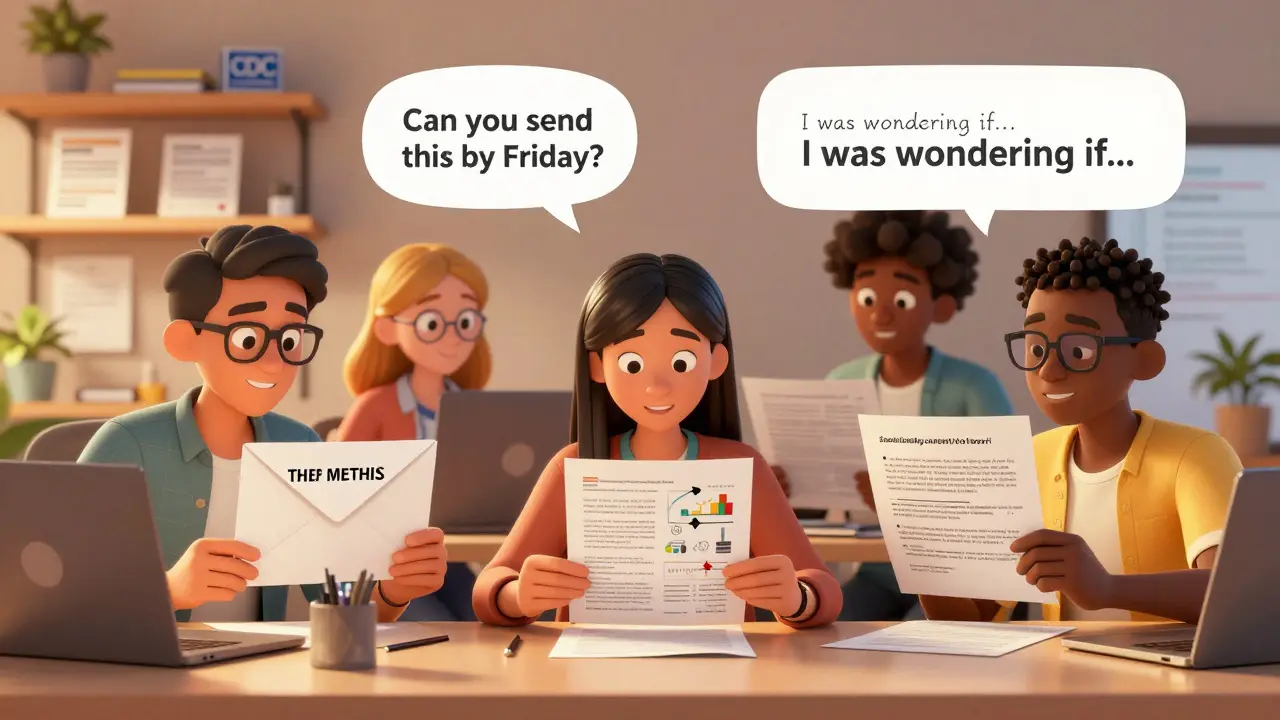
But in most workplaces, especially in the U.S., emails are fast, direct, and action-oriented. Instead of "I would appreciate it if you could possibly consider...", you write: "Can you share the budget report by Friday?"
Effective ESL email training includes:
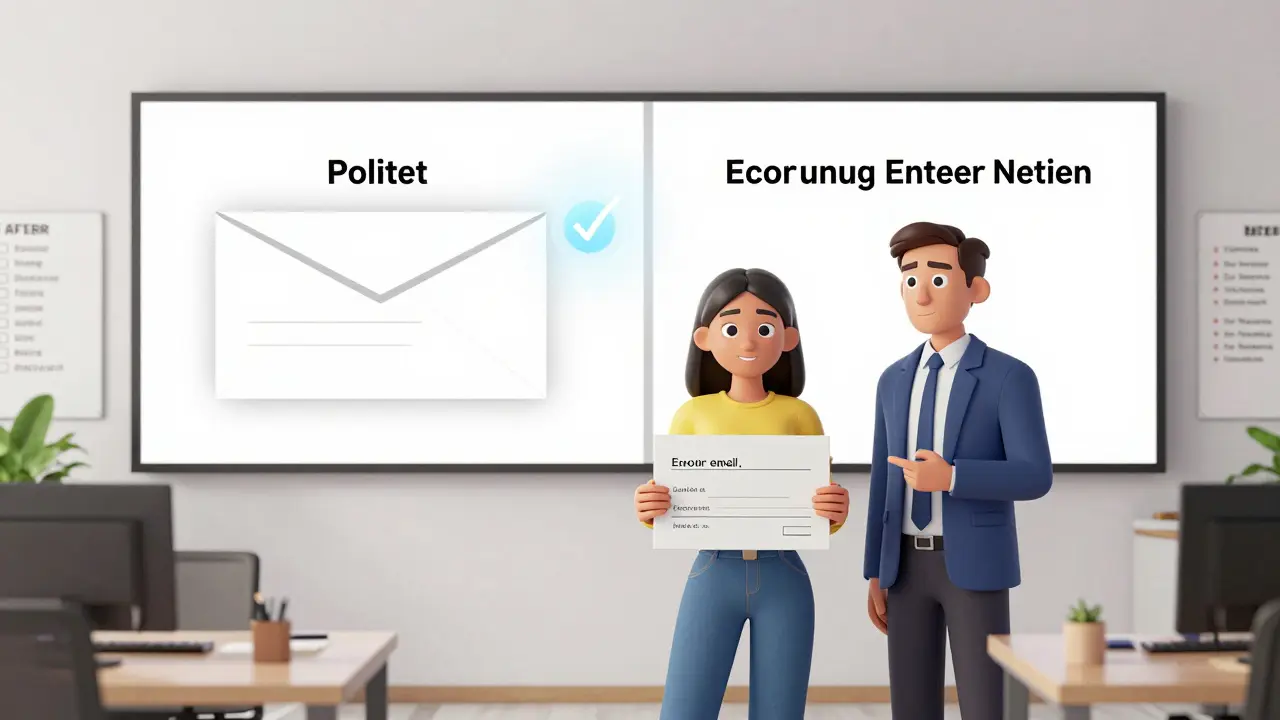
- Recognizing the difference between internal emails (casual, abbreviated) and external emails (more formal, full names)
- Using subject lines that clearly state the purpose
- Knowing when to use "Please" versus "Could you" versus a direct request
- Avoiding over-apologizing: "Sorry to bother you" is often unnecessary
One student from Colombia, working at a tech startup in Austin, told me she failed three internal communications before realizing her emails sounded like requests, not tasks. Once she learned to write in "task mode"-subject line = action, first sentence = deadline-her manager stopped asking for follow-ups.
Reports: Turning Data Into Decisions
Whether it’s a lab report, a sales summary, or a project update, reports demand clarity, structure, and precision. Many ESL learners struggle here because they’re used to essays that tell a story. Reports don’t tell stories-they answer questions: What happened? Why does it matter? What should we do next?
A strong business report in English follows this pattern:
- Summary (executive overview): One paragraph that answers the "so what?"
- Methods or context: What data was used? When? How?
- Findings: Facts, numbers, trends-no opinions here
- Analysis: What do these findings mean?
- Recommendations: Clear, actionable next steps
Students often confuse analysis with description. For example, writing "Sales went up 15%" is description. Writing "Sales increased because the new pricing strategy reduced customer churn" is analysis. ESL programs that use real company reports-like those from local nonprofits or small businesses-help students see how data becomes decisions.
A recent study in the Journal of English for Academic Purposes found that students who practiced writing workplace reports with real datasets improved their logical reasoning skills in English by 52% in just eight weeks.
Essays: The Bridge Between Classroom and Critical Thinking
Eyebrows raise when you say "essay" in an ESL class. Many learners think it’s just about structure: introduction, body, conclusion. But in academic settings, essays are about argument. They’re not summaries. They’re not opinions. They’re claims backed by evidence.
The biggest hurdle? Students from cultures where direct criticism is avoided often write essays that sound hesitant: "Some people think climate change is bad, and maybe it is." That doesn’t convince a professor.
Strong academic writing in English requires:
- A clear thesis statement: "Climate change is accelerating due to industrial emissions, and policy changes are urgently needed."
- Using evidence from credible sources: studies, statistics, expert quotes
- Addressing counterarguments: "Some argue that individual actions matter more, but data shows corporations produce 70% of global emissions."
- Formal tone without being stiff: Avoid "I think" and "in my opinion"-let the evidence speak
One student from Saudi Arabia, studying at Arizona State University, rewrote her first essay five times. Her professor gave her feedback: "You’re polite, but you’re not persuasive." She learned to use data from peer-reviewed journals and to state her position upfront. By the end of the semester, she won the university’s undergraduate writing award.
How to Teach Genre Writing in ESL
Teachers who want to build genre-based writing skills need more than handouts. They need:
- Real examples: Show students actual emails, reports, and essays from native speakers
- Analysis exercises: Have students underline the thesis in an essay, highlight the call-to-action in an email, or trace the data flow in a report
- Role-playing: Simulate workplace scenarios-"You’re the manager. Write an email to your team about a missed deadline."
- Peer review with rubrics: Use genre-specific checklists: "Did the email have a clear subject line? Did the report include recommendations?"
- Feedback that targets genre, not just grammar: Instead of correcting every comma, ask: "Is this email too long? Would the reader know what to do next?"
One teacher in Phoenix started using templates from real companies-like the email format used by Google or the report structure from the CDC. Students didn’t just learn English. They learned how professionals think.
What Happens When Students Master Multiple Genres
When ESL learners can switch between genres, they stop being "language learners" and become confident communicators. They can:
- Negotiate deadlines in emails without sounding rude
- Present data in reports that get funding or approval
- Argue ideas in essays that earn top grades
A 2025 survey of 1,200 ESL graduates in U.S. workplaces found that those who had genre-based writing training were 3.2 times more likely to be promoted within two years than those who hadn’t. Why? Because employers don’t hire people who can speak English-they hire people who can write clearly, think critically, and act decisively.
It’s not about perfection. It’s about function. A poorly punctuated email that gets the job done is better than a perfectly written one that never says what needs to be said.
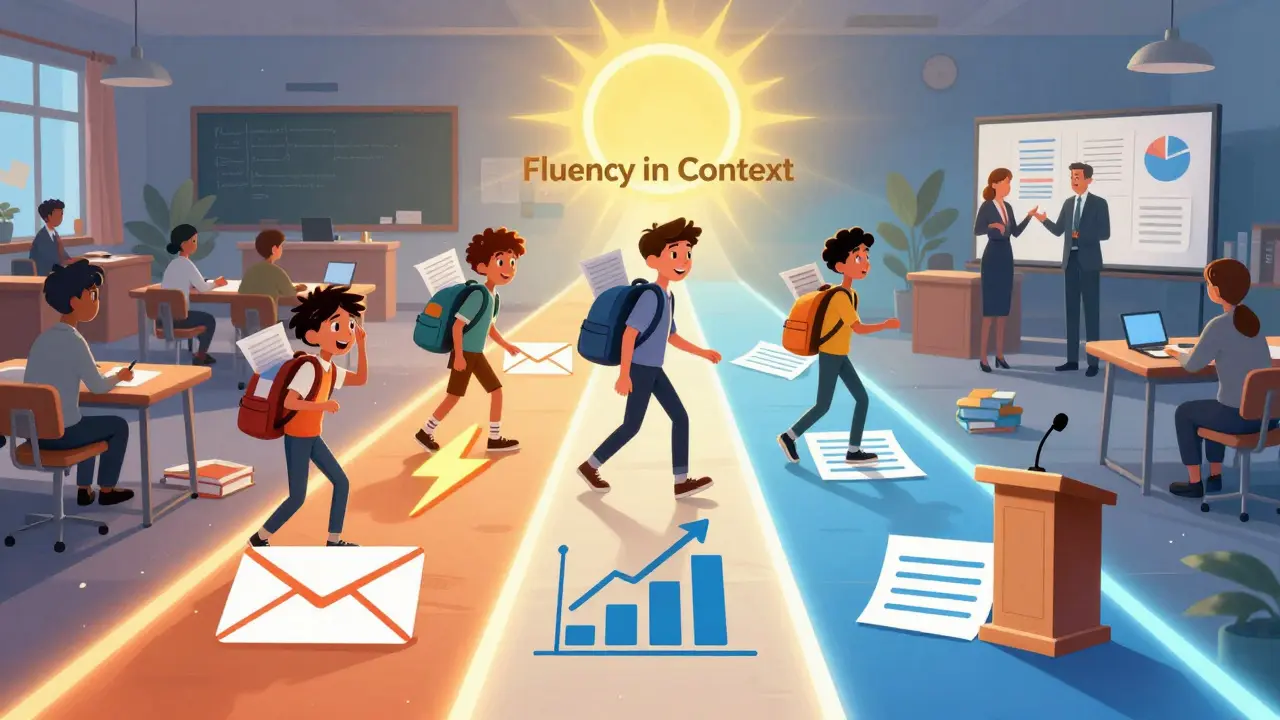
The Real Goal: Fluency in Context
Writing in ESL isn’t about mastering the past perfect tense. It’s about mastering how to get things done in English. Whether you’re writing to your landlord, your professor, or your client-you’re not practicing grammar. You’re practicing power.
Genres are the hidden curriculum of language learning. And once students understand how emails, reports, and essays actually work in the real world, they stop fearing writing. They start using it.
Why do ESL students struggle with writing emails even if they can write essays?
Essays focus on structure and argument, while emails demand tone, brevity, and clear action. Students often translate essay-style politeness into emails, making them sound vague or passive. For example, "I was wondering if you might be able to..." instead of "Can you send this by Friday?" Workplace emails prioritize efficiency over formality, and without targeted practice, learners don’t learn this shift.
Can genre-based writing improve speaking skills too?
Yes. Writing and speaking share the same cognitive patterns: organizing ideas, anticipating audience needs, and adjusting tone. When students learn to write a clear report, they also learn how to summarize information verbally. Many teachers report that students who practice genre writing become more confident in meetings and presentations because they’ve already practiced structuring their thoughts on paper.
What’s the best way to find real examples of business emails and reports?
Look for public documents: company annual reports, government publications (like CDC or EPA summaries), university newsletters, or even open-source project updates on GitHub. Many nonprofits post meeting minutes or funding requests online. These are authentic, unedited examples that show real-world language use. Avoid textbook samples-they’re often too idealized.
Is it okay to use templates for writing emails and reports?
Templates are excellent starting points, especially for beginners. They reduce cognitive load by showing structure. But the goal isn’t to memorize templates-it’s to understand why they work. Once students learn the logic behind a report’s summary section or an email’s subject line, they can adapt the structure to new situations. Over time, templates become internal frameworks, not crutches.
How long does it take for ESL learners to become comfortable writing in different genres?
With consistent practice, most learners show noticeable improvement in 6-8 weeks. The key is frequency: writing one email, one report, and one essay per week, with targeted feedback, builds fluency faster than months of general writing practice. It’s not about quantity-it’s about repetition across contexts.
Antonio Hunter
March 22, 2026 AT 21:55It’s funny how we treat writing like it’s one universal skill, when really, each genre has its own DNA. An essay is a performance. An email is a transaction. A report is a map. You don’t use the same compass for all three.
And honestly? The biggest shift for non-native speakers isn’t vocabulary-it’s unlearning politeness as a default. I’ve seen students write emails that sound like apology letters. "I’m so sorry to disturb you, but if it’s not too much trouble, could you possibly…" No. Just say: "Here’s the data. Need your input by 5."
It’s not rude. It’s efficient. And efficiency is the real currency in most workplaces. The moment someone stops thinking in terms of "correctness" and starts thinking in terms of "function," everything clicks.
One of my students from Japan used to write emails that were 200 words long and ended with three thank-yous. After we broke down real Slack messages from her team, she rewrote one in 17 words. Her manager replied: "Finally, someone who gets it."
Context isn’t just helpful-it’s everything.
Paritosh Bhagat
March 24, 2026 AT 15:31Ugh. I can’t believe people still think grammar doesn’t matter. You can’t just throw out proper punctuation and call it "efficiency." "Can you send this by Friday?" is lazy. It’s missing a subject. It’s not even a complete sentence. What happened to "Could you please send me the report by Friday?"
And don’t get me started on people saying "Sorry to bother you" is unnecessary. That’s basic etiquette. Some cultures just don’t know how to be respectful.
I’ve seen so many non-native speakers ruin their credibility because they think being direct equals being professional. No. Being direct equals being rude if you don’t soften it with the right words. Grammar isn’t a crutch-it’s the foundation.
Ben De Keersmaecker
March 24, 2026 AT 22:21Paritosh is technically right about sentence structure, but he’s missing the point. In spoken and written English at work, we don’t use full sentences all the time. It’s not laziness-it’s rhythm. "Send the report by Friday." is perfectly grammatical as an imperative. It’s not "Can you...?" because it’s not a question. It’s an instruction.
Think about it: if I say "Pass the salt," I don’t say "Could you please pass the salt?" unless I’m being sarcastic or extremely polite.
Language evolves based on function, not textbook rules. And in high-pressure environments, clarity trumps formality every time. The real grammar lesson here is understanding register-not memorizing subject-verb-object structures.
Aaron Elliott
March 25, 2026 AT 03:30Let’s be honest: this entire article is a neoliberal fantasy dressed up as pedagogy. You’re not teaching "function." You’re teaching compliance.
"Write emails like a robot. Write reports like a spreadsheet. Write essays like a thesis statement generator."
Where’s the humanity? Where’s the creativity? Where’s the soul? Language isn’t a tool to get things done-it’s how we express meaning, nuance, identity.
By reducing writing to genre templates, we’re not empowering learners-we’re training them to be better cogs in a corporate machine. "Can you send this by Friday?" isn’t progress. It’s linguistic assimilation.
And let’s not pretend that "task mode" is universal. In Germany, Japan, Sweden-people still value tone, context, and relational harmony. This isn’t global. It’s American. And it’s toxic.
Chris Heffron
March 25, 2026 AT 23:21Love this. 😊
Also, I’ve been teaching ESL for 12 years and I can confirm: the email thing is HUGE. I had a student from Brazil who wrote emails that were 5 paragraphs long. I said: "Try this: 1 line subject. 1 line ask. 1 line deadline." She did. Got a reply in 12 minutes.
Also, "I hope this message finds you well"? Delete. Just. Delete.
And yes-templates are lifesavers. I give my students a Google Doc with real examples from Apple, NASA, and local nonprofits. They love it. No more guessing.
Grammar matters. But not like this. 😅
Adrienne Temple
March 26, 2026 AT 23:04This is so true. I teach adult learners and the moment they stop trying to write "perfect English" and start writing "clear English," everything changes.
One woman from Nigeria was terrified to write emails to her boss. She’d rewrite each one 7 times. I told her: "Say it like you’re telling a coworker in the breakroom. Then delete the fluff."
She did. Got promoted 3 months later.
Also-yes to real examples. Textbooks are useless. Real emails? Gold.
And essays? Ugh. So many students think "I think" is required. No. Just state it. "The data shows." Done.
Grammar is a tool. Not a cage. 🙌
Sandy Dog
March 27, 2026 AT 13:28OH MY GOSH. I just cried reading this. 😭
I’m a former ESL student. I wrote an email to my boss once that said: "I was wondering if maybe, if it’s not too much trouble, you might consider…"
He replied: "Just tell me what you need."
I was so embarrassed. I thought I was being polite. Turns out I was being invisible.
Then I found a YouTube video where a woman from India broke down real Slack messages from Google engineers. I saved it. I watched it 12 times. I printed the templates. I taped them to my monitor.
Now I lead a team. And I teach my new hires this exact stuff.
This article? It saved my career. 🥹💖
Nick Rios
March 28, 2026 AT 02:37I’ve been thinking about this a lot lately. There’s this idea that "native speakers" all write the same way. But they don’t. My coworker from Texas writes emails like he’s texting his brother. My manager from Boston writes like a legal document. Both are effective. Both are different.
What matters isn’t the rules-it’s the audience. And teaching students to read the room in writing? That’s the real skill.
Grammar? Useful. But if you can’t tell the difference between a Slack message and a grant proposal? You’re stuck.
This isn’t about fixing errors. It’s about building awareness.
Amanda Harkins
March 28, 2026 AT 03:25I’m not sure why we’re so obsessed with "efficiency" as the end goal. What if someone just wants to feel heard? What if they need to express uncertainty? What if they’re not in a corporate environment?
Not everyone works at a startup. Not everyone has a manager who wants blunt emails.
There’s value in softness. In nuance. In hesitation. Language isn’t just about getting things done. Sometimes it’s about staying connected.
I’ve seen students from collectivist cultures lose their voice because they were told to "be direct."
Maybe we need to teach flexibility-not just templates.
Jeanie Watson
March 29, 2026 AT 19:20Yeah, but have you actually tried teaching this? I tried. Students got overwhelmed. "Which genre do I use when?" "What if I mix them?" "What if my boss is from China?"
It’s not as simple as "email = direct." Real life is messy. People write weird emails. Bosses reply in emojis. Teams use Slack. Clients send voice notes.
And not every workplace is U.S.-style. I work with a global team. Our emails are a weird hybrid of British formality and American brevity.
This article feels like a checklist. Real fluency? It’s not teachable. It’s caught.
Tom Mikota
March 30, 2026 AT 20:38Grammar police here. 🚨
"Can you send this by Friday?" is NOT a complete sentence. It’s an imperative. Fine for texting. Not for professional writing. Where’s the subject? Where’s the verb agreement? Where’s the modal? It’s lazy. It’s sloppy. It’s what happens when you let people "just be themselves."
And "I hope this message finds you well"? It’s not filler. It’s a cultural bridge. It says: "I see you as a person."
Also, templates? That’s not learning. That’s memorization. You’re training robots, not communicators.
And don’t get me started on "analysis" vs. "description." I’ve seen students confuse correlation with causation because they were told to "sound smart."
This whole thing is a disaster.
Mark Tipton
March 31, 2026 AT 16:19Let me tell you what’s really going on here. This isn’t about ESL. It’s about cultural imperialism.
"Write like an American. Think like a Silicon Valley startup. Speak like a corporate drone."
Behind every "task mode" email is a hidden agenda: assimilate or be excluded.
And don’t pretend this is about "function." It’s about control. Who decides what "clear" means? Who gets to define "professional"?
What about cultures that value indirectness? Harmony? Relationship over transaction?
This isn’t progress. It’s erasure.
And the "3.2x more likely to be promoted" stat? That’s not data. That’s propaganda. Sponsored by LinkedIn. Guaranteed.
Adithya M
April 1, 2026 AT 18:24From India: We do this differently here. We teach grammar FIRST. Then context. You can’t teach tone if they don’t know subject-verb agreement.
Also-"Can you send this?" is fine in casual settings. But in formal reports? No. We use "Kindly share the report by Friday." It’s polite. Clear. Professional.
And templates? Yes. But only after they understand why the structure works.
One size doesn’t fit all. But grammar? That’s the foundation. No foundation = collapse.
Jessica McGirt
April 3, 2026 AT 04:27This. So much this.
I had a student from Iran who wrote essays like poetry. Beautiful. But her professor failed her because she never stated a thesis.
We spent 3 weeks on one thing: "What is your claim?" Not "What do you think?"
She cried. Then she aced her next paper.
It’s not about erasing culture. It’s about adding tools. You don’t lose your voice-you learn to use it in new rooms.
And yes-real examples change everything. I use real emails from my own inbox (anonymized). Students gasp. "Wait. People write like this?"
They do. And they should.
Donald Sullivan
April 4, 2026 AT 05:44Grammar Nazis are exhausting. "Can you send this?" is a sentence. It’s called an imperative. You use it when you’re the boss. Or when you’re asking a favor. Stop pretending English is a Latin exam.
Also-"I hope this message finds you well"? That’s not polite. That’s a waste of time. No one reads it. No one cares. Delete it.
Stop romanticizing "cultural differences." In business? Clarity wins. Always.
Tina van Schelt
April 5, 2026 AT 00:24I used to be terrified of writing emails. Now? I write them like I’m texting my best friend. But I know when to dial it up. Dial it down. That’s the magic.
My boss is from Kenya. My client is from Norway. My team is from 7 countries. I don’t write the same way to all of them.
It’s not about templates. It’s about tuning in.
And honestly? The best teachers I’ve had didn’t teach grammar. They taught me to listen-to the tone, to the silence, to what’s left unsaid.
That’s fluency.
Ronak Khandelwal
April 6, 2026 AT 02:56Genius. 🌍✨
This isn’t about English. It’s about power. Who gets to speak? Who gets to be heard?
When you teach genre writing, you’re not teaching language. You’re teaching access.
One student from rural Bangladesh wrote a report on clean water. Her first draft? 12 pages. Full of metaphors. Beautiful. But the NGO said: "We need bullet points. Numbers. Action."
She cried. Then she rewrote it. Got funded.
Now she’s training others.
This isn’t pedagogy. It’s liberation.
Antonio Hunter
April 6, 2026 AT 15:28Tom, you’re right that "Can you send this?" isn’t a full sentence in traditional grammar. But language isn’t static. It’s alive. And in professional settings, efficiency is a form of respect. The time you save by cutting fluff? That’s time someone gets to breathe.
And let’s be real-if your boss replies to "Could you possibly…" with "Just tell me what you need," you’re not being polite. You’re being a barrier.
Grammar gives you structure. Context gives you power. You need both. But if you had to pick one? Choose power.