Backtesting Crypto Strategies: Essential Data Sources, Common Biases, and How to Validate Them
 Nov, 22 2025
Backtesting a crypto trading strategy sounds simple: plug in some rules, run it against past price data, and see if it would’ve made money. But if you’ve ever done this and then lost money live, you’re not alone. Most retail traders fail here-not because their idea is bad, but because they used bad data, ignored hidden biases, or skipped proper validation. The difference between a strategy that looks amazing on paper and one that survives in live markets comes down to three things: where your data comes from, what biases you didn’t see, and how rigorously you tested it.
Not All Crypto Data Is Created Equal
You can’t backtest crypto like stocks. Markets don’t close at 4 p.m. They trade 24/7. Prices jump between exchanges. Liquidity vanishes in seconds. That means the data you use has to reflect reality, not just a simplified version of it. Many beginners use free OHLCV data (Open, High, Low, Close, Volume) from CoinGecko or CryptoCompare. It’s easy to get, but it’s also dangerously incomplete. OHLCV hides what happens inside each candle. Did the price spike to $70,000 and drop back to $68,000 in 30 seconds? That’s slippage you didn’t account for. Did your stop-loss get hit because of a 0.2% price gap? That’s not in OHLCV. For swing trading, daily data might be enough. For day trading, you need minute-level data. For scalping or market making? You need tick data-millisecond-level price and volume changes-and full order book snapshots. Kaiko found that 83% of professional crypto quant funds use level 2 or 3 order book data. Why? Because without seeing the depth of bids and asks, you can’t simulate realistic fills. Even worse, data from different providers doesn’t always match. Coinbase, Binance, and Kraken report different volumes during high volatility. TokenMetrics reported a 12-18% variance in reported trading volume during pump events. If you’re using data from just one source, you’re building a strategy on a house of cards. The fix? Use at least three data providers. CoinGecko, Kaiko, and CryptoCompare are the most trusted. Cross-check key events: Bitcoin’s 2021 all-time high, the 2022 LUNA collapse, the 2023 SEC crackdowns. If your data shows wildly different outcomes across sources, you’ve found a red flag.The Hidden Biases That Kill Backtests
Here’s the brutal truth: most backtested crypto strategies are lying to you. Not because they’re rigged, but because they’re built on flawed assumptions. Three biases ruin more strategies than bad code. Survivorship bias is the biggest. If you backtest only on coins still trading today, you’re ignoring the 70% of altcoins that died. In 2021, over 5,000 new tokens launched. By 2024, more than half were delisted. If your strategy says “buy any top 10 altcoin,” but you only tested on what’s still alive, you’re ignoring the graveyard. Coinbase’s research shows survivorship bias inflates returns by 17-22% annually. That’s not a strategy-it’s a fantasy. Look-ahead bias is sneakier. It happens when your code accidentally uses future data. For example, you use a 200-day moving average, but your data feed includes today’s price when it shouldn’t yet. Or you use the current market cap of a token that didn’t exist in 2020. This is common in Python scripts where data isn’t properly time-stamped. Dr. Carol Alexander says 75% of backtesting failures come from poor data handling, not bad logic. Timezone mismatches, incorrect candle alignment, and unsorted timestamps are the usual suspects. Overfitting is the most seductive. You tweak your strategy: change the RSI from 70 to 72, adjust the moving average from 50 to 53, add a volume filter. You run it 20 times. One version shows a 45% annual return. You’re thrilled. You go live. It crashes in two weeks. That’s overfitting. You didn’t find a pattern-you found noise. Dr. David Aronchick says most quants test 15-20 variations before calling one a winner. Only 1 in 10 survives live trading. The fix? Walk-forward analysis. Split your data into chunks. Train on 2020-2021, test on 2022. Train on 2022-2023, test on 2024. If your strategy fails on new chunks, scrap it.Execution Matters More Than Your Indicator
A strategy that looks perfect on paper often dies in execution. Why? Because backtesting engines assume perfect fills. Real markets don’t work that way. Slippage is the silent killer. On Binance, slippage averages 0.05-0.30% per trade during normal conditions. During a flash crash? It can hit 1.5%. If your backtest assumes zero slippage, you’re overestimating profits by 10-30%. CryptoCompare’s 2024 study found that 57% of backtesting failures were due to inadequate slippage modeling. Fees matter too. Binance spot fees range from 0.1000% to 0.0200% depending on your VIP level. If you’re trading 10 times a day, that adds up. A strategy that makes 8% a month might only net 4% after fees. Most free tools ignore this. Freqtrade and QuantConnect let you set custom fees. Use them. Latency is another hidden factor. Your bot connects to an exchange via API. That takes 50-200ms. During high volatility, prices move 1% in 200ms. If your strategy relies on quick entries, you’re always late. Backtrader and Backtesting.py don’t simulate latency. QuantConnect does. If you’re building a high-frequency strategy, you need this.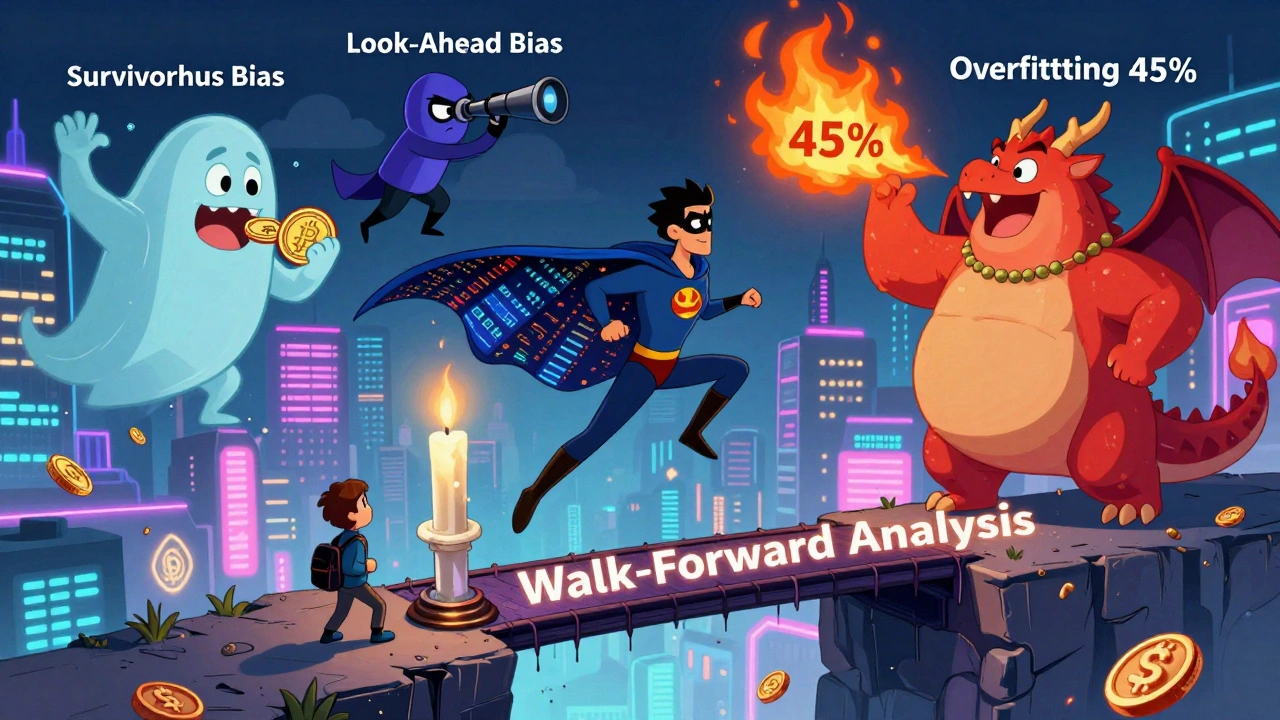
Tool Comparison: What to Use and Why
You don’t need to code from scratch. But choosing the wrong tool wastes months.- TradingView: Great for beginners. Pine Script is easy. But it doesn’t model slippage, fees, or order book depth. It’s fine for swing strategies, useless for scalping.
- Backtrader: Powerful, open-source Python tool. You can build anything. But it’s complex. GitHub shows over 200 open issues on crypto exchange integration. You need 80-120 hours of Python experience to use it well.
- Freqtrade: Built for crypto. Handles hyperparameter tuning, multiple exchanges, and AI integration. Supports 18 major exchanges. Users report 22% higher returns after tuning. But if you trade on lesser-known exchanges, you’re out of luck.
- QuantConnect: Institutional-grade. Backtests go back to Bitcoin’s first block. Includes Monte Carlo simulations and walk-forward analysis. Costs $199/month. Worth it if you’re serious.
- DolphinDB: Blazing fast. Processes 1 billion data points in under 20 seconds. Used by hedge funds. Its backtesting plugin handles order book data, slippage, and latency. Not for beginners, but if you’re scaling, it’s the only tool that won’t bottleneck you.
Validation: The Only Thing That Matters
Validation isn’t a step. It’s a mindset. The Crypto Council for Innovation’s 2025 Backtesting Standards require a minimum 3-year test period across multiple market regimes: the 2020 crash, the 2021 bull run, the 2022 bear market. If your strategy only worked in 2023, it’s not robust. It’s lucky. Here’s how to validate properly:- Test across at least three different market conditions: bull, bear, sideways.
- Use out-of-sample data. Don’t test on the same data you optimized on.
- Run 100+ Monte Carlo simulations. Shuffle your trade sequence. Does your strategy still hold up?
- Test on multiple exchanges. A strategy that works on Binance might fail on Kraken due to different order matching rules.
- Compare your results to a buy-and-hold baseline. If your strategy doesn’t beat BTC/USD over the same period, why are you trading it?

Real-World Failures and Fixes
A Reddit user named CryptoQuant99 backtested a strategy that returned 15% monthly. It crushed the market on paper. When live, it lost 30% in two weeks. Why? Binance’s API rate limits kicked in during volatility spikes. His bot tried to place 50 orders in 10 seconds. The exchange throttled him. He didn’t simulate API limits in his backtest. Another trader used Backtrader with OHLCV data and zero slippage. His strategy looked perfect. Live, it lost money because he never accounted for the 0.4% spread on ETH/USDT during a flash crash. His backtest assumed fills at the close price. Real trades filled at the bid or ask. The fix? Add constraints. Limit order frequency. Model API limits. Simulate slippage based on real volume profiles. Use order book data for high-frequency strategies. Don’t assume the market behaves like a textbook.What’s Next: AI and the Future of Backtesting
The next wave isn’t better indicators. It’s better simulation. TokenMetrics launched Predictive Backtesting in February 2025. It doesn’t just use price data. It adds on-chain metrics: exchange outflows, whale movements, miner activity. Then it uses machine learning to simulate how those signals might behave under different regulatory or macro conditions. QuantConnect now includes crypto-specific volatility regimes. Instead of assuming normal distribution, it models fat tails and jumps-exactly how crypto moves. The biggest shift? Backtesting is merging with paper trading. Platforms like Cryptohopper now let you test your strategy in real-time simulated markets before going live. You’re not just replaying history-you’re stress-testing in live conditions. But here’s the catch: no backtest can predict regulatory change. In April 2025, the SEC required registered crypto advisors to document backtesting methodologies that meet specific standards. If a new law bans certain trading pairs or forces centralized exchanges to change their order matching, all historical data becomes less relevant. Dr. Gary Gensler warned in March 2025 that regulatory evolution could invalidate decades of backtested assumptions. That’s why the best traders don’t rely on one backtest. They test constantly. They monitor live performance. They adjust. Backtesting isn’t the finish line. It’s the starting line.Can I backtest crypto strategies with free data?
Yes, but with major limitations. Free data from CoinGecko or CryptoCompare is fine for basic swing strategies using daily candles. But it lacks tick data, order book depth, and accurate slippage modeling. For day trading or scalping, free data will mislead you. Professional tools like QuantConnect or DolphinDB cost money because they provide the granularity needed to simulate real market behavior.
What’s the most common mistake in crypto backtesting?
Ignoring slippage and fees. Many traders assume they can buy and sell at the exact close price of a candle. In reality, orders fill at the bid or ask, and spreads widen during volatility. A strategy that looks profitable with 0% slippage often loses money once you add 0.2-0.5% slippage and exchange fees. Always model execution costs.
How long should a backtest run to be reliable?
At least three years, covering multiple market regimes: bull, bear, and sideways. Crypto markets are volatile and cyclical. A strategy that worked during the 2021 bull run might fail in a 2022 bear market. The Crypto Council for Innovation recommends testing across 2020 (crash), 2021 (bull run), 2022 (bear), and 2023-2024 (recovery) to ensure robustness.
Should I use AI to optimize my crypto strategy?
Only if you validate it properly. AI can find patterns in data-but it can also find fake ones. Hyperparameter tuning with Freqtrade or QuantConnect can improve returns, but only if you use walk-forward analysis and out-of-sample testing. Never rely on the best result from 100 iterations. That’s overfitting. Use AI to explore, not to find a magic solution.
Is backtesting still useful if crypto markets change so fast?
Yes-but not as a crystal ball. Backtesting helps you understand how your strategy behaves under stress. It reveals flaws in logic, data, and execution. Even if future market conditions differ, a strategy that survives multiple past regimes is more likely to adapt. The goal isn’t to predict the future. It’s to build something resilient enough to handle it.
Christina Morgan
December 5, 2025 AT 07:59Man, I wish I’d read this before I blew up my first crypto account. I used CoinGecko data, zero slippage, and thought I was a genius because my RSI strategy made 300% in backtest. Live? Lost everything in a week. The part about order book depth hit me hard-turns out I was buying at the top of fake spikes. Thanks for the wake-up call.
Now I use Kaiko + QuantConnect. Costs a fortune, but at least I’m not crying into my ramen anymore.
Kathy Yip
December 5, 2025 AT 13:22so… like… if the data is wrong, and the biases are hidden, and the tools are either too simple or too expensive… are we even supposed to backtest? or is this just a giant loop of self-delusion? i feel like crypto trading is just gambling with extra steps.
also, i think ‘walk-forward analysis’ sounds like something my yoga instructor says before savasana.
Bridget Kutsche
December 7, 2025 AT 04:49Hey Kathy, I get where you’re coming from-but don’t throw the baby out with the bathwater. Backtesting isn’t about predicting the future. It’s about finding your blind spots. I used to think I was ‘good at crypto’ until I ran a Monte Carlo simulation and saw my ‘winning’ strategy failed 92% of the time when trade order was shuffled.
It’s not magic. It’s math. And math doesn’t lie. Start small. Use Freqtrade. Add slippage. Test one variable at a time. You’ll be shocked how much you learn just by being humble about your assumptions.
Jack Gifford
December 8, 2025 AT 22:23Just to clarify-when you say ‘tick data,’ you mean actual bid/ask levels with timestamps, right? Not just the OHLCV that’s 5 minutes late because CoinGecko’s API is a potato?
Also, why does everyone ignore API rate limits? I’ve seen so many people backtest 50 trades per minute on Binance, then go live and get throttled after 3. That’s not a flaw in the strategy-it’s a flaw in their imagination.
Sarah Meadows
December 10, 2025 AT 03:39Free data? Please. If you’re not using DolphinDB or institutional-grade order flow, you’re not trading-you’re doing a TikTok dance with your life savings. America built the greatest economy on precision. Crypto isn’t a meme. It’s a battlefield. And if you’re using free data, you’re showing up to a gunfight with a water pistol.
Stop wasting time. Pay for the tools. Or get out.
Nathan Pena
December 11, 2025 AT 08:23Let’s be honest: 98% of retail traders don’t understand what a ‘moving average’ even is, let alone how to properly align timestamps across exchanges. The fact that this post even needs to exist is embarrassing. You don’t get to play with fire and then cry when you get burned.
And please, stop calling ‘backtesting’ a ‘strategy.’ It’s a diagnostic tool. You wouldn’t diagnose cancer with a Google search either.
Mike Marciniak
December 11, 2025 AT 10:32They’re all lying. The data providers, the exchanges, the ‘quant funds’-it’s all a front. The SEC and the big banks control the order books. They manipulate the tick data to trigger stop-losses and suck retail money in. That’s why your ‘robust’ strategy fails every time.
They want you to think it’s about data quality. It’s not. It’s about control. You’re being played. Always have been.
Buy gold. Hide your coins. Don’t trust any backtest.
VIRENDER KAUL
December 12, 2025 AT 13:13Backtesting is an illusion created by Western financial institutions to pacify the masses. In India, we understand that markets are not mathematical constructs but manifestations of collective karma. Your OHLCV data is irrelevant. Your slippage models are arrogance dressed as science.
Instead of coding, meditate. Observe the market with stillness. The truth reveals itself in silence, not in Python scripts.
Also, your timezone settings are probably wrong. You are not in New York. You are in the flow.
Mbuyiselwa Cindi
December 13, 2025 AT 00:05This is gold. I’m from South Africa and we don’t have access to half the tools you guys do. But I’ve been using free data from CryptoCompare and just added a 0.3% slippage buffer and 0.1% fees manually in Excel. It’s not fancy, but now my strategy doesn’t look like a fantasy novel anymore.
Thanks for the reminder that simplicity beats complexity when you’re starting out. Keep it real, folks.
Krzysztof Lasocki
December 13, 2025 AT 11:23Oh wow. Another ‘I spent 6 months learning Python and now I’m a quant’ post. Congrats. You’ve officially joined the club of people who think they’re smarter than the market because they added a volume filter.
Here’s the truth: if your backtest looks too good, it’s garbage. The market doesn’t care about your RSI settings. It cares about liquidity, fear, and greed. And guess what? You can’t backtest human panic.
Go trade a small account for 6 months. Then come back and tell me if your 45% annual return was real-or just a dream with a spreadsheet.
Henry Kelley
December 14, 2025 AT 06:04Biggest thing I learned? Don’t trust any backtest that doesn’t include a ‘what if the exchange goes down for 3 hours’ scenario. That happened to me in 2022. My bot kept trying to buy ETH, but Binance was down. I lost money because I didn’t code for downtime.
Also, I used to think ‘overfitting’ was just a fancy word for ‘trying too hard.’ Now I know it’s the silent killer. I’ve scrapped 3 strategies just because they worked too well on one dataset.
Thanks for the reminder to stay humble.
Victoria Kingsbury
December 15, 2025 AT 05:12Y’all are overcomplicating this. If you’re day trading crypto with OHLCV data, you’re already behind. But here’s the secret: most profitable strategies are dumb. Buy the dip when BTC is under 50k and volatility is high. Hold for 3 days. Sell. No indicators. No AI. No order book depth.
The real edge isn’t in the data-it’s in your discipline. If you can’t stick to a simple rule, no amount of tick data will save you.
Also, QuantConnect is overpriced. Use Freqtrade + manual slippage. Done.
Tonya Trottman
December 16, 2025 AT 22:48Wow. Someone finally wrote something that doesn’t sound like a LinkedIn post from a crypto influencer who bought a Tesla with his ‘alpha.’
But let’s be real-this post is still missing the biggest bias: confirmation bias. You all read this and think, ‘Oh, I’ve got survivorship bias!’ but you’re still using the same 5 coins for backtesting. You’re not testing on dead tokens. You’re just pretending you are.
Also, ‘walk-forward analysis’? That’s not a technique. It’s a cop-out for people who can’t admit their strategy is garbage.
And why is everyone ignoring the fact that backtesting assumes the future resembles the past? In crypto, that’s a fairy tale.
Rocky Wyatt
December 18, 2025 AT 18:36Everyone’s so obsessed with data and slippage and fees. But you’re all ignoring the real problem: your psychology.
I’ve seen traders with perfect backtests blow up because they couldn’t handle a 5% drawdown. They doubled down. Then they cried when they lost 80%.
No tool fixes a broken mindset. No algorithm prevents panic. You don’t need better data-you need better control over your emotions.
Fix yourself first. Then come back to the backtest.
Santhosh Santhosh
December 20, 2025 AT 06:29When I first started backtesting, I used only Binance data and assumed all exchanges were the same. I was shocked when my strategy failed on Kraken. Then I realized: order matching is different. Binance uses price-time priority. Kraken uses a hybrid system. The spread, the latency, the depth-it’s not the same. I spent three months studying exchange whitepapers just to understand how fills actually work.
It’s not about the code. It’s about understanding the machine behind the market. Most people treat crypto like a stock market. It’s not. It’s a global, fragmented, 24/7 auction with no central authority. That changes everything.
So yes, use three data sources. Yes, model slippage. But also, read the exchange API docs. They’re boring, but they’re the truth.
Veera Mavalwala
December 20, 2025 AT 07:38Backtesting is like looking in a mirror made of smoke. You see a face, but it’s not real. The market doesn’t care about your moving averages or your fancy walk-forward tests. It laughs at your spreadsheets. It eats your stop-losses for breakfast.
And let’s not forget: the whales are watching your backtests. They know your patterns. They bait your indicators. They trigger your algorithms with fake volume. You think you’re smart? You’re the bait.
My strategy? I don’t backtest. I watch. I feel. I wait. And when the market screams-I move. No data. No code. Just instinct.
But hey, keep your Python scripts. They make great wall art.
Ray Htoo
December 21, 2025 AT 00:13One thing no one talks about: data gaps. I was using CryptoCompare’s daily data for a swing strategy. Thought I was golden. Then I noticed my ‘buy signals’ were always on Mondays. Turned out CoinGecko had a 2-day data gap every Sunday night. My whole strategy was built on missing data.
Now I cross-check three providers and flag any gaps before I even run a backtest. It’s tedious, but it’s the only way to avoid building a strategy on ghosts.
Also, never trust volume data from a single source. During the LUNA crash, one exchange reported 10x the volume of another. That’s not noise-that’s a trap.
Natasha Madison
December 21, 2025 AT 10:29They’re lying to you. The ‘3-year test period’? That’s a PR stunt. The SEC and the big exchanges control the data feeds. They can inject fake volatility. They can erase trades. You think your backtest is real? It’s a simulation inside a simulation.
And why do you think they push ‘QuantConnect’ and ‘DolphinDB’? So you spend your money on tools they own. So you think you’re independent. You’re not.
Don’t backtest. Don’t trade. Just hold Bitcoin. And pray.
Sheila Alston
December 21, 2025 AT 20:32It’s so sad how people treat money like a game. You spend hours optimizing a strategy to make 12% a year, but you wouldn’t spend 12 minutes learning how to budget your rent.
Backtesting is just another way to avoid real financial responsibility. You think a 45% return will fix your life? It won’t. What you need is a job, a budget, and some emotional maturity.
Stop chasing algorithms. Start chasing peace.
sampa Karjee
December 22, 2025 AT 04:23As an institutional analyst with over two decades of experience in quantitative finance, I must emphasize that retail traders fundamentally misunderstand the nature of financial time series. The assumption that historical price data can be extrapolated into future profitability is a classical fallacy rooted in naive empiricism.
Furthermore, your reliance on Western-centric tools such as QuantConnect and Backtrader reflects a profound epistemological bias. In the Global South, we recognize that market dynamics are shaped by geopolitical, cultural, and infrastructural factors that cannot be captured by OHLCV datasets.
Additionally, your fixation on slippage modeling is a distraction. The real issue is systemic liquidity asymmetry, which is neither quantifiable nor replicable in backtesting environments. Therefore, I conclude that your entire framework is not merely flawed-it is epistemologically illegitimate.
Bridget Kutsche
December 23, 2025 AT 18:42Rocky, you’re right about the psychology part. I had a strategy that made 18% a month in backtest. Live? I froze during a 7% drop and held for 3 weeks. Lost 22%.
Turns out, my ‘edge’ wasn’t in the code. It was in my discipline. Now I have a rule: if I feel anxious during a trade, I close it. No matter what the model says.
Backtesting shows you what *could* work. Your mindset shows you what *will* work.