Fundamental Analysis in Cryptocurrency: How to Evaluate Teams, Tech, and Tokenomics for Long-Term Investing
 Nov, 24 2025
Most people think crypto investing is about watching price charts and hoping for a quick jump. But if you want to hold something for years-not weeks-you need to look past the noise. That’s where fundamental analysis comes in. It’s not flashy. It doesn’t give you instant answers. But over time, it’s the only method that separates the projects that survive from the ones that vanish.
Why Fundamental Analysis Matters in Crypto
Crypto markets are wild. Prices swing 20% in a day. Rumors move markets. Influencers push coins with no real purpose. If you’re buying based on what someone posted on X, you’re gambling-not investing. Fundamental analysis (FA) is the opposite. It’s about digging into what a project actually is: who built it, how it works, and why anyone would use it. Unlike stocks, crypto projects don’t have quarterly earnings reports. You can’t check a balance sheet. So you look elsewhere. You check GitHub commits. You study token distribution. You track how many people are using the network every day. The goal? Find assets that are undervalued because the market hasn’t caught up to their real potential. Chainlink did this in 2020. At $2.50, it was securing over $1 billion in DeFi value through its oracle network. Most investors ignored it. Those who looked deeper saw a critical piece of infrastructure. By January 2021, it hit $32.50. A 2023 study from Trakx found that FA correctly identified assets that outperformed the market over 12 months 82% of the time. Technical analysis? Only 65% accurate for short-term moves. FA doesn’t tell you when to buy tomorrow. But it tells you what to hold for years.Evaluating the Team: Who’s Behind the Code?
A crypto project is only as strong as the people building it. And in crypto, that’s often anonymous. That makes team evaluation harder-but not impossible. Start with LinkedIn. Look for founders and core developers. Have they built something before? Vitalik Buterin didn’t start Ethereum out of nowhere-he’d written for Bitcoin Magazine and contributed to other blockchain projects. That track record mattered. Next, check GitHub. A project with 50+ commits per week from 20+ unique contributors is far more credible than one with 2 commits a month from the same two accounts. Consistent activity means real development, not just marketing. Watch for transparency. Are team members publicly identified? Do they do AMAs? Have they been involved in past scandals? In 2022, a major DeFi project collapsed after it was revealed the lead developer had been banned from GitHub for code theft. That’s not a red flag-it’s a flashing siren. Team size matters too. A project with 50+ full-time developers is more likely to ship updates than one with a handful of part-timers. Fidelity’s 2022 FA framework includes team size and continuity as top-tier metrics. If the team is thin, assume delays. If they’ve been silent for months, assume trouble.Assessing the Technology: Does It Actually Work?
The tech is the engine. Without a solid one, even the best team can’t save you. First, look at the consensus mechanism. Bitcoin uses Proof-of-Work. Ethereum switched to Proof-of-Stake in 2022. That change slashed energy use by 99.95% and boosted transaction capacity from 30 TPS to over 100,000 TPS in theory. That’s not a tweak-it’s a revolution. Next, check scalability. Can the network handle real-world use? Solana had a 5-hour outage in 2022 because its network couldn’t handle traffic spikes. That’s not normal. A reliable chain should stay up under pressure. Security is non-negotiable. Look for audits. Did a reputable firm like CertiK or Trail of Bits review the code? How many critical bugs were found? A project with zero public audits is a liability. Also, check interoperability. Can it talk to other blockchains? Projects like Polkadot and Cosmos were built for cross-chain communication. That’s a long-term advantage. A siloed chain is a dead end. Don’t be fooled by buzzwords. “AI-powered blockchain” or “Web3 metaverse platform” means nothing if the underlying tech can’t deliver. Focus on what the code actually does. Does it solve a real problem? Or is it just another token with a fancy name?Understanding Tokenomics: The Invisible Economics
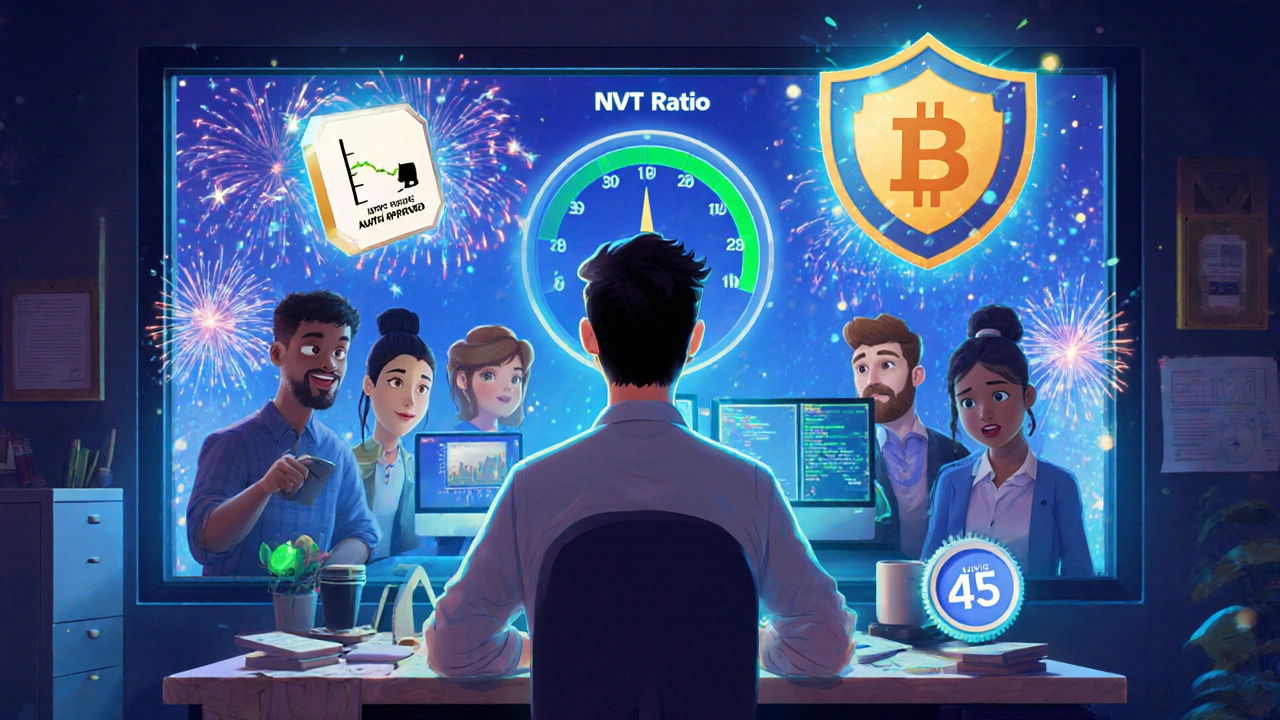
Tokenomics is where most investors fail. They see a low price and assume it’s cheap. But supply and distribution matter more than the number on your screen. Start with total supply. Bitcoin has a hard cap of 21 million. That scarcity is baked in. Ethereum has no cap, but its issuance rate dropped to near zero after the Merge. That’s a different kind of scarcity. Look at emission schedules. Solana started with a 5% annual inflation rate, decreasing 15% each year. That’s a controlled release. Some tokens dump 20% of supply to the market in year one. That’s a recipe for collapse. Team vesting is critical. If the team gets 15% of tokens and can sell them all on day one? Big red flag. Standard vesting is 1-4 years with a 12-24 month cliff. That means they can’t touch their tokens for a year, then get them gradually over the next 2-3 years. That aligns their incentives with long-term growth. Check concentration. If the top 10 wallets hold more than 30% of the supply, the project is vulnerable to manipulation. Glassnode data shows those projects are 47% more volatile. Then there’s utility. Is the token used to pay for services on the network? Does it grant voting rights? Is it required to access features? Chainlink’s LINK token pays node operators. That’s real utility. Many tokens? They’re just speculative assets with no function. Finally, track the NVT ratio-Network Value to Transactions. If the market cap is $1 billion and daily transaction volume is $20 million, the NVT is 50. Historically, ratios below 50 signaled undervaluation during 2021-2023 cycles. Above 100? Often a sign of a bubble.
Tools and Metrics You Actually Need
You don’t need fancy software to start. But you do need the right data sources.- CoinGecko and CoinMarketCap: For supply data, market cap, and trading volume.
- GitHub: Track commits, contributors, and last update dates.
- Etherscan or Solana Explorer: See real-time activity-how many wallets are interacting?
- DeFiLlama: Check Total Value Locked (TVL). If TVL grows over 20% per quarter, the project is gaining traction.
- Glassnode and CryptoQuant: On-chain metrics like active addresses, exchange inflows, and holder distribution.
- TokenTerminal: Shows revenue and fees generated by the protocol. Chainlink made $150 million in oracle fees in 2023. That’s real income.
FA vs. TA: Why You Need Both, But FA Wins Long-Term
Technical analysis (TA) looks at charts. It asks: “Where has the price been? Where is it going next?” It’s great for day traders. But it’s useless for long-term investors. TA can’t tell you if a project’s code is secure. It doesn’t know if the team is trustworthy. It can’t predict if regulators will shut it down. FA asks: “Does this project have a future?” The best investors use both. TA helps time entries. FA tells you what to buy. Example: In late 2020, Bitcoin’s fundamental value-based on adoption, hash rate, and network growth-was estimated at $50,000. But the price didn’t hit that until mid-2021, after a massive speculative surge. FA told you it was undervalued. TA told you when to buy. A 2024 Fidelity study found portfolios built with rigorous FA outperformed market-cap weighted crypto indices by 14.2% annually from 2019 to 2023. That’s not luck. That’s methodology.Common Mistakes and How to Avoid Them
- Ignoring vesting schedules: A project with 40% of tokens unlocked for the team? Run.
- Chasing low prices: A $0.01 token isn’t cheap if 90% of supply is controlled by insiders.
- Believing hype over data: If a project has 1 million Twitter followers but only 500 daily active addresses? It’s a ghost town.
- Not checking audits: No audit? No trust. Period.
- Overlooking regulation: The SEC’s 2023 guidance says “sufficient decentralization” matters. If the team controls 80% of governance votes, it’s not decentralized.
Where to Start: A 5-Step FA Checklist
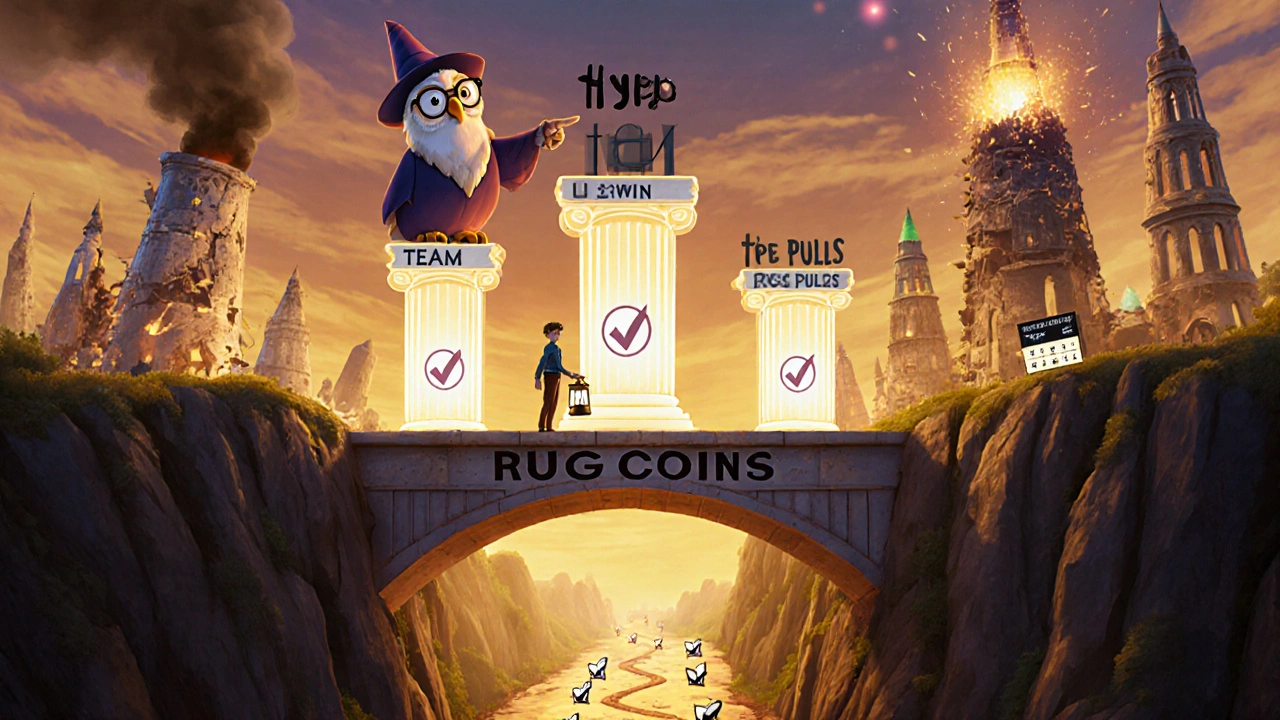
1. Read the whitepaper. Does it explain a real problem? Is the solution technically sound? If it reads like a sci-fi novel, walk away. 2. Check GitHub. Are commits weekly? Are there 20+ contributors? Is the code open and active? 3. Look at tokenomics. What’s the total supply? How are tokens distributed? Is team vesting over 2 years? Is top 10 holding under 30%? 4. Verify on-chain data. Use Etherscan or Solana Explorer. Are active addresses growing? Is TVL rising? Are transactions increasing? 5. Compare to peers. Is this project’s NVT lower than similar chains? Is its revenue higher? Is its team more experienced? Spending 20-40 hours on one project sounds like a lot. But it’s cheaper than losing $10,000 on a rug pull.The Bottom Line
Crypto isn’t a casino. It’s a new financial system being built from scratch. The winners won’t be the ones who timed the pump. They’ll be the ones who understood the infrastructure. Fundamental analysis isn’t about predicting the next 100x. It’s about avoiding the next 99% crash. If you want to build real wealth in crypto, stop chasing trends. Start asking questions. Who built this? How does it work? Who’s using it? Is the token actually needed? If the answers are clear and strong, you’ve found something worth holding.Frequently Asked Questions
Is fundamental analysis reliable for crypto?
Yes-when done correctly. Unlike technical analysis, which only looks at price history, fundamental analysis evaluates real-world factors like team credibility, technology strength, and token utility. A 2023 study found FA correctly identified outperforming assets 82% of the time over 12-month periods, compared to 65% for technical analysis. The key is consistency and depth: using verified data from GitHub, on-chain explorers, and tokenomics trackers, not rumors or social media hype.
How long does fundamental analysis take?
A thorough FA for one project typically takes 20-40 hours. This includes reading the whitepaper, analyzing GitHub commits, reviewing token distribution, checking on-chain metrics like active addresses and TVL, and verifying team backgrounds. Institutional investors now spend an average of 24 hours per project, up from 8 hours in 2020, as evaluation standards have become more rigorous. The time investment pays off by reducing exposure to scams and poorly built projects.
What are the best tools for crypto fundamental analysis?
Essential tools include CoinGecko and CoinMarketCap for supply and market data, GitHub for development activity, Etherscan or Solana Explorer for on-chain metrics, DeFiLlama for Total Value Locked (TVL), Glassnode and CryptoQuant for advanced on-chain signals, and TokenTerminal for protocol revenue. For deeper analysis, paid platforms like Messari (starting at $299/month) and Glassnode (starting at $99/month) offer curated dashboards and historical trend data.
Can a crypto project succeed without a team?
It’s extremely rare. While some projects claim to be “decentralized” or “community-led,” most successful ones have a core team that drives development, secures funding, and responds to critical issues. Projects with anonymous teams or no public contributors have a much higher failure rate. Even decentralized networks like Bitcoin and Ethereum rely on core developers to maintain protocol upgrades and security patches. A completely leaderless project is a red flag unless it has proven, sustained community-driven governance.
How do you know if tokenomics is healthy?
Healthy tokenomics has four key traits: a clear, limited supply or controlled inflation; team tokens locked behind multi-year vesting schedules; no single entity holding more than 30% of the supply; and real utility within the ecosystem (e.g., paying for services, staking, or governance). Metrics like the NVT ratio (Network Value to Transactions) below 50 and rising TVL indicate strong demand. Projects with high inflation, no vesting, and zero revenue generation are at high risk of collapse.
Is fundamental analysis still relevant in a bear market?
It’s more relevant than ever. Bear markets expose weak projects. Teams with no funding or technical progress disappear. Projects with strong fundamentals-like consistent development, growing user adoption, and real revenue-survive and often emerge stronger. In 2022-2023, assets with strong FA signals (like Chainlink, Polygon, and Arbitrum) recovered faster and reached new highs sooner than speculative tokens. FA helps you identify the survivors during downturns so you’re ready when the next bull run begins.
Jeremy Chick
November 26, 2025 AT 08:46Bro, I read this whole thing and still don’t know if I should buy DOGE or not. 😅 But seriously-this is the most coherent crypto guide I’ve seen all year. No fluff, just facts. I’m saving this for my next rug-pull avoidance checklist.
Stephanie Serblowski
November 27, 2025 AT 20:24Team vesting? NVT ratios? GitHub commits? 😭 I came here for memes and got a PhD in blockchain anthropology. But honestly? This is why I stopped trading and started studying. I used to think ‘decentralized’ meant ‘no one’s in charge.’ Now I know it means ‘everyone’s just waiting for the dev team to vanish.’
Also, if your tokenomics slide has the word ‘utility’ in bold but no actual use case? That’s not a project. That’s a TikTok ad with a whitepaper attached.
TokenTerminal is my new best friend. Watching a protocol actually make money? Wild. Like watching a cat learn to use a toilet. Rare. Beautiful. Life-changing.
Also, shoutout to the guy who mentioned Solana’s 5-hour outage. That was the day I realized: if your chain can’t handle a spike from a single Elon tweet, you’re not building infrastructure-you’re building a house of cards made of hype.
And yes, I checked GitHub. 2 commits in 6 months? That’s not a project. That’s a LinkedIn post pretending to be a startup.
FA isn’t sexy. But neither is dying of starvation while your ex posts about their new Lamborghini bought with a rug-pull profit.
Still waiting for someone to explain why we’re all still talking about ‘Web3 metaverse platforms’ that don’t even have a working UI. 🤡
Also, if you’re using TA to time your entry into a project with zero on-chain activity… you’re not investing. You’re just donating to a crypto cult.
Thank you for writing this. I printed it. Laminated it. Taped it to my monitor. My dog now barks at coins with no audits.
Renea Maxima
November 29, 2025 AT 10:46What if the entire premise is wrong? What if value isn’t in the code, the team, or the tokenomics-but in the collective delusion of the crowd? Isn’t that what all money is? A shared hallucination?
Chainlink succeeded not because of its oracle network, but because enough people believed it would succeed. The tech was just the vessel. The belief, the real engine.
So… is FA just a way to rationalize our collective madness? Or are we just fooling ourselves into thinking we can outsmart chaos?
…I’m not saying it’s useless. I’m just saying… it’s poetry dressed as math.
Sagar Malik
November 29, 2025 AT 10:58FA? Pfft. You think GitHub commits matter? I saw a project with 500 commits and 30 devs-turns out 27 were bots. The dev team was a shell company registered in the Caymans with a guy who used to run a pyramid scheme in Nigeria.
And the NVT ratio? Bro, that’s manipulated by whale wallets pumping volume through wash trading. You think Glassnode is real? Nah. It’s a front for the SEC’s crypto surveillance ops.
They want you to believe in ‘fundamentals’ so you don’t look at the real truth: the entire system is a central bank 2.0, just with more crypto buzzwords.
Bitcoin was the only real one. Everything else? Just Wall Street with a blockchain tattoo.
And don’t get me started on ‘team vesting’-they all have backdoor unlocks. I’ve seen the code. They’re just waiting for the pump to dump.
FA is a trap. A distraction. A placebo for the gullible.
Buy BTC. Hold. Ignore the noise. The rest is theater.
Seraphina Nero
November 29, 2025 AT 12:16This was so helpful. I used to just buy whatever looked cool on Twitter. Now I check GitHub. I check TVL. I even read the whitepaper (it took me three tries, but I did it!).
Thank you for making this feel possible. I’m not a tech person. But I’m trying. And that’s enough for now.
Megan Ellaby
November 30, 2025 AT 18:31Wait-so if the team has a 2-year cliff and then unlocks over 3 years… that means they can’t sell for 2 years? That’s actually kinda cool. I thought all crypto teams were just in it for the quick cash. Guess I was wrong.
Also, I had no idea TokenTerminal showed revenue. That’s wild. Like… a crypto project making actual money? Mind blown. 🤯
Thanks for breaking this down. I’m gonna start tracking one project a week. Baby steps, right?
Rahul U.
December 1, 2025 AT 07:45Great breakdown. I’ve been using this framework since 2022. The real game-changer? Checking active addresses on Etherscan. If the number is flat or dropping while price is rising? That’s a divergence. Red flag.
Also, always cross-check DeFiLlama with CoinGecko. Sometimes TVL is inflated by yield farming incentives-those aren’t real users, just bots chasing APY.
And yes-no audit? No investment. Period. Even if the team has MIT degrees. Code is law. No exceptions.
👍
E Jones
December 1, 2025 AT 12:41You think FA is the answer? Let me tell you what’s REALLY happening. The entire crypto space is a psyop orchestrated by the same shadowy cabal that ran the 2008 crash. They created Bitcoin to lure in the gullible, then flooded the market with 10,000 fake tokens to distract you from the real play: central bank digital currencies. They want you to believe in ‘decentralization’ so you don’t realize your wallet is being tracked by the same algorithms that sold you subprime mortgages. The ‘team’? A front. The ‘code’? A Trojan horse. The ‘tokenomics’? A glitter-coated lie. Every single metric you’re using? Manipulated by quant hedge funds with direct access to Fed data. You think GitHub commits are real? They’re generated by AI bots paid in ETH. You think Chainlink’s $150M in fees? That’s fake volume pumped by their own staking pools. And don’t even get me started on the fact that the entire Ethereum merge was a PR stunt to delay regulation. They’re not building a new financial system-they’re building the ultimate surveillance tool with a blockchain veneer. You’re not an investor. You’re a data point. And this post? It’s just another piece of the matrix. Wake up. Or get liquidated.
Barbara & Greg
December 3, 2025 AT 11:47While the intention behind this piece is commendable, one must question the underlying epistemological assumptions of fundamental analysis in a decentralized, pseudonymous ecosystem. If identity is deliberately obscured, how can one reliably assess team credibility? If governance is distributed, how can vesting schedules be trusted? The very framework you propose relies on centralized data points-GitHub, Etherscan, TokenTerminal-platforms that are, in turn, subject to corporate control and potential manipulation. One cannot build a rational investment paradigm on sand.
Moreover, the implicit assumption that ‘real utility’ can be objectively measured is philosophically dubious. Value is subjective. What is utility to one is noise to another. To elevate one set of metrics over others is to replicate the very centralized hierarchies crypto purportedly sought to dismantle.
This is not analysis. It is ritual.
selma souza
December 3, 2025 AT 18:51There is a grammatical error in the third paragraph: ‘If you’re buying based on what someone posted on X, you’re gambling-not investing.’ There should be a space before and after the hyphen. Also, ‘blockchain’ is misspelled as ‘block chain’ in one instance. And you used ‘they’re’ incorrectly in the tokenomics section. This level of carelessness undermines the entire argument.